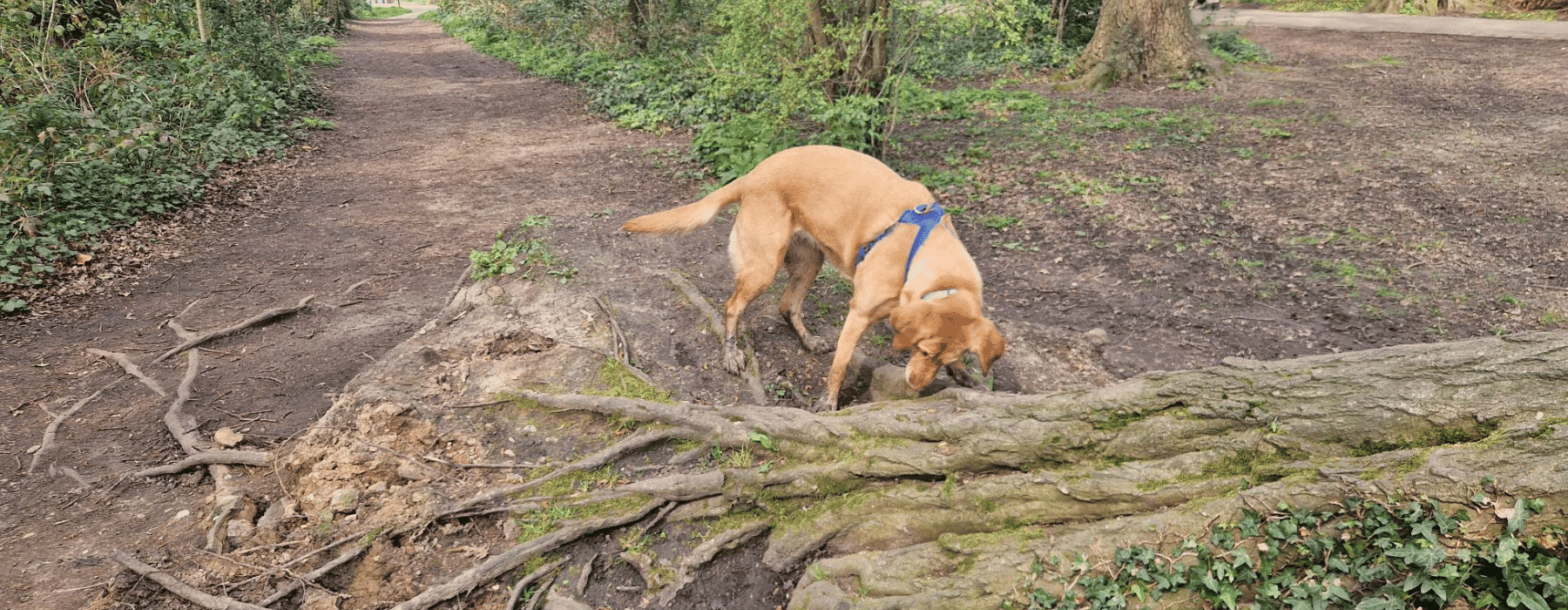
How My Solo Dog-Walking Approach Has Changed Since 2011
Updated October 2026 | By Derek (Del) Chambers, Finchley Dog Walker
I started Finchley Dog Walker in September 2011 and launched my website in July 2012. This is one of the oldest pages on my website, originally written when both the business and my understanding of professional dog walking were quite different.
A great deal has changed since then.
Although I still believe strongly in personal, one-to-one care, my understanding of dog exercise, enrichment, body language, rescue dogs, reactivity, equipment and emotional wellbeing has developed through years of practical experience and continued learning.
Working with nervous dogs, older dogs, rescue dogs and those I affectionately call ‘awkward but awesome’ has taught me that a successful walk isn’t simply about distance, exercise or tiring a dog out.
It is about understanding the individual dog.
Rather than delete this older page, I wanted to preserve its history while explaining how my thinking has changed, what I have learnt and why I now approach dog walking differently.
This article is about that journey. For current prices, availability and booking information, please visit my Solo Dog Walks in Finchley and Muswell Hill service page.
My dog walking today at a glance
- One-to-one walking, with dogs from one household at a time.
- No mixed-household group or pack walks.
- Every walk starts and finishes at the dog’s home.
- No vans, cars or crates for transporting dogs.
- Routes, pace and distance adapted to the dog.
- Sniffing, exploring and appropriate enrichment included naturally.
- Force-free, reward-based handling.
- No aversive training equipment or retractable leads.
- Additional practical support for suitable nervous, rescue and reactive dogs.
- Safe, realistic expectations rather than promises of quick behavioural fixes.
These principles now guide my everyday work, but I didn’t arrive at all of them overnight.
This was one of my original dog-walking pages
When I first started the business, professional dog walking was often promoted using phrases such as:
- Tiring your dog out.
- Burning off excess energy.
- Giving dogs plenty of exercise.
- Socialising dogs with others.
- Correcting unwanted behaviour.
- Providing lots of off-lead running.
Some of that thinking appeared in my early website content.
Looking back, I can see how much my understanding has developed.
I no longer believe that walking further, exercising harder or meeting more dogs automatically means a better experience.
A nervous dog may need a short, familiar walk rather than an exciting adventure.
An older dog might enjoy taking their time, investigating every interesting smell along the way.
A young, energetic dog may benefit from some thoughtful enrichment and opportunities to settle, rather than increasingly demanding physical exercise.
And a dog who finds other dogs difficult may simply need space, understanding and the reassurance that I won’t force them into an uncomfortable encounter.
The most important lesson has been to look at the dog in front of me rather than follow a fixed walking formula.
What has stayed the same since 2011?
Although my approach has changed, some things have remained important from the beginning.
Personal care and familiar faces
I remain an independent local dog walker.
When somebody books me, they know who will be walking their dog. I’m not sending an unfamiliar member of staff or a different walker each week.
This continuity is especially important for dogs who need time to build trust.
One household at a time
My walks are based around one household rather than combining unfamiliar dogs.
Normally, that means one dog receiving my full attention. Where two compatible dogs live together, walking them together may be possible if it is safe and appropriate.
I don’t believe dogs should have to fit themselves into a group simply because that’s how a walking business operates.
You can read more about the differences in my Solo Dog Walks Versus Group Dog Walks guide.
Local walks from your front door
I still collect dogs from their own homes and walk locally on foot.
There are no collection rounds, journeys in vans or periods spent waiting in a vehicle while other dogs are collected.
Depending on the dog, we might explore familiar streets, quieter green spaces or suitable local woodland paths around Finchley and Muswell Hill.
I have always enjoyed the local aspect of dog walking. Working in familiar surroundings also helps me recognise changes, hazards and opportunities along the way.
Reliability and responsibility
Good dog walking involves far more than taking a dog outside.
It includes secure access to homes, checking equipment, following instructions, recognising changes in a dog’s health or behaviour and communicating properly with owners.
Those responsibilities have not changed.
What has changed is how I judge the success of the actual walk.
What has changed in my approach to dog walking?
1. I no longer measure a good walk by distance
There was a time when the length of a walk could be treated as the main measure of its value.
I now see things differently.
A dog may cover several miles but spend the entire time pulling, worrying about other dogs or struggling with busy surroundings.
Another dog may spend half an hour walking gently, sniffing and exploring, then return home comfortable and settled.
Which dog has had the better experience?
Distance alone cannot answer that question.
I now consider:
- Age and physical health.
- Mobility and fitness.
- Temperament and confidence.
- Previous experiences.
- The weather.
- The environment.
- How the dog is coping on that particular day.
Some dogs enjoy long, steady walks. Others need something much gentler.
For a nervous dog, successfully walking past a previously worrying location without becoming overwhelmed may be an important achievement.
The PDSA’s advice on exercise for dogs explains why exercise needs vary between individual dogs.
I’ve also written a more detailed Dog Walking and Everyday Exercise Guide.
2. I no longer try to exhaust every dog
The idea of giving a dog enough exercise to completely wear them out sounds sensible at first.
But more exercise isn’t always the answer.
A dog that regularly receives increasingly intense exercise may become fitter without necessarily becoming calmer.
Some dogs can also become overstimulated by repeated high-energy activities.
That doesn’t mean physical exercise is unimportant. It means exercise should be appropriate and balanced with opportunities to rest, explore and engage in normal dog behaviour.
Over the years, I’ve increasingly valued walks that include:
- Comfortable movement.
- Sniffing and exploration.
- Simple problem-solving.
- Opportunities to make safe choices.
- Quiet observation.
- Predictable routines.
- Time to recover afterwards.
A dog returning home completely exhausted isn’t automatically evidence that I’ve done a good job.
I would much rather see a dog who has enjoyed a suitable walk and is comfortable settling afterwards.
3. Sniffing and enrichment have become much more important
One of the biggest changes in my walking approach has been recognising just how important sniffing can be.
I used to think primarily about getting from one place to another.
Now, I’m perfectly happy to spend several minutes beside a hedge while a dog investigates an interesting smell.
Dogs experience much of their world through scent. Exploring those smells gives them information about their surroundings.
I often joke that they’re catching up on the local ‘wee-mail’.
Depending on the dog, I may also include:
- Simple food searches.
- Gentle changes of pace.
- Exploring different suitable surfaces.
- Rewarding calm choices.
- Practising familiar lead skills.
- Quiet observation from a comfortable distance.
- Confidence-building activities.
- Opportunities to pause and investigate.
Enrichment doesn’t have to involve complicated games, expensive toys or constant instructions.
Sometimes the best enrichment is simply giving a dog time.
My guide, What Are One-to-One Enriched Dog Walks?, explains how enrichment fits naturally into my walking service.
4. I have become much more aware of dog body language
Experience has taught me that dogs are communicating constantly, even when they’re not barking, growling or pulling.
A dog who stops moving, turns their head away, starts scanning the environment or suddenly refuses to continue may be telling us something important.
They might be worried, uncomfortable, overwhelmed or physically struggling.
That doesn’t mean every pause or change of behaviour has a single explanation.
It means I need to pay attention.
I’ve learnt to look at the whole dog, their surroundings and what happened immediately beforehand.
Sometimes that means changing direction.
Sometimes it means creating more space.
And sometimes it means recognising that the dog has had enough for the day.
I would rather change my plans than push a dog through an experience they’re clearly finding difficult.
5. I no longer assume that every dog needs group socialisation
Some dogs genuinely enjoy the company of other dogs.
Others don’t.
For nervous, reactive or newly rescued dogs, repeated close encounters can be difficult.
A dog doesn’t need to greet every dog it passes to have a good walk.
Sometimes the most useful thing I can do is help a dog move through the environment without unnecessary interactions.
That might mean crossing the road, choosing a quieter route or allowing another dog to pass before continuing.
I don’t consider group walks inherently wrong.
I simply believe that individual dogs have different needs, and my own service is built around dogs who benefit from personal attention.
6. I no longer treat off-lead exercise as an automatic benefit
Earlier versions of my dog-walking information placed more emphasis on off-lead exercise.
Today, I take a more individual approach.
Some dogs have reliable recall and can enjoy appropriate off-lead freedom in suitable places.
Others are much safer and more comfortable on a lead or properly managed long line.
This is particularly important for dogs who are nervous, easily distracted, newly adopted or reactive around certain triggers.
Before considering off-lead walking, I need to think about:
- Recall and reliability.
- The surrounding environment.
- Traffic and other hazards.
- Wildlife and livestock.
- Other dogs and people.
- The owner’s instructions.
- Local restrictions.
- The dog’s safety and emotional wellbeing.
A dog doesn’t need to be off lead to enjoy freedom of movement, sniffing and enrichment.
7. I am much clearer about the limits of dog walking and training
This is another important change.
Years ago, dog walkers sometimes used broad language about correcting behaviour, dealing with aggression or changing how dogs reacted to other animals.
I am now much more careful about the promises I make.
I can provide calm, practical, reward-based support during walks.
I can follow suitable training plans, reinforce familiar skills and help maintain routines that owners are already working on with an appropriately qualified trainer or behaviour professional.
I can also adapt the walking environment to reduce unnecessary pressure on a nervous dog.
However, I cannot promise that dog walking will cure reactivity, fear or aggression.
Behaviour can be influenced by physical health, pain, genetics, learning history and the dog’s environment.
Where a dog needs more specialist help, I may recommend veterinary advice or an appropriately qualified professional.
The Animal Behaviour and Training Council provides information about recognised training and behaviour practitioners.
My Rescue Dog Support in Finchley service focuses on practical everyday support, not clinical behaviour treatment.
The influence of rescue dogs on my work
Rescue dogs have played an important part in shaping my approach.
My own dogs, Roxy and Missy, were a significant part of my life and my understanding of dogs as individuals.
Roxy was one of the reasons Finchley Dog Walker came into existence in the first place.
Over time, both my own experiences and the dogs I have cared for have reinforced how important patience, trust and predictable routines can be.
Some dogs settle into new situations relatively quickly.
Others need much longer.
I’ve learnt not to measure their progress against somebody else’s expectations.
A dog who was frightened of leaving the house may make meaningful progress simply by stepping outside comfortably.
A dog who once barked at every unfamiliar person may gradually learn that not everyone approaching presents a threat.
These changes do not necessarily happen in a straight line.
There can be good days, difficult days and occasional setbacks.
The important thing is to recognise progress without pushing beyond what the dog can cope with.
Rudy: a reminder that confidence takes time
Rudy is one of the dogs who helped reinforce the value of patience and consistency.
Our early interactions were quite different from the relationship that developed over time.
Progress didn’t come from forcing him into busy environments or trying to tire him out.
It came from getting to know him, recognising what he found difficult and adapting our routine accordingly.
As trust developed, everyday walks became more comfortable.
Rudy’s story is a reminder that confidence often grows through small, manageable experiences rather than dramatic breakthroughs.
You can read more in From Barking at the Door to Loving Our Walks: Rudy’s Success Story.
Why I now put so much emphasis on one-to-one walking
One-to-one walking allows me to make decisions based on the needs of the dog I’m caring for.
If a dog is nervous, I can choose somewhere quieter.
If they’re older, I can slow down.
If they need more time to sniff, I can allow it.
If they are uncomfortable around another dog, I can create distance without worrying about managing several unrelated dogs at the same time.
And if conditions aren’t suitable for the planned walk, I can adapt the activity.
I also find that spending time individually with dogs makes it easier to notice the smaller things.
Perhaps a dog is moving differently.
Perhaps they seem unusually reluctant to walk.
Or perhaps something that worried them last month no longer seems quite so difficult.
These details matter.
They help me provide more thoughtful care and communicate useful observations to the owner.
My equipment and welfare standards have developed too
My approach to equipment has become more consistent over the years.
I favour secure, appropriately fitted harnesses or suitable flat collars, with leads and long lines selected according to the dog’s needs.
I use force-free, reward-based handling.
I do not use:
- Prong collars.
- Choke or check chains.
- Slip leads used for correction.
- Electronic or shock collars.
- Rattle bottles.
- Other equipment intended to frighten, hurt or intimidate a dog.
- Retractable leads.
I want dogs to feel safe with the person walking them.
Equipment should help me manage a dog safely, not rely on pain, fear or intimidation to control them.
My Walking Kit for Nervous or Reactive Dogs guide explains the types of equipment I consider when supporting dogs who need additional care.
I have also learnt when not to walk
Living and working in North London means dealing with everything from heatwaves to icy pavements and heavy rain.
One of the lessons experience has taught me is that a booked walk should never take priority over welfare.
In very hot weather, a long walk may be inappropriate.
During icy conditions, certain routes may be unsafe.
And during thunderstorms, strong winds or other severe conditions, the sensible decision may be to adapt the visit.
Depending on the dog and what has been agreed with the owner, that could mean a short toilet break, indoor enrichment, companionship or a change to the planned routine.
The aim is to provide appropriate care rather than insist on completing a particular distance or route.
My Extreme Weather Policy explains this approach in more detail.
Experience has made me more cautious, not less confident
After more than a decade of professional dog walking, I am certainly more experienced than I was when I first launched Finchley Dog Walker.
But experience doesn’t mean believing I can handle every dog or solve every problem.
In fact, it has taught me the importance of recognising my limits.
There are times when a dog may need:
- Veterinary advice.
- A more suitable walking environment.
- Different equipment.
- A slower introduction to a new walker.
- Support from an appropriately qualified behaviour professional.
- A service that I cannot safely or realistically provide.
Being honest about those situations is part of responsible professional care.
My ongoing learning in canine first aid, dog body language, enrichment and reward-based training has helped me develop a more thoughtful approach.
But there is always more to learn.
Dogs are individuals, and they have an impressive ability to remind us of that.
What I would tell myself back in 2011
If I could go back and offer my younger dog-walking self some advice, it would be this:
Don’t judge a walk by how far you’ve travelled.
Don’t assume that more exercise is always the answer.
Listen to what the dog is communicating.
Let them sniff.
Be prepared to change your plans.
Don’t promise results that are outside your control.
And remember that building trust is often more important than completing a route.
Perhaps most importantly, never stop learning.
The dogs I’ve walked over the years have taught me far more than I could have learnt from simply following the same routine every day.
Frequently asked questions
Has Finchley Dog Walker offered solo walks since 2011?
I established Finchley Dog Walker in September 2011, and one-to-one care has remained central to my approach. My understanding of enrichment, dog behaviour, exercise and welfare has continued to develop since then.
Why do you prefer one-to-one dog walks?
One-to-one walking lets me adapt the pace, route, and activities to the individual dog without managing a group of unfamiliar dogs. This is particularly useful for dogs who need additional space, confidence or consistency.
Do dogs need long walks to be happy?
Not necessarily. Exercise requirements depend on age, health, fitness and individual needs. Many dogs benefit from a balance of suitable physical activity, sniffing, enrichment and rest rather than distance alone.
Do you work with nervous or reactive dogs?
Yes, where I can safely and appropriately meet their needs. I offer practical, reward-based walking support and can follow suitable plans agreed with owners and their qualified professionals. I do not offer clinical behavioural diagnosis or treatment.
Are your dog walks always off lead?
No. Whether off-lead walking is suitable depends on recall, the individual dog, the owner’s instructions and the environment. Many dogs enjoy safe, enriching walks on a standard lead or appropriately managed long line.
Do you still offer solo dog walks in Finchley?
Yes. Solo dog walking remains one of my established services. My main service page contains the current details about prices, locations and enquiries.
Looking for a solo dog walker in Finchley?
Although this article explains how my approach has developed since 2011, I still provide professional one-to-one dog walking in Finchley, East Finchley, North Finchley, Finchley Central and Muswell Hill, subject to availability.
Every walk starts and finishes at your dog’s home.
There are no collection vans, unfamiliar dogs added to the walk or pressure to fit into a group.
I aim to provide appropriate exercise, natural enrichment and calm, consistent care based on the needs of your dog.
For the practical details, visit my Solo Dog Walks in Finchley and Muswell Hill service page.
You can also contact me directly to discuss your dog’s needs.
Related reading
If you would like to explore some of the subjects discussed in this article, these guides may be helpful:
- Solo Dog Walks Versus Group Dog Walks
- Dog Walking and Everyday Exercise
- What Are One-to-One Enriched Dog Walks?
- Rescue Dog Support in Finchley
- Walking Kit for Nervous or Reactive Dogs
- Rudy’s Nervous Dog Success Story
Originally published during the early years of Finchley Dog Walker. Substantially updated in August 2026 and reviewed again in October 2026 to reflect my current approach and professional experience.