
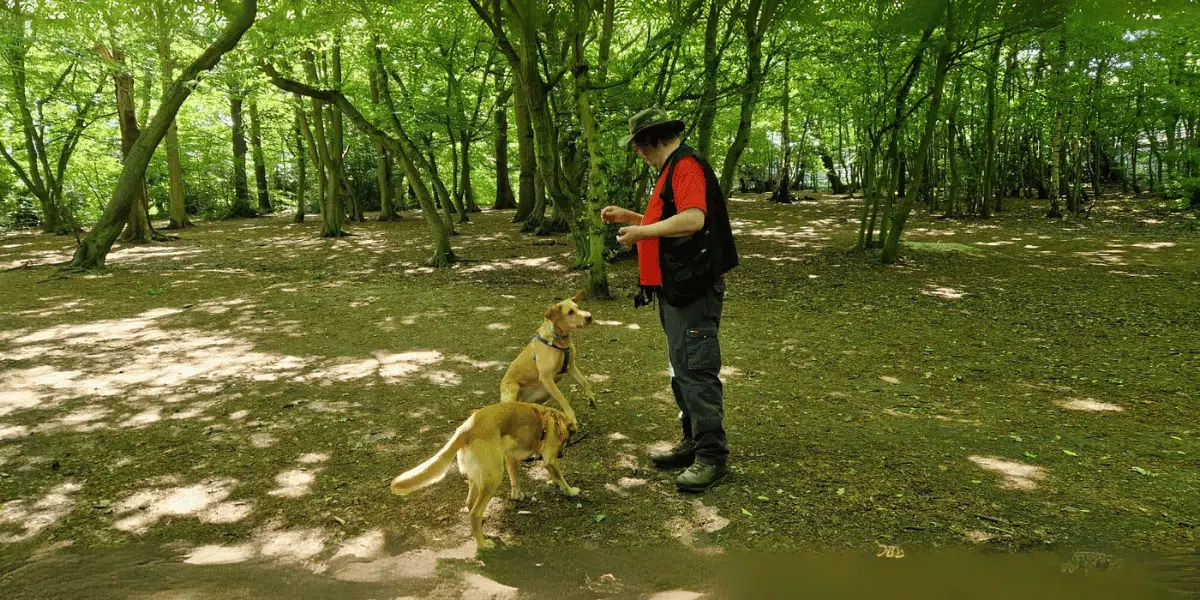
Dog and Pet Care Guides for Finchley Owners

DerekDerekChambers1972Edit Profile
Updated September 2026
Calm, practical guidance to help you make everyday decisions about your dog, cat or small pet.
I have provided professional dog walking and in-home pet care around Finchley and nearby parts of North London since 2011. During that time, I have worked with puppies, rescue dogs, nervous and reactive dogs, senior pets, cats, rabbits, guinea pigs and multi-pet households.
This page is the main starting point for the Finchley Dog Walker guides.
You do not need to read everything.
Choose the question that matters today, then follow the link to the specialist guide or hub that covers that subject.
If your pet is unwell, injured, in pain or showing a significant or sudden change in behaviour, contact your veterinary practice rather than relying on an online guide.
Summary
- Start with the subject that best matches the question you have today.
- Dog Behaviour and Body Language is for understanding what your dog may be feeling or communicating.
- Dog Training is for what and how you want to teach.
- Rescue Dog Help is for rescue-specific settling, adjustment and confidence.
- Dog Enrichment covers sniffing, searching, play, chewing, exploration and other appropriate activities.
- Dog Walking and Everyday Exercise covers physical activity, walking and exercise balance.
- Dog Health and First Aid covers health observations, emergencies and veterinary escalation.
- Puppies, senior dogs, cats, small pets and new pet owners each have their own dedicated guides.
- If you are going away, there are separate guides and services for house-sitting, cat-sitting, and choosing suitable pet care.
- Product recommendations are kept separately on my Dog and Pet Products I Recommend page.
- Good pet care is not always about doing more. Sometimes a quieter walk, more rest, more distance or a simpler routine is the better choice.
Table of contents
- Summary
- Start With What You Need Today
- My dog needs better walks or more suitable exercise
- My dog is nervous, reactive or easily overwhelmed
- I have recently adopted a rescue dog
- My dog needs more enrichment
- I need help with everyday dog training
- I have a new puppy
- My puppy is turning into a teenager
- I have an older dog
- I am getting my first pet
- I need information about cats
- I have rabbits, guinea pigs or other small pets
- I am going away and need somebody to care for my pet
- I need seasonal pet-safety advice
- I have a question about dog food or nutrition
- I need health or first-aid information
- I need advice about dogs and children
- Making Dog Walks Calmer and More Useful
- Enrichment Does Not Have to Be Complicated
- Equipment and Products
- When Less Can Be More
- When an Online Guide Is Not Enough
- Recommended Finchley Dog Walker Guides and Hubs
- About Finchley Dog Walker
- Frequently Asked Questions
- Where should I start?
- Are these guides only for people in Finchley?
- Are the guides a replacement for veterinary advice?
- Do you provide dog training?
- Do I need to buy the products you recommend?
- What if my dog has suddenly started behaving differently?
- What if I am going away and do not know whether I need house-sitting, visits, or another type of care?
- How do I find out whether you can care for my pet?
- Find the Right Support for Your Pet
- Veterinary and Behaviour Disclaimer
Start With What You Need Today
My dog needs better walks or more suitable exercise
Start with my Dog Walking and Everyday Exercise Guide.
There is no single number of minutes that suits every dog.
Age, health, fitness, confidence, weather, the environment, sleep and recent activity can all change what is appropriate.
A successful walk is not necessarily the longest one.
One dog may enjoy a longer woodland walk. Another may benefit far more from twenty minutes of quiet sniffing and exploration without being hurried or repeatedly struggling with things around them.
If you need individual local walking support, see my Solo Dog Walks in Finchley and Muswell Hill.
My dog is nervous, reactive or easily overwhelmed
Start with my Dog Behaviour and Body Language Guide.
This is the main hub for understanding:
- Stress and threshold
- Fear and uncertainty
- Reactivity
- Barking
- Growling
- Overstimulation
- Frustration
- Difficult walks
- Personal space and choice
- Dogs and children
- Separation-related behaviour
- Recovery after stressful experiences
- Behaviour changes that may need veterinary or professional help
Behaviour gives us information.
Rather than concentrating only on stopping barking, lunging, freezing or pulling, it helps to look at the whole dog, what happened immediately beforehand and what changes when the situation becomes easier.
If your dog is struggling specifically outside, read How to Walk an Anxious Dog Without Making It Worse.
I have recently adopted a rescue dog
Start with the Rescue Dog Help in Finchley Hub.
This owns the rescue-specific information about:
- Settling into a new home
- Early routines
- First walks
- Secure equipment
- Building trust
- Nervous behaviour
- Confidence
- Time alone
- Enrichment
- Avoiding common early mistakes
A newly adopted dog does not automatically need more walks, visitors, outings and social experiences.
Some dogs initially need the opposite.
A predictable routine, somewhere quiet to rest and manageable experiences can be more useful while they adjust.
If you are mainly trying to understand what barking, freezing, fear, reactivity or other behaviour may be communicating, use the Dog Behaviour and Body Language Guide alongside the rescue-specific advice.
For practical local support with a suitable dog, see Rescue Dog Support in Finchley.
My dog needs more enrichment
Use my Dog Enrichment Guide.
Enrichment can include:
- Sniffing
- Searching
- Foraging
- Chewing
- Play
- Learning
- Exploring
- Suitable choice
- Quiet observation
- Rest
It does not have to mean buying lots of toys or continually making activities harder.
The aim is to give your dog appropriate opportunities to use natural behaviours and engage with their environment without keeping them permanently occupied.
I need help with everyday dog training
Use my Dog Training Hub.
Training and behaviour are connected, but they are not the same thing.
The Behaviour Hub helps answer:
“What might my dog be communicating?”
The Training Hub helps answer:
“What do I want my dog to learn and how can I teach it?”
My training advice is reward-based and can include everyday skills such as:
- Recall foundations
- Loose-lead walking
- Checking in
- Settling
- Calm greetings
- Moving away from distractions
- Reinforcing useful everyday behaviour
For owners who would like practical help working alongside their dog, I also offer One-to-One Dog Training Support in Finchley.
I am not a clinical animal behaviourist. Where a dog needs specialist behavioural assessment, I would rather refer you to an appropriately qualified professional than work outside my role.
I have a new puppy
Start with Bringing a Puppy Home.
The Puppy Hub covers the first days, weeks and first year, including:
- Preparing your home
- Sleep and rest
- Toilet training
- Puppy exercise
- First walks
- Equipment
- Reward-based learning
- Settling
- Social experiences
- Common puppy questions
Puppies have a lot to learn, but they do not need everything at once.
Short, manageable experiences, plenty of sleep, suitable chewing, predictable routines and gradual introductions are often more useful than trying to tire a puppy out.
For practical local care, see Puppy Visits and Puppy Support in Finchley.
My puppy is turning into a teenager
Adolescence can bring changes in attention, confidence, excitement, frustration and how your dog responds to things they previously appeared to understand.
Do not assume that your dog has suddenly decided to be difficult.
Start with the Dog Training Hub for everyday skills and the Dog Behaviour and Body Language Guide if you are trying to understand changes in arousal, confidence or behaviour.
Puppy-specific development will remain within Bringing a Puppy Home until we determine whether a separate adolescent resource is genuinely needed.
I have an older dog
Start with my Senior Dog Care Guide.
Older dogs can still enjoy:
- Walking
- Sniffing
- Enrichment
- Learning
- Play
- Time outdoors
- Familiar routines
What changes is often the pace, duration or type of activity.
Do not automatically dismiss reduced stamina, reluctance to walk, changes in sleep or new behaviour as simply “getting old”.
Pain, changes in mobility, hearing, sight and general health can all affect how an older dog behaves.
Unexpected changes deserve veterinary attention.
I am getting my first pet
Use Your First Pet: A Practical Guide for New Pet Owners.
It covers preparing before your pet arrives, choosing suitable equipment, veterinary registration, microchipping, insurance considerations, early routines, exercise, training and arranging care before you actually need it.
One of the easiest mistakes for a new owner to make is trying to buy, teach and organise everything at once.
Start with safety, essential care, suitable food, a comfortable place to rest, and a manageable routine.
Then build from there.
I need information about cats
Cats have their own behaviour, welfare and care needs.
Use my Cat Care Advice in Finchley Hub rather than trying to apply dog advice to cats.
The Cat Care Hub covers:
- Everyday cat care
- Kittens
- Older cats
- Behaviour
- Enrichment
- Home routines
- Holiday planning
- Preparing for a cat sitter
- Cat sitting
If you are going away and would prefer your cat to remain at home, see Cat Sitting in Finchley.
Although the business is called Finchley Dog Walker, cats are an important part of the pet care I provide.
I work with confident cats, shy cats, kittens, senior cats and multi-cat households.
I do not force a nervous or hiding cat to interact simply to get a photograph.
I have rabbits, guinea pigs or other small pets
Start with my Small Animal Care in Finchley Hub.
Small pets are sometimes treated as simpler alternatives to dogs and cats.
They are not.
Different species have very different requirements around:
- Space
- Companionship
- Diet
- Housing
- Temperature
- Enrichment
- Cleaning
- Handling
- Veterinary care
Use species-specific welfare information rather than assuming that general pet advice applies equally to rabbits, guinea pigs, hamsters and other animals.
I am going away and need somebody to care for my pet
Start with How to Choose a Dog Walker or Pet Sitter.
The right arrangement depends on the individual pet.
For some dogs, boarding is perfectly suitable.
Others may be much happier staying in their own home with their usual bed, smells, walking routes and routine.
My House Sitting in Finchley service is designed to keep pets in their familiar home environment.
For cats, see Cat Sitting in Finchley.
You can also explore all of my Pet Care Services before deciding which option fits.
I need seasonal pet-safety advice
Use my Seasonal Pet Safety in Finchley Guide.
Weather, fireworks, darker evenings, holidays and changes in household routine can all affect pets.
The appropriate response is not always to continue with the normal routine.
Sometimes the safer option is:
- A shorter walk
- A different walking time
- More time at home
- A quieter route
- Different enrichment
- Additional supervision
- A change to normal holiday arrangements
For fireworks specifically, use my Dogs and Fireworks: Complete UK Safety Guide.
I have a question about dog food or nutrition
Start with my Dog Food and Nutrition Guide.
Food is an area where individual health matters.
General information can help you understand terminology and ask useful questions, but it cannot diagnose:
- Allergies
- Digestive disease
- Unexplained weight loss
- Unexplained weight gain
- Nutritional deficiencies
- Medical conditions requiring a specialist diet
Speak to your veterinary practice about medical diets, persistent digestive problems, unexplained weight changes or other health concerns.
I need health or first-aid information
Start with Dog Health and First Aid.
First aid is about knowing what to do while appropriate professional veterinary help is being arranged.
It is not a replacement for veterinary treatment.
If your pet is seriously unwell, has collapsed, is struggling to breathe, has suffered significant trauma or is causing you immediate concern, contact your veterinary practice or emergency veterinary service.
I need advice about dogs and children
Start with Dogs and Children: Helping Them Live Safely Together.
Children and dogs can have excellent relationships, but adults remain responsible for supervision, personal space and preventing interactions from becoming too difficult.
I am a Kids Around Dogs Affiliate and support its welfare-led approach to safer relationships between children and dogs.
Affiliate status is different from being a KAD Approved Professional.
For specialist child-and-dog support, use Kids Around Dogs and its own professional resources.
Making Dog Walks Calmer and More Useful
One of the biggest changes in my own approach since I started Finchley Dog Walker in 2011 has been paying less attention to distance and more attention to the individual dog.
That does not mean exercise is unimportant.
It means I look at the whole walk.
Can the dog move comfortably?
Can they sniff and explore?
Can they cope with the environment?
Are they continually scanning what is around them?
Can we create enough distance from something they find difficult?
Do they return home able to settle?
Around Finchley and Muswell Hill, the same route can feel completely different depending on the time of day.
Cherry Tree Wood, Coldfall Wood, Highgate Wood and the Parkland Walk can all provide enjoyable walking opportunities, but even a pleasant green space can be difficult for a nervous dog when it becomes crowded.
Sometimes I use quieter streets.
Sometimes I shorten the route.
Sometimes we spend longer investigating one patch of grass.
The dog in front of me helps determine what is useful.
If you notice freezing, constant scanning, barking, lunging or other signs that your dog may be struggling with the environment, read my Dog Behaviour and Body Language Guide.
For the physical side of walking and exercise, use Dog Walking and Everyday Exercise.
Enrichment Does Not Have to Be Complicated
Some of the most useful enrichment costs nothing.
It might be:
- Letting your dog sniff
- Allowing them to investigate
- Giving them two safe directions to choose between
- Searching for some of their normal food
- A short reward-based training game
- Suitable play
- Chewing
- Quiet observation
- Rest
More complicated does not automatically mean better.
An enrichment activity is not useful if it repeatedly leaves the dog frustrated or unable to settle.
Use my Dog Enrichment Guide for ideas and guidance.
Equipment and Products
You do not need to buy something every time you read a pet-care guide.
Equipment should support good care rather than replace it.
For dogs, I generally prefer appropriate fixed leads and well-fitted equipment rather than retractable leads or equipment designed to hurt, frighten or correct a dog through discomfort.
I do not recommend:
- Prong collars
- Choke or check collars as corrective equipment
- Electronic collars
- Rattle bottles
- Retractable leads for routine professional walking
- Rawhide
- Products promoted as quick fixes for behavioural problems
If you are specifically looking for equipment, toys or products I use or consider suitable, visit Dog and Pet Products I Recommend.
That keeps product recommendations separate from the main educational guides, so you can decide whether you actually need the item before buying it.
When Less Can Be More
Pet owners are constantly being told to do more.
Walk further.
Train more.
Buy another toy.
Take the puppy somewhere new.
Socialise with everybody.
Keep the rescue dog busy.
Keep the older dog active.
Sometimes those things are appropriate.
Sometimes reducing the pressure is the better decision.
A puppy may need sleep.
A nervous dog may need more distance.
A rescue dog may need a familiar route.
A senior dog may prefer a short sniff rather than a long outing.
A cat may want you to sit quietly rather than coax them from under the bed.
A dog that has had a particularly difficult walk may need to recover rather than another exciting activity.
Good pet care is not about completing the greatest number of activities.
It is about noticing what the individual animal needs.
When an Online Guide Is Not Enough
Online information is useful for understanding a subject and preparing questions.
It cannot examine your pet.
Speak to your veterinary practice about illness, injury, unexplained pain or significant changes in health or behaviour.
If your dog has serious fear, panic, repeated aggression, a history of biting, severe resource guarding, significant separation-related distress or behaviour that poses a risk to people or animals, seek appropriately qualified individual support.
My Dog Behaviour and Body Language Guide can help you understand some of the signs you may be seeing, but it cannot diagnose a behavioural condition.
The Animal Behaviour and Training Council practitioner directory is a useful route for finding appropriately assessed behaviour and training professionals.
For reliable general information, I also recommend:
- Dogs Trust Dog Advice
- RSPCA Pet Advice
- Cats Protection Help and Advice
- Rabbit Welfare Association and Fund Advice
- Kids Around Dogs for child-and-dog safety and specialist resources
Recommended Finchley Dog Walker Guides and Hubs
Dogs
- Dog Behaviour and Body Language Guide
- Dog Walking and Everyday Exercise
- Dog Training Hub
- Dog Enrichment Guide
- Dog Health and First Aid
- Dog Food and Nutrition Guide
Puppies, rescue dogs and senior dogs
Cats and small pets
Seasonal and safety
Choosing professional pet care
- How to Choose a Dog Walker or Pet Sitter
- House Sitting in Finchley
- Cat Sitting in Finchley
- Solo Dog Walks in Finchley and Muswell Hill
- Rescue Dog Support in Finchley
- One-to-One Dog Training Support in Finchley
Equipment and product recommendations
About Finchley Dog Walker
I am Derek Chambers, although most people know me as Del.
I established Finchley Dog Walker in 2011 and provide calm, personalised pet care around Finchley, Muswell Hill and selected nearby parts of North London.
My service is deliberately low-volume.
I care for one household at a time.
Dog walks start and finish at the dog’s home. I do not run van-based collection rounds or mix unrelated dogs into pack walks.
My services include:
- House sitting
- Cat sitting and feeding
- Solo one-to-one dog walks
- Rescue and nervous-dog support
- Small-animal care
- Puppy support
- One-to-one training support
I am fully insured and hold an Ofqual Level 3 Canine First Aid qualification.
My approach is calm, reward-based and welfare-led.
If I do not believe I am the right person for a particular pet or situation, I will say so.
Frequently Asked Questions
Where should I start?
Start with the question you actually have.
For barking, growling, fear, reactivity, stress or body language, use the Dog Behaviour and Body Language Guide.
For walks and physical activity, use Dog Walking and Everyday Exercise.
For teaching skills, use the Dog Training Hub.
For a newly adopted dog, use the Rescue Dog Help Hub.
For puppies, use Bringing a Puppy Home.
For cats, use Cat Care Advice in Finchley.
You do not need to work through the website in order.
Are these guides only for people in Finchley?
No.
Most of the general information can be useful wherever you live.
Local examples, walking areas and Finchley Dog Walker service availability relate mainly to the parts of North London where I work.
Are the guides a replacement for veterinary advice?
No.
They are general educational resources.
A veterinary professional should assess illness, injury, medication, unexplained pain and significant changes in your pet’s health or behaviour.
Do you provide dog training?
I provide One-to-One Dog Training Support for suitable owners and dogs using reward-based methods.
I can also reinforce agreed everyday skills during one-to-one walks where appropriate.
I am not a clinical animal behaviourist and do not present an ordinary walk or training-support session as treatment for serious behavioural problems.
Do I need to buy the products you recommend?
No.
Most pets do not need lots of equipment.
My general guides should still be useful if you never buy anything through the website.
Where you are specifically looking for equipment or toys, I keep those recommendations on Dog and Pet Products I Recommend and related buying guides.
What if my dog has suddenly started behaving differently?
Consider physical health as well as training or behaviour.
Pain, illness, sensory changes and other physical problems can affect behaviour.
If the change is significant, sudden or unexplained, speak to your veterinary practice.
You can also use my Dog Behaviour and Body Language Guide to understand the wider context.
What if I am going away and do not know whether I need house-sitting, visits, or another type of care?
Start with How to Choose a Dog Walker or Pet Sitter.
Then compare the needs of your individual pet with House Sitting in Finchley, Cat Sitting in Finchley or the wider Pet Care Services page.
How do I find out whether you can care for my pet?
Check my Pet Care Services, current prices and service area.
If it sounds as though we might be a good fit, contact me with your postcode and a little information about your pet.
Find the Right Support for Your Pet
You do not have to solve everything today.
Choose the issue that matters most.
Read the relevant guide.
Make one or two sensible changes.
If something involves health, pain, or significant behavioural concerns, seek appropriate professional help.
If you need practical, local pet care, I provide calm, one-to-one support in and around Finchley and nearby parts of North London.
[INSERT BACK-TO-TOP BUTTON HERE]
Veterinary and Behaviour Disclaimer
This website provides general educational information.
It does not replace veterinary examination, diagnosis or treatment.
Contact your veterinary practice if your pet is unwell, injured, in pain or showing a sudden or significant change in behaviour.
Where a dog is experiencing severe fear, panic, repeated aggression, biting, serious resource guarding, significant separation distress or behaviour that presents a safety risk, seek veterinary advice and appropriately qualified behavioural support.
