

Rescue Dog Support in Finchley
Calm, one-to-one walking support for rescue, nervous and reactive dogs
Bringing home a rescue dog can be rewarding, but everyday life may not become easy immediately.
Your dog may be worried about unfamiliar people, reluctant to leave the house, overwhelmed by traffic or reactive when another dog appears.
They may need more time, space and predictability than a normal group-walking service can provide.
I offer focused, one-to-one rescue dog support walks in Finchley, North Finchley, Finchley Central, East Finchley, Muswell Hill and selected nearby areas.
Walks begin and end at your home. There are no vans, collection rounds or unfamiliar dogs added to the walk.
The aim is not to force your dog around a particular route. It is to provide calm, practical support that helps them cope with everyday walks and routines at a pace they can manage.
Contact Del about rescue dog support
View current dog-walking prices
Rescue dog support at a glance
| Service detail | Information |
|---|---|
| Service | Focused one-to-one rescue, nervous or reactive dog support walk |
| Duration | Up to 60 minutes |
| Price | £30 |
| Collection | From your dog’s home |
| Transport | No cars or vans |
| Other dogs | Dogs from different households are never mixed |
| Main areas | Finchley, N12, N3, N2 and Muswell Hill N10 |
| Best suited to | Rescue, nervous, anxious, reactive or easily overwhelmed dogs |
| Approach | Calm, reward-based and adapted to the individual dog |
| First step | Initial discussion and meet-and-greet |
| Formal training included? | No. This is practical walking and routine support |
All services are subject to location, availability, safe handling arrangements and an appropriate introduction.
Key Takeaways
- Rescue dog support Finchley provides one-to-one walking aid for nervous and reactive dogs, focusing on calm and structured experiences.
- Walks begin and end at home, ensuring no vans or unfamiliar dogs are involved during the session.
- Each session lasts up to 60 minutes, costing £30, and includes tailored routes to manage triggers and improve comfort.
- The service supports dogs needing additional space and predictability, rather than formal training or behaviour consultations.
- Consistent routines and gradual introductions help build trust and make the experience manageable for rescue dogs.
What is rescue dog support?
Rescue dog support is a focused one-to-one service for dogs who need more planning, patience or structure than a standard walk.
The service may be appropriate when your dog:
- Has recently been adopted
- Is still learning to trust unfamiliar people
- Finds it difficult to leave the house
- Freezes or refuses to walk
- Becomes overwhelmed on ordinary streets
- Barks or lunges at dogs, people or traffic
- Needs carefully selected routes
- Struggles with busy parks
- Requires more distance from triggers
- Needs several introductions before walking with someone new
- Benefits from slower, more predictable routines
- Cannot safely join a conventional group walk
The first aim is not to cover a set distance.
It is to help your dog have a manageable experience.
For one dog, that may mean a steady local walk. For another, it may mean standing outside the house, sniffing along part of the street and returning home before they become overwhelmed.
Both can be useful.
Is this a dog-training service?
No.
This is practical day-to-day walking and routine support. It is not a formal dog-training lesson, behaviour consultation or veterinary behaviour programme.
During walks, I can support suitable routines that you already use, such as:
- Giving your dog more distance
- Using an agreed direction-change cue
- Rewarding calm attention
- Reinforcing moments of loose-lead walking
- Following an existing plan from your trainer or behaviourist
- Reducing exposure when your dog is becoming overwhelmed
- Helping your dog settle before leaving the house
- Keeping routes and expectations predictable
I will not promise to cure reactivity, remove fear or transform your dog within a fixed number of sessions.
Where your dog needs a structured training programme, I may recommend working with an appropriately qualified, reward-based trainer or behaviour professional alongside the walking support.
Find an appropriately qualified practitioner through the Animal Behaviour and Training Council.
Standard solo walks or focused rescue support?
Not every rescue dog needs the focused £30 support service.
Some rescue dogs settle well, can be walked safely using a normal routine and benefit from a calm one-to-one walker.
Standard solo dog walks.
Standard solo walks may be suitable where your dog:
- Can leave home without significant difficulty
- Can be handled safely using their usual equipment
- Does not need detailed route planning
- Can recover reasonably well from ordinary encounters
- Does not require extensive feedback or behavioural observation
- Can complete a normal 30 or 60-minute walk
Current prices are:
- 30 minutes: £18
- 60 minutes: £25
Read about standard Solo Dog Walks in Finchley
Focused rescue, nervous or reactive support
The focused 60-minute service costs £30.
It may be more appropriate where your dog:
- Needs a slower introduction to a new walker
- Struggles to leave the house
- Freezes or shuts down
- Reacts strongly to dogs, people, vehicles or movement
- Needs carefully selected walking times
- Requires additional distance from triggers
- Has a detailed handling plan
- Needs a shorter outdoor walk followed by calm enrichment
- Requires more observation and feedback
- Cannot yet manage a conventional hour-long route
I will discuss which service appears most appropriate before walks begin.
Rescue dogs often need less pressure.
Newly adopted dogs are frequently expected to manage a lot of change at once.
They may be dealing with:
- A different home
- Unfamiliar people
- New household sounds
- Different feeding times
- New walking routes
- New equipment
- Other animals
- Visitors
- Being left alone
- New rules and expectations
Some dogs cope with this quickly. Others need weeks or months before they feel secure.
Doing more is not always the answer.
Dogs Trust recommends allowing a newly adopted dog to settle at their own pace, avoiding forced interaction and keeping the home calm while they become familiar with their new surroundings.
Read Dogs Trust guidance on helping a rescue dog settle
The same principle can apply outdoors.
A shorter, quieter walk that your dog can manage is usually more useful than a long walk that leaves them frightened, exhausted or unable to cope.
How I approach the first meetings
A meet-and-greet is normally required before I take responsibility for your dog.
For rescue and nervous dogs, one meeting may not be enough.
During the first meeting, I may:
- Sit quietly rather than approaching your dog
- Avoid direct eye contact
- Allow your dog to observe from a distance
- Scatter or offer suitable treats where agreed
- Discuss safe entry arrangements
- Learn what your dog does when worried
- Look at their usual equipment
- Discuss known triggers
- Walk a short distance with you present
- Agree what I should do if your dog refuses to leave
- Discuss when the session should end
Your dog does not need to greet me enthusiastically.
A successful first meeting may mean that your dog remains in the room, watches without escalating or takes food while I am present.
I will not force-touch, attach a lead before the dog is ready, or insist that we leave the home simply because a walk has been booked.
What happens during the first support walks?
Early walks are kept simple.
Depending on your dog, the first session may involve:
- Putting on the lead calmly
- Leaving the house without rushing
- Spending time near the front door
- Walking a short familiar route
- Allowing time to sniff
- Observing the environment from a safe distance
- Practising an agreed turn-away cue
- Returning home before your dog becomes overwhelmed
- Providing calm enrichment indoors
- Discussing what appeared manageable
The first few walks help me learn:
- How your dog responds when you are absent
- Which routes feel manageable
- What distance they need from triggers
- How quickly they recover
- Which rewards they value
- How they communicate discomfort
- Whether their current equipment is suitable
- Whether the service can be provided safely
Some dogs behave differently with a walker than they do with their owner.
I will keep you informed about what I observe.
How I manage triggers on walks
A trigger is something that causes a noticeable emotional or behavioural response.
For some dogs, this may be:
- Another dog
- A stranger
- A child
- Traffic
- Bicycles
- Joggers
- Delivery trolleys
- Loud noises
- Narrow paths
- People approaching the home
- Sudden movement
- Being unable to move away
My approach may include:
- Changing direction
- Crossing the road
- Using a safe visual barrier
- Increasing distance
- Waiting in a wider space
- Choosing quieter times
- Avoiding narrow paths
- Using familiar routes
- Allowing the dog to sniff and decompress
- Ending the walk early where necessary
I do not deliberately move closer to something to test your dog.
The goal is to help them remain within a level of difficulty they can manage.
Dogs Trust advises that reactive behaviour can become stronger when a dog repeatedly experiences stress and that reward-based methods should be used rather than approaches involving fear, pain or intimidation.
Read Dogs Trust guidance on reactive dogs
For a more detailed explanation of my walking approach, read:
Reactive and Nervous Dog Walking in Finchley
I do not force social interaction
Your rescue dog does not need to greet every person or dog.
Some dogs may gradually become more comfortable around others.
Some will always prefer more space.
My aim is not to turn every dog into a highly social dog. It is to help your dog navigate ordinary life as safely and calmly as possible.
I avoid:
- Forced greetings
- Crowded group walks
- Busy dog-park environments
- Flooding a dog with triggers
- Dragging a dog forwards
- Punishment-based handling
- Deliberately provoking reactions
- Expecting progress to follow a fixed timetable
A quiet walk where nothing dramatic happens may be exactly what your dog needs.
Safe walking equipment
Rescue dogs may have unknown histories, unexpected fears or a greater risk of trying to escape when startled.
Secure, correctly fitted equipment is therefore important.
Before walks begin, I will discuss:
- Harness fit
- Collar fit
- Identification tags
- Fixed-length leads
- Backup attachments where appropriate
- Long-line use
- Muzzle use where relevant
- Known escape behaviour
- Door and gate security
- Equipment your dog dislikes
- Safe methods of putting equipment on
I normally expect dogs to be provided with:
- A secure, correctly fitted harness or suitable flat collar
- A fixed-length lead
- A legally required identification tag
- Appropriate backup equipment where the dog presents an escape risk
I do not use:
- Shock or electronic collars
- Prong collars
- Choke or check chains
- Rattle bottles
- Punishment-based equipment
- Retractable leads
- Lead jerks or intimidation
Equipment cannot solve fear or reactivity by itself, but a secure and comfortable setup can help everyone work more safely.
Read my Rescue Dog and Reactive Walking Kit Guide
Working with muzzled dogs
A muzzle does not automatically mean that a dog is aggressive.
Dogs may wear a muzzle because they:
- Pick up food or rubbish
- Have a bite history
- Are worried about handling
- Need an additional safety precaution
- Are following veterinary or behavioural advice
I may work with a dog who wears a suitable basket muzzle, subject to an assessment and safe arrangements.
The dog should already be comfortable wearing it through reward-based muzzle training.
I will not force an unfamiliar muzzle onto a frightened dog immediately before a walk.
Supporting routines already in place
Consistency matters.
Please tell me about:
- Words or cues you use
- How you leave the house
- What rewards work well
- Routes your dog can manage
- Known difficult locations
- Whether your dog needs space from people or dogs
- Existing trainer or behaviourist recommendations
- What you do after a difficult encounter
- How your dog signals that they have had enough
Where the plan is suitable and within my role, I can reinforce it during walks.
I will not replace your existing approach without discussing it with you.
Progress may look different from expected
Progress is not always a dog walking further or greeting more dogs.
For a rescue dog, useful progress may include:
- Leaving the house more readily
- Recovering more quickly after a noise
- Taking food outside
- Sniffing instead of constantly scanning
- Walking past a previously difficult location
- Choosing to move away rather than barking
- Returning attention to the handler
- Resting more easily after the walk
- Tolerating my presence in the home
- Accepting their lead or harness calmly
There is no guaranteed timeline.
Progress can also fluctuate. Illness, pain, weather, nearby building work, unfamiliar dogs and other changes can affect how a dog copes on a particular day.
The aim is consistent support rather than a promise of uninterrupted improvement.
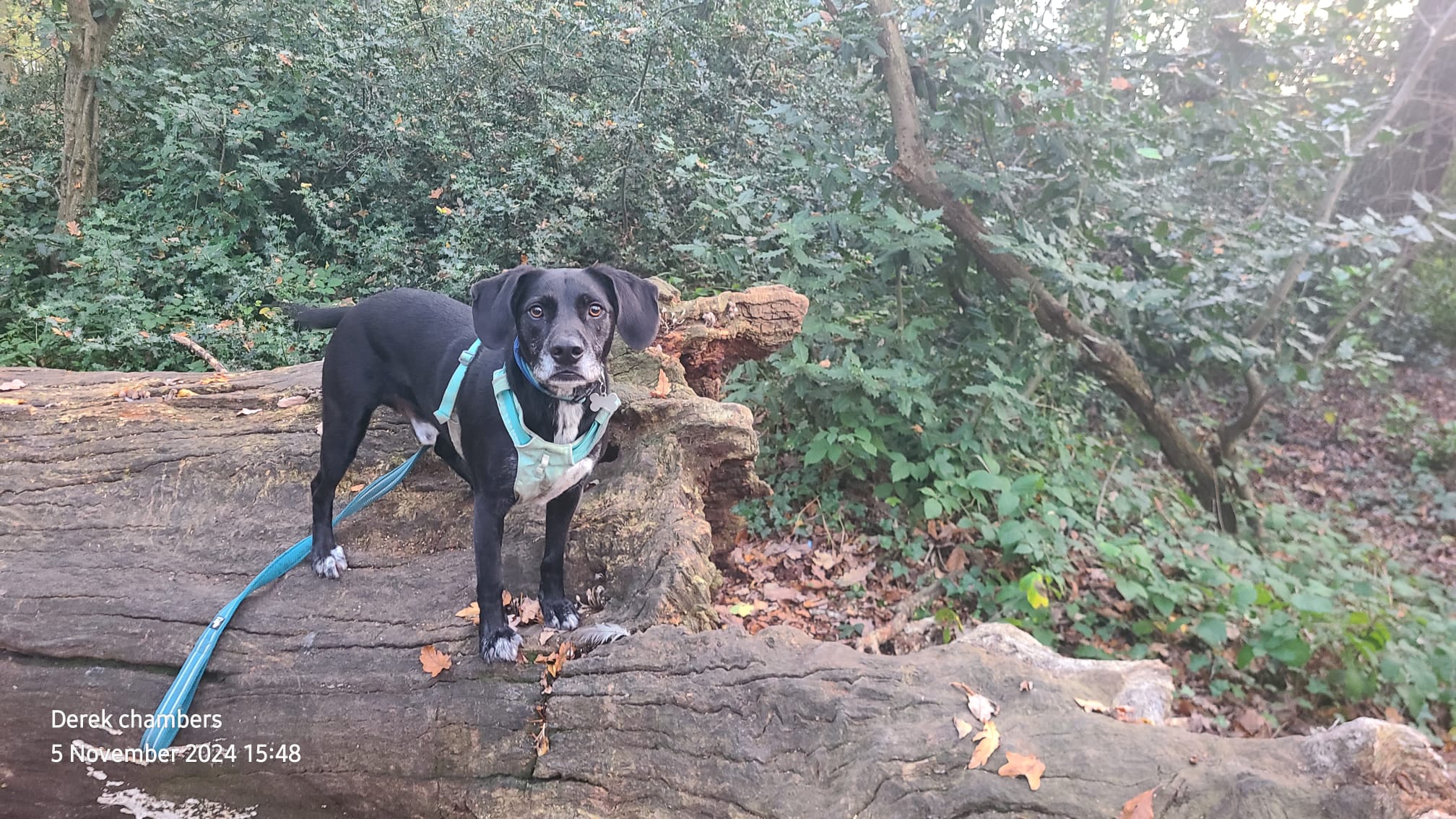
Rudy’s story
Rudy did not immediately trust me.
Building a relationship with him required time, familiar routines and repeated low-pressure experiences.
Progress happened gradually.
What mattered was not trying to rush the relationship. It was giving him enough predictability to learn that walks with me were safe.
His experience is a useful example of why small changes matter.
Read Rudy’s rescue-dog success story.
Support at home and while you are away
Walks are only one part of a rescue dog’s routine.
Many rescue dogs also benefit from:
- Predictable feeding
- Quiet rest
- A safe sleeping area
- Lower-pressure enrichment
- Care from familiar people
- Gradual introductions
- Remaining in their own home while their owner travels
If your dog does not cope well with kennels, boarding or unfamiliar environments, house sitting may allow them to remain at home and follow a more familiar routine.
Read about House Sitting for Rescue Dogs
Read about House Sitting and In-Home Pet Care
You can also explore the wider Rescue Dog Help and Advice Hub and Dog Behaviour, Body Language and Emotional Wellbeing
When veterinary or behaviour support may be needed
Behaviour can be affected by pain, illness, fear, anxiety and previous learning.
Speak to your vet if:
- Behaviour changes suddenly
- Your dog appears uncomfortable
- They become reluctant to move
- They react when touched
- Their appetite or sleep changes
- Reactivity becomes significantly worse
- They show severe panic
- They injure themselves
- Aggression is escalating
- There is a bite history you have not previously addressed
A vet can assess possible medical contributors and advise whether a referral to a qualified behaviour professional is appropriate.
Specialist behavioural help may also be needed where a dog shows:
- Repeated biting
- Serious aggression
- Severe separation-related distress
- Extreme shutdown
- Significant guarding
- Self-injury
- Behaviour that cannot be managed safely during an ordinary walk
I may work alongside an existing professional plan, but I do not replace veterinary or clinical behavioural support.
Find a qualified behaviour practitioner through the Animal Behaviour and Training Council
When I may not be the right person
I may decline or stop the service where:
- I cannot safely enter the property
- The dog cannot currently be handled safely by one person
- Important bite or aggression information has been withheld
- The dog needs two handlers
- Safe equipment cannot be provided
- The required work falls outside my experience
- The owner requires punishment-based methods
- The dog needs a formal behaviour programme rather than walking support
- The location is outside my practical service area
- The required time cannot fit safely around existing clients
- The dog’s health needs make walking inappropriate
- The arrangement creates an unreasonable risk to the dog, public or me
Declining a booking is not a judgement on the dog.
It means that another type of support may be safer or more appropriate.
Price
A focused rescue, nervous or reactive support walk costs:
£30 for up to 60 minutes
The session may include:
- Calm preparation before leaving
- A locally planned walk
- Additional time for transitions
- Route changes
- Space from triggers
- Sniffing and decompression
- A shorter outdoor walk where appropriate
- Calm indoor enrichment
- Following an agreed routine
- A post-walk update
The fee is for my booked time and focused support.
It does not guarantee that your dog will walk for the full hour or cover a particular distance.
Where your dog no longer needs the focused service, we can discuss whether a standard solo walk is appropriate.
View the complete Finchley Dog Walker price list
Areas covered
Focused rescue dog support is available, subject to location and existing commitments, in:
- North Finchley and N12
- Finchley Central and N3
- East Finchley and N2
- Muswell Hill and N10
- Selected nearby areas
Because I work on foot and walks begin and end at your home, your postcode matters.
Please include it in your first message.
Check the complete Finchley Dog Walker service area
What to include when you enquire
Please tell me:
- Your name
- Your postcode
- Your dog’s age, breed or type
- How long they have lived with you
- Where they were adopted from, where known
- What happens on a difficult walk
- Known triggers
- Any bite history
- How they respond to unfamiliar people
- The equipment they use
- Existing veterinary, training or behaviour support
- The days and times you need
- Whether timing is flexible
- Any medical or mobility concerns
Please be completely honest about behaviour and safety.
Accurate information helps me decide whether I can provide appropriate support and plan the introduction safely.
Frequently asked questions
Do you only work with rescue dogs?
No.
The focused support service may also suit nervous, anxious, reactive or easily overwhelmed dogs who have not been rescued.
Do you train rescue dogs?
I provide practical walking and routine support.
I am not offering a formal training or clinical behaviour service. I can reinforce suitable routines already agreed with you or your professional.
How much does rescue dog support cost?
A focused session costs £30 for up to 60 minutes.
Will my dog be walked for the full hour?
Not necessarily.
The booked time may include calmly entering, attaching equipment, helping your dog leave the home, a manageable outdoor walk, returning safely, and providing calm enrichment or an update.
The service is based on what your dog can cope with rather than distance covered.
What if my dog refuses to leave the house?
I will not drag or force them outside.
The session may begin with calm work near the door, time in the garden, a very short outing or low-pressure enrichment while we build familiarity.
Can you work with reactive dogs?
Yes, where I believe the arrangement can be managed safely.
I will assess known triggers, handling requirements, bite history, equipment and the local environment before accepting the booking.
Can you walk a dog with a bite history?
Possibly, but this must be disclosed before we meet.
Whether I can help depends on the circumstances, severity, triggers, equipment, existing professional support and whether the risk can be managed safely.
Can my dog wear a muzzle?
Yes, where the dog is already comfortable wearing a suitable basket muzzle and the arrangement has been discussed.
Do you use group walks to socialise rescue dogs?
No.
I do not mix dogs from different households. I also do not use forced greetings as a method of socialisation.
Do you use a van?
No.
I work locally on foot. Walks begin and end at your dog’s home.
How many introductory meetings will my dog need?
That depends on the dog.
Some dogs are comfortable after one meeting. Others may need several short introductions before it is appropriate for me to take them out alone.
How quickly will my dog improve?
There is no guaranteed timetable.
Some dogs make progress quickly. Others need longer, and progress may vary from week to week.
What if my dog needs a behaviourist?
I will tell you if I believe the problem falls outside my role.
Your vet can assess possible medical factors and help with an appropriate referral. You can also search the Animal Behaviour and Training Council register.
Can you follow my trainer’s plan?
Usually, provided it is reward-based, clearly explained, safe and within my role.
Do you offer house sitting for rescue dogs?
Yes.
House sitting may be suitable for rescue dogs who are more comfortable remaining in their own home while their owner travels.
Do you use treats?
I may use suitable rewards with your permission.
Please tell me about allergies, dietary restrictions and any foods your dog should not receive.
What happens during hot weather?
I follow my Extreme Weather Policy.
The outdoor part of a session may be shortened or replaced with toileting, calm indoor enrichment and a welfare check where walking would be unsafe.
Read the Finchley Dog Walker Extreme Weather Policy
Looking for rescue dog support in Finchley?
Your dog does not have to walk a long route, greet other dogs or make rapid progress to have a successful session.
The starting point is understanding what they can manage now.
Send me your postcode, the days or times you need and an honest description of what happens on walks.
I will tell you whether I believe I am the right person to help or if i can help with training support
Contact Del about rescue dog support
WhatsApp: 07707 763344
Explore the Rescue Dog Help Hub
All services are subject to location, availability, appropriate introductions, full disclosure of behavioural history, suitable equipment and my assessment that the arrangement can be provided safely.
