Training-Support Walks in Finchley: Everyday Skills on Your Dog’s Walk
Updated September 2026
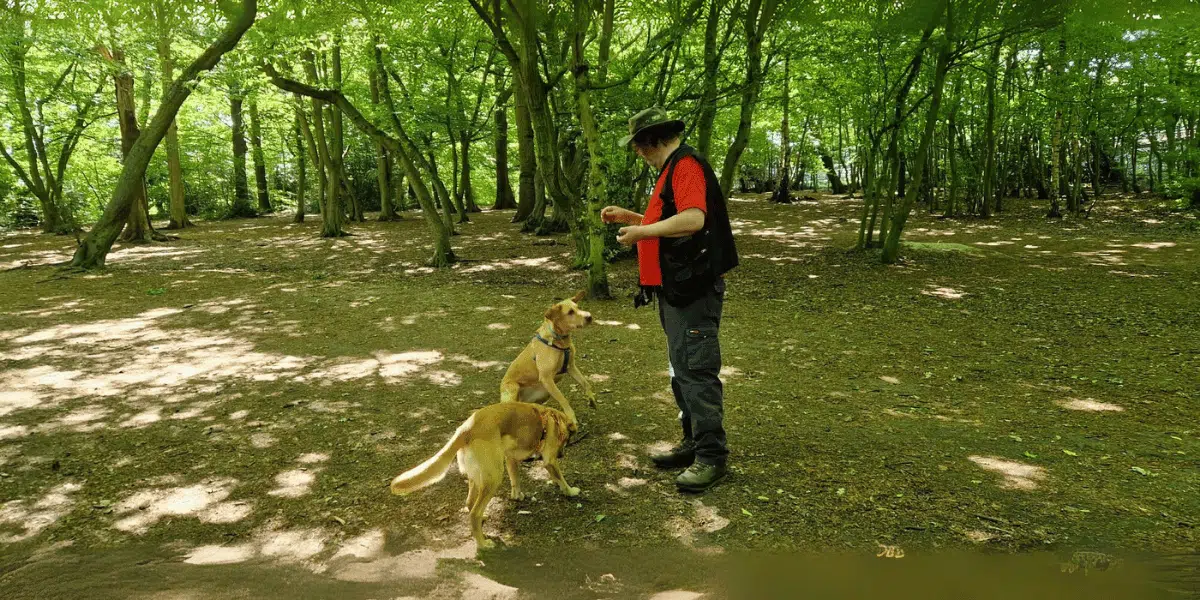
A training-support walk is a one-to-one dog walk where I reinforce useful everyday skills while your dog still has time to sniff, explore, exercise and enjoy being outside.
It is primarily me and your dog working together during their normal local walk.
If you want to learn and practise alongside your dog, my One-to-One Dog Training Support in Finchley is the better place to start.
Training-support walks are not a promise that I will take your dog away and return them “fully trained”. They are practical, consistent support for suitable dogs who benefit from practising familiar skills during everyday walks.
Training-support walks at a glance
| Service | One-to-one dog-only training-support walk |
| Duration | Up to 60 minutes |
| Current price | £30 |
| Collection | From your dog’s home |
| Transport | No cars or vans |
| Other dogs | No unrelated dogs added to the walk |
| Approach | Calm, reward-based and welfare-led |
| Useful for | Loose-lead skills, check-ins, recall foundations, calm starts, confidence and following an existing training plan |
| Main areas | N2, N3, N12, N10 and selected N11 addresses |
| Not suitable for | Clinical behaviour treatment, serious aggression or work that cannot safely be handled by one person |
All bookings are subject to location, availability, an appropriate introduction and my assessment that I can work safely with your dog.
Some links on this page may be affiliate links. If you buy something through one of these links, I may receive a small commission at no extra cost to you. I only recommend equipment I genuinely find useful, and that fits how I work.
Key Takeaways
- Dog training walks in Finchley provide one-to-one support for your dog during walks, focusing on reinforcing everyday skills.
- These walks allow dogs to sniff, explore, and enjoy their environment while practising useful behaviours.
- Sessions last up to 60 minutes and cost £30, including practice in loose-lead walking and recall foundations.
- Training-support walks differ from formal training; they integrate practice into regular walks instead of formal lessons.
- This service suits dogs with some foundation skills who benefit from consistent practice during their normal walks.
Table of contents
- Training-support walks at a glance
- What is a training-support walk?
- Is this different from one-to-one dog training support?
- What can my dog practise during a training-support walk?
- How can training-support walks help with loose-lead walking?
- Can you practise recall during the walk?
- Check-ins, attention and moving away
- What about nervous, rescue or reactive dogs?
- Sniffing is part of the walk
- Can you follow the plan my trainer or behaviourist has given me?
- What rewards do you use?
- What equipment might be useful?
- Who might a training-support walk suit?
- When is a training-support walk not the right service?
- How does a training-support walk work?
- Where are training-support walks available?
- How much does a training-support walk cost?
- Frequently asked questions
- Training practice should still feel like a walk
- Related guides
What is a training-support walk?
A training-support walk is still a dog walk.
I do not spend an hour continually asking your dog to perform exercises.
Dogs need opportunities to:
- sniff and investigate
- move at an appropriate pace
- go to the toilet
- explore their surroundings
- take breaks
- process what is happening around them
- simply enjoy being outside
Within that walk, there are plenty of natural opportunities to reinforce useful behaviour.
Your dog looks back at me voluntarily. I can reward that check-in.
They walk several steps with slack in the lead. I can reinforce it.
We need to change direction because another dog is approaching. We can practise moving away together calmly.
Your dog returns to me while using a long line. That is another opportunity to reinforce recall.
Training becomes part of ordinary life rather than something that happens only during a formal lesson.
You can explore the wider approach in my Dog Training Hub open Dog Training Hub.
Is this different from one-to-one dog training support?
Yes. They have deliberately different jobs.
Training-support walk
This page is about me working with your dog during a one-to-one local walk.
It may be useful if your dog already understands a skill and would benefit from consistent practice during the week.
One-to-one dog training support
My One-to-One Dog Training Support in Finchley is primarily you, your dog and me working together.
Those sessions can take place at my private venue in N6, close to East Finchley and Highgate, including an indoor hall, enclosed garden, and small private woodland area.
The emphasis there is on helping you understand, practise and develop the skills yourself.
A simple way of thinking about the difference is:
Training-support walk: I help your dog practise.
One-to-one training support: I help you and your dog practise together.
What can my dog practise during a training-support walk?
The exact plan depends on your dog, what they already know and what happens during their normal walks.
I might reinforce:
- calm preparation before leaving home
- walking through the front door without rushing
- voluntary check-ins
- name response
- short periods of loose-lead walking
- changes of direction
- moving away with me
- pausing and waiting where appropriate
- recall foundations
- engagement around everyday distractions
- settling after excitement
- appropriate use of sniffing as a reward
- confidence around manageable everyday situations
- exercises supplied by your existing trainer or behaviour professional
I am not trying to fit all of these into every walk.
One or two useful things practised successfully are usually more valuable than constantly asking your dog to work.
How can training-support walks help with loose-lead walking?
A training-support walk gives me opportunities to reinforce the moments when your dog walks without maintaining constant tension on the lead.
I do not expect dogs to march beside my leg for an entire walk.
They should still be able to sniff, investigate their surroundings and move naturally.
Depending on your dog, I may reward a few loose steps, a voluntary check-in or a calm change of direction before giving them another opportunity to sniff.
Your dog also needs to practise somewhere they can actually succeed. Expecting perfect lead walking on a busy pavement when they can barely concentrate is rarely productive.
My Loose-Lead Walking: A Calm, Reward-Based Guide explains the approach in much more detail.
Can you practise recall during the walk?
Where it is safe, suitable and agreed with you, recall foundations can form part of a training-support walk.
That does not mean simply letting your dog off the lead and hoping they return.
Depending on the dog and location, I may use a suitably handled long line attached to an appropriate harness.
We can reinforce:
- turning towards me
- moving back in my direction
- voluntary check-ins
- returning when called
- allowing the lead to be handled
- returning and then being allowed to continue exploring
I will not promise a “100 per cent guaranteed recall”.
Dogs are living animals, not machines, and safety comes before proving that training works.
My Dog Recall Training Guide explains how I build recall gradually.
Check-ins, attention and moving away
One of the most useful things a dog can learn on a walk is to stay aware of the person at the other end of the lead.
That does not mean staring at me continuously.
I like to reinforce spontaneous check-ins.
Your dog is sniffing and looks back to see where I am.
That is useful.
Another everyday skill is moving away.
A familiar “this way” or change-of-direction cue can become useful when:
- another dog appears
- a pavement becomes crowded
- food has been dropped ahead
- a cyclist approaches
- the environment suddenly becomes too difficult
- we simply need to take another route
Teaching the movement somewhere easy is far more useful than waiting until I urgently need it.
What about nervous, rescue or reactive dogs?
Sometimes the most useful training decision is not asking the dog to do anything at all.
A nervous or easily overwhelmed dog may benefit more from additional distance, a quieter route or some time to process what they have noticed.
Around Finchley, that may mean choosing quieter residential streets rather than heading straight into the busiest part of a park.
I am interested in what the dog can manage on that particular day.
For some dogs, useful progress might be:
- leaving home more calmly
- walking a short familiar route
- looking at another dog from a comfortable distance
- disengaging and moving away
- accepting food outdoors
- spending more time sniffing
- recovering more quickly after something unexpected
If your dog needs a more specialised walking arrangement because they are nervous, reactive or newly adopted, start with my Rescue Dog Support in Finchley
My Dog Behaviour and Body Language Hub also explains thresholds, stress, fear and other things worth noticing before assuming every problem needs more training.
Sniffing is part of the walk
Training support should not remove everything your dog enjoys about going outside.
I actively allow appropriate sniffing and exploration.
Sometimes sniffing can even become part of the reward.
A few successful loose-lead steps might be followed by:
“Go sniff.”
That means something the dog naturally wants becomes part of the training rather than something I am constantly trying to prevent.
Your dog’s walk should still belong partly to your dog.
For a broader look at how I combine exercise, choice and enrichment, read What Are One-to-One Enriched Dog Walks?
Can you follow the plan my trainer or behaviourist has given me?
Yes, where the plan is appropriate, reward-based and within my professional scope.
You do not need to stop working with your existing trainer in order to use me.
In fact, training-support walks can be particularly useful when somebody has already shown you what they want your dog to practise and you want more consistency between appointments.
With your permission, I am happy to work from written instructions or exercises supplied by your trainer or behaviour professional.
I will not replace their programme with something completely different simply because I am holding the lead that day.
Consistency matters.
What rewards do you use?
Food can be extremely useful because it is quick and easy to deliver at the moment the dog does something worthwhile.
But food is not the only reward.
Depending on the dog, I may use:
- food
- praise
- play
- movement
- access to sniffing
- an opportunity to explore
- creating additional distance
- continuing the walk
The important question is what your dog genuinely values at that moment.
My Dog Training Rewards Guide explains how I use food and other rewards during everyday walks.
What equipment might be useful?
Equipment should support safe walking and training rather than promise an instant fix.
Depending on the individual dog, useful equipment may include a well-fitted harness, fixed or double-ended lead, appropriately handled long line and an easily accessible treat pouch.
I do not use prong collars, choke or check chains, electronic collars, retractable leads for routine service use or equipment intended to frighten or hurt a dog.
If you are buying walking equipment, my Dog and Pet Products I Recommend page explains what I actually use or recommend and how I use it.
Optional affiliate links for this section
I would use only these three rather than turning the service page into a shopping page:
Halti Training Lead on Amazon UK
Useful when a suitable dog benefits from an adjustable double-ended fixed lead.
Waterproof long line on Amazon UK
Useful for suitable recall practice and controlled exploration in appropriate open spaces.
Washable silicone treat pouch on Amazon UK
Useful when rewards need to be delivered promptly during a walk.
Who might a training-support walk suit?
This service may suit your dog if they already have some foundation skills and would benefit from additional consistent practice.
It may be particularly useful when:
- you are already practising loose-lead walking
- recall is being developed gradually
- your dog benefits from regular check-in practice
- you want walking routines kept consistent during the week
- you have been given exercises by another professional
- your young dog is learning everyday walking skills
- your rescue dog benefits from calm, predictable handling
- your dog finds group walks unsuitable
- you want their normal walk to include useful reward-based practice
Your dog does not need to be perfectly trained before I work with them.
I do, however, need enough information to decide whether I can handle them safely.
When is a training-support walk not the right service?
A normal training-support walk is not a substitute for veterinary assessment, a clinical behaviour consultation or specialist work with serious aggression.
Please tell me before booking if your dog has:
- bitten or attempted to bite a person or animal
- caused an injury
- shown significant resource guarding
- become impossible for one person to handle safely
- experienced severe panic outside
- shown serious separation-related distress
- suddenly changed their behaviour
- developed pain, mobility problems or sensitivity to touch
- been given specialist handling requirements
Telling me does not automatically mean I will refuse the dog.
It means I can make an informed decision rather than discover an important safety issue while holding the lead.
Sudden changes in behaviour can also have a medical component, so your vet should be involved where pain or illness may be relevant.
If the work is outside my role, the Animal Behaviour and Training Council practitioner register can help you find appropriately assessed professionals. ABTC maintains registers covering animal training and behaviour roles.
For general owner guidance, the RSPCA’s dog-training advice also recommends reward-based training and beginning new learning with manageable levels of distraction.
How does a training-support walk work?
We start with a conversation about your dog and what you are hoping to reinforce.
I will want to know about their normal walk, equipment, health, behaviour, known triggers and any previous training.
If another trainer or behaviour professional is already involved, tell me what they are working on.
For a new dog, an appropriate introduction is required before I take responsibility for them.
Once I know the dog, a typical walk may combine ordinary walking, sniffing and exploration with short pieces of appropriate practice.
I will adjust what we do to the dog in front of me rather than trying to complete a fixed training checklist.
Where are training-support walks available?
Because I work locally on foot and do not operate a van collection round, regular walks have to fit my existing route.
Training-support walks may be available in:
- East Finchley N2
- Finchley Central N3
- North Finchley N12
- Muswell Hill N10
- selected addresses around Bounds Green and Arnos Grove N11
N11 coverage depends particularly on the exact road and requested time.
Please send your postcode when enquiring.
You can check the current boundaries on My Service Area
How much does a training-support walk cost?
A dog-only training-support walk costs:
£30 for up to 60 minutes
The booked time may include preparation at home, the walk itself, appropriate training practice, route changes, sniffing and an update afterwards.
It does not mean your dog will spend 60 minutes continuously training.
The point is useful, consistent practice within an appropriate walk.
See Current Finchley Dog Walker Prices for my other dog walking, pet care and one-to-one training charges.
Frequently asked questions
Will you train my dog for me?
I can reinforce suitable everyday skills during the time I spend with your dog, but I cannot make training completely separate from what happens at home.
Dogs benefit from consistency.
If I reward loose-lead walking but everybody else allows the dog to pull towards whatever they want, progress is likely to be slower.
If you want help learning what to do yourself, choose my One-to-One Dog Training Support
Are training-support walks the same as a normal solo walk?
Not quite.
My normal Solo Dog Walks already include calm handling, sniffing, enrichment and reinforcement of agreed routines.
A training-support walk has a more deliberate focus on practising particular everyday skills or following an agreed training plan.
Do you offer group training walks?
No.
I work with one dog or household at a time.
I do not combine unrelated dogs into training groups or transport them together in a van.
Can you work with a reactive dog?
Possibly.
“Reactive” covers a very wide range of behaviour.
Tell me exactly what happens, what your dog reacts to and whether there has ever been snapping, biting or an injury.
Sometimes my Rescue Dog Support will be more appropriate.
Sometimes the dog needs veterinary or specialist behavioural support instead.
Can you use a long line for recall?
Where the dog, location and circumstances make it appropriate, yes.
I use long lines as safety equipment rather than as proof that a dog’s recall is already reliable.
They require enough space and careful handling and are not appropriate beside roads or in many crowded environments.
Do you use punishment or corrective equipment?
No.
My work is reward-based and welfare-led.
I do not use prong collars, choke or check chains, electronic collars, rattle bottles, lead jerks or methods intended to frighten or hurt a dog.
Training practice should still feel like a walk
My aim is not to turn every outing into an obedience lesson.
I want your dog to develop useful everyday skills while still having opportunities to sniff, explore, move, make appropriate choices and enjoy being outside.
Sometimes that means practising a recall.
someimes it means rewarding a loose lead.
Other times it means turning around before a situation becomes too difficult.
And sometimes the best decision is simply giving your dog five minutes to investigate an interesting hedge.
That balance matters.
If you want me to reinforce familiar skills while I walk your dog, ask about a training-support walk.
If you want to be involved and learn alongside your dog, start with One-to-One Dog Training Support in Finchley
Your postcode, your dog’s age and breed or type, what happens on a typical walk, what you would like them to practise and whether you are already working with a trainer or behaviour professional.
Established 2011 | One dog or household at a time | Reward-based support | Ofqual Level 3 Canine First Aid
Related guides
Dog Training Hub training advice and guides
Loose-Lead Walking Guide loose-lead walking
Dog Recall Training Guide recall training
Dog Training Rewards Guide training rewards
Dog Behaviour and Body Language Hub behaviour and body language
Rescue Dog Support in Finchley rescue dog support
Solo Dog Walks in Finchley solo dog walking