
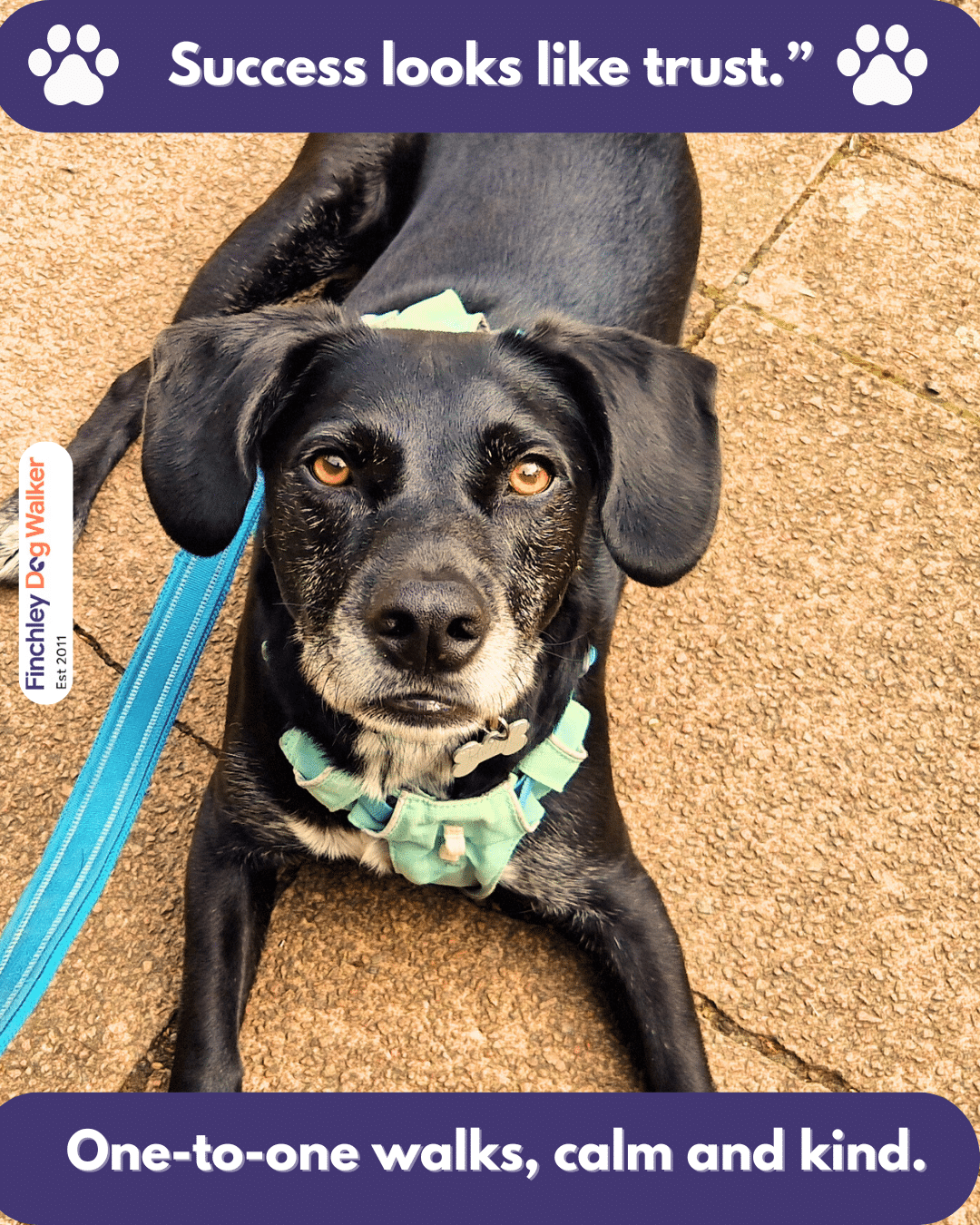
Success with a dog does not always mean teaching an impressive trick or completing a long walk.
Sometimes success is a dog choosing to come a little closer.
It can be taking a few more steps away from home, accepting a treat or beginning to trust someone who once felt unfamiliar.
For Rudy and me, success has been built slowly over the past three years. His story shows why patience and a calm approach can make such a difference when supporting a nervous dog
Our first meeting
When I first met Rudy, I sat and chatted with his owners while giving him plenty of space.
Rudy barked at me and made it clear that he did not want to come near me. I did not try to approach him, touch him or persuade him to interact.
He needed time to watch me and decide whether I was safe.
It can be tempting to try to win a nervous dog over immediately. People may reach out a hand, call the dog repeatedly or offer treats while moving closer.
For some dogs, this can add even more pressure.
Instead, I allowed Rudy to stay at the distance where he felt comfortable. I spoke calmly with his owners and avoided making him the centre of attention.
There was no dramatic breakthrough during that first meeting. Rudy did not suddenly decide that I was his new best friend.
That was fine.
The important thing was that our relationship had begun without forcing him to do anything he was not ready to do.
Our first walk to the corner
Our first walk together was not really much of a walk.
Rudy was very reluctant to leave with me. We made it as far as the corner before returning home.
For some dogs, that might not sound like much. For Rudy, it was a significant achievement.
He had left the safety of his home with someone he barely knew. He had walked a short distance and returned safely.
The distance did not matter.
What mattered was helping Rudy learn that he could go out with me and that I would listen when he showed me he was unsure. This is one of the reasons I offer calm one-to-one dog walks rather than expecting every dog to cope with a group.
I did not pull him along or try to make him complete a particular route. We simply went as far as he could comfortably manage that day.
The next walk was another opportunity to build on that experience.
Trust grew one walk at a time
Over time, Rudy began to feel more comfortable.
Our walks gradually became longer. He started exploring more, sniffing more and appearing less concerned about being away from home with me.
There was no single walk when everything suddenly changed. His progress came through many small experiences.
I arrived when expected.
I gave him space.
I kept our walks calm and predictable.
I paid attention when he was uncertain.
Most importantly, I did not rush him.
This consistency helped Rudy understand what to expect from me. As his trust grew, so did his confidence.
The dog who once barked and would not come near me now goes completely mad with excitement when he sees me.
It is quite a welcome.
What Rudy’s owner says
After I had been walking Rudy for two years, his owner, Jordanna, shared this lovely review:
“Derek has been walking our nervous dog for the past two years. Derek has built up his confidence and he gets so excited whenever he comes to collect him. Our dog truly loves Derek and we are so pleased.”
Reviews like this mean a great deal to me.
I see the changes during our walks, but hearing that Rudy’s family can also see his growing confidence makes his progress even more rewarding.
We have known each other for over three years now, and his excitement when I arrive has certainly not faded.
Adventures in Coldfall Wood
Rudy now loves his walks in Coldfall Wood.
Rather than simply walking from one end of the woods to the other, we include plenty of opportunities to sniff, explore and use his brain.
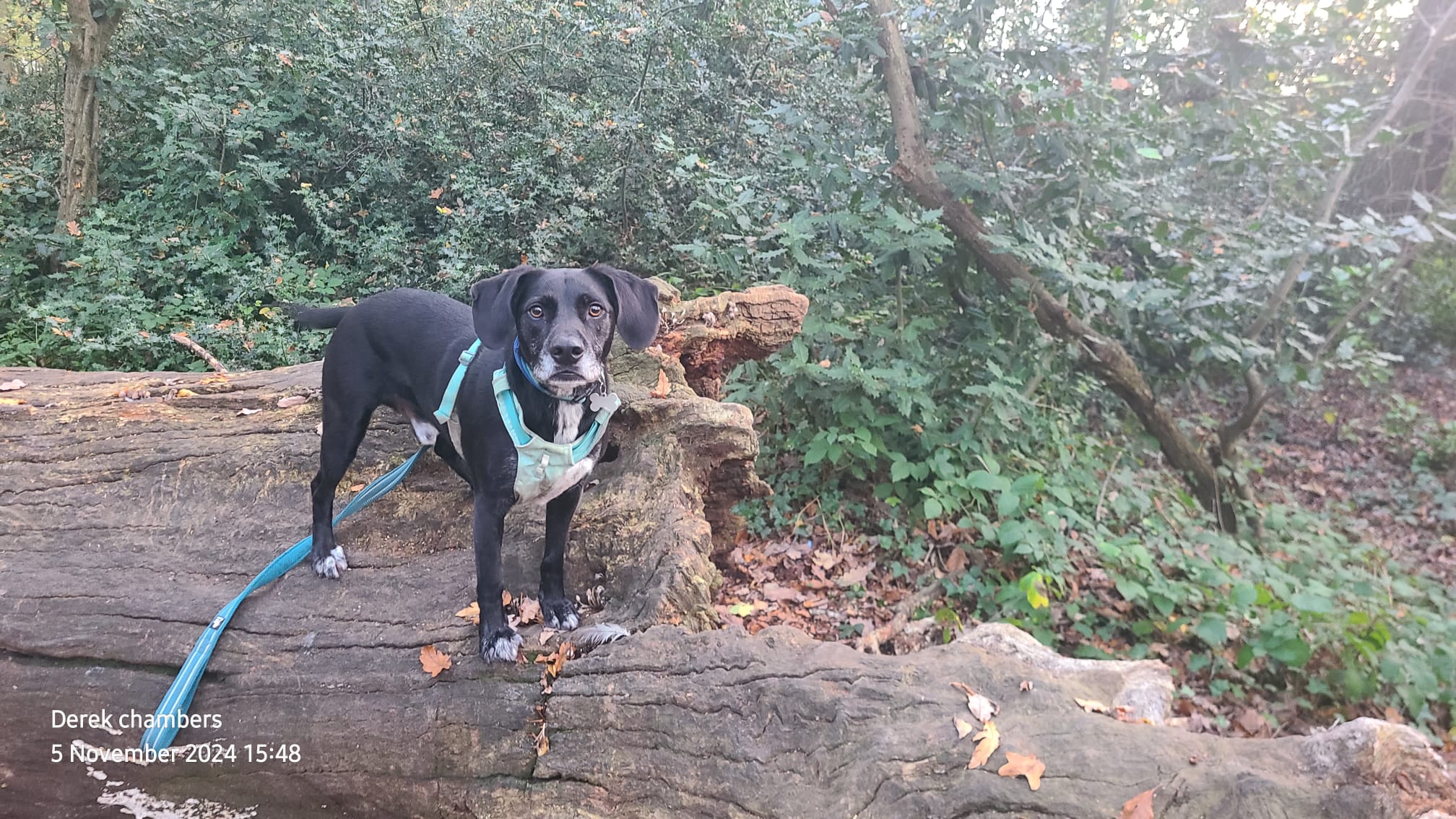
One of Rudy’s favourite activities is the Magic Tree.
The Magic Tree is a tree where I hide treats for him to find. I place them safely around the trunk and within natural gaps in the bark while Rudy waits nearby.
The game can be made easier or more challenging depending on how Rudy is feeling.
For an easy search, I use ordinary kibble and place it somewhere fairly obvious. This allows him to find the reward quickly and helps him understand that the game has started.
For a more difficult search, I use something more exciting, such as sprats, and hide the treats in less obvious places.
Rudy then has to use his nose and work out where the smell is coming from.
Watching a dog search can be just as enjoyable as watching them run. Their pace often slows, their nose takes over, and they become completely focused on the task.
It is a simple activity, but it provides mental stimulation and gives Rudy something enjoyable to solve.
The Magic Tree has become part of our walking routine. Rudy knows exactly what might happen when we approach it.
Even the crows have joined us
We are often joined by a few local crows during our walks.
They have worked out that food sometimes appears when Rudy and I are nearby. They wait around hopefully, watching for a piece of kibble that Rudy might have missed.
At one time, the movement and presence of the birds could have been another distraction for him.
Now Rudy largely ignores them.
He concentrates on his own search while the crows wait for their chance to inspect the area afterwards.
It is another small sign of how much more comfortable and confident he has become.
Success does not need to be rushed
Rudy’s story is a reminder that progress should be measured against the individual dog, not against what other dogs can do.
Our first walk only reached the corner.
Today, he is excited to see me, enjoys exploring Coldfall Wood, and enthusiastically searches the Magic Tree while ignoring the nearby audience of crows.
That change did not happen because Rudy was pushed beyond what he could manage.
It happened because he was given time.
There may be moments when progress with a nervous or cautious dog feels slow. There may also be days when they find something difficult that they managed easily the week before.
That does not mean the work has failed.
Trust is rarely a straight line. It is built through repeated experiences in which the dog feels heard and safe.
The best part of Rudy’s success story
I love seeing Rudy enjoy his walks, but the most rewarding part is the relationship we have built.
Three years ago, he barked at me and would not come close.
Now he cannot contain his excitement when I arrive.
To someone passing us in the woods, Rudy may simply look like a happy dog enjoying a walk and searching for treats.
I see all the small steps that helped him reach that point.
I see the dog who made it to the corner on his first walk.
I see the trust that grew gradually with each arrival.
I see the confidence that now allows him to relax, explore and enjoy himself.
That is Rudy’s success story, and I feel very lucky to be part of it.
Every dog is different, and progress depends on their individual needs, history and circumstances. A qualified reward-based behaviourist or veterinary professional should be consulted where a dog’s fear or behaviour is causing concern.
Continue around the blog circle
This post is part of a blog circle exploring success stories.
Next, visit Urban Tails and read about one of the biggest milestones for Urban Tails so far.
