
Updated August 2026
A good dog walk does not have to mean walking as far or as fast as possible.
Some of the most enriching things you can do on a walk are surprisingly simple: let your dog sniff, vary the route, search for food, practise a useful skill, explore a safe surface or occasionally let your dog choose which way to go.
I have been walking dogs professionally in North London since 2011, and one thing I have learned is that different dogs enjoy very different walks.
One dog may love exploring a new path. Another may be happier spending ten minutes investigating the same patch of grass.
The aim isn’t to cram twelve activities into every walk. It is to make the walk more interesting and better suited to the dog in front of you.
If you want to understand the wider subject, read my guide to mental stimulation for dogs.
Key Takeaways
- Dog walk enrichment ideas include allowing dogs to sniff, choose their routes, and play games like ‘find it’.
- Simple training and rest are essential; not every moment needs structured activities.
- Puppies, seniors, and nervous dogs benefit from tailored walks that suit their needs.
- Sometimes slowing down the walk and just letting dogs explore is the best enrichment.
- Make walks engaging without overwhelming; focus on quality over quantity.
Quick answer: how can I make my dog’s walk more interesting?
Try adding opportunities for your dog to:
- sniff without being hurried
- choose between safe routes
- search for a few treats
- explore different safe surfaces
- practise simple reward-based training
- find a hidden toy
- follow a scent trail
- pause and watch the world
- take a different route
- enjoy short, appropriate play
- investigate somewhere new
- slow down
You don’t need special equipment for most of these.
And you certainly don’t need to keep your dog entertained every second of the walk.
Sometimes the enrichment is simply having enough time to be a dog.
1. Let your dog sniff
This is probably the easiest change you can make.
Dogs experience much of their world through smell. Yet it is easy for a human walk to become:
“Come on.”
“Leave that.”
“Keep moving.”
“Come on!”
Unless there is a reason you need to move on, give your dog some time to investigate.
I don’t expect dogs I walk to spend the entire outing marching beside me. Sniffing and exploring are part of the walk.
This doesn’t mean your dog gets to drag you towards every lamppost. You can still have sensible lead manners while allowing plenty of opportunities to sniff.
My Dog Training Hub explains how I combine reward-based everyday skills with opportunities for dogs to behave naturally.
2. Let your dog choose the route occasionally
You still need to make the safety decisions, particularly around roads, livestock, wildlife, busy paths and places where dogs are restricted.
But when you reach two equally safe paths, why not occasionally see which one your dog chooses?
You might be surprised.
Choice doesn’t mean abandoning boundaries. It means allowing your dog some appropriate control over their experience.
For a dog whose whole day is decided by humans, even small choices can add interest.
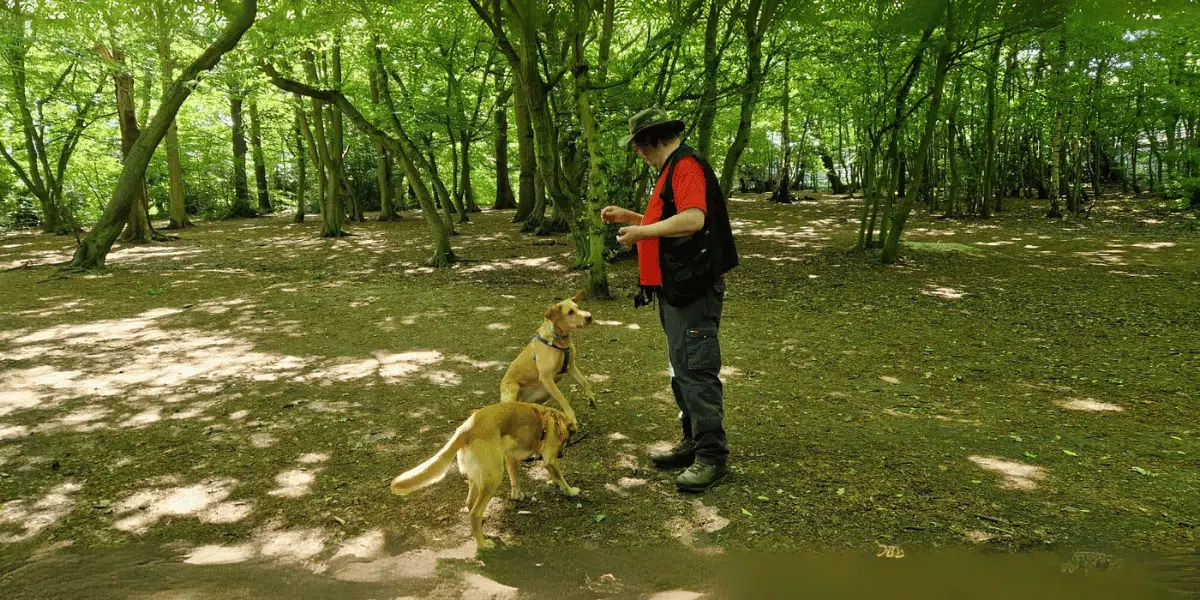
3. Play “find it”
A simple food search is one of my favourite activities because you need very little equipment.
Start somewhere quiet.
Let your dog see you drop or gently scatter a few pieces of their normal food or suitable treats onto a safe, clean patch of ground and encourage them to find them.
Once they understand the game, you can make the search slightly more interesting.
Keep it achievable.
If your dog is becoming frantic or frustrated, make the search easier rather than continually increasing the difficulty.
Avoid scattering food where there may be broken glass, litter, toxic plants, chemicals or anything else you don’t want your dog picking up.
If your dog has dietary restrictions, allergies, or a medical condition that affects what they can eat, use food approved for them.
4. Follow a simple scent trail
You can extend “find it” by making a short trail.
Use a few tiny pieces of suitable food and place them several steps apart, finishing with a slightly better reward.
Then allow your dog to work out where the trail leads.
For beginners, keep the pieces fairly close together.
As your dog gets better, you can increase the spacing.
This isn’t competitive scent work. It’s simply an easy way to encourage your dog to use their nose.
5. Change your usual route
Dogs often benefit from predictability, so “different is always better” isn’t a rule.
But if your dog is confident and enjoys exploring, occasionally walking a different safe route can provide new smells and things to investigate.
You don’t necessarily need to travel anywhere.
Turning left instead of right or exploring a different path through a familiar local green space may be enough.
For a nervous or newly adopted dog, however, novelty can be stressful rather than enriching. Familiar routes may initially be much more useful.
6. Use the environment for gentle exploration
The environment can provide plenty of interest without turning the local park into an agility course.
Depending on your dog, you might encourage them to:
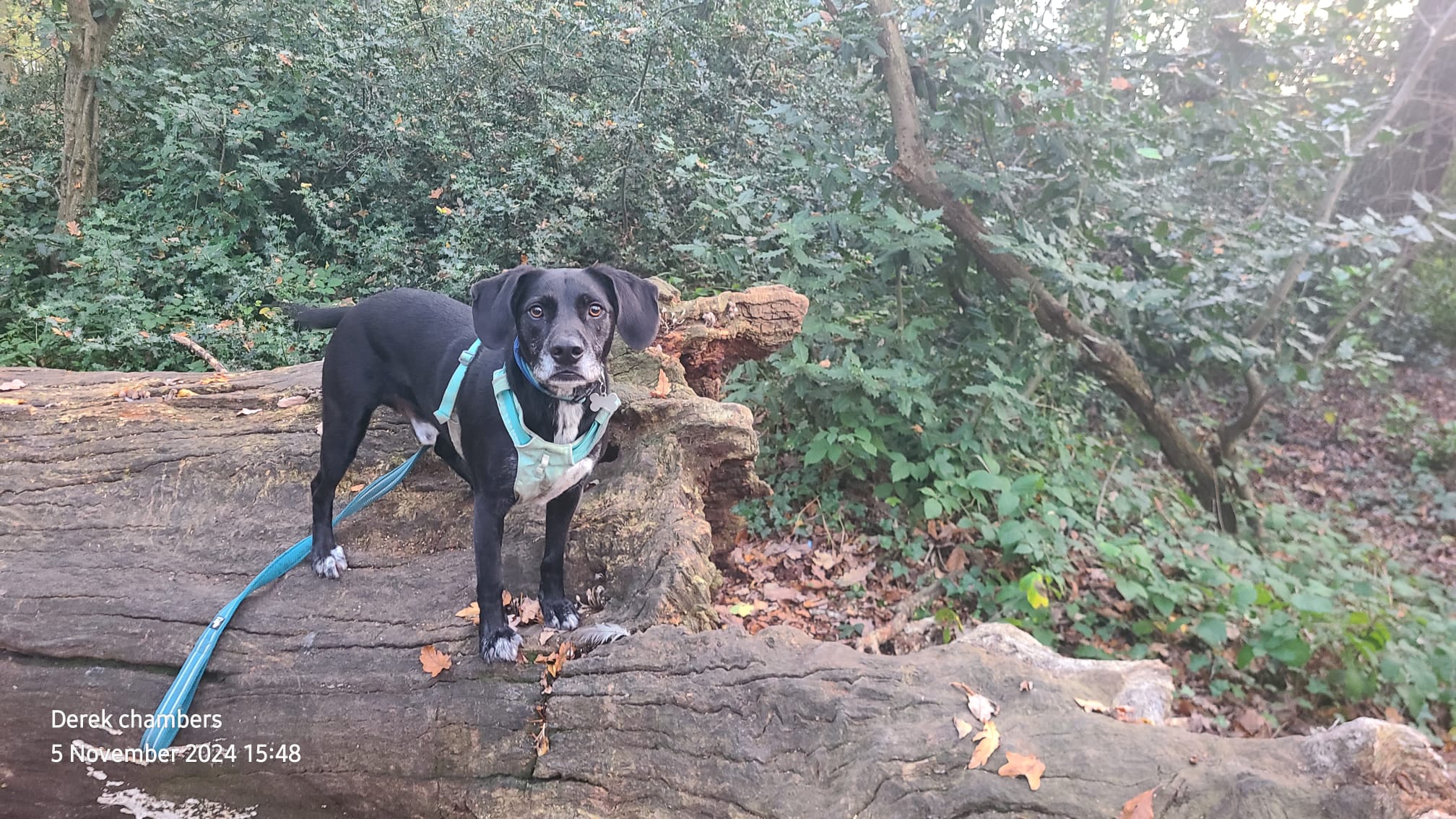
- step over a low fallen branch
- walk around a tree
- put their front paws on a stable low surface
- weave between widely spaced posts
- explore different safe textures underfoot
Keep everything low, stable and voluntary.
Avoid high jumps, slippery surfaces, unstable benches, sharp objects and forced climbing.
Puppies should not be encouraged into repetitive jumping, and dogs with pain, arthritis, injuries or exercise restrictions need activities appropriate to their physical condition.
If your dog has a medical or mobility problem, follow advice from your vet or veterinary physiotherapist.

7. Have a short toy game
Some dogs enjoy a toy much more than food.
A favourite toy can be used for a brief game during the walk. You could:
- hide it nearby for your dog to find
- practise a short retrieve
- play a few seconds of appropriate tug
- ask your dog to carry it
- practise exchanging or releasing the toy
Choose something suitable for your dog’s size and playing style and check it regularly for damage.
I don’t recommend throwing sticks. A purpose-made toy is a much more sensible option.
For dogs that enjoy tugging, I use and recommend Tug-E-Nuff toys.
Affiliate disclosure: I may earn a commission if you buy through an affiliate link, at no additional cost to you. I only recommend products I consider genuinely useful.
8. Turn a little training into a game
Your whole walk doesn’t need to become a training session.
A minute or two of simple reward-based practice can add variety and reinforce useful everyday skills.
Depending on your dog, you might practise:
- responding to their name
- hand targeting
- checking in with you
- changing direction with you
- a few loose-lead steps
- waiting briefly
- recall foundations where it is safe and appropriate
Then let your dog go back to sniffing.
Training can be part of the walk without taking over.
My guide to training dogs using games has more ideas.
9. Stop and watch the world
Not all enrichment involves doing something.
Find a suitable quiet spot and stop for a moment.
Let your dog sniff the air, watch people at a comfortable distance or simply sit with you.
For a confident dog, calm observation can be an interesting part of a walk.
For a nervous dog, distance matters. Don’t deliberately position them close to dogs, traffic, children or anything else they find worrying in the name of “socialisation”.
If your dog cannot relax, increase the distance or move to a quieter spot.
10. Use real-life rewards
Food isn’t the only reward available on a walk.
Suppose your dog desperately wants to sniff a particular tree.
You could reward a few steps on a loose lead by saying “go sniff” and moving towards it together.
Or your dog comes back when called and, when safe, is released to continue exploring.
This can make training feel less like a separate lesson and more like part of everyday life.
11. Try a short, thoughtful retrieve
If your dog enjoys retrieving, you don’t necessarily have to remove the game completely.
But I wouldn’t spend the entire walk repeatedly launching a ball as far as possible.
Repeated sprinting, sudden stops, tight turns and jumping may not suit every dog, and some dogs become increasingly wound up rather than pleasantly settled.
Instead, you could mix an occasional controlled retrieve with sniffing, searching, walking and calmer activities.
For puppies, senior dogs and dogs with joint or mobility problems, take particular care with repetitive high-impact exercise.
12. Slow the walk down
This may be the most overlooked enrichment idea of all.
You don’t have to add anything.
Instead, take something away: the rush.
Allow more time for sniffing.
Stop somewhere quiet.
Let your dog investigate.
Take the shorter route and spend longer exploring it.
A walk doesn’t become better simply because your fitness tracker says you covered more miles.
My current approach to one-to-one enriched walks is built around this principle: the walk should suit the individual dog rather than forcing every dog into the same routine.
What about puppies?
Puppies don’t need every walk to be a miniature adventure park.
The outside world is already full of new smells, sounds, surfaces, people and experiences.
Keep things simple.
Short sniffing opportunities, gentle exploration, easy searches and a few reward-based interactions can be plenty.
Avoid repetitive jumping and excessive high-impact play.
Give your puppy time to process what they are experiencing rather than continually adding more stimulation.
What about senior dogs?
Older dogs can still enjoy rich, interesting walks even when their physical abilities change.
You may simply need to shift the emphasis from distance and speed towards sniffing, searching and gentle exploration.
Watch for changes in gait, reluctance to continue, difficulty getting up, unusual tiredness or other signs that something has changed.
My senior dog exercise and enrichment guide has more ideas for adapting activities as dogs get older.
Sudden or persistent changes in mobility or willingness to exercise should be discussed with your vet.
What about nervous, reactive or rescue dogs?
More stimulation isn’t necessarily what a nervous dog needs.
A quiet familiar route with plenty of sniffing and enough distance from things they find difficult may be far more enriching than taking them somewhere new.
Don’t use an enrichment game to lure a worried dog closer to something they are trying to avoid.
For some dogs, success might be:
- sniffing quietly
- choosing to move away
- watching something from a comfortable distance
- checking in with you
- exploring a familiar area
- going home before they become overwhelmed
My Rescue Dog Support in Finchley explains more about the calm one-to-one approach I use with dogs who need additional space and predictability.
Do enrichment walks need to be longer?
No.
A longer walk isn’t automatically a better walk.
A short outing containing plenty of sniffing, gentle exploration and appropriate choice can be worthwhile.
Age, health, breed, fitness, weather, confidence and the individual dog’s needs all matter.
My complete guide to dog walking and everyday exercise looks at this in more detail.
When enrichment stops being enriching
Watch your dog.
An activity that one dog loves can frustrate, frighten or over-arouse another.
Stop or make things easier if your dog is becoming increasingly frantic, repeatedly giving up, showing signs of discomfort or trying to leave.
Enrichment should provide appropriate opportunities, not another list of things your dog has to complete.
And remember that rest matters too.
You don’t need to entertain your dog for the whole walk
This is the point I would most like you to take from this guide.
You don’t need twelve games on tomorrow’s walk.
Pick one idea if you want to.
Or don’t pick any.
Give your dog time to sniff, explore safely and enjoy being outside with you.
Sometimes the best enrichment is simply giving a dog a little more time to do what dogs naturally do.
One-to-one walks with enrichment built in
This is also how I approach my professional walks.
I don’t collect several unfamiliar dogs in a van and take them somewhere for a standard group route.
I walk one dog or one household at a time, starting and finishing at your home.
Depending on the dog, that can include sniffing, exploring, calm reward-based practice, confidence-building, searching and plenty of time to decompress.
For dogs who need more structured practice of everyday skills, I also offer training-support walks in Finchley. (Finchley Dog Walker)
If you’re looking for calm, individual dog walking in Finchley or nearby areas, you can contact Finchley Dog Walker.
Established in 2011. One dog or household at a time. No group collections. Calm, reward-based care.


