Updated October 2026
Winter does not mean your dog has to stop going for walks.
It does mean you may need to change the plan.
Cold rain, frost, ice, shorter daylight hours and strong winds can turn a perfectly ordinary local walk into something much harder for your dog. Puppies, senior dogs, nervous dogs and dogs with health or mobility problems may need even more adjustment.
I have been walking dogs professionally in Finchley and North London since 2011. One of the most useful things I have learned is that the planned distance matters far less than the dog in front of me.
Some winter days are perfect for a good walk. On others, I may choose a quieter route, slow down, stay closer to home, shorten the walk or replace some outdoor time with calm enrichment.
The aim is not to avoid winter.
It is to make sensible decisions about today’s walk.
For broader advice about coats, paws, grit, antifreeze, snow, frozen water and cold-weather health, read my Winter Dog Care: Cold Weather, Snow, Ice and Paw Safety guide.
Key Takeaways
- Most healthy dogs can continue regular walks in winter, but you may need to adjust distance or routes.
- Consider shortening walks if your dog shows signs of discomfort, like shivering or slowing down.
- Nervous and senior dogs may struggle more in winter; monitor their comfort and adapt routines accordingly.
- Always prioritise safety, avoiding icy paths and extreme weather conditions during walks.
- Use shorter walks paired with indoor enrichment when the weather is too harsh for normal outings.
Table of contents
- Quick answer: should you walk your dog in winter?
- Start with the dog in front of you
- When should I shorten a winter dog walk?
- When should I skip the normal walk?
- Choose the route, not just the distance
- Walking your dog when it is icy
- What about walking in snow?
- Dark winter walks need a different approach
- Rain and wind can matter as much as temperature
- Nervous and rescue dogs may find winter walks harder
- What about senior dogs?
- Puppies and winter walks
- Do dogs need winter coats for walks?
- What should I do after a wet winter walk?
- What if the walk needs to be shorter?
- How I adapt professional winter walks in Finchley
- My winter walk decision checklist
- Frequently asked questions
- Should I walk my dog every day in winter?
- How cold is too cold to walk a dog?
- Is it safe to walk my dog when it is icy?
- Should I walk my dog in snow?
- Is a shorter winter walk enough?
- Why is my dog more reactive in winter?
- Should my dog wear a coat?
- What should I do if the weather is too bad for a normal walk?
- Winter walks do not have to follow the normal routine
- Related winter and walking guides
- Looking for one-to-one dog walking in Finchley?
- Veterinary disclaimer
Quick answer: should you walk your dog in winter?
Most healthy dogs can continue enjoying regular walks throughout a normal UK winter.
You may need to shorten, change or occasionally skip a normal walk when:
- your dog is cold or uncomfortable
- pavements or paths are dangerously icy
- snow is hiding hazards
- strong wind or heavy rain is causing distress
- your dog is struggling with reduced visibility
- your dog is elderly, unwell or has mobility problems
- a puppy is becoming cold or tired
- your nervous or reactive dog is becoming overwhelmed
- conditions are unsafe for you as the person holding the lead
There is no prize for completing the normal route.
A shorter, manageable walk can be much more useful than pushing your dog through conditions they are not coping with.
Start with the dog in front of you
No single winter walking rule suits every dog.
Before deciding what today’s walk should look like, consider:
- your dog’s age
- health
- mobility
- coat and body condition
- confidence
- usual activity level
- how they normally cope with cold and wet weather
- whether they are already tired, sore or unwell
- what the weather is actually doing outside
The same dog can cope differently from one day to the next.
A crisp, dry winter morning can feel very different from the same temperature combined with driving rain and wind.
Watch your dog rather than relying entirely on a temperature displayed on your phone.
When should I shorten a winter dog walk?
Consider shortening the walk if your dog:
- starts shivering
- repeatedly lifts their paws
- slows down unusually
- keeps stopping
- becomes reluctant to continue
- tries to turn towards home
- becomes increasingly tense or watchful
- struggles with slippery ground
- appears stiff or uncomfortable
- is getting very wet and cold
- stops enjoying the walk
You do not have to wait until your dog is obviously distressed.
If a dog who normally walks happily starts telling me through their behaviour that they have had enough, I listen.
Sometimes that means turning around after ten minutes rather than completing the route I originally had in mind.
That is not a failed walk.
It is sensible dog care.
When should I skip the normal walk?
Sometimes the normal walk simply isn’t worth the risk.
I would reconsider a walk if:
- pavements are covered in dangerous black ice
- snow or flooding makes the route unsafe
- extreme weather makes safe handling difficult
- your dog is unwell
- your dog is struggling to walk normally
- conditions would put you at significant risk of falling
- your vet has advised restricted exercise
You may still be able to provide a short toilet opportunity close to home.
The important distinction is between your dog’s need to toilet and the idea that you must complete their normal exercise route regardless of conditions.
My Extreme Weather Policy explains how I adapt professional walks when weather conditions make the usual arrangement unsafe.
Choose the route, not just the distance
One of the easiest ways to improve a winter walk is to change where you go.
Think about:
- how slippery the surface is
- hills and steep paths
- lighting
- road crossings
- sheltered areas
- muddy or flooded sections
- frozen water
- whether the route is familiar to your dog
- how easy it is to turn around and return home
On a normal winter day, places such as Cherry Tree Wood, Coldfall Wood, Highgate Wood and the Parkland Walk can provide lovely local walks.
But local knowledge matters.
A route that was fine yesterday may be muddy, flooded, frozen or slippery today.
I would rather use a less exciting but safer route than insist on visiting a particular park because that is where we normally go.
Walking your dog when it is icy
Ice changes the walk for both ends of the lead.
Your dog can slip.
You can slip.
A dog suddenly pulling towards another dog, squirrel or interesting smell can become much harder to manage when you are standing on ice.
When conditions are icy, I may:
- choose flatter routes
- avoid steep paths
- avoid known slippery areas
- walk more slowly
- stay closer to home
- shorten the walk
- avoid running or energetic games
- turn back if conditions deteriorate
Be particularly careful with black ice because it can be difficult to see.
Your own safety matters too. If you fall and lose the lead, both you and your dog may be at risk.
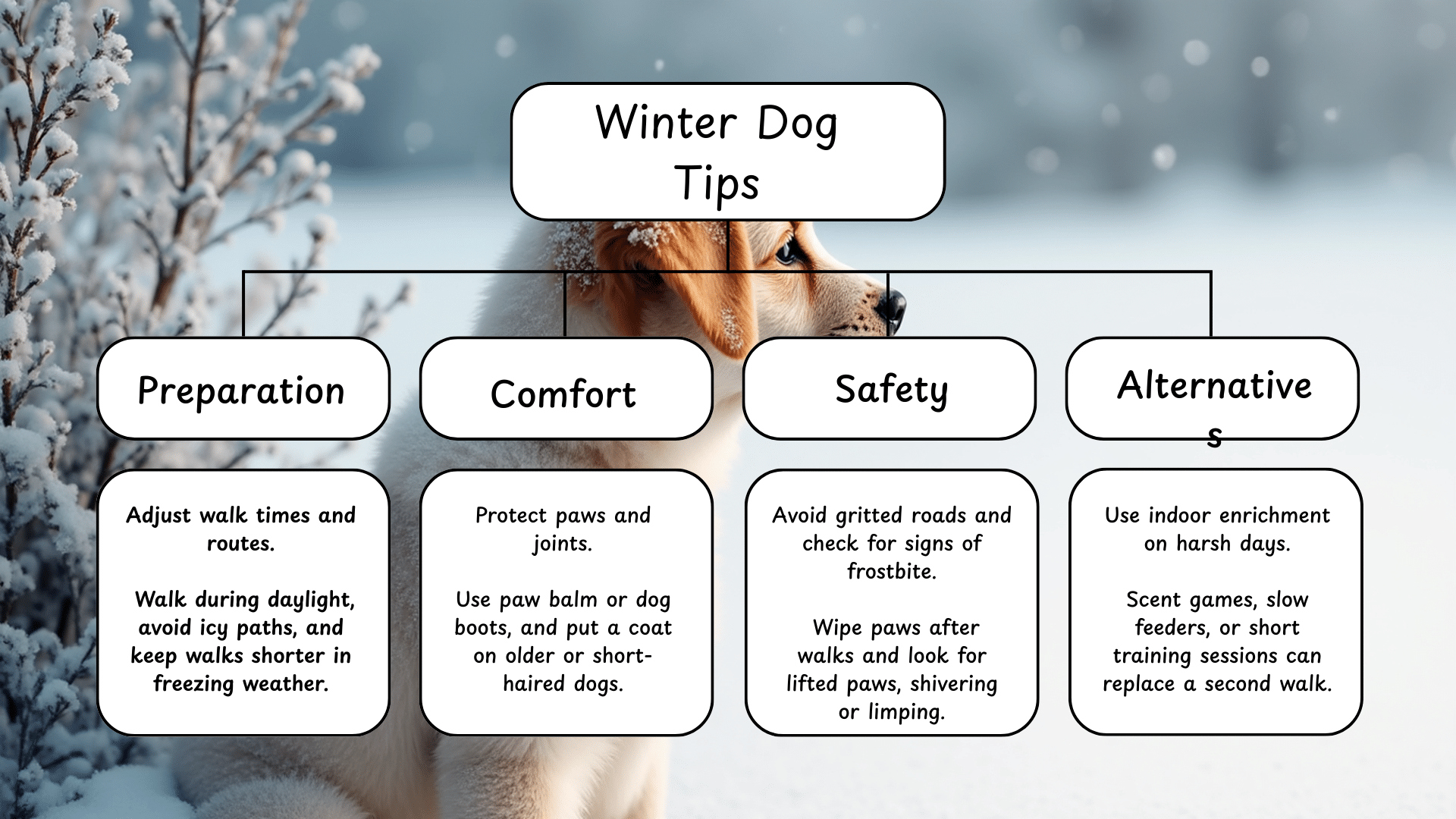
For detailed advice about grit, road salt, ice between the toes and winter paw care, see my Winter Dog Care guide.
Also, the PDSA have a very good winter dog care guide
What about walking in snow?
Many dogs enjoy snow.
Others are unsure about it.
Snow changes how familiar places look, smell and feel. It can also hide kerbs, holes, broken glass, uneven ground, ice and other hazards.
If you walk in snow:
- consider keeping your dog on a lead where hazards may be hidden
- avoid deep snow if your dog is struggling through it
- keep away from frozen ponds and lakes
- check paws during and after the walk
- watch for signs your dog is becoming cold
- turn back if conditions are worsening
Do not assume that a dog racing around excitedly at the beginning of a snowy walk will want to stay outside for an hour.
Excitement and comfort are not always the same thing.
Dark winter walks need a different approach
For much of the UK winter, many owners have little choice but to walk before sunrise or after sunset.
Reduced visibility can make familiar routes harder.
Your dog may also react differently to:
- people wearing hoods
- umbrellas
- cyclists
- runners
- car headlights
- shadows
- people appearing suddenly
- other dogs that are difficult to see
- unfamiliar objects left on pavements
I favour familiar routes and good visibility where possible.
I also use a fixed-length lead rather than a retractable lead. In darkness, near roads or on slippery surfaces, I want reliable control without metres of thin line between me and the dog.
Reflective equipment and a torch or head torch can help you be seen, but equipment cannot make an unsuitable route safe.
For more detail, read my Nighttime Dog Walking guide.
Rain and wind can matter as much as temperature
Winter walking in Finchley is often less about deep snow and more about cold rain, mud and wind.
A wet dog may become uncomfortable much sooner than they would on a dry winter day.
Strong wind can also make walks more difficult for some dogs.
Wind changes the environment.
Branches move.
Bins rattle.
Objects blow across pavements.
Smells move differently.
There may be sudden noises.
For a confident dog, that might not matter much.
For a nervous dog, it can make an otherwise familiar route much harder.
If rain, wind or storms are the main problem, see my Walk Your Dog in the Rain: Puddles, Wind and Thunder guide.
Nervous and rescue dogs may find winter walks harder
Winter changes more than the weather.
Darkness, umbrellas, hoods, bulky coats, wind, Christmas decorations and changed walking times can make familiar streets feel very different.
Some nervous or rescue dogs become:
- more watchful
- easier to startle
- reluctant to leave home
- quicker to react
- worried by unfamiliar shapes
- less able to concentrate
- more interested in getting home
That does not automatically mean their training has gone backwards.
The environment may simply have become more difficult.
One of the rescue dogs I have walked can cope confidently with familiar routes during brighter months but becomes more watchful when winter changes the environment.
My response is not to force him through it.
I can choose a quieter route, create more distance from triggers, slow the walk down and return home before he becomes overwhelmed.
Sometimes less pressure produces a better walk.
If your dog regularly finds everyday walks difficult, my Rescue Dog Support in Finchley service provides calm one-to-one support for nervous, rescue and reactive dogs.
What about senior dogs?
An older dog may need their winter routine adjusted even if they happily completed the same walks a few years ago.
You may notice:
- stiffness
- slower movement
- hesitation on slippery surfaces
- difficulty getting up
- reluctance to go as far
- taking longer to recover afterwards
- becoming cold more easily
- wanting to return home sooner
One senior terrier I have walked copes better with a shorter winter outing, followed by a little scent work at home, than with pushing on with a longer route.
The important point is not the exact number of minutes.
It is that his routine can change as needed.
Do not automatically assume new stiffness or reduced mobility is simply old age. A noticeable change in movement, behaviour or willingness to exercise is worth discussing with your vet.
Puppies and winter walks
Puppies may become cold or tired more quickly than adult dogs.
Winter also introduces lots of unusual experiences:
- darkness
- umbrellas
- hats and hoods
- strong wind
- snow
- ice
- Christmas decorations
- people carrying unusual objects
Keep outings appropriate for the individual puppy.
A puppy does not need to complete a long winter walk simply because an adult dog could.
Short, positive experiences can be more useful than staying outside until the puppy is tired, cold or overwhelmed.
Do dogs need winter coats for walks?
Some do.
Others do not.
Short-coated, lean, small, elderly, young, or unwell dogs may benefit from extra protection, while many healthy dogs with suitable coats stay comfortable without it.
Rather than duplicating the subject here, I cover coat choice and fit in my Winter Dog Care guide and Does My Dog Need a Winter Jacket? guide.
Whatever your dog wears should fit properly and allow normal movement.
What should I do after a wet winter walk?
Once home:
- Remove wet coats and walking equipment.
- Towel-dry your dog.
- Check their paws.
- Remove visible grit or debris.
- Rinse paws with plain water if necessary.
- Dry between the toes.
- Give your dog a warm, dry place to settle.
- Allow wet equipment to dry properly before using it again.
If your dog has painful, bleeding or persistently irritated paws, seek veterinary advice.
What if the walk needs to be shorter?
A shorter walk does not automatically mean your dog has missed out.
Depending on the individual dog, you can use some of the remaining time for:
- sniffing
- a simple scent search
- scatter feeding part of their normal food
- short reward-based training
- a familiar food toy
- gentle play
- calm companionship
- rest
You do not need to replace every missed minute of walking with frantic indoor entertainment.
Some dogs need enrichment.
Some dogs need rest.
Many need a sensible balance of both.
My Dog Enrichment Ideas That Actually Help Calm and Tire Your Dog guide has practical ideas for adapting activity to the individual dog.
How I adapt professional winter walks in Finchley
One-to-one walking makes winter decisions much easier.
I am not trying to make a group of unrelated dogs complete the same route at the same pace.
I collect your dog from home and walk locally.
There are no vans, collection rounds or pressure to travel somewhere else simply to complete a walk.
Depending on the dog and conditions, I may:
- change the route
- choose flatter ground
- avoid icy paths
- stay closer to home
- slow the pace
- allow more sniffing
- create more distance from triggers
- shorten the outdoor part of the visit
- towel-dry your dog afterwards
- provide agreed calm enrichment
- recommend changing the arrangement if conditions are unsafe
That flexibility is particularly useful for nervous dogs, senior dogs and dogs whose needs change from one day to the next.
The walk should fit the dog.
The dog should not have to fit the walk.
You can read more about my Solo Dog Walks in Finchley and Muswell Hill.
My winter walk decision checklist
Before leaving home, I would ask:
Is my dog well enough for their normal walk?
If they are suddenly lame, unwell or behaving unusually, the weather may not be the real problem.
What are conditions actually like?
Look beyond the temperature.
Consider rain, wind, frost, ice, visibility and the ground underfoot.
Is our normal route sensible today?
If not, change it.
Is my dog comfortable once we are outside?
Watch their movement and body language.
Are conditions getting worse?
Do not be afraid to turn around.
Does my dog still want to continue?
If the answer is clearly no, listen.
Would a shorter walk plus enrichment or rest be better today?
Sometimes it will be.
Winter dog walking is not about sticking rigidly to a routine.
It is about making a sensible decision for the dog in front of you.
Frequently asked questions
Should I walk my dog every day in winter?
Most healthy dogs still benefit from regular exercise and opportunities to sniff and explore during winter. Adapt the length, route, and type of activity to the individual dog and conditions.
How cold is too cold to walk a dog?
No single temperature applies to every dog. Age, health, size, coat, mobility, wind, rain and how long the dog is outside all matter.
Is it safe to walk my dog when it is icy?
Sometimes, but you need to consider both your dog’s safety and your own. Choose flatter routes, avoid obviously icy areas, slow down and shorten or change the walk if necessary.
Should I walk my dog in snow?
Many dogs can enjoy walking in snow when conditions are suitable. Be aware that snow can hide hazards and ice, and keep dogs away from frozen water.
Is a shorter winter walk enough?
It can be. A shorter, comfortable walk with opportunities to sniff and explore may be much more useful than forcing a dog through a longer walk when they are cold, worried or struggling.
Why is my dog more reactive in winter?
Darkness, wind, changed routines, unfamiliar clothing and reduced visibility can make the environment harder for some dogs. Give your dog more space and consider quieter, more familiar routes.
Should my dog wear a coat?
Some dogs benefit from a properly fitted coat and others do not need one. Your dog’s coat, size, age, health and response to the weather all matter.
What should I do if the weather is too bad for a normal walk?
Prioritise safety. A toilet break, appropriate indoor enrichment and rest may be more sensible than insisting on the usual walk when conditions are unsafe.
Winter walks do not have to follow the normal routine
A winter walk does not have to cover the same distance, take the same amount of time or follow the same route as a summer walk.
Some days your dog may happily enjoy their normal outing.
Other days, ten minutes outside followed by warmth, sniffing, enrichment or rest may be the better choice.
Watch the weather, but more importantly, watch your dog.
Change the route when you need to.
Turn around when you need to.
And do not measure the success of a walk simply by how far you travelled.
After more than a decade of walking dogs professionally, I would rather bring a dog home early because conditions are not right than push them through a walk just to say we completed it.
Related winter and walking guides
Winter Dog Care: Cold Weather, Snow, Ice and Paw Safety
Walk Your Dog in the Rain: Puddles, Wind and Thunder
Dog Enrichment Ideas That Actually Help Calm and Tire Your Dog
Does My Dog Need a Winter Jacket?
What to wear in winter for dog walking
Seasonal Pet Safety in Finchley
Looking for one-to-one dog walking in Finchley?
I provide calm solo dog walks in Finchley, East Finchley, North Finchley, Finchley Central and Muswell Hill, subject to location and availability.
Walks start and finish at your dog’s home.
There are no group walks, vans or collection rounds.
For nervous, rescue or reactive dogs who need more planning and support, I also offer focused one-to-one rescue dog support.
Solo Dog Walks in Finchley and Muswell Hill
Rescue Dog Support in Finchley
Veterinary disclaimer
This guide provides general information about winter dog walking. It does not diagnose illness, pain or mobility problems and is not a substitute for veterinary advice.
If your dog develops new lameness, significant stiffness, breathing difficulties, unusual weakness, persistent pain or another concerning change, contact your veterinary practice.