
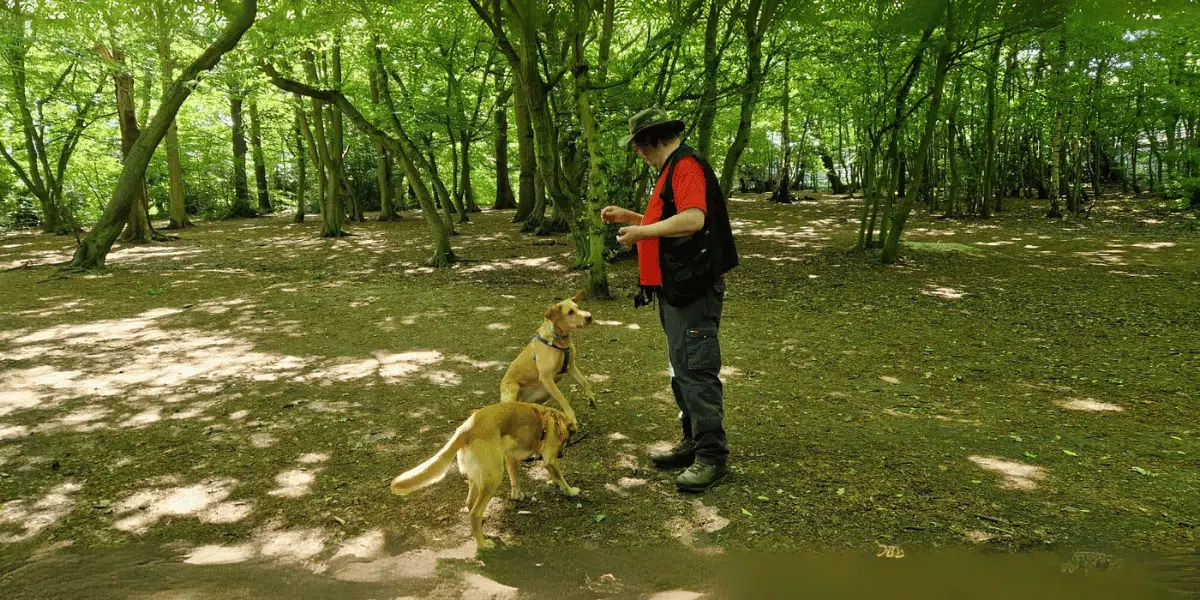
Training-Support Walks in Finchley
Helping your dog practise everyday skills during their one-to-one walk
Dog training doesn’t only happen during a training session.
The everyday walk gives your dog opportunities to practise checking in with you, walking on a loose lead, responding to familiar cues, coping with distractions and making good choices.
My training-support walks in Finchley combine the calm, one-to-one walks I already provide with consistent practice of appropriate skills your dog is learning.
This isn’t a replacement for working with a dog trainer or behaviourist, and it isn’t a service where I take your dog away and promise to return them “fully trained”.
Instead, I can help reinforce appropriate skills during your dog’s normal one-to-one walks.
If you want to learn and practise alongside your dog, see my One-to-One Dog Training Support in Finchley service.
In brief
- One dog or one household at a time
- Walks start and finish from your home
- No vans or group walks
- Reward-based, dog-centred approach
- Appropriate training practice incorporated into the walk
- Can complement work you’re already doing with a trainer or behaviourist
- Particularly useful for consistency between training sessions
- Sniffing, enrichment and opportunities to decompress remain part of the walk
- Clear referral to another professional where a dog’s needs fall outside my scope
What is a training-support walk?
A training-support walk is still a dog walk.
Your dog needs time to sniff, explore, go to the toilet, move their body, and enjoy being outside. I don’t turn the entire walk into a continuous obedience lesson.
Instead, I use appropriate moments during the walk to reinforce useful everyday skills.
Depending on your dog, that could include:
- Checking in voluntarily
- Responding to their name
- Loose-lead walking
- Recall foundations where appropriate
- Waiting and pausing
- Moving away from distractions
- Engagement with the person holding the lead
- Settling after something exciting
- Confidence around everyday environments
- Appropriate sniffing and enrichment
The exact balance depends on the individual dog.
Some dogs enjoy lots of little training games during a walk. Others need more opportunities to sniff, decompress and process what’s happening around them.
The aim is not to cram as many exercises as possible into an hour.
It’s to make everyday walks useful, enjoyable and appropriate for the dog in front of me.
Already working with a dog trainer or behaviourist?
Training-support walks can be particularly useful when your dog is already working with another professional.
Perhaps you’ve attended puppy classes.
Maybe you’ve had a one-to-one session with a trainer.
Or perhaps your behaviourist has given you particular exercises or management strategies to follow.
With your agreement, I’m happy to reinforce appropriate exercises during your dog’s walks.
My role isn’t to replace your trainer’s programme with another.
It is to provide consistency and supported practice where that is appropriate.
If necessary, you’re welcome to show me the exercises or written programme you’ve been given. With your permission, I’m also happy to work from instructions supplied by your trainer or behaviourist.
That can help keep everybody working towards the same goal.
Your trainer teaches you what to work on. I can help your dog practise appropriate elements of it during their everyday walks.
Training-support walks aren’t the same as one-to-one training support
This distinction is important.
Training-Support Walk
A training-support walk is primarily me and your dog.
I collect your dog from home, take them for their usual walk, and incorporate appropriate training into it.
It’s particularly useful for dogs who benefit from consistency during the week.
One-to-One Dog Training Support
My One-to-One Dog Training Support in Finchley is primarily you, your dog, and me working together.
Those sessions can use a private venue in N6, close to the East Finchley/Highgate boundary, with an indoor hall, an enclosed garden, and a small woodland area.
The emphasis is on helping you understand and practise the skills so that you can continue working with your dog yourself.
If you’re struggling with recall, loose-lead walking, puppy foundations, engagement, or confidence and want me to work alongside you, the one-to-one training support service is probably the better starting point.
Why consistency matters
Dogs don’t necessarily understand that something they’ve learned in one place also applies everywhere else.
Your dog might walk beautifully beside you in the garden but pull towards the park.
Recall might be excellent in the house but much harder when an interesting smell appears.
That’s why practising appropriate skills in everyday environments can be valuable.
Your dog’s normal walk gives us opportunities to reinforce familiar behaviours in response to the sorts of distractions they encounter in real life.
It doesn’t mean continually making things harder.
Good training often means arranging situations where the dog has a reasonable chance of succeeding.
You can find more practical guidance in my Dog Training Hub..
Loose-lead walking during everyday walks
Loose-lead walking is one of the most common things owners ask about.
I don’t expect a dog to spend an entire walk marching beside my leg.
Dogs need opportunities to sniff and investigate their surroundings.
Instead, loose-lead work is about helping the dog learn to move through the environment without continually pulling on the end of the lead.
That might involve rewarding check-ins, changing direction, allowing appropriate sniffing opportunities and adjusting the environment when something is simply too difficult.
Read my Loose-Lead Walking Guide for more about my approach.
If you would like to practise loose-lead skills with someone alongside you, my one-to-one training support sessions are the more appropriate option.
Recall and long-line practice
Recall isn’t just about repeatedly shouting a dog’s name and hoping they come back.
Good recall begins with engagement, reinforcement and gradually practising around appropriate levels of distraction.
Where suitable and agreed with you, recall foundations can form part of a training-support walk.
A long line may be used where appropriate.
I don’t remove a dog’s lead simply because we’re practising recall, and I won’t promise that any dog can be made to have a “100% guaranteed recall”.
The priority is always safe, progressive practice.
You can read more in my og Recall Training Guide..
Confidence-building on walks
Not every dog needs a faster or more exciting walk.
Some dogs need the opposite.
Shy, nervous and newly adopted dogs can benefit from predictable routines, space and opportunities to investigate the environment at their own pace.
For these dogs, a useful training-support walk might involve:
- Choosing a quieter route
- Allowing additional sniffing time
- Increasing distance from something worrying
- Rewarding voluntary engagement
- Building confidence around everyday sights and sounds
- Giving the dog opportunities to make appropriate choices
- Recognising when the environment is becoming too difficult
Progress isn’t always measured by how far we’ve walked.
Sometimes a shorter, calmer walk in which a nervous dog successfully processes something new is far more valuable than covering several miles.
Read more about my Rescue Dog Support in Finchley and Dog Behaviour and Body Language guides.
Sniffing and enrichment are part of the walk
Training support doesn’t mean removing everything your dog enjoys about walking.
Sniffing is important.
It allows dogs to gather information about their environment and can form part of a calm, enriching walk.
I use food rewards where appropriate, but food isn’t the only thing a dog may find rewarding.
For some dogs, being allowed to investigate an interesting smell can be valuable in itself.
The aim is to balance training practice with your dog’s need to explore and enjoy being outside.
You can find more ideas in my Dog Enrichment Guide.
What I don’t use
My approach is reward-based and dog-centred.
I don’t use equipment or methods designed to cause pain, fear or discomfort.
That includes:
- Prong collars
- Choke or check chains
- Electric collars
- Rattle bottles
- Physical intimidation
I prefer to look at why the behaviour is happening, what the dog is communicating and how we can help the dog make better choices.
You can read more about my experience, qualifications and continuing professional development on my Certificates and Qualifications page.
When a training-support walk isn’t enough
There is an important limit to what should be addressed during an ordinary dog walk.
A training-support walk isn’t a substitute for specialist behavioural assessment.
If your dog has a significant bite history, serious aggression, severe resource guarding, severe separation-related problems or behaviour that could have an underlying medical cause, I may recommend that you speak to your vet or an appropriately qualified professional before I work with your dog.
Similarly, if something happens during our ongoing walks that makes me think your dog needs additional professional assessment, I’ll tell you.
The Animal Behaviour and Training Council provides information about recognised practitioner roles and finding appropriately qualified professionals.
I’d rather help you find the right support than attempt something outside my professional scope.
Do I need a training-support walk or a one-to-one session?
If you mainly want consistent practice incorporated into your dog’s normal solo walk, a training-support walk may be appropriate.
If you want to:
- Learn how to work with your dog yourself
- Improve your handling skills
- Practise recall together
- Work on loose-lead walking together
- Get help with a new puppy
- Build your dog’s confidence
- Understand your dog’s body language
- Practise a programme you’ve been given by your trainer or behaviourist
Then start with One-to-One Dog Training Support in Finchley.
The initial session lasts 75 minutes and costs £60.
Frequently asked questions
Will you train my dog for me?
Training practice can be incorporated into your dog’s walk, but I don’t offer a service where a dog is taken away and returned “fully trained”.
Dogs live with their owners, so owner involvement and consistency remain important.
If you want to learn and practise alongside your dog, choose my One-to-One Dog Training Support.
Can you follow exercises from my existing trainer?
Yes, where they’re appropriate for the walk and consistent with the reward-based methods I use.
You’re welcome to show me the exercises or programme you’ve been given.
Will the whole walk be training?
No.
Your dog still needs opportunities to sniff, explore, toilet and enjoy their walk.
Training practice is incorporated naturally where appropriate.
Can you work on recall?
Recall foundations can be practised where it is safe and appropriate.
That may include engagement exercises and long-line work rather than simply letting a dog off lead.
Can you help a nervous rescue dog?
Potentially, yes.
I’ve worked with many shy, nervous and rescue dogs over the years.
I’ll consider the individual dog and what they need. If I believe specialist behavioural support is required, I’ll tell you.
Do you use punishment-based training?
No.
My approach is reward-based and dog-centred. I don’t use prong collars, choke chains, electric collars or intimidation.
Practical training support for everyday life
The aim of a training-support walk isn’t to produce a perfectly obedient dog.
It’s to make good use of the time I already spend with your dog.
A walk can provide exercise, sniffing, enrichment and enjoyment while also giving your dog opportunities to practise useful everyday skills.
And when you need to be involved too, we can move from dog-only walks to One-to-One Dog Training Support in Finchley..
That gives us a simple distinction:
Training-support walks: I help your dog practise.
One-to-one training support: I help you and your dog practise together.
Contact Finchley Dog Walker to tell me a little about your dog and what you’d like help with.
Established 2011 | One dog or household at a time | Reward-based support | Ofqual Level 3 Canine First Aid
