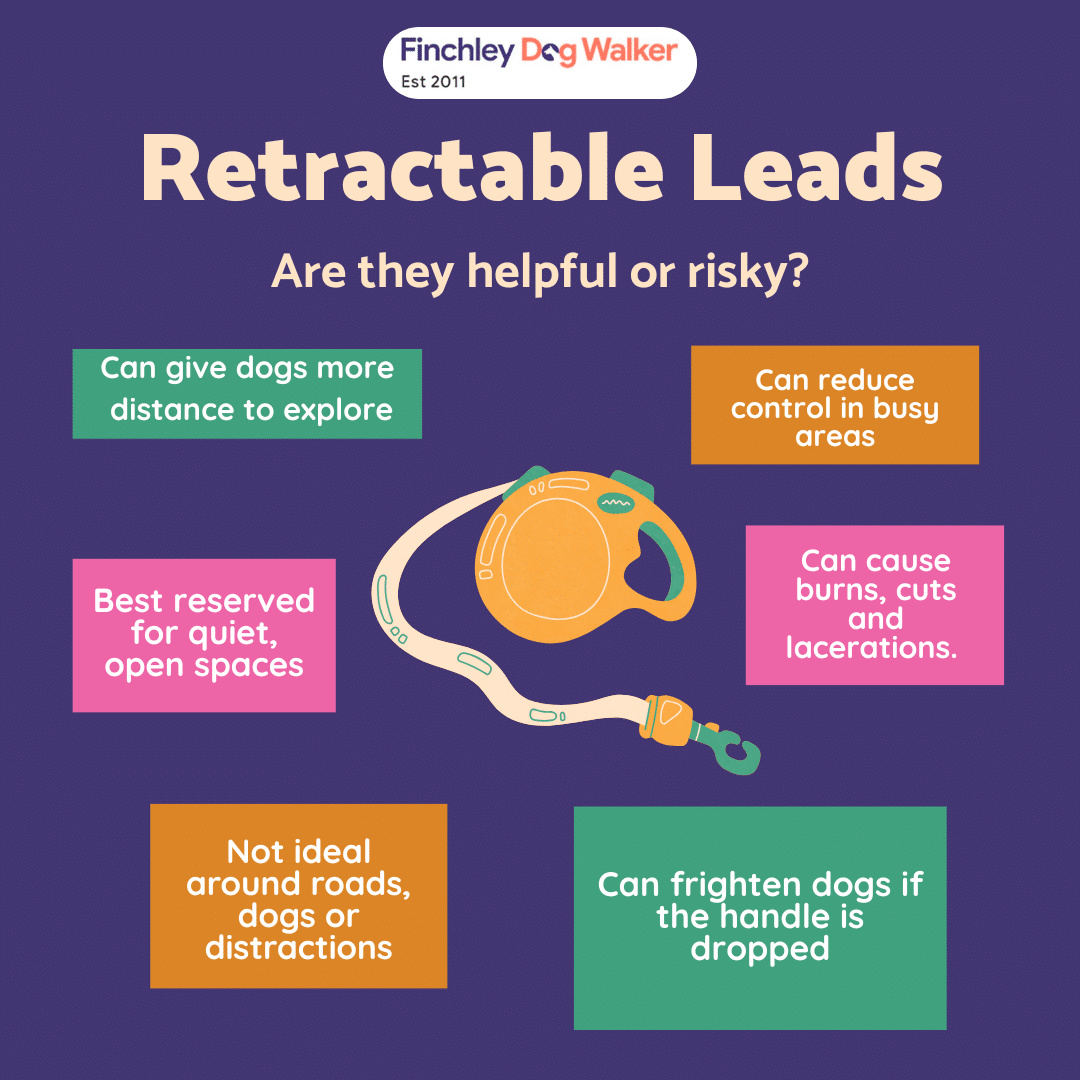
Retractable Dog Leads – Good or Bad?

Retractable Dog Leads

Most dog owners I meet didn’t choose a retractable lead because they wanted to take risks.
They chose it because it looked practical.

More freedom for the dog.
Less pulling on the arm.
An easier walk.

I understand that thinking. I hear it often on doorsteps and at the park gates. And on paper, retractable dog leads safety sounds like a simple question with a simple answer.

In real life, it is rarely that straightforward.

I work with dogs every day. Different sizes. Different temperaments. Calm dogs. Nervous dogs. Young dogs learning the world. Older dogs whose bodies need protecting. I also work around other people, children, cyclists, runners, and dogs who are not always friendly.

Over time, patterns appear.

Retractable leads are involved in more near misses, more injuries, and more stressful moments than almost any other piece of walking equipment I see. Not because owners are careless. But the design creates problems that most people do not expect until something goes wrong.

If you use one, or you are thinking about it, this article is not about judgment. It is about clarity. I want you to understand what these leads actually do in real walking situations, how they affect your dog’s body and behaviour, and what safer alternatives look like.

I will talk honestly about the risks of retractable dog leads.
I will explain where injuries occur in both dogs and people.
I will help you decide what works best for your dog, not what looks easiest in the shop.

You know your dog better than anyone. My job is to help you make choices that keep them safe and relaxed on every walk.

Why retractable leads cause more trouble than people expect

Retractable leads promise freedom.
What they often deliver is uncertainty.

The long cord, the constant tension, and the delayed response time change how dogs move and how we react. That combination creates risk, especially in everyday environments like pavements, parks, and shared paths.

I see problems most often when owners assume they still have control. Technically, the dog is attached. Practically, they are metres away and moving at speed.

Small moments matter on walks.
Seconds matter.

They can hurt your dog’s neck and back

When a dog hits the end of a retractable lead, the stop is sudden. There is no warning. No gradual pressure. Just force.

I see this most with dogs who pull, lunge, or accelerate quickly when they spot something exciting or worrying.

That force goes straight through the neck, throat, and spine.

Over time, this can contribute to:

  • Sore necks and shoulders
  • Strain through the back
  • Damage to the windpipe
  • Increased tension in dogs already prone to pulling

This is one of the most common retractable lead injuries I hear vets and physios talk about. The The Kennel Club and Dogs Trust both highlight the importance of avoiding sudden pressure on the neck, especially for dogs that pull or react.

If your dog wears a collar, the risk increases.

Ask yourself:

  • Does my dog ever hit the end of the lead at speed
  • Do they lunge towards dogs, birds, or smells
  • Do they already have stiffness or soreness

If the answer is yes, their body is taking repeated impact, you may not see it straight away.

They let your dog get into other dogs’ spaces

This is one of the biggest real-world problems I deal with.

Retractable leads allow dogs to drift forward. Sniffing. Wandering. Approaching. Often, without the owner noticing until it is too late.

Even friendly dogs can make others uncomfortable.

Some dogs are:

  • Nervous
  • Reactive
  • Recovering from injury
  • In training
  • Simply not interested in social contact

When a dog suddenly appears within their space, reactions happen quickly. Barking. Lunging. Panic. Fear.

I have seen calm walks unravel in seconds because a dog on a retractable lead reached another dog’s face before either owner could react.

This is one of the most common retractable lead hazards for dogs, not because dogs are bad, but because the distance removes clear communication and control.

A shorter, fixed lead makes your intentions clear.
It shows other owners that you are managing your dog.

You lose control when it matters most

With a standard lead, your dog stays close.
With a retractable one, they can be several metres away.

That distance matters when something unexpected happens.

I see problems when:

  • A dog runs out of a driveway
  • A child darts past on a scooter
  • A cyclist appears silently
  • A cat bolts across the pavement
  • A loud noise startles your dog

You cannot reel in fast enough.
The braking mechanism takes time.
Your dog is already committed to the movement.

I have seen dogs pulled into the roads.

Retractable lead pros and cons often focus on freedom, but control is what keeps dogs safe in unpredictable environments.1

They can hurt people, too

This is rarely talked about, but it matters.

The thin cord can cause serious dog lead friction burns.
It wraps easily around fingers, wrists, ankles, and legs.

I have seen:

  • Burned hands
  • Cut skin
  • Falls caused by sudden stops
  • Dogs tangled and panicked

Bulky retractable handles also make it harder to respond quickly. You cannot shorten the lead instantly without pressing buttons, adjusting the grip, and hoping the mechanism works smoothly.

In busy areas, this turns a simple walk into a risk for everyone around you.

The RSPCA has repeatedly advised caution with retractable leads due to the risk of injury to both dogs and handlers.

Behavioural impact you may not notice at first

Retractable leads change how dogs experience the world.

They learn that:

  • Pulling works
  • Pressure is constant
  • Distance from you is normal

This can make loose lead walking harder, not easier.

I often meet dogs who feel anxious when brought closer because they are used to roaming ahead. The lead becomes a source of frustration rather than guidance.

If you are working on training, confidence building, or calm walking, this matters.

Ask yourself:

  • Does my dog check in with me on walks
  • Do they respond quickly when I call
  • Do they walk calmly beside me when needed

If not, the equipment may be working against you.

Long line vs retractable lead

This is where many owners get surprised.

If your goal is freedom, exploration, or recall training, a long line is often the best option for retractable dog lead alternatives.

A long line offers:

  • Predictable length
  • No sudden stop
  • Clear handling
  • Better feedback for your dog

Long line leads allow you to

Choose the environment.
Manage the distance.
Step on it if needed.

I use long lines regularly for training walks. They give dogs space without sacrificing safety.

Long line vs retractable lead is not about restriction. It is about clarity.

When people think that retractable leads help with anxiety

Some owners use retractable leads because they think distance helps anxious dogs. Sometimes, the opposite is true.

An anxious dog far from you has less support.
They feel pressure but not guidance.
They are left to manage situations alone.

I often see anxious dogs settle more when they are closer, with a clear, calm handler and predictable movement.

If your dog is worried, reactive, or easily overwhelmed, structure usually helps more than freedom.

Situations where retractable leads are especially risky

From experience, I avoid them completely in:

  • Busy pavements
  • Shared paths
  • Parks with off-lead dogs
  • Near roads
  • During training sessions

The risks of retractable dog leads increase as distractions increase.

Quiet, open spaces do not stay quiet forever.

Safer alternatives I recommend

There is no one-size-fits-all solution. But there are safer patterns.

I usually suggest:

  • A fixed-length lead for everyday walks
  • A well-fitted harness if your dog pulls
  • A long line for training and exploration

The best alternative to retractable dog lead use depends on your dog’s size, strength, and behaviour, but predictability always wins.

Yappily, and many UK professionals now recommend fixed leads and long lines for safety and training consistency.

What I see change when owners switch

When owners move away from retractable leads, I often see:

  • Calmer walks
  • Better communication
  • Fewer surprises
  • Less tension on the lead
  • More confidence in both dog and owner

Walks become shared, not negotiated.

Frequently asked questions

Are retractable dog leads ever safe

They can be used with caution in quiet, open areas with excellent recall. Even then, I rarely recommend them because risks appear quickly when the environment changes.

Do retractable leads cause behaviour problems?

They can contribute to pulling, frustration, and poor lead manners by rewarding tension and distance.

Are they better for small dogs?

Size does not remove risk. Small dogs can still hit the end at speed and suffer neck injuries.

What should I use instead?

A fixed lead for everyday walks and a long line for training or open spaces is usually safer and clearer for most dogs.

Final thoughts

Retractable dog leads safety is not about fear. It is about understanding how equipment shapes behaviour, movement, and reactions.

Most problems I see are not dramatic. They are small moments that stack up. A sudden stop. A near miss. A startled dog. A shaken owner.

You deserve walks that feel calm and predictable.
Your dog deserves equipment that protects their body and supports their behaviour.

If you are unsure what works best for your dog, I am always happy to talk it through during walks, training sessions, or home visits. Small changes often make the biggest difference.

At the end of this page, you will find links to related articles and services that may help you choose safer walking options.

Disclaimer

This article is for general guidance only and does not replace advice from your vet or a qualified behaviour professional. If you have concerns about your dog’s health or behaviour, speak to a professional who knows your dog.

Key Takeaways

  • Retractable dog leads may seem practical, but they often pose risks such as injuries and loss of control.
  • When dogs suddenly hit the end of a retractable lead, it can cause harm to their necks and backs.
  • These leads can allow dogs to invade others’ spaces, leading to conflicts and misunderstandings with other pets.
  • Retractable dog leads can also cause injuries to people, such as friction burns and falls, due to their thin cords.
  • Safer alternatives include fixed-length leads for walks and long lines for training, offering better safety and control.

    Other blog posts you may like