

House Sitting for Rescue Dogs in Finchley
Calm, familiar care for rescue dogs who are happier staying at home
Finding the right holiday care for a rescue dog is not always straightforward.
You may have spent months helping your dog settle.
You know their routines.
You know which noises make them look up.
You know which dogs they prefer to avoid and which walking routes they feel more comfortable on.
Then you need to go away.
For some rescue dogs, moving to kennels or somebody else’s home is simply another change to process.
House sitting gives them another option.
Your dog stays in their own home, sleeps in their usual place and keeps as much of their normal routine as practical.
I stay overnight and provide calm, one-to-one care built around the dog in front of me.
No vans.
No group walks.
No changing carers.
Just familiar surroundings and one consistent person caring for your dog.
Read about my main house and pet sitting service.
I have professionally cared for dogs since 2011 and regularly work with rescue, nervous and reactive dogs. This page is general information about my pet care service. I am not a veterinary surgeon or a clinical animal behaviourist, and house-sitting is not a replacement for veterinary or behavioural support when needed.
Why can house sitting suit a rescue dog?
Every rescue dog is different.
Some arrive in their new home and appear to take everything in their stride.
Others need more time.
Even when a rescue dog is doing well, they may still rely heavily on familiar routines and surroundings.
They know:
- where they sleep
- when food normally appears
- the sounds of their home
- where the water bowl is
- their usual toilet routine
- familiar local walks
- where they go when they need space
When you go away, your absence is already a change.
House sitting means we do not necessarily need to change the dog’s home, sleeping area and walking neighbourhood at the same time.
The RSPCA’s guidance on leaving pets while you are away says that having someone care for a pet in their own home is usually best, as it helps keep things as familiar as possible.
That is also how I approach house sitting.
I cannot promise that your dog will not notice you are away.
Of course they will.
I aim to keep the rest of their world as calm and predictable as I reasonably can.
House sitting built around your rescue dog
I do not have a standard routine that every dog has to fit into.
I start with your dog’s normal life.
What time do they usually eat?
Where do they sleep?
Do they like an early walk, or do they need time to wake up?
Which routes work well?
Are there particular roads, dogs or situations you normally avoid?
Does your dog want company in the evening or prefer to disappear to their bed?
Are there parts of their body they dislike being touched?
Do they need medication?
What happens when the doorbell rings?
These details matter.
Particularly with a nervous or rescue dog.
My house-sitting service is based on keeping your dog’s routine familiar while providing calm, one-to-one care.
See how I support rescue dogs in Finchley
What my rescue dog house sitting includes
House sitting means I stay overnight at your home and care for your pets.
Care is agreed around your dog’s individual needs and normally includes:
- feeding according to your instructions
- fresh water
- local walks suited to your dog
- toilet breaks
- medication where agreed in advance
- calm companionship
- indoor enrichment where appropriate
- following your dog’s normal evening routine
- an overnight presence
- morning care
- photo or video updates
- general welfare monitoring
I also deal with simple household tasks while I am there.
These may include:
- bringing in post
- putting bins out or bringing them back
- switching lights on or off
- basic security checks
- watering agreed plants in pots with saucers
My priority is always the animals in my care.
Longer or additional household jobs may need to be booked separately.
You can see my pet care add-ons and additional services for more information.
No vans and no group walks
My normal dog walking service is one-to-one and on foot from your home.
I keep the same basic approach when house sitting.
I do not collect your rescue dog in a van and take them out with a group of unfamiliar dogs.
Walks start from home.
For a dog who already has familiar local routes, that can be useful.
I may use the walks you normally take.
I may suggest a slight change in timing if a route is particularly busy.
With dogs I know well, I also learn which corners, paths and green spaces tend to work for them.
The aim is not to cram as much exercise as possible into the day.
It is to give your dog suitable walks while keeping their overall welfare in mind.
Read about my calm one-to-one dog walks
What about nervous or sensitive rescue dogs?
A dog does not need to be barking, lunging or hiding under the table to find change difficult.
Sometimes the signs are much quieter.
A nervous dog may:
- eat less
- pace
- pant
- follow people constantly
- become unusually still
- struggle to sleep
- scan their surroundings
- become more alert to noises
- avoid interaction
- react more quickly on walks
You know what is normal for your dog.
That information helps me.
I do not expect a nervous rescue dog to love me instantly.
I do not force greetings.
I do not insist on fuss.
I do not keep calling a dog towards me to make them friendly.
Some dogs need time.
That is fine.
My job is to listen to what the dog is communicating and work at a sensible pace.
My guide to helping a nervous dog settle at home explains more about the calm approach I use.
Trust may take time
One of the best examples of this is Rudy.
When I first met Rudy, he barked at me and did not want to come near me while I spoke to his owners.
Our first walk was hardly a walk.
We went to the corner.
That was enough.
I did not need to drag him around Finchley to prove I had completed a walk.
Over time, Rudy learnt about me, and I learnt about him.
We built trust.
Now he goes completely crazy when he sees me and loves his walks in Coldfall Wood.
We have the Magic Tree, where I hide treats for him to find.
Sometimes it is easy kibble.
Sometimes I make it harder by using a higher-value treat, such as a sprat.
Even the crows have learnt our routine and occasionally join us.
Rudy did not become confident because I pushed him.
Trust grew because we had time and consistency.
That same patience matters when I house sit for a rescue dog.
Meeting your dog before you go away
I would not want my first proper interaction with a nervous rescue dog to be you closing the front door with a suitcase in your hand.
A meet and greet is important.
We meet at your home.
Your dog can see me in their own environment.
For some dogs, that means coming over for a sniff.
For others, it means watching me from the other side of the room.
Both are useful information.
We can talk about:
- your dog’s normal routine
- rescue background, where known
- feeding
- walks
- triggers
- reactions to other dogs
- reactions to unfamiliar people
- separation issues
- medication
- handling
- sleep
- guarding concerns
- escape risk
- vet information
- emergency contacts
Please be honest.
I am not judging your dog.
Telling me that your dog has snapped, guarded food, escaped from a harness, or reacted strongly to another dog does not automatically mean I will refuse to provide care.
Hiding it could put your dog or somebody else at risk.
I would always rather know.
Rescue dogs who need space
Some rescue dogs are happiest when people leave them alone.
That can feel strange when you have booked a pet sitter.
You might imagine I would spend the evening cuddling your dog on the sofa.
Your dog might have other ideas.
They may want to lie in another room.
They may prefer their usual bed.
They may watch me for a few days before choosing to sit closer.
I am comfortable with that.
Care is not measured by how many photographs I can take of myself cuddling your dog.
Sometimes good care means creating enough safety and predictability for a dog to rest.
That may not make the most exciting social media photograph.
It matters more to me that the dog can settle.
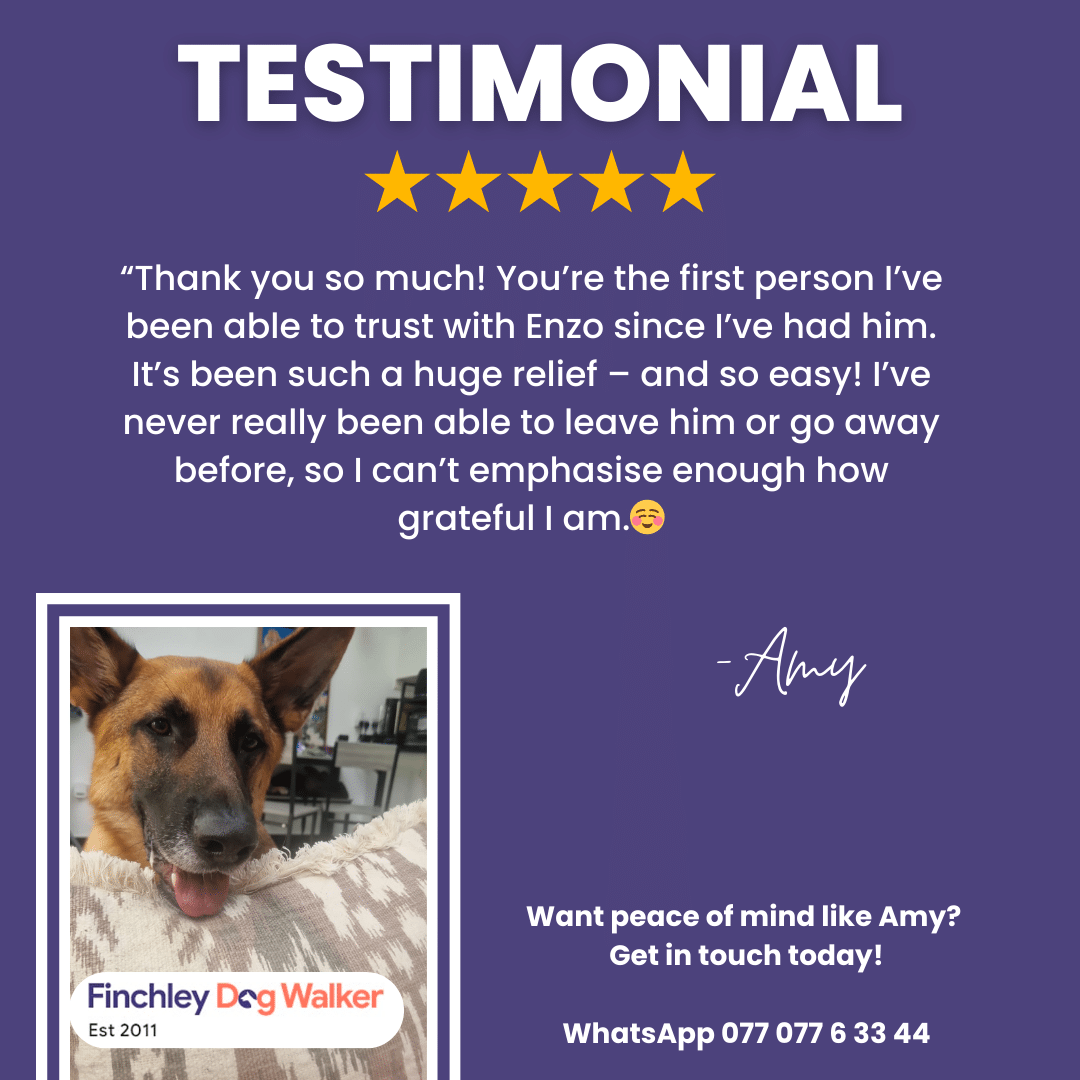
House sitting for reactive rescue dogs
Reactive dogs can find holidays particularly difficult to plan.
You may worry about somebody else walking them.
You know which dogs in the area are difficult.
You know the narrow paths you avoid.
You know when the park becomes busy.
You probably have a collection of small routines that make walks easier.
Tell me.
I regularly work one-to-one with reactive and nervous dogs.
That does not mean I promise to change your dog’s behaviour or replace their trainer or behaviourist.
During house sitting, my first priority is safe and consistent care.
Where a dog is already following a professional behaviour plan, I can discuss how to maintain their normal routine.
I use calm, reward-based methods.
I do not use prong collars, choke or check collars, shock collars, rattle bottles or other aversive tools.
I also do not use retractable leads.
You can read more about my reactive and nervous dog walking in Finchley.
What about a newly adopted rescue dog?
Newly adopted rescue dogs deserve particular thought.
You may still be learning who your dog is.
The first few weeks do not always tell you everything.
As a dog becomes more comfortable, you may begin to see different behaviour.
That is not necessarily the dog getting worse.
You may simply be learning more about them.
Before arranging house sitting, tell me how long your dog has been with you and what you know about their history.
Think about:
- how they react to visitors
- whether they can settle with another person
- whether they guard the home
- how they cope when you leave
- whether they are an escape risk
- their walking behaviour
- handling sensitivities
House-sitting may eliminate the need to move your new dog to a different environment.
However, the dog still needs to cope with a different person being in their home.
This is why I look at the individual dog rather than saying house sitting is automatically right for every rescue.
My Rescue Dog Help in Finchley guide hub has more practical help for the early stages of life with a rescue dog.
House sitting or boarding?
This page is about house-sitting, but I am not going to tell you that boarding is bad.
Some rescue dogs are confident, social and adaptable.
They may cope perfectly well in a suitable boarding environment.
Other dogs depend much more heavily on routine or find unfamiliar dogs, sounds and surroundings difficult.
The question is not which service is universally best.
The question is which setup suits your dog.
I have written a separate guide comparing house sitting vs boarding for rescue dogs.
Read that if you are still deciding.
A typical house sitting booking
Every dog and household is different, but the process normally looks like this.
Step 1: You contact me
Tell me about your dog and the dates you need.
For a rescue dog, it helps if you briefly explain why you think house sitting will suit them.
You can contact me here.
Step 2: We arrange a meet and greet
I meet you and your dog at home.
This gives us a chance to talk properly and lets your dog see me.
There is no expectation that a nervous dog will become my best friend in one meeting.
Step 3: We discuss the routine
You explain how your dog’s day normally works.
The boring details are often useful.
Where is the lead kept?
Which bowl do they use?
Does the dog refuse breakfast unless you have been for a walk?
Do they bark at the fox at 2 am?
Where do you normally put the poo bags?
Tell me.
The more I understand, the easier it is to keep things familiar.
Step 4: We confirm the booking
We agree the dates and care arrangements.
I need suitable emergency contact and veterinary information.
You should also make sure I have clear access instructions.
My homeowner’s pet sitter checklist can help you prepare.
Step 5: I care for your dog at home
I arrive as agreed and follow the care plan.
You receive updates so you know how things are going.
If something concerns me, I tell you.
I do not think owners need every tiny detail made dramatic.
But I also do not hide welfare concerns just to send a cheerful photograph.
I will always try to be honest with you.
What does a normal day look like?
There is no single Finchley Dog Walker timetable for house sitting.
That would defeat the point.
Your dog’s day is based on their normal routine and the care we have agreed.
For one dog, the morning might start early with a quiet toilet walk before North Finchley becomes busy.
Another dog may prefer breakfast first and refuse to consider going anywhere until they are properly awake.
A senior rescue dog may need a slower sniff walk.
A reactive dog may benefit from a quieter route.
Another dog may want more enrichment at home.
During hot weather, walks may also need to be shortened, moved or replaced with safer home-based care under my extreme weather policy.
I do not promise to follow a written timetable blindly if I have a genuine welfare concern.
Your dog’s safety comes first.
House sitting for homes with more than one pet
House sitting can also be useful when your rescue dog shares their home with other pets.
You may have:
- a dog and cat
- several dogs
- cats
- rabbits
- guinea pigs
- other small pets
Moving every pet into separate holiday care can become complicated.
Staying at home allows me to care for the household in a familiar environment.
I provide cat sitting and cat care in your own home and small animal care as part of my wider pet care services.
We will discuss each animal’s needs before the booking.
Medication and additional care
I can give agreed medication as part of a normal care routine where I am comfortable and competent to do so.
Please give me clear instructions.
Medication should be properly labelled.
I also need to know why your pet takes it and what I should do if a dose is missed, refused or vomited.
Some medical conditions require specialist or veterinary care.
I will be honest if your dog’s needs are outside the care I can safely provide.
That is not a criticism of your dog.
It is part of responsible pet care.
Areas I cover for rescue dog house sitting
I am based in Finchley and provide house sitting in selected parts of North London.
This includes:
- Finchley
- North Finchley
- East Finchley
- Muswell Hill
I also consider house-sitting bookings in:
- Whetstone
- Highgate
Whetstone and Highgate are house-sitting areas rather than regular dog-walking areas.
Because I stay in your home, location and travel arrangements need to work alongside my existing pet care commitments.
Please check my service area or contact me with your postcode.
Why choose me to house sit your rescue dog?
I have professionally cared for dogs since 2011.
My own rescue dog, Roxy, played a huge part in shaping Finchley Dog Walker.
She was awkward but awesome.
Living with her taught me that the dog who needs a little more patience can also be the dog who teaches you the most.
My experience and training include:
- canine first aid
- canine body language
- working with reactive and nervous dogs
- Tellington TTouch learning
- reward-based and game-based approaches
I am fully insured, and Enhanced DBS checked through my Scouting role.
More importantly, I am honest about what I do.
I am not a clinical animal behaviourist.
I do not diagnose behaviour problems.
I do not promise quick fixes.
I provide calm, practical, experienced pet care.
For many rescue dog owners, that is exactly what they are looking for when they go away.
You can read more about Finchley Dog Walker and me.
Frequently asked questions
Is house sitting good for rescue dogs?
It can be a good option for rescue dogs who are more comfortable in familiar surroundings or find changes to routine difficult.
It is not automatically the right option for every rescue dog.
Your dog still needs to cope with a sitter in their home.
I look at the individual dog.
Will you meet my rescue dog before I go away?
Yes.
A meet-and-greet is an important part of the process.
For nervous dogs, additional familiarisation may sometimes be sensible and can be discussed individually.
What if my rescue dog barks at you?
Barking at the first meeting does not automatically worry me.
I look at the whole situation and the dog’s body language.
Please tell me about any known history of snapping, biting or guarding before we meet.
Do you force nervous dogs to interact?
No.
I do not believe a nervous dog needs to be forced into greeting or physical contact simply because I am the pet sitter.
Safety still matters, and there may be practical care tasks to handle.
We discuss those before you go away.
Do you walk reactive dogs?
Yes, where I believe I can safely meet the dog’s needs.
Walks are one-to-one and start from your home.
I need honest information about your dog’s triggers and previous behaviour.
Do you use my dog’s normal walking equipment?
Usually, yes, provided I believe it is suitable and safe.
I do not use retractable leads or aversive equipment such as prong, choke, check or shock collars.
I prefer a suitable harness or a soft flat collar, with appropriate fixed-length or long-line equipment where needed.
Do you stay in my home overnight?
Yes.
My house-sitting service provides live-in overnight care in your home.
The exact daytime arrangements and your dog’s needs are discussed before booking.
Are you in the house all day?
Not normally.
House sitting is not automatically continuous 24-hour care.
I have other commitments and may need to leave during the day.
How long your dog can comfortably and safely be left is something we discuss before accepting a booking.
Can you give my dog medication?
I can give agreed medication where I am comfortable and competent to do so.
Please provide clear instructions and properly labelled medication.
More complex medical care may need a veterinary professional or specialist pet sitter.
Can you house sit for a newly adopted rescue dog?
Possibly.
It depends on the dog, how recently they arrived and how they react to unfamiliar people in the home.
Contact me early so we can discuss the situation honestly.
How far in advance should I book?
As early as you can.
House sitting is one-to-one, and I can only stay overnight in one home.
School holidays, summer and popular travel dates can fill more quickly.
I do not use live online availability, so please contact me with your dates.
How much does rescue dog house sitting cost?
My current prices are shown on the Finchley Dog Walker prices page.
The price and care arrangements are confirmed before booking.
Is house sitting right for your rescue dog?
Perhaps.
I know that is not the most exciting sales answer.
But it is the honest one.
If your dog relies on familiar surroundings, needs a predictable routine or struggles in new environments, staying at home may be worth considering.
If your dog loves new places and happily settles elsewhere, another form of care may suit them perfectly well.
I am interested in what works for your dog.
Tell me about them.
Tell me what they find difficult.
Tell me what a normal day looks like.
Then we can have an honest conversation about whether my house-sitting service is a good fit.
Read about my house and pet sitting service
Compare house sitting and boarding for rescue dogs
