
This article on dog walking tips is brought to you by Finchley Dog Walker.
Updated July 2026
Most dog walks pass without a problem.
That does not mean we should leave safety to chance.
A worn lead clip, loose harness, approaching dog, discarded food, or sudden noise can turn an ordinary walk into a difficult situation very quickly.
I have provided professional dog walks in Finchley and nearby areas since 2011. The safety habits I rely on are usually simple. I check the equipment. I watch the dog. I pay attention to what is happening around us. I change the route when something does not feel right.
This guide brings those habits together.
It covers practical dog walking safety tips for before, during and after a walk. It is written for everyday dog owners, but many of the same checks should also form part of a professional dog walker’s routine.
This article provides general information. It is not a substitute for veterinary advice, an individual behaviour assessment or instructions from an emergency service.
Quick answer: how do you keep a dog safe on walks?
Before leaving home:
- check the lead, harness, collar and clips
- make sure your dog is wearing the required identification
- consider the weather, route and your dog’s health
- take poo bags, treats, water and your phone
- tell someone where you are going on longer or unfamiliar walks
During the walk:
- keep your dog on a suitable lead near roads
- stay aware of traffic, cyclists, dogs and people
- give other dogs space unless both handlers agree to a greeting
- only allow off-lead exercise where it is permitted and recall is reliable
- watch for scavenging, toxic substances and unsafe water
- change direction before a situation becomes difficult
After the walk:
- check paws, legs, ears, eyes and coat
- look for grass seeds, cuts, ticks and irritation
- offer fresh water and time to settle
- pay attention to limping, excessive panting or unusual behaviour
Safety is not about making every walk restrictive.
It is about reducing avoidable risks so that your dog can explore, sniff and enjoy the walk.
Check your dog’s walking equipment before leaving
Equipment can wear gradually.
A lead may look fine until you notice that the stitching has started to separate. A trigger clip may still close but no longer lock securely. A harness that fitted six months ago may now be too loose.
I carry out a brief equipment check before every professional walk.
It only takes a few seconds.
Check:
- the lead for worn webbing, cuts and damaged stitching
- the trigger clip or carabiner
- harness buckles and adjustment points
- the collar and identification tag
- any safety connector between a harness and collar
- whether the harness still fits correctly
- whether your dog could reverse out of the equipment
Nervous dogs can be particularly good at backing out of a loose harness. A frightened dog may suddenly stop, spin or pull backwards when startled.
Dogs who have escaped before may benefit from a secure harness, a correctly fitted collar, and a backup connection.
You can find a more detailed inspection routine in my guide to checking dog-walking equipment before every walk.
Make sure identification details are current.
Microchipping does not replace the need for a collar and identification tag.
Dogs in public places in England should wear a collar with the owner’s name and address attached or inscribed. Your dog must also be microchipped, and the registered details need to remain current.
A telephone number is sensible because it gives someone a quick way to contact you, although it does not replace the legally required information.
Check the details whenever you:
- move home
- change telephone number
- adopt or rehome a dog
- change the person responsible for the dog
- notice that the tag has become difficult to read
You can check the current requirements through the UK Government’s dog microchipping and identification guidance.
Consider the dog you are walking today.
Do not plan the walk only around what your dog managed yesterday or last year.
Before leaving, look at the dog in front of you.
Ask yourself:
- Are they moving normally?
- Do they appear stiff or uncomfortable?
- Are they unusually tired?
- Have they eaten and drunk normally?
- Are they recovering from illness or injury?
- Are they more worried than usual?
- Is their breathing normal?
- Could medication affect their exercise tolerance?
- Are they showing signs of overheating before the walk begins?
A senior dog may need a shorter walk on a cold, damp morning.
A nervous dog may need a quieter route after nearby building work begins.
A puppy who had a very busy day yesterday may need a short sniff and toilet walk rather than another adventure.
If your dog suddenly refuses to move, begins limping or behaves very differently from normal, do not assume they are being stubborn.
Read my guide on what to do when your dog refuses to walk, and speak to your vet when pain or illness could be involved.
Check the weather and walking conditions.
A familiar route can become unsuitable when the conditions change.
Before leaving, consider:
- temperature
- humidity
- direct sunlight
- surface temperature
- heavy rain
- ice or snow
- strong winds
- thunderstorms
- reduced visibility
- flooding
- local fires or smoke
- fireworks
- roadworks
Hot weather is not the only concern.
Ice can hide uneven ground. Strong winds can bring down branches. Heavy rain can make paths slippery and streams fast-flowing. Thunder or fireworks can cause dogs to panic.
Do not feel that you must complete a normal walk because it is part of the routine.
Shorten it, change the route or replace it with a toilet break and suitable enrichment when conditions are unsafe.
My Summer Dog Safety Guide covers heat, pavements and vulnerable dogs in more detail.
I also follow a written extreme weather policy during professional walks.
Choose a suitable route
The longest or greenest route is not automatically the safest.
Think about:
- traffic
- narrow pavements
- school arrival and collection times
- busy park entrances
- blind corners
- cyclists
- off-lead dogs
- livestock
- water
- broken glass
- dropped food
- roadworks
- escape routes if your dog becomes worried
For a nervous or reactive dog, a quieter residential route may be safer than a busy woodland path.
Coldfall Woods and Highgate Wood can be calm at certain times. At busy times, dogs may appear suddenly from several directions. Parkland Walk has narrow sections where dogs, runners and cyclists can meet with little warning.
Knowing when to change direction is an important safety skill.
You do not need to prove that your dog can cope with every situation.
Leave the house calmly
Safety starts before you reach the pavement.
A dog who charges through the front door may pull you off balance or run towards another dog, person or vehicle.
Before opening the door:
- attach the lead securely
- check that the door or gate will not allow another pet to escape
- look and listen for dogs, people and vehicles
- give your dog a moment to settle
- keep control of keys, phone and other items
- avoid wrapping the lead around your hand
You do not need a formal obedience routine.
A short pause while you check the environment is enough.
If your dog becomes highly excited before every walk, practise calmer starts at times when you are not in a hurry.
Keep your dog secure near roads.
Dogs should be kept on a suitable lead near roads, driveways and car parks.
Even a dog with good recall can be startled by:
- a horn
- a motorbike
- a reversing vehicle
- a cat
- a fox
- another dog
- a dropped object
- roadworks
Keep enough lead control to prevent your dog entering the road, but avoid holding them under constant tight pressure.
Where practical, walk with yourself between the dog and moving traffic.
Pause before crossing. Look for bicycles, electric scooters, and cars. Watch vehicles turning into side roads and pulling out of driveways.
Retractable leads can create additional risks near traffic because the dog can gain distance quickly and the thin cord may be difficult for other road users to see.
I do not use retractable leads during my normal professional dog-walking work.
Stay aware instead of watching your phone
Your attention is one of your most useful safety tools.
Looking ahead gives you time to notice:
- an approaching dog
- a child running towards you
- a cyclist
- broken glass
- food on the pavement
- an open gate
- a fox
- a cat beneath a car
- roadworks
- a dog becoming worried
You do not need to stare at your dog for the whole walk.
You do need to know what is happening around you.
Keep phone use brief. Avoid walking with both ears covered by headphones, particularly near roads or on shared paths.
Photographs and messages can usually wait until you are somewhere safe.
Read your dog’s body language
Dogs often show discomfort before they bark, lunge or try to escape.
Watch for:
- slowing down
- freezing
- leaning away
- repeated scanning
- a tightly closed mouth
- sudden panting
- refusing food
- taking food roughly
- lowering the body
- pulling towards home
- a tucked tail
- stiff movement
- staring
- frantic sniffing
- hiding behind you
These signs do not all mean the same thing.
The important point is to notice when your dog’s behaviour changes.
Create distance early.
Cross the road where it is safe. Turn into another street. Step behind a parked vehicle. Move away from a narrow gate or path.
Waiting until your dog is barking or lunging makes the situation more difficult for everyone.
My guide to walking an anxious dog without making things worse explains how I use quieter routes, predictable routines and distance.
Give other dogs space.
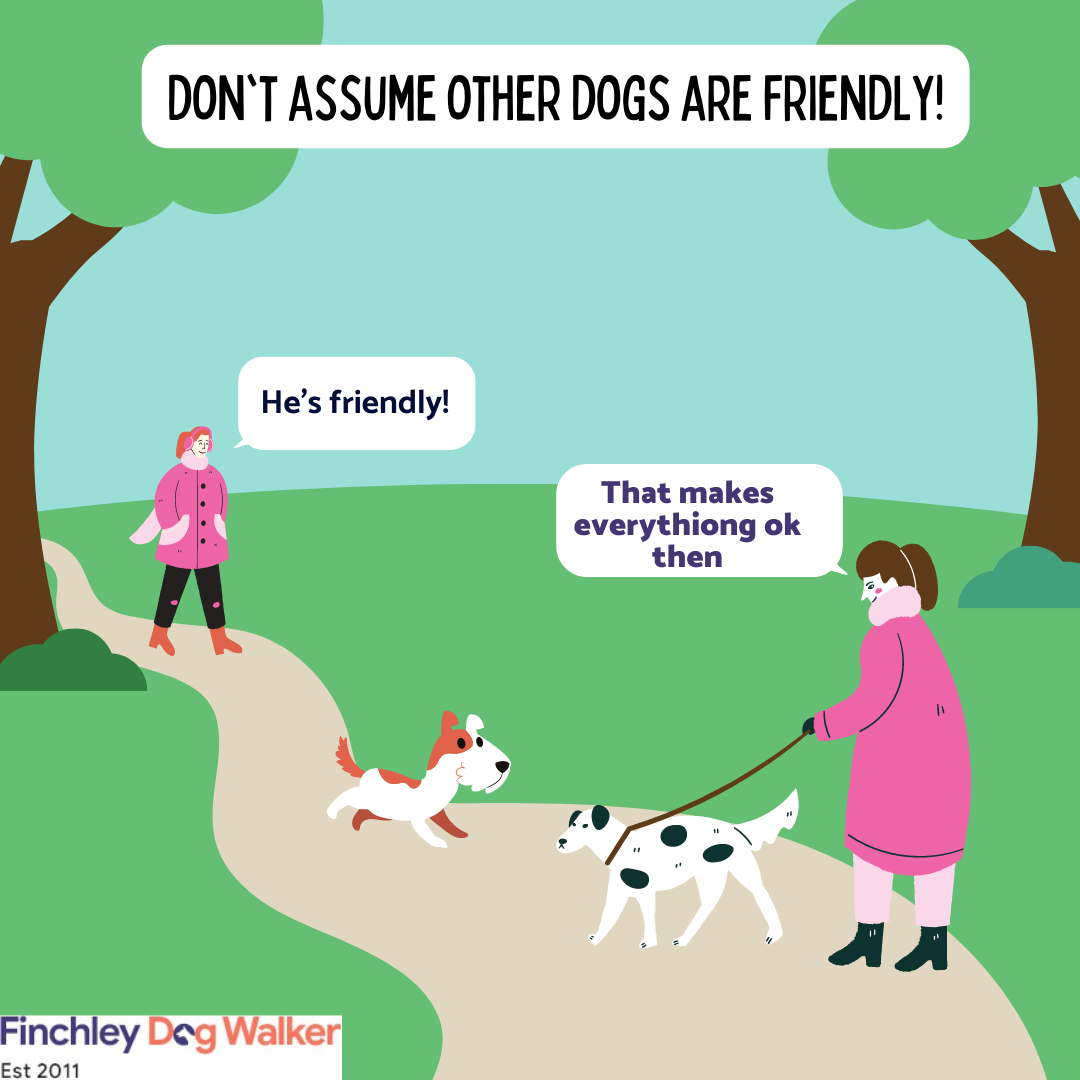
A dog being friendly does not give them permission to approach every dog.
The other dog may be:
- nervous
- reactive
- elderly
- recovering from surgery
- in pain
- in training
- newly rescued
- worried about puppies
- uncomfortable with close greetings
If you see a dog on a lead, call your dog back and give them space.
Ask the handler before allowing contact.
Read “It’s okay, my dog is friendly” for more about why friendly dogs should not run up to unfamiliar dogs.
If a greeting is agreed, keep the leads loose where possible and watch both dogs. Do not force them to remain nose-to-nose.
My three-second dog greeting guide explains how brief greetings and calm movement away can reduce pressure.
Be careful around children, runners and cyclists
Not everyone wants to meet your dog.
Some people are frightened. Others may have allergies, mobility difficulties or cultural reasons for avoiding dogs.
Keep your dog close enough to prevent:
- jumping
- blocking a path
- tangling someone in the lead
- chasing a bicycle
- approaching a pushchair
- taking food
- running into a game
On shared paths, move to one side and give people space to pass.
A child should not approach or touch a dog without the handler’s permission.
Even a sociable dog can become worried by a child running directly towards them, shouting or reaching over their head.
Use off-lead freedom carefully.
Off-lead exercise should only happen where it is permitted and where you can manage the risks.
Reliable recall means your dog can return when:
- another dog appears
- wildlife runs past
- someone opens a gate
- children begin playing
- a cyclist approaches
- your dog finds food
- you need to leave immediately
Recall in the garden is not the same as recall around squirrels, dogs and exciting smells.
If recall is not dependable, use a long line attached to an appropriate harness in a suitable open space.
Do not attach a long line to equipment that could put sudden force through the neck.
Dogs Trust advises continuing recall practice on a long lead and only allowing off-lead exercise in suitable areas once you are confident the dog will return.
Read the Dogs Trust recall-training guide for step-by-step advice.
Handle long lines safely
A long line can give a dog more freedom while retaining a connection to the handler.
It still needs careful handling.
Avoid:
- using it beside roads
- allowing it to wrap around legs
- grabbing a fast-moving line with bare hands
- letting it trail through groups of people
- attaching it to a retractable lead
- allowing the dog to hit the end at speed
- using it where it could wrap around trees or benches
Gather the line gradually rather than wrapping it around your wrist.
Wear suitable footwear and stay aware of where the line is in relation to your dog, other dogs and people.
Watch what your dog picks up
Scavenging is one of the most common walking hazards.
Dogs may find:
- chicken bones
- discarded takeaway food
- chocolate
- grapes or raisins
- chewing gum
- mouldy food
- medication
- cannabis
- nicotine products
- fishing hooks
- food wrappers
- dead animals
- animal faeces
- rat poison
- slug pellets
- antifreeze
- unknown substances
Do not rely only on spotting the item before your dog does.
Practise a reward-based leave and drop cue. Carry suitable treats so that you can exchange rather than chase or wrestle with your dog.
For dogs who repeatedly swallow dangerous objects, speak to a qualified reward-based trainer about safe muzzle training.
Never pull an embedded hook, sharp object or string from a dog without veterinary advice.
My guide to hidden dangers on dog walks covers common plants, chemicals and seasonal hazards.
Take care near ponds, streams and standing water
Water can be inviting, especially in warm weather.
It may also contain:
- blue-green algae
- sewage
- bacteria
- fishing equipment
- broken glass
- strong currents
- steep or slippery banks
- submerged objects
- stagnant water
Do not assume water is safe because other dogs are swimming.
Avoid encouraging a dog into unfamiliar water. Keep dogs away from water that looks discoloured, has surface scum or has warning signs nearby.
After long dry periods, shallow streams and ponds can become particularly unpleasant. They may contain concentrated waste, stagnant areas and debris.
Carry drinking water rather than relying on ponds, puddles or streams.
Adjust walks for heat
There is no single temperature that is safe for every dog.
Risk depends on:
- age
- breed or type
- coat
- body condition
- health
- fitness
- humidity
- direct sunlight
- surface temperature
- exercise intensity
Puppies, senior dogs, overweight dogs, flat-faced dogs and dogs with health conditions may struggle sooner.
Watch for:
- heavy panting
- slowing down
- seeking shade
- excessive drooling
- weakness
- confusion
- vomiting
- collapse
A shaded sniff walk does not make dangerous heat safe.
When conditions are unsuitable, shorten or cancel the walk and use calm activities at home.
Read How Hot Is Too Hot to Walk Your Dog? for more detailed guidance.
Make night walks visible and predictable
Reduced visibility affects both you and your dog.
At night:
- use well-lit routes
- wear visible or reflective clothing
- consider a safe light or reflective item for your dog
- carry a torch
- shorten the lead near roads
- avoid unfamiliar uneven ground
- watch for cyclists and runners
- keep your phone charged
- tell someone your route on longer walks
A flashing light should not replace secure equipment or careful handling.
More advice is available in my guide to walking your dog safely at night.
Follow local rules and signs
Dog controls vary between locations.
A park may require dogs to be on a lead in certain areas or at particular times. Dogs may be excluded from children’s playgrounds, sports areas or wildlife zones.
Follow:
- entrance signs
- temporary notices
- lead requirements
- dog exclusion areas
- requests from authorised officers
- seasonal wildlife restrictions
Some public spaces have different rules from surrounding streets or parks.
Do not assume that yesterday’s rules still apply if new signs have appeared.
Keep dogs controlled around livestock
When walking in the countryside, keep your dog under effective control and use a lead around livestock.
Even a dog who has never attacked an animal can cause distress by chasing.
Follow the Countryside Code, local signs and instructions from landowners.
If cattle or other livestock threaten you, official guidance advises releasing the dog rather than risking becoming trapped or injured while holding the lead.
Do not allow dogs to chase wildlife either. This protects animals, your dog and other countryside users.
Adapt the walk for puppies
Puppy walks are not endurance tests.
Young puppies may become overwhelmed long before they appear physically tired.
Keep early walks:
- short
- positive
- predictable
- suitable for the puppy’s vaccination status
- away from chaotic dog gatherings
- focused on confidence rather than distance
Do not force a puppy to greet every dog or person.
A puppy who sits down, bites the lead, zooms, freezes or becomes frantic may need less stimulation and more rest.
Read my Puppy’s First Walk Guide for a calmer introduction to outdoor walks.
Adapt the walk for senior dogs
Older dogs still benefit from movement, sniffing and time outdoors.
They may need:
- shorter routes
- slower pacing
- flatter surfaces
- more time to sniff
- fewer slippery paths
- additional rest
- protection from extreme temperatures
- easier access to home
Do not compare your senior dog with the dog they were five years ago.
Watch for stiffness, lagging behind, hesitation at steps, paw scuffing and difficulty settling after exercise.
Changes in mobility should be discussed with your vet.
Take extra care with nervous or reactive dogs
Safety for a nervous dog is not only about preventing physical injury.
Repeatedly pushing a worried dog into situations they cannot cope with can increase stress and make walks harder.
Useful adjustments include:
- quieter times
- wider paths
- familiar routes
- secure equipment
- a backup connection where appropriate
- visual barriers
- early changes of direction
- more distance from triggers
- shorter walks
- calm enrichment at home
Do not force greetings.
Do not punish barking or lunging caused by fear.
Do not assume that a busy park will “socialise” the problem away.
My Reactive and Nervous Dog Walking page explains the slower one-to-one approach I use.
Know when to abandon the walk
Turning around is not failure.
Go home or move somewhere safer when:
- your dog is panicking
- equipment is damaged
- the weather becomes dangerous
- there is smoke or fire nearby
- your dog becomes unwell
- an uncontrolled dog repeatedly follows you
- paths are flooded or blocked
- you feel unsafe
- your dog cannot recover after a trigger
You do not receive a prize for completing the planned route.
Safety comes before distance.
Carry a practical walking kit
For an ordinary local walk, I usually consider:
- secure lead
- poo bags
- suitable treats
- mobile phone
- water when needed
- basic first-aid supplies
- spare lead or safety connector
- tissues or a small towel
- any medication required for the individual dog
- emergency contact details when caring for someone else’s dog
Longer or rural walks may require additional water, food, clothing, a map, a power bank and details of the nearest veterinary practice.
Equipment should suit the walk rather than turning every local outing into an expedition.
Know your emergency plan
Think about emergencies before they happen.
Keep these details available:
- your normal vet
- the nearest emergency vet
- your dog’s insurance details
- an emergency contact
- relevant medical information
- microchip database details
- a recent photograph of your dog
If your dog escapes:
- avoid chasing if that makes them run
- use a familiar recall cue
- move away rather than directly towards them where appropriate
- contact local dog wardens, vets and the microchip database
- use local lost-dog groups carefully without encouraging crowds to chase
If your dog eats something potentially toxic, contact a vet promptly. Do not wait for symptoms and do not induce vomiting unless a veterinary professional tells you to do so.
If your dog is injured, struggling to breathe, collapsing, or showing signs of heatstroke, seek urgent veterinary help.
A canine first-aid course can help you respond calmly while arranging professional care. You can also visit my dog first-aid guide.
Check your dog after every walk
A brief post-walk check can catch small problems before they become more painful.
Check:
- paw pads
- between the toes
- nails
- legs
- armpits
- groin
- ears
- eyes
- nose
- coat
- collar and harness areas
Look for:
- cuts
- thorns
- grass seeds
- ticks
- burrs
- broken nails
- redness
- swelling
- limping
- excessive licking
- sore areas
- changes in movement
Long grass, woodland, mud and rough paths can all leave something behind.
My complete post-walk dog check guide explains what to inspect and when to contact your vet.
Allow your dog to recover
After returning home:
- offer fresh water
- remove wet equipment
- dry the dog where needed
- provide a quiet place to rest
- avoid immediately adding more excitement
- monitor breathing and movement
- record anything unusual
A dog who remains extremely restless, pants for a long time, appears stiff or cannot settle may have found the walk too physically or emotionally demanding.
The aim is not to return with a dog who is completely exhausted.
A suitable walk should leave them comfortable and able to recover.
Common dog-walking safety mistakes
Focusing only on distance
Longer is not always better.
The route, weather, dog’s health and emotional state matter more than completing a target number of miles.
Assuming every dog wants to meet
Many dogs need space.
Ask before allowing an interaction.
Using damaged equipment
Small areas of wear can become complete failures under sudden pressure.
Check equipment regularly.
Letting a dog off lead too soon
A new rescue dog or adolescent may behave differently in an exciting environment.
Use secure equipment while building recall.
Walking through obvious fear
Forcing a frightened dog forward may make the situation worse.
Reduce pressure and create distance.
Ignoring local signs
Lead requirements and exclusion areas are there for a reason.
Read signs at entrances and along the route.
Looking at a phone instead of the environment
Many situations are easier to avoid when noticed early.
Skipping the post-walk check
Grass seeds, cuts and damaged nails are easier to deal with when found promptly.
My approach to safer dog walks in Finchley
I provide calm, one-to-one dog walks from the dog’s own home.
I do not use cars, vans or group walks.
Walking locally means I can get to know:
- familiar routes
- quieter times
- road crossings
- busy school periods
- local dogs
- escape points
- seasonal hazards
- places where food is often discarded
The walk can be adjusted around the individual dog.
A confident young dog may enjoy a longer route.
A senior dog may need a slower pavement walk.
A nervous rescue dog may benefit from a familiar ten-minute loop with plenty of time to sniff.
You can read more about my solo dog walks in Finchley and Muswell Hill.
Frequently asked questions
What is the safest equipment for walking a dog?
Equipment should be secure, comfortable and correctly fitted for the individual dog. A suitable harness, collar and standard lead work well for many dogs. Nervous dogs or known escape risks may need a backup connection.
Check all clips, buckles and adjustment points regularly.
Should dogs always be kept on a lead?
Dogs should be on a suitable lead near roads, where local rules require it, around livestock and whenever recall or the environment makes off-lead exercise unsafe.
Off-lead freedom should only be allowed where it is permitted and the dog remains under effective control.
Is a harness safer than a collar?
A well-fitted harness can be a comfortable option and may reduce pressure on the neck. However, a poorly fitted harness can rub or allow a dog to escape.
The safest choice depends on the dog, the fit and how the equipment is used.
Should I take water on every dog walk?
Water is particularly important during warmer weather, longer walks and trips away from home.
For a short local walk in cool conditions, carrying water may not always be necessary. Consider the individual dog and the conditions.
Is it safe to let my dog greet other dogs on a lead?
Some dogs are comfortable with brief lead greetings. Others feel trapped or worried.
Ask the other handler first, keep the greeting brief and move away if either dog becomes stiff, worried or overexcited.
What should I do if an off-lead dog approaches?
Stay as calm as possible.
Create distance if you can. Move behind a barrier, turn away or ask the owner to call their dog.
Avoid tightening your dog’s lead more than necessary, as this can increase pressure. Do not put your hands between fighting dogs.
Can I skip a dog walk when conditions are unsafe?
Yes.
A shortened walk, a toilet break, or a missed walk is usually safer than exercising a dog in dangerous heat, storms, ice, or other unsuitable conditions.
Use calm indoor enrichment where appropriate.
Why does my dog suddenly stop on walks?
Freezing or refusing to walk may be caused by fear, pain, tiredness, heat, equipment discomfort or something in the environment.
Do not simply drag your dog forward. Look for the cause and seek veterinary advice when the behaviour is new, or pain could be involved.
Should I carry a dog first-aid kit?
A small first-aid kit can be useful, especially on longer or remote walks.
It does not replace veterinary treatment. First aid should help you manage the immediate situation while arranging professional care.
Final thoughts
Good dog walking safety is mostly about preparation and attention.
Check the equipment.
Watch the weather.
Read your dog.
Look ahead.
Give other people and dogs space.
Change the route early when something does not feel right.
Then check your dog when you get home.
None of this needs to make the walk dull or restrictive.
It creates the secure framework that allows your dog to sniff, explore and enjoy being outside.
If your dog struggles with groups, traffic, unfamiliar dogs or busy walking environments, my one-to-one dog walks provide a calmer alternative in Finchley, North Finchley, East Finchley, Finchley Central and Muswell Hill.
Here is a related guides section ready to paste at the end of the article.
Related dog walking guides
Continue with these practical guides to help make your dog’s walks safer, calmer and more enjoyable.
Check your dog’s equipment before every walk
Learn how to inspect leads, harnesses, collars, clips and stitching before a small fault becomes a serious escape risk.
Read: The Importance of Checking Equipment Before Walking Your Dog
Check your dog when you return home
A quick check of your dog’s paws, coat, ears and legs can help you spot grass seeds, ticks, cuts and other problems early.
Read: How to Check Your Dog After a Walk
Recognise hidden hazards on your route
Discover some of the toxic plants, discarded substances and seasonal dangers dogs may encounter on everyday walks.
Read: Hidden Dangers on Dog Walks
Walk safely after dark
Prepare for reduced visibility, quieter streets and unexpected encounters with practical advice for evening and winter walks.
Read: Walking Your Dog Safely at Night
Help an anxious dog feel safer outside
Find out how quieter routes, greater distance and predictable routines can support a nervous or easily overwhelmed dog.
Read: How to Walk an Anxious Dog Without Making Things Worse
Keep walks safer during hot weather
Learn when to shorten, change or cancel a walk and how to recognise early signs that your dog is struggling with the heat.
Read: How Hot Is Too Hot to Walk Your Dog?
Explore more everyday exercise advice
Visit the main dog walking and exercise guide for advice on sniffing, suitable walk lengths, enrichment, puppies, senior dogs and different exercise needs.
Read: Dog Walking and Everyday Exercise
Disclaimer: This guide provides general dog-care information. Seek veterinary advice if your dog is injured, becomes unwell, shows signs of pain or displays a sudden change in behaviour.
