
Updated July 2026
You see a dog wandering alone.
No owner.
No obvious lead.
Perhaps the dog is standing near a road, running through a park, or nervously watching people from a distance.
The natural reaction is to help.
But slow down for a moment.
A lost dog may be frightened, confused or already highly stressed.
Even a normally friendly dog can behave differently when they are scared.
My first priorities would be:
Your safety.
The dog’s safety.
The safety of people and traffic around you.
Then we can start working out how to reunite the dog with their owner.
This guide explains what to do if you find a lost or stray dog in the UK, including the current procedure for a dog found in Finchley or the London Borough of Barnet.
For advice on what to do when your own dog goes missing, read my “What to Do When Your Dog Gets Lost” guide.
Important
This guide provides general information based on current UK and local-authority guidance.
Council stray-dog contacts and procedures can change, so check your local council’s current information when dealing with a found dog.
If a dog is injured, seriously unwell or in immediate danger, contact a vet or the appropriate emergency service.
First: is the dog genuinely lost?
Not every apparently unattended dog is lost.
An owner might be around the corner.
The dog may have briefly slipped out of a garden.
Someone may be searching nearby.
Before doing anything dramatic, look around.
Can you see somebody calling or searching?
Is there an open gate nearby?
Are other dog walkers trying to attract the dog’s attention?
Ask people nearby whether they recognise the dog.
But do not spend half an hour doing this while a frightened dog runs beside a busy road.
Use common sense.
If the dog appears unattended and at risk, the priority is keeping everybody safe.
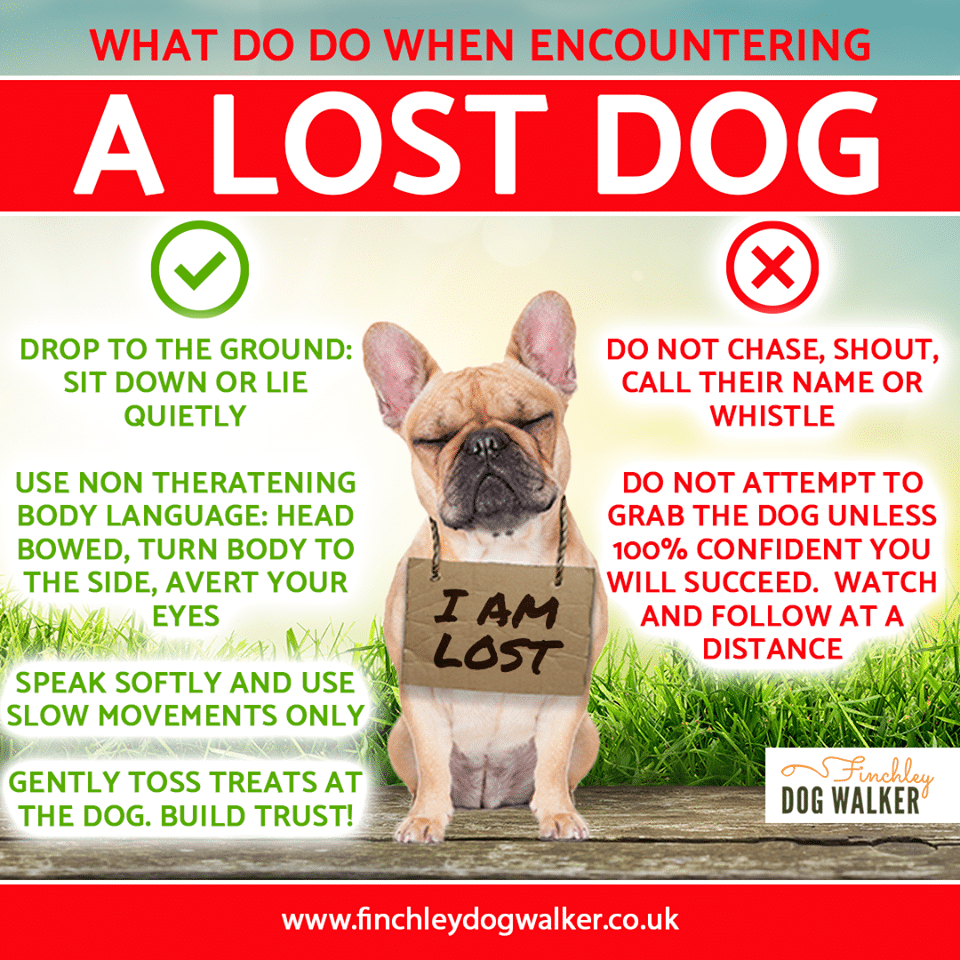
Do not chase a frightened dog
This is one of the biggest mistakes people can make.
Dog runs away.
Person follows.
Dog runs faster.
Three more helpful people join in.
Suddenly the dog has a small search party chasing them across the park.
A frightened dog may not understand that you are trying to help.
If the dog is moving away from you, slow down.
Do not run directly at them.
Do not corner them unless there is an immediate danger that makes intervention unavoidable.
Keep your body calmer.
Avoid looming over the dog.
Give them room.
The RSPCA’s current advice is to approach only if the dog is calm and to stay clear of a dog displaying aggressive behaviour while contacting the local dog warden.
My How to Greet a Dog Properly Without Causing Stress guide explains why a direct, head-on approach can put unnecessary pressure on an unsure dog.
Watch the dog’s body language
Look at the whole dog.
Are they loose and relaxed?
Or are they:
Backing away?
Freezing?
Tucking their tail?
Repeatedly turning their head?
Growling?
Snapping?
Trying desperately to escape?
A wagging tail alone does not tell you that the dog wants to be touched.
A lost dog may be tired, frightened or overwhelmed.
If the dog is showing aggressive behaviour, do not try to prove that you are good with dogs.
Keep your distance.
Contact the local authority’s dog service.
Your safety matters too.
Try to keep the dog away from immediate danger
A loose dog beside a road presents an urgent risk.
Where it is safe, you may be able to position yourself so the dog moves away from traffic.
Move slowly.
Avoid shouting.
Do not suddenly grab.
If other people are present, ask them to stop chasing and give the dog space.
Too many people surrounding a frightened dog can make things harder.
If the dog is in imminent danger or in a dangerous location, the RSPCA advises contacting the emergency services and not putting yourself in danger.
Do not step into moving traffic after a dog.
You are no use to the dog if you are injured as well.
Can I put a lead on a found dog?
Possibly.
It depends on the dog.
A calm dog may happily approach and allow you to attach a lead.
Another dog may panic as soon as a hand moves towards their collar.
Do not assume:
He’s come over, so he’ll let me grab him.
Approaching you and consenting to physical handling are not necessarily the same thing.
If the dog is relaxed and you can safely secure them with a suitable lead, do so calmly.
Avoid sudden movements.
Do not put your face beside the dog’s face.
If the dog stiffens, growls, snaps or becomes increasingly distressed, stop.
In Barnet, the Animal Welfare Officer currently only attends when a stray dog has been contained, for example somewhere the dog cannot escape or when the dog is held on a lead.
That does not mean you should risk being bitten to get a lead onto a frightened dog.
Contain them only when you can do so safely.
Check the dog for an identification tag
Once the dog is safely contained and is comfortable with you being close enough, look for an identification tag.
Do not wrestle a frightened dog to inspect their collar.
If a tag has a contact telephone number, try it.
Explain:
Where you found the dog.
Where you are now.
That the dog appears safe.
Any obvious injuries or concerns.
Keep the conversation simple.
You may be speaking to somebody who has been desperately searching.
Current UK rules still require dogs in public to wear a collar and tag showing the owner’s name and address, even where the dog is microchipped. (GOV.UK)
A phone number is extremely useful for quick reunification, but do not assume a dog without a visible phone number has no owner.
Move to the next step.
Ask locally, but keep the dog secure
If the dog seems calm and is safely contained, ask nearby people whether they recognise it.
Local dog walkers often know the dogs well.
A neighbour may know which house the dog lives in.
Someone may have just seen a person searching.
But be careful.
Do not hand a dog to the first person who says:
Oh yes, I know him.
And do not let the dog loose because somebody thinks the owner lives three streets away.
Keep the dog secure while you make sensible checks.
Get the dog scanned for a microchip
Dogs in the UK must be microchipped and registered by eight weeks old. A vet, dog warden, or rescue centre can scan a dog when the chip number is unknown.
A microchip does not work like a GPS tracker.
It does not show you where the dog’s house is on a map.
The chip contains an identification number that can be read by a scanner and linked to registration information on an approved database.
If you have safely contained a found dog, contact a local vet or the council dog service.
Phone a veterinary practice before simply turning up.
Explain that you have found a stray dog and ask whether they can help arrange a microchip scan.
The RSPCA currently recommends contacting a local vet for a microchip scan as part of the process of helping reunite a found dog with their owner. (RSPCA)
My [Dog Tags and Microchipping Guide] explains why both forms of identification matter.
What if the microchip details are out of date?
This is one of the frustrating problems with microchips.
A dog can be chipped.
But the owner has moved.
Changed telephone number.
Or failed to update the registered details.
Current GOV.UK guidance says owners are responsible for keeping their pet’s microchip information up to date.
Do not assume that an unsuccessful first contact means the dog has been abandoned.
Report the dog to the council.
Continue through the proper found-dog process.
There may be other ways to identify the owner.
This is also a useful reminder to check your own dog’s details.
Do you know which database your dog is registered with?
Is your current mobile number on the record?
Is your address correct?
Those are much easier questions to sort out before your dog disappears.
You must report a stray dog to the council if you cannot contact the owner
This is the part I have updated most strongly from the old version of this article.
Current GOV.UK guidance says:
If you know who the owner is, you must return the stray dog to them.
If you cannot contact the owner, you must report the stray dog to the local council.
So:
Vet scan or social media does not replace reporting a found stray dog to the council when the owner cannot be contacted.
The local authority’s dog service is an important part of the reunification process.
The owner may already have reported their dog missing.
Found a lost dog in Finchley or Barnet?
As of July 2026, Barnet Council says its stray-dog service is actioned by the London Borough of Waltham Forest.
The current Animal Welfare Officer number is:
07815 512833
Barnet currently gives the following contact hours:
Monday to Friday: 7 am to 10 pm, with the last call-out at 9 pm.
Saturday, Sunday and bank holidays: 10 am to 6 pm, with the last call-out at 5 pm.
The council says the officer will only attend when the dog has been contained, for example on a lead or in a location where the dog cannot escape. (Barnet Council)
Outside those hours, Barnet currently advises taking the dog to a vet or rehoming centre where the microchip can be checked, if possible keeping the dog safe, and leaving the Animal Welfare Officer a message with your details and the dog’s location.
Council services and phone numbers can change.
What if I find a dog in Muswell Hill or another area?
Report the dog to the local authority responsible for where the dog was found.
Do not assume every North London stray-dog report goes to Barnet.
For example, Haringey currently operates its own lost-and-stray-dog information through a dog team, with the service provided by Waltham Forest Council.
The simplest option is the official GOV.UK: report a stray dog service that uses your location to direct you to the relevant council.
That makes this page useful beyond Finchley without pretending every borough follows exactly the same process.
Can I take a found dog home?
This needs a sensible answer.
Temporarily keeping a safely contained dog in a secure location while you contact the owner or council may sometimes be the practical thing to do.
But first think about the dog.
And your home.
Do you have other dogs?
Cats?
Children?
A nervous rescue dog?
Can you keep the found dog completely separate?
Do you know whether the dog is injured or unwell?
Do you know how the dog behaves around food or other animals?
A lost dog may be frightened and unpredictable.
Do not walk into your living room with an unknown dog and announce:
Everybody, meet your new friend.
Keep animals separated.
Give the dog space.
Avoid unnecessary handling.
And remember the legal point: if you cannot contact the owner, you still need to report the stray dog to the council.
Can I keep the dog?
Not simply because you found them.
GOV.UK says you must return a stray dog to their owner if you know who the owner is. Otherwise, you must contact your local council. You can tell the council you are interested in keeping the dog, and you may later be allowed to do so if the owner cannot be found and the council considers you suitable. (GOV.UK)
Do not privately decide:
Nobody has claimed him after two days, so he’s mine.
Somewhere an owner may still be desperately searching.
Follow the proper procedure.
What should I post on social media?
Social media can help.
Local Facebook groups can move information around very quickly.
But I would be careful about sharing every identifying detail.
My practical recommendation is to post:
The general area where the dog was found.
The date and approximate time.
A clear photograph where appropriate.
A way for people to contact you or the organisation handling the dog.
State that the dog has been reported through the correct channels.
I would consider holding back one or two small identifying details.
For example:
A distinctive collar detail.
A small marking.
A particular tag.
Then somebody claiming to be the owner can describe something that was not in the public post.
That is my practical recommendation, not a legal requirement.
You can also search local groups for recent lost-dog posts.
The RSPCA recommends using social media and local groups as part of its current suggestions for spreading the word about a found dog.
Do not publicly post a stranger’s personal details
Suppose you find a tag with:
A name.
An address.
A phone number.
You do not need to photograph the tag and publish everything on Facebook.
Contact the owner.
If you create a found-dog post, keep personal contact information private.
The post is about reuniting the dog.
It is not an opportunity to publish the owner’s address to an entire local group.
What if somebody claims the dog is theirs?
Most reunions will hopefully be straightforward.
The dog sees their person.
Everybody is relieved.
But when you are unsure, ask sensible questions.
Can they describe the dog?
Do they have photographs?
Can they describe the collar or harness?
Do they know where the dog was lost?
Can they provide veterinary or microchip information if necessary?
Do not turn yourself into a detective interrogating a genuine distressed owner for three hours.
But equally, I would not hand an unchipped, untagged dog to a random stranger because they typed:
That’s my mate’s dog.
Where the dog is already with the council, vet or another organisation, let them follow their own identification and reunification procedures.
What if the dog appears injured?
A found dog who is injured needs veterinary help.
Look for:
Heavy bleeding.
Difficulty breathing.
Collapse.
An inability to stand.
A serious wound.
Severe pain.
An obvious eye injury.
Signs the dog has been hit by a vehicle.
Do not spend an hour creating a Facebook poster while a seriously injured dog waits.
Contact a vet.
If the dog is in immediate danger in a dangerous location, contact the appropriate emergency service and do not put yourself at risk. The RSPCA currently advises contacting a local vet or animal centre for a sick or injured stray dog.
My When Should I Call the Vet?]guide covers warning signs that need professional help.
For basic emergency awareness, read my Dog First Aid Guide.
Be careful handling an injured lost dog
Pain changes behaviour.
A dog who would normally happily be handled may growl or snap when injured.
With a found dog, you do not even know what their normal behaviour looks like.
Keep your face away from the dog’s face.
Do not force a painful dog into physical contact unless immediate safety requires handling.
Keep things calm.
Contact the vet.
A growl is information.
Listen.
What if the dog is running away and I cannot catch them?
Do not continue an uncontrolled chase.
Make a note of:
The exact location.
The direction the dog travelled.
The time.
The dog’s colour and approximate size.
Breed or type if you can reasonably describe it.
Collar or harness details.
Whether the dog appeared injured.
Take a photograph or video if it is safe and does not delay dealing with an immediate danger.
Report the sighting to the appropriate council dog service.
Check local lost-dog posts.
A precise sighting can be useful.
Brown dog somewhere in North London.
is not very helpful.
Medium black dog wearing a red harness, seen heading from X towards Y at approximately 4.20pm.
is much better.
Do not invent details you are not sure about.
Should I feed a found dog?
My instinct would be not to offer a large meal immediately.
You do not know:
The dog’s medical history.
Whether they have allergies.
Whether they need a specialist diet.
Whether they have recently eaten.
Whether they are about to need veterinary treatment.
Fresh water may be appropriate for a calm dog while help is arranged, unless a veterinary professional advises otherwise.
For food, I would first concentrate on identification, reporting and getting the dog somewhere safe.
Do not use food to get close to a dog that is warning you to keep away.
Keep found dogs away from your own pets
Even if the dog appears friendly.
You do not know their history.
You do not know how they behave around your dog or cat.
You do not know whether either animal will feel threatened.
Use separate rooms and secure doors where a dog is temporarily in your home.
Do not carry out a cheerful introduction in the hallway.
Lost dogs have already had enough excitement for one day.
Calm and boring is fine.
What happens after the council collects a stray dog in Barnet?
Barnet Council currently says that reasonable steps are taken to contact the owner when a lost or stray dog is picked up by the dog warden. If the owner cannot be found, the council says the dog is kept for seven days and then transferred to a suitable rehoming centre or may be humanely euthanised. (Barnet Council)
I mention that because it reinforces why proper identification matters.
A current microchip record.
A legal collar tag.
A recent photograph.
Reporting a missing dog quickly.
These are not boring bits of dog paperwork.
They can help get a dog home.
My “Reduce the Risk of Losing Your Dog” guide focuses on prevention.
A note about microchips
All dogs in the UK must currently be microchipped and registered by eight weeks old, and owners are responsible for keeping the registered information up to date. Dogs in public must still wear a collar and identification tag with the owner’s name and address.
This is why I ask dog owners to think about identification before something goes wrong.
A microchip with a telephone number from three house moves ago is not as useful as an up-to-date record.
Take five minutes.
Check your dog’s details.
My Dog Tags and Microchipping Guide explains the basics.
What I would do if I found a loose dog on a walk
My priorities would be:
Keep the dog I am already responsible for safe.
Assess whether the loose dog is in immediate danger.
Avoid creating a chase.
Observe the found dog’s body language.
Contain the dog only if I can do so safely.
Check identification where safe.
Try to contact the owner if contact information is available.
Report the stray dog to the correct council when the owner cannot be contacted.
Arrange a microchip scan through the appropriate service.
Pass on accurate information.
That first point matters.
As a professional dog walker, I already have a dog in my care.
I cannot simply forget about my client’s dog and concentrate entirely on the loose dog.
This is another reason I prefer Solo Dog Walks.
I have one household’s dog to think about, not a vanload or a large group, while trying to manage an unexpected situation.
Found dog checklist
Found a loose dog?
Stop and assess
Is the dog genuinely unattended?
Are they in immediate danger?
Do not chase
A frightened dog may run further.
Watch the body language
Only approach when it appears safe.
Contain safely where possible
A lead or secure area may help.
Do not risk a bite.
Check the tag
Try the owner’s contact details.
Arrange a microchip scan
Contact a vet, dog warden or suitable rescue service.
Report the stray dog to the council
If you cannot contact the owner, current GOV.UK guidance says the dog must be reported to the council.
Share carefully
Check local lost-dog posts and use local social media sensibly.
Get veterinary help for an injured dog
Do not delay urgent care.
Final thoughts
Most people who stop for a loose dog are trying to do something kind.
That matters.
But enthusiasm can sometimes turn into ten people chasing a terrified dog around a park.
Slow things down.
Look at the dog.
Think about safety.
Do not grab simply because you want to help.
Check identification.
Arrange a microchip scan.
And when the owner cannot be contacted, report the dog to the appropriate local council.
For Finchley and the London Borough of Barnet, check Barnet Council’s current stray dog information before relying on an old saved phone number.
For prevention, read Reduce the Risk of Losing Your Dog and Dog Tags and Microchipping.
Sometimes a very small thing gets a dog home.
A readable tag.
A current phone number.
And somebody calm enough to stop and help.
Disclaimer
I am a professional dog walker with training in canine first aid and canine body language. I am not a vet, a council Animal Welfare Officer, or a lawyer. This guide provides general information only. Council services and procedures can change, so check the current local authority guidance. Contact a vet for a sick or injured dog, and the appropriate emergency service if there is an immediate danger to people or traffic.


