
Key Takeaways
- A yellow ribbon on a dog indicates they need space and should not be approached without permission.
- Dogs wearing yellow may be nervous, recovering, or simply prefer not to interact; this does not indicate aggression.
- Always respect the request for space when you see a yellow marker, regardless of your dog’s friendliness.
- Children should be taught to give yellow dogs space and not approach without asking first.
- Not every nervous dog wears yellow; pay attention to body language and handler requests for space.
If you see a dog wearing a yellow ribbon, yellow lead cover, yellow bandana, or an “I NEED SPACE” message, there is a simple thing you can do to help:
Give that dog more room.
Yellow is used by the Yellow Dog movement as a visual way for an owner or handler to say that their dog would prefer not to be approached.
That does not automatically mean the dog is aggressive.
They may be nervous, reactive, elderly, recovering from illness or surgery, in training, newly rescued or simply uncomfortable with unfamiliar dogs or people getting too close.
The important message is not why the dog needs space.
It is that they need it.
I have worked professionally with dogs around Finchley and North London since 2011, including many rescue, nervous and reactive dogs. One of the easiest ways we can make local walks calmer for everyone is to stop assuming that every dog wants to say hello.
The quick answer
A yellow marker on a dog usually means:
- please give this dog space
- do not let your dog run over to them
- do not approach or touch without permission
- give the handler room to move away
- call your own dog back if necessary
- allow them to pass without forcing a greeting
You do not need to work out whether the dog is frightened, reactive, recovering from an operation or simply prefers not to interact.
Respecting the request for space is enough.
What is a Yellow Dog?
A Yellow Dog is a dog whose owner or handler is using yellow equipment to communicate that the dog needs additional space.
The marker might be a yellow ribbon tied to a lead, but you may also see a yellow lead, lead cover, bandana, vest, harness patch or coat displaying words such as “I NEED SPACE”.
Yellow Dog UK explains that dogs may need space for a wide range of reasons, including nervousness, anxiety, training, recovery from surgery, age, rescue backgrounds and medical needs.
That range is important.
You cannot look at a yellow dog and know exactly what has happened in their life.
You do not need to.
Yellow is the communication.
Give us a little more room.
Does yellow mean the dog is aggressive?
No.
A yellow ribbon does not mean:
“This dog is dangerous.”
It means:
“This dog needs more space.”
Those are very different messages.
A dog may need distance because they are frightened of unfamiliar dogs. Another may be recovering from an operation and should not be knocked over. An older dog may be uncomfortable around energetic puppies. A rescue dog may still be learning that walks are safe.
A dog who reacts by barking or lunging may be trying to make something move further away rather than trying to start a fight.
My guide Why Is My Dog Reactive on the Lead? explains some of the reasons dogs can behave differently when they cannot freely increase their distance from something worrying.
Dogs Trust also advises owners of reactive dogs to avoid situations that make their dogs worried and to create enough distance for them to cope. Read the Dogs Trust guide to reactive dogs.
Why might a dog need space?
There are many possible reasons.
Some dogs have had frightening experiences.
Some have not had many positive experiences around unfamiliar people or dogs.
Some become overexcited very quickly.
Some feel trapped when they are attached to a lead.
Some are in pain.
Some are learning.
Some simply do not enjoy close social contact.
The reason may also change from day to day.
A dog who usually copes well may need more space after veterinary treatment, when they are tired, when an injury is sore or when the environment is unusually busy.
This is why I prefer not to label a dog solely by what they do during one difficult moment.
If you live with a worried dog, my guide to walking an anxious dog without making it worse explains how distance, choice and calmer routes can help.
What should I do when I see a Yellow Dog?
The best response is usually very simple.
Create space early rather than waiting until you are almost beside each other.
If you are walking towards the dog, you might cross the road, move to the other side of a wide path or simply stop somewhere with enough room for them to pass.
If you are walking your own dog, keep them with you.
Do not allow them to approach simply because they are friendly.
The other dog has no way of knowing that.
Your dog may be playful and sociable, but a direct approach could still be frightening to a dog who is nervous, in pain or trying hard to cope.
My Dog Walking Etiquette for Dog Owners explains this in more detail.
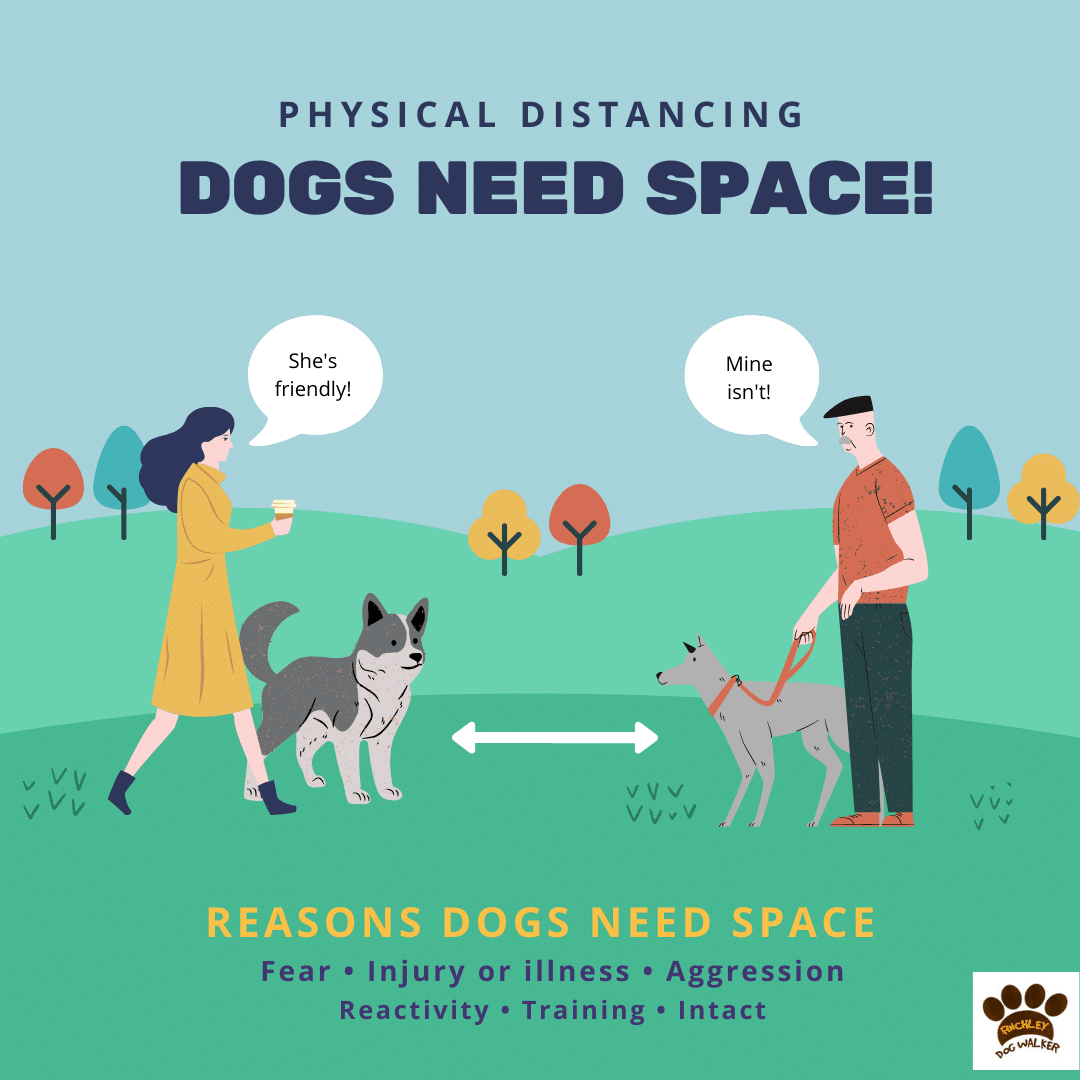
“It’s OK, my dog is friendly”
This is probably one of the least helpful things an owner of a nervous dog can hear.
The issue is not whether your dog is friendly.
The issue is whether the other dog wants the interaction.
A friendly Labrador bouncing towards a nervous rescue dog can still be terrifying.
A playful puppy climbing over an arthritic older dog can still hurt.
A sociable dog running directly towards a reactive dog on a lead can still create a difficult-to-manage situation.
Friendliness does not create automatic permission.
I have a separate article about exactly this problem: It’s OK, My Dog Is Friendly? Why That Is Not Always Enough.
What if my dog is off lead?
If you see a Yellow Dog, call your dog back before they get close.
Do not rely on shouting:
“He’s friendly!”
The handler may already be trying to move their dog away.
If your recall is not reliable enough to prevent your dog approaching another dog, use appropriate management such as a lead or long line where the environment allows.
Dogs do not have to greet one another simply because they happen to be walking in the same park.
If you notice that another owner puts their dog on a lead, shortens their lead, changes direction or moves to the edge of the path, give them room even if you cannot see a yellow marker.
My guide Respect My Dog When He Is on the Lead looks specifically at why a leaded dog may need more distance.
A dog does not need to be wearing yellow to deserve space
This is one of the most important points on this page.
Not every nervous or reactive dog will be wearing yellow.
The owner may not be aware of the Yellow Dog campaign.
They may have forgotten the yellow lead.
The dog may have become worried unexpectedly.
Or the owner may simply have decided that their dog needs more room today.
Respect body language, the handler’s behaviour, and equipment.
If somebody crosses the road, do not follow them across because you think the dogs should meet.
If somebody moves onto the grass to create distance, let them have that distance.
If they say:
“Please don’t let your dog approach.”
The correct response is not an argument about whether your dog is friendly.
It is to help them create the space they have asked for.
Look at the dog as well as the yellow marker
Yellow equipment is useful because it can communicate from a distance.
But your dog’s body language still matters.
A dog who needs more room may turn their head away, change direction, slow down, freeze, lick their lips, lower their body, stare, bark or try to move away.
Some signals are much quieter than barking or lunging.
The RSPCA’s dog-handling guidance explains that dogs use body language both when they are comfortable being approached and when they want to increase distance. Read the RSPCA guidance on understanding and approaching dogs.
My Staying Safe Around Dogs in Finchley guide also explains why giving a dog room and allowing them to choose whether to approach can make interactions safer.
Should I ask whether I can stroke a Yellow Dog?
If a dog is clearly wearing an “I NEED SPACE” message, the most helpful thing is usually not to approach in the first place.
That includes approaching the owner to ask questions while standing close to the dog.
If the owner initiates a conversation and there is plenty of space, that is different.
But nobody walking a nervous dog should have to explain the dog’s entire history every time they leave the house.
If you do meet a dog whose owner says that an introduction is appropriate, let the dog decide whether they want to come closer rather than leaning over them or immediately reaching towards their head.
My guide How to Greet a Dog Properly Without Causing Stress explains how to make greetings less intrusive.
Children and Yellow Dogs
Children may naturally want to stroke a dog they see outside.
They should be taught to ask the owner first whether or not the dog is wearing yellow.
If a dog is displaying an “I NEED SPACE” message, the safest approach is to give them room rather than asking the child to try to make friends.
Do not allow children to:
run towards the dog, hug them, follow them when they move away or put their face close to the dog’s face.
The RSPCA advises that children should not approach unfamiliar dogs and that dogs should be allowed space when they appear unhappy or want to move away. Read the RSPCA guidance about children and dogs.
What if my dog needs space?
Using yellow can be helpful.
It may make some people notice you earlier and give you more room.
You can learn more about the campaign and the different ways of displaying the message through Yellow Dog UK.
But I would never treat yellow equipment as your only safety plan.
Some people will not know what it means.
Some will not notice it.
Some dogs will still run over.
Think about the complete walk as well.
That may mean choosing quieter times, wider routes, avoiding bottlenecks, creating distance early, and having a plan to turn around when necessary.
For dogs who find ordinary walks difficult, my Reactive and Nervous Dog Walking in Finchley page explains how I use individual routes and one-to-one support rather than trying to make every dog fit into a group walk.
You do not need to prove that your dog can cope
Owners sometimes feel embarrassed about crossing the road or turning around.
There is nothing wrong with it.
If you know that walking directly towards another dog is likely to make your dog struggle, changing direction is sensible management.
You do not need to use every passing dog as a training opportunity.
Sometimes the best decision is simply:
“Not today.”
That can be particularly important when your dog is already tired, stressed or has dealt with several difficult things during the walk.
What if a loose dog approaches?
This can be one of the hardest situations for somebody walking a nervous or reactive dog.
If you see the loose dog early enough, create distance.
You may be able to turn away, cross the road or use a physical feature such as a parked car, hedge or gate to give your dog more space.
Ask the other owner to call their dog back.
Avoid encouraging a face-to-face greeting simply because avoiding it feels awkward.
My full guide What to Do if a Loose Dog Approaches You and Your Dog on a Lead covers this situation in much more detail.
Yellow is communication, not a training solution
Putting a yellow ribbon on a lead does not change how the dog feels.
It does not treat fear or reactivity.
It does not replace secure equipment.
And it does not mean the owner should stop helping their dog.
It is simply communication.
It may help create enough space for the owner to work more successfully with their dog.
For some dogs, the longer-term plan may involve gradual reward-based training.
For others, veterinary investigation may be needed, particularly if behaviour has changed suddenly or pain could be involved.
More complex fears, aggression, or other behavioural problems may require support from an appropriately qualified behaviour professional.
Why this matters to me as a dog walker
I regularly work with dogs who benefit from more space.
Some are rescue dogs.
Some are nervous.
Some become reactive when another dog comes too close.
Some simply do not enjoy group walks.
That is one of the reasons I provide solo dog walks in Finchley and Muswell Hill rather than putting unfamiliar dogs into vans and walking them together.
If I see another dog on a lead, I do not automatically assume they want to meet the dog I am walking.
If I see yellow, I give them space.
If the owner moves away, I help them move away.
It is a small courtesy, but for somebody trying to help a nervous dog feel safer outside, it can make a very big difference.
Frequently Asked Questions
What does a yellow ribbon on a dog mean?
It generally means that the dog needs additional space and should not be approached without permission. Yellow Dog UK promotes yellow ribbons, leads, lead covers, bandanas and vests as a visible “I NEED SPACE” message.
Does a yellow lead mean a dog is aggressive?
No. Dogs may need space for many reasons, including nervousness, recovery from surgery, age, training, previous experiences or medical needs.
Should I let my friendly dog approach a Yellow Dog?
No. Call your dog back and allow the other dog and handler enough room to pass.
Can I stroke a dog wearing yellow?
Do not approach unless the owner clearly invites an interaction. If an introduction is appropriate, allow the dog to choose whether they want to approach you.
Does every nervous dog wear yellow?
No. Always pay attention to the dog, the handler and requests for space, even when no yellow equipment is visible.
My dog needs space. Should I buy yellow equipment?
It can be a useful additional visual signal, but it should be combined with suitable management, secure equipment and sensible route planning. You can find information about the campaign through Yellow Dog UK.
What should I do if another owner crosses the road with their dog?
Give them the space they are creating. Do not cross after them so that your dogs can meet.
Why is my dog worse when they are on a lead?
A lead can limit the dog’s ability to move away or change direction, and some dogs become fearful, frustrated or overexcited when that choice is restricted. Read Why Is My Dog Reactive on the Lead?.
A final thought
You do not need to know a dog’s life story to respect their space.
You do not need to decide whether they look frightened enough.
And you do not need to prove that your own dog is friendly.
If somebody is asking for distance, give it.
If you see yellow, give it.
If another owner puts their dog on a lead, moves away or asks you not to approach, help them rather than making the situation harder.
Not every dog wants to say hello.
And that is perfectly OK.
About Del Chambers
I am Derek “Del” Chambers, and I established Finchley Dog Walker in 2011.
I provide calm, one-to-one dog walking and home pet care in Finchley, North Finchley, Finchley Central, East Finchley, Muswell Hill and selected nearby areas of North London.
I regularly work with rescue, nervous, reactive and sensitive dogs who benefit from individual attention, predictable handling and more space.
I do not use vans or group walks. Each walk begins and ends at the dog’s home and is adapted around the dog in front of me.
If your dog finds group walks, unfamiliar dogs or busy environments difficult, read about my Reactive and Nervous Dog Walking in Finchley or Solo Dog Walks.


