
Retractable dog leads are everywhere.
You’ll see them in parks, on pavements, and on everyday walks around Finchley.
Some owners swear by them. Others avoid them completely.
The reality is a bit more balanced.
They can work in certain situations.
But for many dogs, they make walks harder, not easier.
This guide may contain affiliate links. If you choose to buy through them, I may earn a small commission at no extra cost to you.
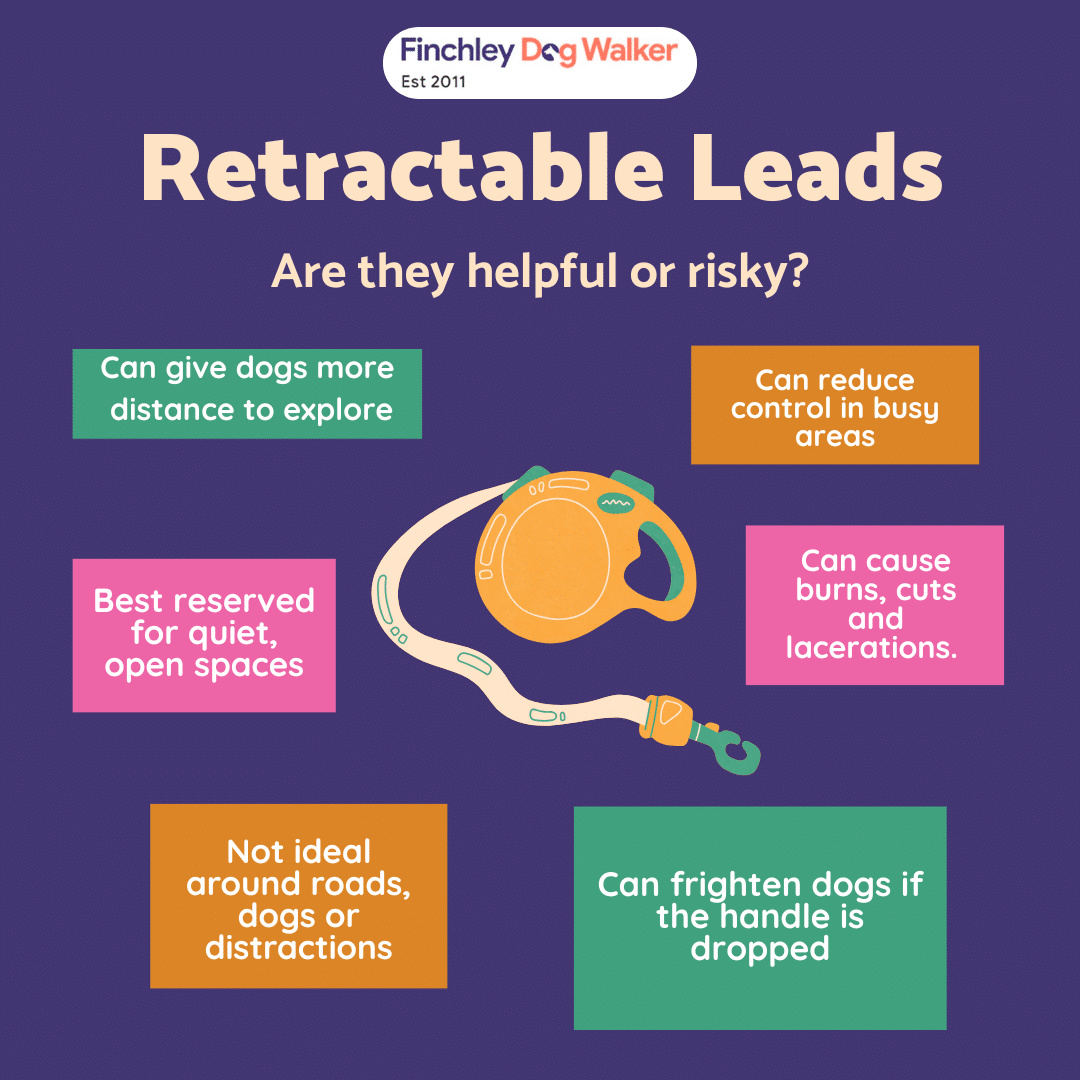
What is a retractable lead?
A retractable lead is a handle with a long cord or tape that extends and retracts.
It allows your dog to move further away while still being attached to you.
This can seem like giving your dog more freedom.
But that freedom comes with trade-offs.
Why people use retractable leads
There are a few common reasons:
- giving dogs more space to explore
- trying to replicate off-lead freedom
- convenience on open paths
For confident, calm dogs in quiet areas, they can sometimes work.
Where problems start
In real-world walking, things are rarely predictable.
This is where retractable leads can become difficult to manage.
Reduced control
The longer the lead, the harder it is to react quickly.
If your dog suddenly:
- runs towards another dog
- chases something
- reacts to a trigger
you have less control than with a fixed lead.
Constant tension
Many retractable leads keep a slight tension on the line.
For some dogs, this can:
- increase pulling
- create frustration
- make calm walking harder
Difficult in busy areas
In places like:
- pavements
- parks
- shared paths
long leads can:
- get tangled
- trip people
- cause awkward interactions
Not ideal for nervous or reactive dogs
For dogs who need:
- space
- calm handling
- predictable movement
Retractable leads often make things more stressful.
If your dog struggles on walks, you can read more here:
→ Rescue Dog Support Page
When they can work
To be fair, retractable leads are not always a bad choice.
They can be useful:
- in quiet, open areas
- with calm, non-reactive dogs
- when used carefully and attentively
But even then, they need to be used with awareness.
A calmer alternative
For most dogs, especially those needing structure, a simpler setup works better.
Fixed lead
A standard lead gives you:
- consistent control
- clearer communication
- easier handling
A double-ended training lead, like the Halti Training Lead, offers flexibility without sacrificing control.
Long line (better option for space)
If your goal is to give your dog more freedom, a long line is usually a better choice.
It allows:
- safe distance
- controlled exploration
- better handling
You can see what I recommend here:
→ Walking Kit for Nervous or Reactive Dogs
How this affects your dog’s behaviour
The equipment you use changes how your dog experiences a walk.
For some dogs, retractable leads:
- increase excitement
- reduce focus
- make it harder to stay calm
For others, they may not cause issues.
But it depends heavily on the individual dog.
Real-world experience
Some of the dogs I work with couldn’t walk calmly past another dog at first.
Using a retractable lead in those situations would have made things harder.
Starting with:
- shorter leads
- quieter routes
- more control
helps build confidence over time.
You can read more about this here:
→ Solo Dog Walks
A simple way to decide
Retractable leads may work if your dog is:
- calm and responsive
- non-reactive
- walked in quiet areas
They are usually not ideal if your dog:
- pulls or reacts
- gets easily overwhelmed
- needs structured, calm walks
Quick checklist
Before using a retractable lead, ask:
- can I control my dog quickly?
- is the area quiet and safe?
- will this help or increase stress?
If you’re unsure, a simpler setup is usually better.
Recommended essentials (simpler setup)
If you want to keep things calm and manageable:
- Lead → Halti Training Lead (Amazon)
- Harness → Perfect Fit Dog Harness
- Enrichment → LickiMat Classic Dog Mat (Amazon)
You don’t need anything complicated.
Simple, consistent equipment works best.
If you’re unsure what to use
Every dog is different.
If you’re not sure what setup would work best, it’s completely normal.
If you’d like to talk things through, you’re welcome to get in touch.
Related guides
Final thoughts
Retractable leads aren’t always wrong.
But for many dogs, especially those who need a calmer approach, they add more problems than they solve.
Keeping things simple usually leads to better walks.
FAQ
Not always, but they can make control more difficult and increase pulling for some dogs.
They can be safe in quiet areas with calm dogs, but they carry more risk in busy environments.
A fixed lead or long line usually offers better control and consistency.
The short answer is no. It’s better to start with a standard lead so your puppy learns to walk calmly first
The constant tension can encourage pulling and make it harder for your dog to understand boundaries.
Here are some other posts you may be interested in
