Going away when you have a dog takes a little more preparation than throwing a few clothes into a suitcase.
Your dog still needs their usual meals, walks, medication, comfortable sleeping arrangements and somebody who understands their routine.
And then there are the small things.
Where do you keep the spare lead? What happens if your dog refuses breakfast? Which vet should your sitter call if something goes wrong?
I’ve been providing professional dog walking and pet care around Finchley and Muswell Hill since 2011. One thing I’ve learnt is that preparing for a holiday isn’t really about buying more dog equipment.
It’s about making sure the person caring for your dog has everything they need without having to guess.
This checklist covers what to pack if your dog is staying with a boarder, what to leave at home for a house sitter and the information every carer should have before you travel.
You can also read my House Sitting in Finchley and North London guide if you would prefer your dog to remain at home.
Affiliate disclosure: This article contains Amazon affiliate links. If you buy through one, I may receive a small commission at no extra cost to you. As an Amazon Associate, I earn from qualifying purchases. You don’t need to purchase new equipment just because you’re going away.
Key Takeaways
- Keep your dog’s food, medication and normal routine as consistent as possible.
- Provide clear written instructions rather than relying on verbal explanations.
- Check leads, harnesses, collars and identification before travelling.
- Leave your usual veterinary details and an alternative emergency contact.
- Tell the sitter about fears, handling difficulties, escape risks and any bite history.
- Discuss how long your dog can comfortably be left alone.
- If your dog is staying at home, organise supplies rather than packing everything into a bag.
- If your dog is going to a boarding establishment, agree exactly what you need to bring.
- Leave extra food and essential medication arrangements in case your return is delayed.
- A familiar routine is more important than buying new enrichment toys or accessories.
First, Is Your Dog Staying at Home or Going Somewhere Else?
Before making a packing list, it’s worth deciding what sort of care you’re arranging.
There are some important differences.
| Care arrangement | What to prepare |
|---|---|
| House sitting in your home | Organise food, medication, equipment, household access and written instructions |
| Licensed home boarding | Pack the items the boarder requests, including food and familiar belongings |
| Boarding kennels | Follow the kennel’s instructions about food, bedding, medication and vaccination records |
| Staying with family or friends | Provide suitable supplies and a clear care plan |
| Travelling on holiday with you | Pack equipment for the journey, accommodation, weather and planned activities |
If a sitter is staying in your home, you usually don’t need to pack your dog’s bed, food bowls, and toys into a suitcase.
They’re already in the right place.
Instead, make everything easy to find.
For a dog moving to another property, familiar bedding and food may help maintain consistency, subject to the boarder’s safety and hygiene requirements.
The PDSA’s guide to holiday pet-care options explains the different arrangements and the importance of choosing care that suits your pet.
Check the difference between house sitting and boarding
In England, businesses offering commercial dog home boarding generally require a local authority licence.
A sitter caring for your dog in the dog’s usual home is a different arrangement.
You can check the official GOV.UK guidance on dog boarding licences.
I provide house sitting in the client’s home, not boarding in my own property.
For more guidance, read my Boarding Your Dog: How to Choose Holiday Care.
1. Leave Enough of Your Dog’s Normal Food
This is one of the most important things to get right.
I wouldn’t recommend changing your dog’s food immediately before a holiday unless there’s a medical reason and your vet has advised it.
Travel, unfamiliar surroundings and changes in routine can already be unsettling.
Adding a sudden diet change may create unnecessary digestive problems.
Leave:
- Enough of their usual food for the full booking
- A sensible reserve for travel delays
- Clear portion sizes
- Feeding times
- Any preparation instructions
- Storage instructions
- Details of food allergies or intolerances
- Information about permitted treats
Write down exact quantities
Don’t simply write:
“Give a scoop in the morning.”
Not everybody uses the same-sized scoop, and even the same scoop can hold different amounts.
Instead, write the actual amount your dog normally receives.
For example:
“Breakfast at 8 am: 100g of the labelled dry food.”
Use the correct amount for your individual dog.
If your dog eats wet food, explain how to store it after opening.
If you have several dogs, label their food separately and explain whether they need to eat in different rooms.
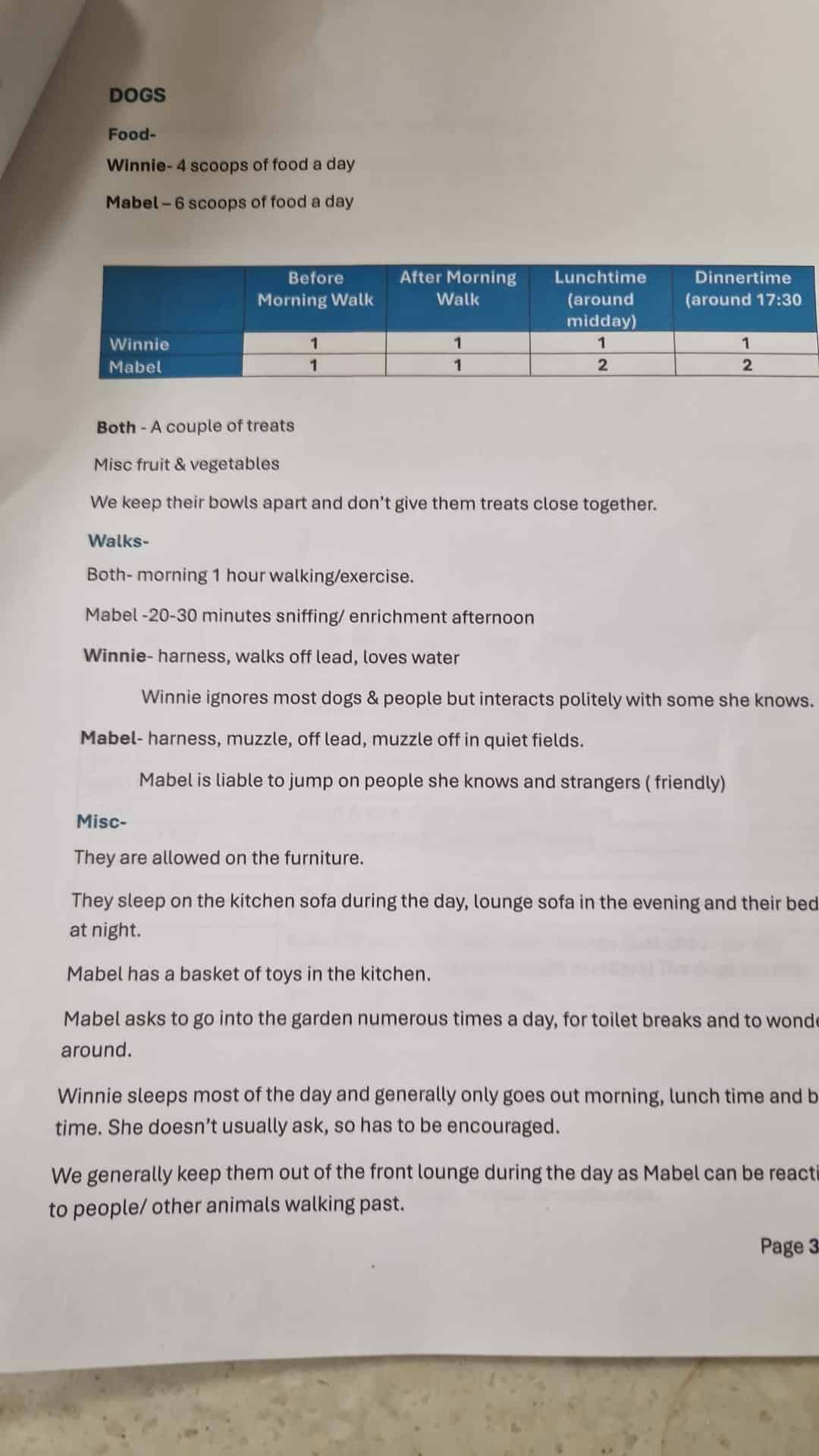
Do you need a special food container?
Not necessarily.
If your existing food storage is clean, secure and works well, there’s no reason to replace it.
For a house sit, I find it helpful when the food is easy to locate, and the correct measuring equipment is nearby.
If you’re taking food to a boarder, use whatever suitable container the carer has requested.
My Dog Food and Nutrition Hub covers complete food, portion sizes and practical feeding advice.
2. Prepare Medication and Veterinary Information
If your dog needs medication, don’t leave the sitter relying on memory.
Write everything down.
Include:
- Medication name
- Prescribed dose
- Exact times or permitted time window
- How it is given
- Whether it needs food
- Storage requirements
- Prescribing veterinary practice
- What your vet has instructed you to do if a dose is refused or missed
Keep medication in its original labelled packaging where possible.
Make sure there is enough for the booking, together with a sensible contingency plan for delays.
Never expect a pet sitter to decide whether to change, repeat or stop a prescribed dose.
Those decisions need veterinary advice.
Tell the sitter how medication is normally given
A dog who happily takes a tablet in a small amount of suitable food may have a very different experience from one who becomes frightened or defensive when handled.
Explain what normally works.
If medication has previously caused guarding, snapping or distress, discuss that before booking.
Some medical procedures may require a veterinary professional or a carer with specific competence and insurance cover.
Don’t assume every sitter can provide every form of treatment.
Leave the veterinary details
Your instructions should include:
- Normal veterinary practice
- Telephone number
- Out-of-hours emergency arrangements
- Relevant medical history
- Pet insurance information where appropriate
- Agreed emergency veterinary authority and expenditure arrangements
Make sure your sitter understands who to contact if you cannot be reached.
The RSPCA’s advice about leaving pets in someone else’s care recommends providing clear care instructions, veterinary information and emergency contacts.
3. Check Your Dog’s Lead, Harness and Collar
I take equipment checks seriously because a small fault can become a big problem when something unexpected happens.
Before a booking, check:
- Harness fit
- Collar fit
- Lead stitching
- Clips and buckles
- Attachment rings
- Identification tag
- Spare lead
- Any agreed backup safety connection
A harness that fitted well six months ago may no longer be suitable.
Puppies grow, older dogs can change shape, and equipment gradually wears.
I would rather discover that a clip is unreliable at home than when walking beside a busy North London road.
My Checking Dog Walking Equipment Before Every Walk guide explains exactly what to inspect.
A suitable everyday lead
One lead I recommend considering is the Halti double-ended Training Lead.
Its adjustable arrangement can be useful for everyday walking, provided it suits the dog and is used correctly.
View the Halti Training Lead on Amazon UK
If your dog already has a comfortable, secure lead, you don’t need to buy another just for the holiday.
What about harnesses?
A properly fitted harness is particularly important for dogs who may panic or reverse when frightened.
One option worth considering is the PerfectFit modular harness.
This is a manufacturer link, not an Amazon affiliate link.
The correct fit matters more than the brand.
If you’re unsure what type of equipment would suit your dog, read my Dog Leads and Harnesses UK Guide.
4. Keep Identification and Microchip Details Current
Even with careful handling, an unexpected escape can happen.
Your dog should have the identification required by law.
In England, dogs generally need to be microchipped and registered by eight weeks of age, subject to limited exceptions.
Most dogs in public places must also wear a collar displaying the owner’s name and address, subject to specific exemptions.
Check the government’s microchipping guidance.
Before travelling, make sure:
- Your address and telephone number are correct on the microchip database.
- The ID tag is attached and readable.
- Your sitter has a recent photograph.
- Your sitter knows whether your dog has a history of escaping.
- You have discussed what to do if your dog goes missing.
Don’t leave an escape-prone dog with somebody who hasn’t been told about the risk.
5. Leave Their Normal Bed and Familiar Belongings
If your dog is staying in your home, keep their usual sleeping arrangements wherever practical.
Dogs can be particular about where they sleep.
One may prefer a bed beside the sofa.
Another might sleep upstairs.
A senior dog may need a familiar low bed with easy access and a non-slip route to reach it.
Don’t suddenly move everything because a sitter is arriving.
For dogs staying elsewhere, ask the carer whether you can bring familiar bedding.
Some kennels have specific requirements about washable bedding and what they can safely accept.
Avoid introducing unfamiliar toys
A brand-new toy isn’t necessarily the best holiday present.
If your dog hasn’t used it before, you won’t know whether they try to chew pieces off or whether it creates frustration.
I prefer familiar items that the dog already enjoys and uses safely.
6. Write Down Your Dog’s Normal Routine
This is probably more valuable than anything you can buy.
When I look after a dog, I want to understand what an ordinary day looks like for them.
Write down:
- Normal waking time
- Breakfast and dinner
- Toilet opportunities
- Walking times
- Preferred walking routes
- Where they normally sleep
- When they usually rest
- Their normal play and enrichment
- Anything that upsets them
- How long they’re comfortable being left alone
Try to be realistic.
If your dog normally sleeps most of the afternoon, your sitter doesn’t need to keep entertaining them.
If your dog needs a toilet break soon after eating, say so.
If they are nervous around particular dogs or sounds, include that information.
How long can your dog be left alone?
Don’t assume that booking overnight house sitting automatically means somebody will remain inside your home for 24 hours.
Under my standard house-sitting arrangement, agreed daytime absences can be up to four continuous hours.
Pets needing much more constant company require a different arrangement.
My Does a House Sitter Stay All Day? guide explains the distinction.
Agree the arrangements before travelling, particularly if your dog has separation-related difficulties, medical needs or requires frequent supervision.
7. Explain Behaviour, Fears and Handling Needs
This is especially important for nervous, rescue and reactive dogs.
Some owners worry that mentioning behaviour problems will make a sitter refuse the booking.
But withholding information can put the dog and the carer at risk.
Be clear if your dog:
- Barks or lunges at other dogs
- Is frightened of traffic
- Guards food or toys
- Dislikes being touched in certain places
- Has snapped or bitten
- Becomes worried when left alone
- Tries to escape through doors
- Reacts strongly to visitors
- Is frightened of fireworks or thunderstorms
- Needs extra distance from unfamiliar people
Tell the sitter what you normally do to help.
For example, if your dog is nervous near busy roads, explain which quiet routes work better.
If they need a double-ended lead and backup attachment, show how to fit it.
Don’t expect a sitter to introduce new behaviour training while you’re away.
The priority should be keeping your dog safe and following the care plan you’ve agreed.
My Rescue Dog Starter Kit explains some of the preparation that can help nervous dogs.
8. Prepare Familiar Enrichment and Suitable Treats
Enrichment can be useful during a house sit, but it doesn’t mean your dog needs constant entertainment.
Some dogs enjoy food puzzles.
Others prefer a sniff around the garden, a familiar chew or a quiet afternoon sleeping.
If you leave toys, explain:
- Which ones your dog normally enjoys
- Whether they require supervision
- What food can be used
- Whether they guard particular toys
- Whether any toys should be removed after use
A KONG for familiar food enrichment
A correctly sized KONG Classic may be useful for dogs who already enjoy food-stuffable toys.
It can provide a suitable food activity when used with familiar ingredients and under appropriate supervision.
View the KONG Classic on Amazon UK (affiliate link, exact size and listing to verify).
I wouldn’t introduce a completely unfamiliar, tightly stuffed toy on the first day of a house-sitting booking.
For size and filling advice, see my Complete Guide to KONG Toys.
You can also try simple activities from my Dog Enrichment Hub.
9. Don’t Forget Everyday Supplies
These are the items people occasionally overlook because they’re so familiar.
Make sure the sitter can find:
- Poo bags
- Towels
- Cleaning products suitable for the home and pets
- Spare bedding where needed
- Grooming equipment your dog already tolerates
- Food and water bowls
- Treats
- Lead and harness
- A suitable first-aid kit
- Dog-safe cleaning materials
- Any mobility equipment your dog normally uses
For dogs staying elsewhere, ask the carer which supplies they provide and which you need to pack.
A kennel may supply bowls and bedding.
A relative may need you to bring everything.
Agree rather than assume.
10. Prepare Your Home for a House Sitter
When a sitter stays in your home, the preparation goes beyond pet equipment.
You should also explain how the property works.
That includes:
- Keys and alarms
- Front and back doors
- Garden gates
- Heating and cooling
- Wi-Fi where needed
- Bin arrangements
- Other people who may visit
- Deliveries
- Emergency access
- Any home security concerns
Test the keys before travelling.
If your dog is likely to rush towards an open door, make that very clear.
Cameras and privacy
Discuss security cameras before the booking.
A sitter should know which cameras are operating, where they’re located and who can access the recordings.
Cameras must not intrude into bedrooms, bathrooms or other private spaces provided for the sitter.
You can find a much more detailed home-preparation checklist in my Homeowner’s Pet-Sitter Checklist.
11. Plan for Delayed Returns and Emergencies
Flights are delayed.
Trains are cancelled.
People become ill.
Even a well-organised holiday can change unexpectedly.
That’s why I recommend having a practical backup plan.
Make sure your sitter knows:
- Your expected return date and time
- What to do if you cannot return
- Who can authorise agreed emergency arrangements
- Where additional food can be obtained
- How medication supplies would be managed
- Your preferred veterinary practice
- Who can help if the original sitter becomes unavailable
Try to choose a local emergency contact who can genuinely help.
Don’t simply list someone because they’re related to you.
My Emergency Pet Care Plan Guide goes into this in more detail.
12. Extra Preparation for Senior Dogs
Older dogs may need a more detailed care plan.
Some require:
- Shorter walks
- More frequent toilet breaks
- Medication at particular times
- Help avoiding slippery floors
- Extra rest
- Changes to sleeping arrangements
- Careful monitoring of appetite and drinking
Tell the sitter what is normal.
If your dog has started hesitating before using the stairs or needs extra time to get up, don’t leave that information out.
A new carer may not recognise these changes unless you’ve explained them.
My Holiday Care for Senior Dogs guide explains how to choose suitable arrangements for older pets.
13. Seasonal Extras
Summer holidays
During hot weather, make sure your sitter understands:
- Which rooms stay coolest
- When walks should be shortened or cancelled
- Where fresh water is kept
- Safe ventilation arrangements
- Whether your dog has any heat-related health risks
Water bottles and cooling mats don’t make unsafe temperatures safe.
Changing the walk or allowing your dog to rest indoors may be more appropriate.
Winter and Christmas
In colder weather, discuss:
- Any coat your dog normally wears
- Road salt and paw care
- Safe walking routes after dark
- Heating instructions
- Fireworks around Christmas and New Year
- Your dog’s response to visitors and seasonal decorations
Avoid introducing unfamiliar festive foods or treats while you’re away.
For more information, visit my Seasonal Pet Safety Hub.
Your Complete Dog Staycation Checklist
Use this list a few days before leaving.
Food and feeding
- Enough normal food for the stay
- Reserve food for travel delays
- Written portion sizes
- Feeding times
- Food storage instructions
- Approved treats
- Allergy and dietary information
Health and medication
- Medication in labelled packaging
- Written medication instructions
- Veterinary contact details
- Emergency veterinary arrangements
- Insurance information
- Agreed emergency authorisation
- Alternative emergency contact
Walking and safety
- Well-fitting harness
- Secure collar and identification
- Main lead
- Spare lead
- Any agreed safety connector
- Poo bags
- Normal walking routine
- Escape risks explained
- Microchip details checked
Comfort and enrichment
- Usual bedding
- Familiar toys
- Suitable enrichment
- Approved food fillings
- Grooming instructions
- Sleeping arrangements
- Normal rest routine
Home arrangements
- Keys tested
- Alarm instructions
- Doors and garden gates explained
- Heating and cooling instructions
- Camera arrangements agreed
- Household contacts
- Return travel details
- Contingency plan
You can copy the checklist into a note or print it and tick off each item.
Equipment I Recommend
You don’t need to buy a whole collection of products before a house-sitting booking.
If you already have suitable, safe equipment, keep using it.
These are two optional products I have mentioned in the guide:
| Product | Why it may be useful |
|---|---|
| Halti double-ended Training Lead (affiliate) | Adjustable everyday walking arrangements |
| KONG Classic (affiliate) | Familiar food enrichment for suitable dogs |
Check the exact model, size and suitability before ordering.
You can find more information in my Recommended Dog and Pet Products guide.
Frequently Asked Questions
What should I leave for a dog sitter?
Leave your dog’s normal food, medication, bedding, walking equipment, routine, veterinary information, emergency contacts and clear household instructions. The exact supplies depend on whether the sitter stays in your home or looks after your dog elsewhere.
Do I need to buy new toys for my dog before going away?
No. Familiar toys that your dog already uses safely are generally a better starting point than introducing a collection of unfamiliar products.
Should I pack my dog’s normal food for boarding?
Usually, keeping their familiar diet is sensible. Ask the boarder or kennel how much food you should provide and how they want it packaged.
What if my dog needs medication?
Discuss the medication before booking. Leave clear instructions and make sure the person providing care is willing, competent and appropriately insured to carry out the agreed task.
Should I leave my dog’s microchip number?
It’s sensible to ensure the sitter has access to the necessary identification and emergency information. Most importantly, keep your contact details up to date in the microchip database.
Does a house sitter stay with my dog all day?
Not necessarily. Standard overnight care may include agreed daytime absences. If your dog needs more continuous supervision, arrange that before booking.
Is house sitting better than boarding?
It depends on the individual dog. Some settle happily in boarding environments. Others, especially nervous or older dogs, may benefit from remaining in familiar surroundings with suitable care.
What if my return journey is delayed?
Agree a contingency plan before travelling. Leave additional food, clear emergency contacts and arrangements for medication and continued care.
Should I leave a first-aid kit?
Yes, it’s useful to have a suitable first-aid kit accessible, but the sitter should know when to contact a veterinary professional rather than attempting treatment beyond their competence.
My Approach to House Sitting in Finchley
When I provide house sitting, I want the pets to have a familiar, predictable routine.
That means knowing when they eat, where they normally sleep, what their usual walks involve and anything that might cause them concern.
For some dogs, that means an ordinary daily walk and a quiet evening.
For an older dog, it might mean several short outings, time to sniff and a comfortable place to rest.
For a nervous rescue dog, I may need to adapt the route or allow extra space around unfamiliar dogs and people.
I care for one house-sitting household at a time.
I don’t bring unfamiliar dogs into your home, and I don’t use group walks or transport vans.
My aim is to provide practical, individual care that fits the dog in front of me.
Need House Sitting in Finchley or Muswell Hill?
I’m Del Chambers, owner of Finchley Dog Walker.
I’ve provided professional dog walking and pet care around Finchley and North London since 2011.
I offer overnight house sitting for suitable households, including those with nervous dogs, rescue pets, senior animals, cats and other appropriate small pets.
My service is provided in your home rather than boarding dogs at my property.
Before a booking, I arrange a meet-and-greet so we can discuss the pets, their routine, the property and any particular requirements.
You can read about my House Sitting Service or send me a WhatsApp message.
Please include your postcode, travel dates, pets and any important care requirements.
Related Guides
- House Sitting in Finchley and North London
- How to Prepare Your Home for a Pet Sitter
- Does a House Sitter Stay All Day?
- A Day in the Life of a Finchley House Sitter
- Holiday Care for Senior Dogs
- Boarding Your Dog: Choosing the Right Care
- Emergency Pet Care Plan
- Checking Your Dog’s Walking Equipment
- Recommended Dog and Pet Products
About the Author
I’m Del Chambers, owner of Finchley Dog Walker.
Since 2011, I’ve provided professional one-to-one dog walking and pet care in Finchley, Muswell Hill and surrounding parts of North London.
My experience includes house sitting, caring for rescue and nervous dogs, senior pets and multi-pet households.
I hold an Ofqual Level 3 qualification in Canine First Aid and undertake continuing professional development in canine welfare, body language and reward-based handling.
My advice combines everyday practical experience with established animal welfare guidance.
Veterinary and Affiliate Disclaimer
This article provides general pet-care and holiday preparation information. It does not replace veterinary advice, medical treatment or an individual behavioural assessment.
Always discuss medication, medical conditions and emergency requirements with your veterinary practice and chosen pet-care provider.
Some links are Amazon affiliate links. As an Amazon Associate, I earn from qualifying purchases. Product models, availability and prices may change. Check the exact product and its suitability before ordering.
First published: 3 April 2026
Substantially updated: 2 November 2026