
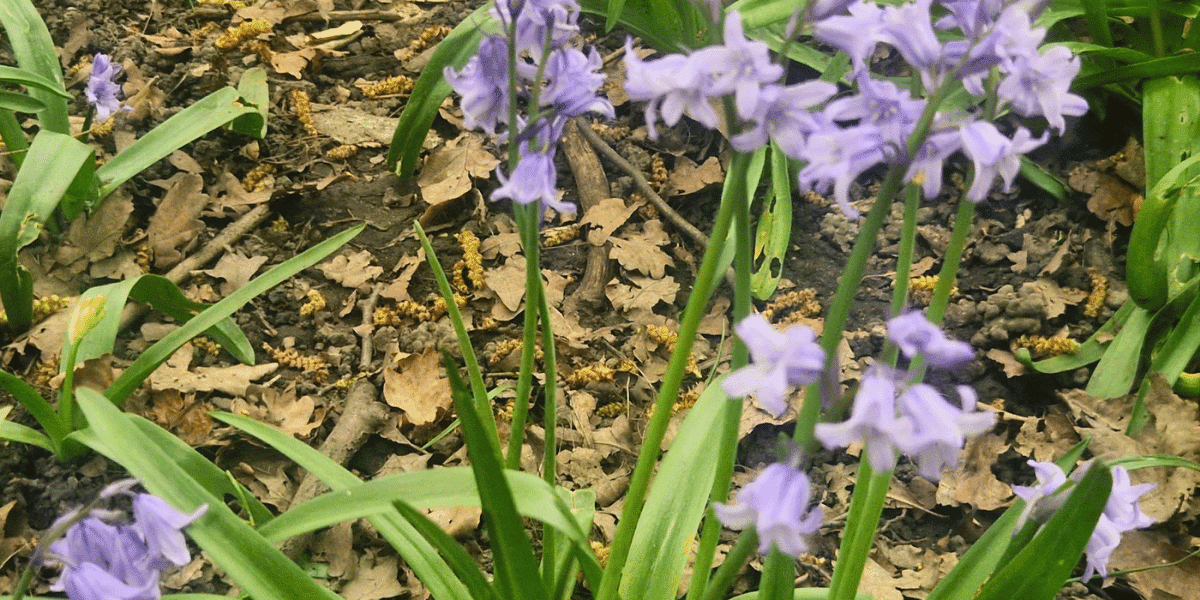
What I Want You to Know Before Spring Walks
This article is based on practical experience and general UK guidance. It is not a substitute for veterinary advice. If you think your dog has eaten bluebells or is unwell, contact your vet straight away.
Spring walks can be brilliant for dogs. The ground is softer, the air feels lighter, and the woods start to come alive again.
But bluebell season brings a question I hear every year. Are bluebells dangerous for dogs?
The short answer is yes, they can be. That does not mean you need to avoid every bluebell wood. It means you need to walk with a bit more care. This is the same with our spring plants and flowers
In practice, most dogs are far more interested in scents, mud, squirrels and whatever another dog left behind than they are in eating bluebells. But curious puppies, dogs that like chewing plants, and dogs that scoop up random things on walks can be a different story. I am always a bit more alert in spring for that reason.
When bluebells are out, I focus on three things. I keep my dog close if I know he is likely to nose around plants. I stick to the paths so we do not trample flowers. And I pay attention to any change in behaviour when we get home.
If you want more seasonal pet care advice, have a look at my dog and cat care guides for practical, everyday tips.
This post may include affiliate links. If you buy through them, I may earn a small commission at no extra cost to you.
Are bluebells poisonous to dogs?
Yes. Bluebells are not a plant I would let a dog chew or dig around. The main risk is if a dog eats part of the plant, especially bulbs.
Signs to watch for can include vomiting, diarrhoea, drooling, stomach pain, or unusual tiredness. If enough has been eaten, symptoms may be more serious.
If your dog has only brushed past bluebells, that is not the same as eating them. I would not panic over normal contact on a walk. But if your dog has chewed leaves, mouthed flowers, dug at bulbs, or come home showing symptoms, I would ring your vet.
You can also read the RSPCA’s spring pet safety advice here: [external link: RSPCA spring pet safety page]
When are bluebells out in the UK?
Bluebells usually flower in April, though you may see them from late March in the south of England, depending on the weather.
Around Finchley, North Finchley and East Finchley, you often start seeing them on woodland edges and in older wooded spots as spring settles in. If you walk in places such as Coldfall Woods, Cherry Tree Wood or Highgate Woods, it is worth assuming there may be patches of bluebells during the season and planning your walk around that.
Can dogs safely walk in woods with bluebells?
Yes, often they can, as long as you manage the walk well.
The bigger issue for many dogs is not the flower itself. It is the combination of excitement, narrow paths, wildlife scent, and owners switching off because the setting looks peaceful. I see the best walks happen when the dog knows what is expected and the owner stays present.
For some dogs, a bluebell walk is no trouble at all. For others, especially younger dogs or dogs who get over-aroused outdoors, it is better to keep things simple.
What I do on bluebell walks
I choose the route carefully
If I know a path is narrow and runs straight through a dense patch of bluebells, I may skip it that day. This matters even more with a larger dog, a young dog, or a dog that swings about at the end of the lead.
I use a longer lead only where it is sensible
In open spaces, a long line can work well. But in a woodland full of flowers, roots, and other walkers, a standard lead often provides better control.
I reward check-ins
When a dog chooses to come back to me, look at me, or move on from sniffing something, I mark that and reward it. That keeps the walk calm and stops me needing to keep repeating myself.
I avoid letting dogs barge through flowers
This is about safety, but it is also about respecting the woodland. Bluebells are slow to recover and do badly when people and dogs keep walking through them.
I keep spring walks shorter if needed
For some rescue or reactive dogs, spring brings more triggers anyway. Busier parks, picnics, children out of school, more dogs out. A shorter, steadier walk is often the better choice.
If your dog needs quieter one-to-one support outdoors, you can read more about my calm solo dog walks in Finchley
A real-world example
I have worked with dogs who were absolutely fine around bluebells and dogs who would try to investigate every leaf on the ground.
One young rescue dog I walked in Coldfallwoods had a habit of grabbing plants when he felt over-aroused. In bluebell season, I changed the route, kept him on a shorter lead through the wooded section, and gave him more simple sniff breaks on the path instead of letting him dive into the edges.
He settled much better with that clear structure.
That is usually how I handle spring risks. Not by making the walk tense, but by making it more predictable.
If that sounds familiar, you can find out more about my support for rescue and reactive dogs
Good habits for bluebell season
Stick to established paths
This helps protect the flowers and gives you more control over your dog.
Keep your dog from digging
Bulbs are among the things I worry about most if a dog is prone to digging or grabbing things from the ground.
Do not let your dog eat plants just because he seems curious
A lot of dogs sample something and seem fine. That does not make it a good habit.
Watch children too
If you are walking as a family, bluebell patches can get damaged very quickly when everyone wanders off the path.
Choose the right route for the dog in front of you
In places around Finchley and Muswell Hill, spring woodland can be lovely, but it also gets crowded. For some dogs, especially rescue dogs or reactive dogs, the safest option is not always the prettiest path. Sometimes the better walk is the quieter route with fewer people, less pressure and more space to think.
For more on bluebell season and why it matters to stay on paths, see the Woodland Trust guidance here: Woodland Trust bluebell guide
Quick checklist before heading to the woods with bluebells
- Has my dog been eating plants or sticks lately?
- Do I need a shorter lead for this route?
- Can I avoid the busiest section of the woodland?
- Do I have treats ready for calm check-ins?
- Do I know what I will do if my dog grabs something?
- Do I have my vet number saved?
Recommended essentials
These are the simple bits I find most useful in spring.
Standard walking lead
Hunte neoprene lead from zooplus
Treat pouch for quick rewards on the move
Standard teat pouch (amazon)
Long line for controlled space work in a suitable area
Easy to clean long line (amazon)
Travel water bottle for warmer spring days.
Water bottle (amazon link)
If your dog finds busy spring walks hard work, my reactive dog walking kit may help you think through what to carry and what to keep simple.
And once the weather starts to warm up properly, my hot-weather dog kit is a useful next read, too.
What to do if your dog eats bluebells
Do not wait to see how he goes.
What I would do is simple.
Move your dog away from the plant.
Check what he may have eaten.
Take a photo if you can do it quickly.
Call your vet.
Follow their advice and monitor symptoms closely.
Don’t try to make a dog sick unless a vet tells you to.
A useful number to keep on you at all times is the National Animal Poison line

Why does this matter more for some dogs than others
Not every dog is going to try to eat a flower. But some dogs are far more likely to get themselves into trouble outdoors.
That includes puppies, dogs in an excitable phase, dogs who pick things up quickly, and some rescue dogs who are still learning to settle outside.
This is one reason I keep one-to-one walks simple and calm. Dogs often make better choices when they are not dealing with too much all at once.
FAQ
Usually, sniffing near them is not the main concern. The bigger risk is chewing or eating the plant, especially bulbs. If your dog seems unwell, ring your vet.
Yes, but it is best to stay on paths, keep your dog under control, and stop him from digging or charging through flowers. That protects both your dog and the woodland.
Yes. Native bluebells are protected in the UK, which is another reason to keep dogs on paths and avoid disturbing them.
Usually April, with some flowering from late March, depending on weather and location.
Vomiting, diarrhoea, drooling and abdominal discomfort are common warning signs. In more serious cases, there may be changes to the heartbeat.
Only if your dog is reliable, calm and unlikely to run through flowers or pick things up. For many dogs, staying on a lead is the better option in bluebell season.
Final thoughts
If spring walks have started to feel a bit harder with your dog, you are not doing anything wrong. This time of year can be a lot. A calmer plan usually helps.
If you are in Finchley, North Finchley, East Finchley, Muswell Hill, or nearby, and need support, I offer solo walks, rescue support, house-sitting, cat-sitting, and small-animal care. The aim is always the same: quiet, sensible care that works for the animal in front of me.
If you found this helpful, you can support via Buy Me a Coffee.
I also recommend you read my spring dangers and stay safe on woodland walks
