DIY Dog Toys: Safe Homemade Enrichment Ideas and What to Avoid
Updated July 2026
Homemade dog toys and enrichment activities do not need to be complicated or expensive.
A towel, an open cardboard box or a few pieces of your dog’s normal food can provide a useful opportunity to sniff, search and make choices.
However, not every object from the recycling box makes a suitable dog toy.
Plastic bottles, altered balls, string, fabric and cardboard can all present risks when they are given to the wrong dog or used without close supervision.
This guide explains which simple homemade activities I am comfortable suggesting, why I do not generally recommend plastic bottle toys and how to choose an activity that suits your individual dog.
Affiliate disclaimer: This guide contains a small number of affiliate links. If you buy something through one of these links, I may receive a commission at no extra cost to you. As an Amazon Associate, I earn from qualifying purchases. You do not need to buy anything to try most of the activities in this guide.
Are plastic bottle toys safe for dogs?
Some dog owners use an intact plastic bottle as a supervised treat dispenser, but it is not suitable for every dog.
A dog that gently rolls a bottle may interact with it very differently from a dog that bites, crushes or tears plastic.
Possible risks include:
- sharp edges when the bottle splits
- pieces of plastic being swallowed
- the bottle cap or plastic ring being removed
- a dog becoming frustrated and biting the bottle
- food becoming trapped inside
- residue from the bottle’s original contents
- a dog learning that ordinary household bottles are toys
I do not recommend cutting or punching holes into a bottle for your dog. The edges may become rough or sharp, even when they initially appear smooth.
I would also avoid placing raw meat or wet food inside a homemade plastic bottle. It may be difficult to clean thoroughly, and food can become trapped in damaged areas.
Blue Cross advises constant supervision when a plastic bottle is used as a treat dispenser and says it should be removed immediately if the dog starts eating the plastic or the bottle breaks.
For FinchleyDogWalker.co.uk, the safer and more consistent recommendation is to use an open cardboard search, towel activity or purpose-made food toy instead.
Why I have changed my advice
The original version of this article suggested:
- bottles with holes cut into them
- raw meat placed inside a bottle
- a homemade bottle mechanism inside a cardboard box
- cutting an additional opening into an existing rubber ball
I would no longer recommend those activities.
My approach to enrichment has developed through years of practical work with dogs, including rescue dogs, nervous dogs and dogs that become easily overexcited.
Homemade enrichment should not be judged by how inventive it looks. It should be judged by whether it is safe, manageable and genuinely helpful for the dog using it.
A very simple activity is often better than a complicated homemade toy.
Homemade dog-toy safety rules
Before using any household object for enrichment:
- supervise your dog throughout
- choose objects too large to swallow
- remove tape, staples, string and plastic windows
- avoid brittle or damaged materials
- do not use containers that held chemicals or cleaning products
- use a stable, non-slip surface
- remove the activity if your dog begins eating it
- keep children away from dogs using food enrichment
- separate dogs when food is involved
- make the activity easy at first
- stop if your dog appears worried or frustrated
Dogs Trust recommends considering the dog’s health, abilities, preferences and dietary needs before choosing an enrichment activity. It also advises close supervision with homemade food enrichment. Read the Dogs Trust enrichment guidance. (Dogs Trust)
Take food used during games from your dog’s normal daily allowance where appropriate. This helps prevent enrichment from quietly adding a large number of extra calories.
Speak to your vet before changing your dog’s feeding routine if they have allergies, digestive problems, pancreatitis, diabetes, kidney disease, dental pain or a prescribed diet.
Eight simple DIY enrichment activities
These are starting activities rather than challenges your dog must complete.
Choose one and watch what your dog does.
1. The flat towel search
Place a clean towel flat on a non-slip floor.
Put several pieces of your dog’s normal dry food openly on the towel and allow them to search.
There is no need to fold, roll or knot it during the first session.
Remove the towel if your dog starts biting, pulling or swallowing the fabric.
2. The open cardboard box
Remove all tape, staples, labels and plastic from a clean cardboard box.
Place the box on its side or upright with several visible pieces of food inside.
A shallow box may be easier for:
- small dogs
- puppies
- senior dogs
- flat-faced dogs
- nervous dogs
- dogs with reduced mobility
Your dog should not need to tear through several layers to reach the food.
3. The beginner muffin-tin game
Use a clean muffin tray and place food in several open sections.
Leave every section uncovered at first.
Once your dog understands the activity, you can cover one or two sections with appropriately sized dog toys that cannot be swallowed.
Do not cover every section immediately. The game should continue to offer easy success.
Read my complete guide to the muffin-tin enrichment game for dogs.
4. A short treat trail
Place several pieces of food in a short, visible trail across one room.
The trail might lead towards:
- your dog’s bed
- their usual food bowl
- a familiar toy
- the garden door
- another person they know well
Keep the first trail obvious.
Do not hide food beneath heavy furniture or anywhere your dog could become trapped.
5. Find a familiar toy
Let your dog watch you place a favourite toy partly behind a doorway or chair.
Encourage them to find it.
Gradually make the hiding place slightly less obvious, but keep the toy easy to reach.
This can be useful for dogs that enjoy toys more than food.
6. The open paper-cup search
Place two or three plain paper cups upright on the floor.
Put a piece of food inside one cup while your dog watches.
Allow your dog to sniff and investigate.
Use cups large enough that your dog cannot swallow them. Remove them if your dog begins tearing or eating the paper.
Do not use brittle plastic, glass or ceramic cups.
7. Open cardboard tubes
Place several clean cardboard kitchen-roll tubes on the floor with both ends completely open.
Put food inside some of the tubes where your dog can see it.
Do not:
- fold the ends closed
- tie tubes together
- add string
- use elastic bands
- seal them with tape
Remove the tubes if your dog swallows cardboard rather than simply moving or tearing it.
8. Choosing between two toys
Place two familiar dog toys several feet apart.
Allow your dog to decide which one they want to investigate.
Play gently with the toy they select.
Do not repeatedly redirect them towards the toy you prefer. Having a genuine choice can be enriching in itself.
For many more low-cost ideas, visit my guide to 50 easy dog enrichment activities using household items.
Household items I would avoid
I would not use:
- plastic bottles with holes cut or punched into them
- damaged or crushed bottles
- loose bottle caps
- the small plastic ring beneath a bottle cap
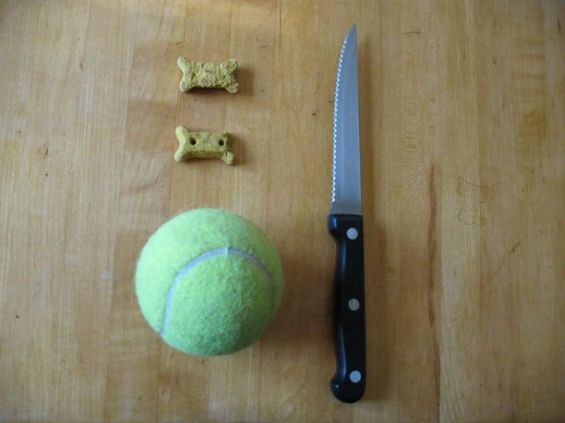
- altered tennis balls
- rubber toys with homemade holes
- plastic carrier bags
- elastic bands
- string, ribbon or wool
- tightly knotted towels
- frayed rope
- glass jars
- sharp tins
- brittle food containers
- containers that held chemicals
- old batteries or electrical items
- objects small enough to swallow
- old socks for dogs that already steal clothing
Something being free does not automatically make it safe.
When an object needs to be cut, punctured, glued, tied or substantially altered, a purpose-made dog toy is often the better option.
How to introduce a homemade activity
Begin at the easiest level.
Let your dog see the food. Use an open box before introducing paper. Place food openly on a towel before adding a loose fold.
A first session may last less than two minutes.
Allow your dog to move away. Do not repeatedly push the object towards them or place their head or paws into it.
Your dog does not need to finish every piece of food for the activity to have been worthwhile.
Helping your dog succeed does not spoil the game.
Signs the game is too difficult
Make the activity easier or stop if your dog:
- barks repeatedly at it
- bites or throws the object
- paws at it frantically
- repeatedly looks to you for help
- freezes or backs away
- loses interest and walks off
- begins swallowing material
- becomes possessive
- cannot settle afterwards
- appears physically uncomfortable
Enrichment should not create frustration to keep a dog occupied for longer.
Some dogs enjoy solving puzzles. Others prefer sniffing food from an open towel or exploring the environment during a calm walk.
Both are valid.
Read my guide to dog enrichment safety and frustration before introducing more complicated puzzles.
DIY enrichment for puppies
Puppies explore with their mouths, so household materials require particularly close supervision.
Begin with:
- one visible piece of food
- a flat towel search
- a shallow open box
- choosing between two suitable toys
- a short treat trail
- one minute of simple reward-based training
Avoid complicated destruction games.
Puppies also need:
- regular toilet breaks
- suitable opportunities to chew
- gentle exploration
- predictable routines
- human interaction
- plenty of uninterrupted sleep
Stop before your puppy becomes frantic, overtired or increasingly mouthy.
Enrichment for nervous and rescue dogs
A nervous rescue dog may not understand a homemade toy or puzzle.
An unfamiliar box, rattling muffin tin or moving bottle can be worrying rather than entertaining.
Begin with:
- food placed openly on the floor
- a flat towel
- one shallow box
- a familiar toy
- a trusted person
- quiet observation from a safe place
Allow your dog to investigate at their own pace.
Do not lure a frightened dog towards an object they are trying to avoid. Move the object further away or choose a different activity.
My guide to low-pressure enrichment for nervous and rescue dogs explains how to introduce activities without turning them into confidence tests.
I also offer rescue dog support in Finchley for dogs that benefit from calm, patient and consistent handling.
Activities for senior dogs
Older dogs can still enjoy searching, sniffing, learning and making choices.
Adapt the activity around:
- mobility
- balance
- eyesight
- hearing
- dental health
- pain
- medication
- cognitive changes
- recovery time
Use shallow containers and non-slip flooring.
Suitable starting activities may include:
- food placed on a flat towel
- a short treat trail
- an open muffin tray
- choosing between two familiar toys
- food in two easy locations
- calm observation from a comfortable bed
Do not assume an indoor game is physically harmless. Repeated bending, twisting, pawing and standing may be unsuitable for a dog with pain or movement restrictions.
Read my senior dog exercise and enrichment guide.
When a purpose-made toy is safer
A reusable dog toy may be safer when your dog:
- bites through household objects
- swallows cardboard or fabric
- becomes highly excited around moving bottles
- needs a toy of a specific size
- requires something easier to clean
- needs a more durable food dispenser
- is likely to be left with the item for more than a brief session
Possible alternatives include:
KONG Classic
A correctly sized KONG can provide a durable alternative to a homemade bottle dispenser.
Start with loose food rather than packing it tightly. Supervise your dog and remove the toy if the rubber becomes damaged.
[Insert the existing Amazon UK affiliate link for the KONG Classic]
Read my complete guide to choosing and filling KONG toys.
LickiMat
A suitable lick mat can provide a reusable alternative to spreading food on household plastic or fabric.
Use a thin layer of suitable food and supervise your dog. Remove it if they fold, bite or chew the mat.
[Insert the existing Amazon UK affiliate link for the LickiMat Classic]
Snuffle mat
A snuffle mat may suit a dog that enjoys searching through towels or blankets.
It is not appropriate for dogs that tear and swallow fabric.
[Insert the existing Amazon UK affiliate link for the recommended snuffle mat]
You do not need to buy all three. Choose one item only when it suits a genuine need and the way your dog interacts with toys.
What should I do if my dog swallows part of a toy?
Contact your vet immediately if you think your dog has swallowed plastic, rubber, fabric, string or another part of a toy.
Do not wait for symptoms to develop and do not try to make your dog vomit unless your vet specifically instructs you to do so.
Foreign objects can cause choking, internal injury or a blockage. PDSA advises contacting a vet immediately after a dog eats something potentially harmful and warns that blockages can be extremely serious. Read the PDSA guidance on dogs eating harmful objects.
Possible warning signs include:
- vomiting
- reduced appetite
- low energy
- abdominal discomfort
- difficulty passing faeces
- repeated straining
- changes in behaviour
Do not rely on the absence of symptoms. Contact your vet for advice.
Frequently asked questions
Can dogs play with empty plastic bottles?
Some dogs may gently roll an intact bottle under close supervision, but others immediately crush, bite or tear it.
Because plastic can split and create sharp edges, I prefer safer activities such as an open-box search or a correctly sized, purpose-made food toy.
Never leave a dog alone with a plastic bottle.
Should I put a plastic bottle inside a sock?
I do not recommend this.
The fabric can hide damage to the bottle, while some dogs may tear and swallow the sock. It may also encourage dogs to treat ordinary socks and clothing as toys.
Can I cut holes in a bottle to make a treat dispenser?
I would not.
Cut or punctured plastic can leave rough or sharp edges. A purpose-made food dispenser is easier to inspect and usually easier to clean.
Can I leave my dog alone with a homemade toy?
Cardboard, paper, fabric and recycling activities should generally remain supervised.
Even an activity that appears safe initially may become unsafe when a dog begins chewing, tearing or swallowing the material.
Are homemade toys suitable for heavy chewers?
Usually not.
Heavy chewers may quickly destroy cardboard, fabric and thin plastic. Choose a suitably sized, purpose-made toy designed for the dog’s chewing style and supervise its use.
Can I use a tennis ball in a homemade puzzle?
I would avoid altering, cutting or puncturing a tennis ball.
Any ball used around a dog should be large enough not to become lodged in the mouth or throat and should be removed when damaged. PDSA recommends choosing appropriately sized, durable dog toys and replacing cracked or torn balls. (PDSA)
How long should an enrichment session last?
There is no required length.
A useful session may last one or two minutes. Stop while your dog remains comfortable rather than trying to keep them occupied for as long as possible.
Does enrichment replace a walk?
No.
Indoor enrichment can complement exercise or help on days when a normal walk must be shortened. However, dogs still need suitable opportunities for movement, toileting, sniffing and experiencing the outside world.
Read my complete guide to dog walking and everyday exercise.
My approach to homemade enrichment
I use enrichment to support a dog’s wellbeing, not to test how clever they are.
The best activity is one that suits the dog in front of you.
That may be:
- sniffing three pieces of food from a towel
- investigating an open box
- choosing between two toys
- searching for a familiar person
- using a purpose-made food toy
- taking a slow sniff walk
- resting without being disturbed
Simple is not inferior.
A calm dog that succeeds easily has gained more from the activity than a frustrated dog struggling with an impressive-looking homemade puzzle.
Related dog-enrichment guides
Continue with:
- 50 Easy Dog Enrichment Ideas Using Household Items
- Complete Dog Enrichment Guide
- Dog Enrichment Safety and Frustration
- The Muffin-Tin Game for Dogs
- Creating a Scent Box for Dogs
- Best Enrichment Toys for Rescue Dogs
- How to Clean Dog Toys Safely
Calm one-to-one support in Finchley
Enrichment can be part of a calm, individual routine rather than a replacement for attention, suitable exercise and rest.
I offer one-to-one dog walks and rescue dog support in Finchley, North Finchley, East Finchley, Finchley Central and parts of Muswell Hill.
There are no vans, group collections or pressure for your dog to keep pace with several others.
Learn more about my solo dog walks in Finchley or contact me to discuss your dog’s needs.
Final thoughts
Homemade dog enrichment can be useful, affordable and easy to adapt.
However, not every household object should become a dog toy.
I do not generally recommend plastic bottle toys, particularly bottles that have been cut, punctured or filled with food. Safer starting options include a flat towel, an open cardboard box, a visible treat trail, or a purpose-made food toy.
Supervise every homemade activity; start and remove anything your dog begins to damage or swallow.
The activity should fit your dog.
Your dog should never be expected to fit the activity.
Veterinary disclaimer
I am a professional dog walker with an Ofqual Level 3 Canine First Aid qualification, but I am not a veterinary surgeon.
This guide provides general educational information and does not replace individual veterinary advice, diagnosis or treatment. Under the Veterinary Surgeons Act 1966, veterinary diagnosis and treatment must be provided by an appropriately qualified veterinary professional.
Contact your vet immediately if your dog has swallowed plastic, rubber, fabric, string or part of a toy.