Sometimes the best dog enrichment ideas are the simplest.
You don’t need an expensive puzzle toy, a cupboard full of equipment or a complicated training plan to give your dog something interesting to do.
A muffin tin, a little of their usual food and a few minutes of your time can be enough.
I’ve worked with dogs professionally around Finchley and Muswell Hill since 2011, and I’ve learnt that not every dog needs more excitement.
Some need a chance to slow down, use their nose, and work something out at their own pace.
The muffin tin game is a simple food-search activity that you can adapt to different dogs. It can be useful on rainy days, during hot weather or whenever you want to offer something different from another energetic game.
Here’s how to set it up safely, make it easier or harder, and recognise when your dog has had enough.
Affiliate disclosure: This guide contains Amazon affiliate links. If you buy through one, I may earn a small commission at no extra cost to you. As an Amazon Associate, I earn from qualifying purchases. You don’t need to buy anything to play the muffin tin game, and a commercial product is not automatically more suitable for your dog.
Key Takeaways
- The muffin tin game uses a cupcake tray and small pieces of dog food to encourage sniffing and problem-solving.
- Start with uncovered food before introducing objects your dog needs to move.
- Use only suitable, correctly sized and undamaged toys, and supervise throughout.
- Keep the activity easy enough for your dog to enjoy without frustration.
- Puppies, senior dogs and nervous dogs may benefit from a simpler version.
- Food used for enrichment still counts towards your dog’s daily allowance.
- Stop if your dog starts chewing equipment, guarding food or becoming distressed.
What Is the Muffin Tin Game for Dogs?
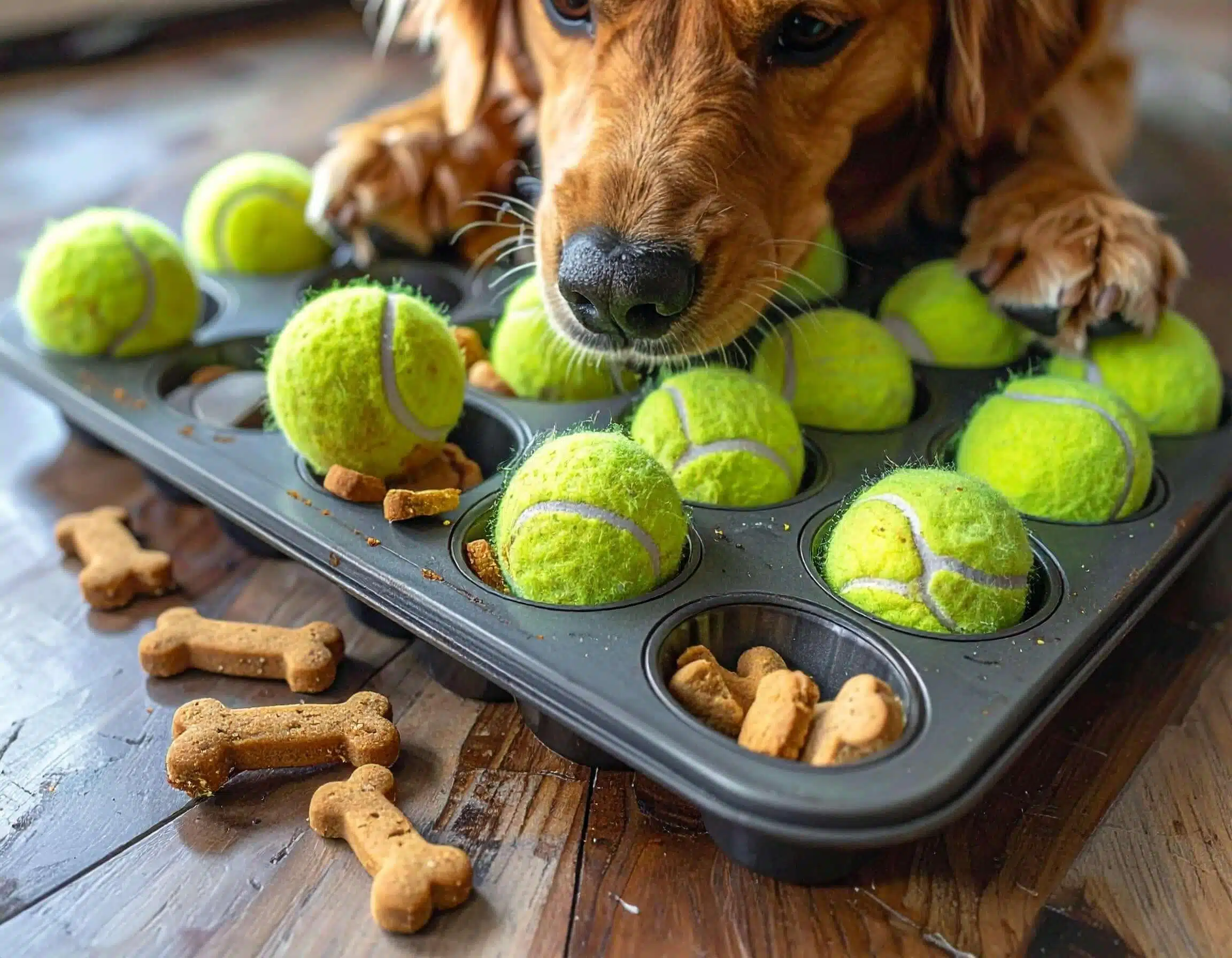
The muffin tin game is an indoor food-search activity made using an ordinary baking tray.
Place a few pieces of your dog’s food in the compartments and let them find it.
Once they understand the activity, you can cover some compartments with suitable objects that they can safely move aside.
Your dog then has to investigate where the food is hidden.
They may use their nose to locate it, gently move an object or work out which compartments contain something worth finding.
The purpose isn’t to make the puzzle as difficult as possible.
It’s to provide an enjoyable opportunity to sniff, search and make choices.
Dogs Trust includes a muffin-tin hide-and-seek game among its homemade dog enrichment activities.
The ASPCA also describes the muffin tin puzzle as a DIY enrichment activity.
These activities can be useful, but they aren’t a substitute for appropriate exercise, rest, social contact or veterinary care.
For a wider explanation, see my Dog Enrichment Guide.
Why I Like Simple Food-Search Games
When people talk about tiring dogs out, they often focus on physical exercise.
Longer walks. More running. More ball throwing.
But dogs need different types of activity.
A good routine gives them opportunities to move, rest, explore, sniff, interact and use their natural behaviours.
Food-search games can contribute to that.
They may help your dog:
- Practise sniffing and searching
- Explore food in a different way
- Solve a manageable problem
- Make choices without constant instructions
- Enjoy an activity at home
- Experience something new without a lot of physical effort
Some dogs settle comfortably after a short enrichment activity.
Others become excited or want to keep playing.
Neither response means you should automatically make the game harder or keep it going longer.
I pay attention to the individual dog rather than assuming enrichment always produces calm behaviour.
My Sniff and Decompress Guide explores why giving dogs opportunities to use their noses can be valuable during walks too.
What You Need for the Muffin Tin Game
You probably already have everything at home.
Essential equipment
- A clean muffin or cupcake tray
- A few pieces of your dog’s normal kibble or suitable treats
- A stable, non-slip surface
- A little time to supervise
That’s enough for the beginner version.
Optional equipment
Once your dog understands the game, you may introduce:
- Suitable dog-safe balls that are too large to swallow
- Other lightweight, safe objects your dog can move without chewing or swallowing
- Different approved foods for a more interesting scent search
A six-hole muffin tray is often enough. You don’t need a large baking tray.
Check that the tray has no damaged coating, rust, sharp edges or loose components.
If it slides around on the floor, place it on a suitable non-slip surface.
I would avoid using a hot tray straight from the oven. The equipment should be clean and at room temperature before your dog investigates.
What food should you use?
For most dogs, I would start with their normal dry food.
It keeps things simple and avoids unnecessary extras.
Other possibilities include:
- Small pieces of suitable commercial dog treats
- A little plain cooked chicken, if tolerated
- Appropriately sized fish-based dog treats
- Other food already known to be safe for your individual dog
Avoid introducing unfamiliar rich foods to make a puzzle more exciting.
If your dog has allergies, digestive problems, pancreatitis, or a veterinary prescription diet, follow your vet’s advice.
Read more in my Best Dog Training Treats UK Guide.
How to Play the Muffin Tin Game: Step by Step
I recommend starting with the easiest version, even if your dog normally enjoys food puzzles.
Step 1. Put the tray somewhere comfortable
Choose a quiet part of your home where your dog feels relaxed.
Place the tray on the floor where it won’t slide or tip easily.
Keep other pets away if they might compete for the food.
You want your dog to feel comfortable exploring, not worried that another animal will take their reward.
Step 2. Add a few pieces of food
Place one or two pieces of kibble in several compartments.
Leave the food visible.
You don’t need to fill every hole.
At this stage, your dog is simply learning that investigating the tray leads to something rewarding.
Step 3. Let your dog explore
Allow your dog to approach in their own time.
Some dogs will immediately investigate every compartment.
Others may pause and look at you.
That’s fine.
You can make the activity easier by placing a piece of food near the edge of the tray or offering a treat beside it.
Avoid pushing your dog towards the equipment.
Step 4. Introduce a small challenge
Once your dog is confidently finding the uncovered food, you can cover one compartment with a suitable object.
Choose something safe for your dog’s size and chewing behaviour.
A ball that is small enough to be swallowed, chewed into pieces or become lodged in the mouth is not suitable.
If you cannot find an appropriately sized object, keep playing the uncovered version or use a different enrichment activity.
Your dog may nudge or gently move the object to uncover the food.
Keep the remaining compartments uncovered at first.
Step 5. Let your dog solve the problem
Give your dog time to investigate.
You don’t need to tell them exactly what to do.
If they seem unsure, make the puzzle easier.
You might remove the covering object so they can access the reward, then try again.
The aim is success, not persistence at any cost.
Step 6. Finish while your dog is comfortable
Once your dog has found the food, remove the tray and any loose objects.
A few minutes may be enough.
There is no minimum amount of time your dog needs to spend playing.
Some dogs may enjoy another round, but others will be ready for a drink and a rest.
Watch their behaviour and finish before they become frustrated or start chewing the equipment.
How to Make the Game Easier
This is particularly useful for puppies, nervous rescue dogs and dogs who haven’t used food puzzles before.
Try one or more of these changes:
- Leave every compartment uncovered.
- Use fewer compartments.
- Place food closer to the edge.
- Use slightly more noticeable but suitable food.
- Remove objects as soon as your dog becomes unsure.
- Keep the activity very short.
- Allow your dog to choose whether to participate.
If your dog is worried by the noise of a metal tray moving, don’t insist on using it.
A quiet food search on a non-slip mat or towel may suit them better.
The best enrichment is something your dog actually enjoys.
How to Make the Game More Interesting
Once the basic activity is familiar, you can introduce a little variety.
1. The alternating compartments game
Place food in every other compartment.
Leave the rest empty.
Your dog has to investigate which sections contain something interesting.
This is a simple way to change the activity without adding extra objects.
2. The different scents game
Use two familiar, suitable foods with different smells.
For example, a few pieces of regular kibble and one or two small pieces of an approved higher-value treat.
Place them in different compartments.
Allow your dog to search.
You don’t need to tell them which food to find.
Avoid foods that may upset their stomach or interfere with a veterinary diet.
3. The partly covered game
Cover one or two compartments with suitable, safe objects.
Leave the others uncovered.
Only increase the number of covered compartments if your dog is working through the game comfortably.
Don’t make the activity more difficult simply because they have completed it quickly.
4. The quiet confidence game
For a nervous dog, leave the tray uncovered and place it somewhere familiar.
Use a small number of easy-to-find rewards.
Let the dog investigate without watching too closely or encouraging it repeatedly.
Some dogs benefit from having more space and less attention while exploring something new.

5. The no-muffin-tin alternative
If your dog dislikes the tray or tends to pick it up, try a different food search.
Scatter a few pieces of kibble across a clean floor or a suitable mat.
You can also place a few pieces of food on an unfolded towel.
This offers a similar sniffing opportunity without the challenge of moving objects.
My DIY Dog Enrichment Toys Guide has more ideas using things you already own.
Is the Muffin Tin Game Safe for Dogs?
It can be a suitable supervised activity, but that depends on the dog, the food, and the equipment used.
The main risk is not the muffin tin itself.
It’s what your dog might do with loose objects, treats, or the tray.
Be careful with tennis balls
Traditional versions of the muffin tin game often use tennis balls.
Dogs Trust and the ASPCA describe versions that use them, but that doesn’t mean every tennis ball is safe for every dog.
Some dogs chew through balls, swallow pieces or try to put an entire ball in their mouth.
A ball that is too small can become a choking hazard.
The PDSA’s guide to choosing safe dog balls explains why size, condition and materials matter.
You can also read my Are Tennis Balls Dangerous for Dogs? guide.
I would avoid using balls in the game if your dog:
- Tries to swallow them
- Destroys or chews through them
- Becomes possessive around toys
- Picks up and throws the entire tray
- Becomes excessively excited or frustrated
For those dogs, use the uncovered food-search version or choose another activity.
Other safety considerations
Always:
- Supervise the whole activity.
- Check the tray for damage.
- Remove loose objects if your dog starts chewing them.
- Keep the tray stable.
- Choose food your dog can safely eat.
- Avoid sharp, breakable or easily swallowed objects.
- Separate dogs if there is any risk of competition or guarding.
- Clean the tray thoroughly after use.
- Put the equipment away once finished.
If your dog swallows part of a toy or appears to be choking, seek urgent veterinary help.
Can Puppies Play the Muffin Tin Game?
Yes, some puppies enjoy simple food-search games.
But I would make it considerably easier than the version intended for an experienced adult dog.
Begin with a few pieces of the puppy’s normal food in an uncovered tray.
Allow them to investigate.
You don’t need to make them work hard for every piece.
Puppies are still developing their coordination, confidence and ability to cope with frustration.
They may also be much more likely to chew unfamiliar objects.
Avoid using loose balls or objects that present a swallowing risk.
Keep the activity brief and finish while the puppy is enjoying it.
For more ideas about balancing play, enrichment and rest, see my Puppy Visits and Support Guide.
Is the Muffin Tin Game Suitable for Senior Dogs?
It can be, with a few adjustments.
Older dogs may enjoy sniffing and gentle mental activities even when longer walks have become more difficult.
However, reaching down to the floor, standing for extended periods or manipulating objects may be uncomfortable for some dogs.
If your dog has arthritis, mobility problems, dental pain or another health condition, adapt the game around their needs.
You could:
- Keep the food uncovered.
- Use fewer compartments.
- Place the tray at a comfortable, stable height if appropriate.
- Avoid objects that need forceful movement.
- Let your dog stay in a comfortable position.
- Stop when they show signs of discomfort.
Don’t insist that an older dog completes the game.
They may enjoy a few easy pieces of food and then decide they’ve had enough.
You can find more gentle activities in my Senior Dog Exercise and Enrichment Guide.
What About Nervous or Reactive Dogs?
This is one reason I like having a selection of simple indoor games.
Some nervous or reactive dogs find busy environments difficult.
A dog who has struggled with traffic, barking dogs or unexpected activity outside may benefit from an opportunity to relax in a familiar, quiet environment.
A simple food search can provide something enjoyable without adding more outdoor pressure.
But food puzzles don’t treat reactivity or anxiety.
They are one small part of providing suitable enrichment and supporting a dog’s overall welfare.
For a nervous dog, I would:
- Use a familiar, quiet room.
- Start with visible food.
- Avoid unnecessary noise.
- Allow the dog to approach voluntarily.
- Keep the task easy.
- Stop if they become worried or frustrated.
A dog who freezes, retreats or avoids the tray is telling you that the activity may not be right for them at that moment.
You can read more about my Reactive and Nervous Dog Support.
Can You Use the Muffin Tin Game When Your Dog Cannot Have a Normal Walk?
Sometimes, but it depends on why their activity is restricted.
During hot weather
A short food-search game can be a useful alternative to strenuous activity when it’s too hot to walk safely.
However, the room must be comfortably cool.
Indoor games don’t prevent overheating if the environment itself is too hot.
If your dog is already overheated or unwell, don’t offer a puzzle instead of getting appropriate help.
My Summer Dog Safety Guide covers managing walks and activity during hot weather.
On rainy days
Not every dog minds rain.
But if conditions are unpleasant or your dog needs a shorter walk, an indoor food search can provide some additional variety.
You can find more options in my Rainy Day Activities for Dogs guide.
During recovery from surgery or injury
Only use enrichment activities that your vet has confirmed are appropriate.
Even a simple muffin tin game may encourage a dog to bend, twist, paw or become excited.
For some recovering dogs, a different activity or simply resting will be more suitable.
Don’t assume a game is safe purely because it takes place indoors.
Don’t Accidentally Overfeed Your Dog
One issue with food enrichment is that the extra food can quickly add up.
Your dog might receive treats during training, another handful in a puzzle, food in a KONG and something from the family later in the day.
Individually, those amounts may seem small.
Together, they can make a difference.
The PDSA’s guidance on dog treats recommends keeping treats to no more than around 10% of a dog’s daily food allowance.
For the muffin tin game, I would normally use a small portion of the dog’s regular measured meal.
If you’re using additional treats, account for them within their overall diet.
The game doesn’t need to involve lots of food.
You can also read my How Much Should I Feed My Dog? guide for more feeding advice.
What if Your Dog Doesn’t Enjoy the Game?
That’s absolutely fine.
Not every dog likes every type of enrichment.
Some prefer sniffing outside.
Others enjoy licking, chewing an appropriate toy, finding scattered food, or simply resting beside you.
If your dog walks away, leave them.
If they become frustrated, simplify the activity.
If they start barking, repeatedly pawing at the tray, chewing objects or trying to tip it over, stop and consider whether a different activity would be better.
The aim isn’t to keep your dog occupied for as long as possible.
It’s to offer something worthwhile that fits their needs.
Alternatives to the Muffin Tin Game: Useful Enrichment Products
You don’t need to buy any of these products to play the muffin tin game.
However, if your dog enjoys food searches and you want some different activities, these are options worth considering.
1. Snuffle Mat for Dogs
A snuffle mat allows you to hide small pieces of food among fabric strips.
It can be useful for dogs who enjoy sniffing but find a muffin tray noisy or awkward.
I would start with food placed where it’s easy to find.
Don’t bury every piece deeply.
A snuffle mat isn’t suitable for a dog who pulls out and swallows fabric.
View the OSDUE Snuffle Mat on Amazon UK.
You can also make a simple food search using a clean towel instead.
2. KONG Classic
A KONG is a different sort of enrichment activity.
Rather than moving objects to uncover food, your dog works to remove suitable food from inside a rubber toy.
It can be useful for dogs who enjoy licking and working through soft food.
The size and rubber type need to suit your dog.
A red KONG Classic isn’t automatically suitable for every age, size, or chewing style.
View the KONG Classic on Amazon UK
Before buying, read my KONG Toys for Dogs: Sizes, Types, Fillings and Safety Guide.
3. LickiMat Tuff Soother Pro
For dogs who prefer licking to searching, a lick mat may be another option.
You spread a small amount of suitable soft food across the surface and let your dog lick it away.
This differs from the muffin tin game, but it offers another way to provide food enrichment.
The Tuff Soother Pro is a specific model and should not be confused with the standard LickiMat Classic.
It still requires supervision and should be removed if your dog starts chewing it.
View the LickiMat Tuff Soother Pro on Amazon UK
My Lick Mats for Dogs: Benefits, Fillings and Buying Guide explains how to choose and use one.
Do you need all three?
No.
I would rather you find one or two activities your dog genuinely enjoys than buy a collection of toys they rarely use.
If the muffin tin game works well, there’s no reason to replace it.
You can explore more options through my Dog and Pet Products I Recommend page.
Frequently Asked Questions
Does the muffin tin game tire dogs out?
It can provide useful mental engagement through sniffing and problem-solving. Some dogs settle afterwards, but the effect varies. It isn’t a guaranteed way to tire out a dog or a substitute for appropriate exercise and rest.
How long should a dog play the muffin tin game?
There is no fixed time. Start with a short, easy activity and watch your dog. A few minutes may be enough, particularly for puppies, older dogs and dogs unfamiliar with food puzzles.
Can I use ordinary kibble?
Yes. For many dogs, their normal food is a sensible starting point. It avoids unnecessary extra treats and allows you to use part of their daily food allowance.
Are tennis balls safe for the muffin tin game?
They aren’t suitable for every dog. Balls that are too small, damaged, or easy to swallow pose risks. If your dog chews balls or you cannot find an appropriately sized option, use the uncovered version instead.
Can puppies play the muffin tin game?
Yes, with close supervision and a very simple setup. Start with uncovered food, avoid swallowable objects and keep the activity short and positive.
Can senior dogs play the game?
Some older dogs enjoy easy food searches. Adapt the height, difficulty and duration around mobility, comfort and health. Ask your vet for guidance if your dog has a medical condition affecting activity.
What if my dog picks up the muffin tray?
Stop the game and remove the tray. Try scattering food on a suitable mat or using another activity that doesn’t involve loose equipment.
Can I leave my dog alone with the muffin tin puzzle?
No. Supervise the whole activity and remove the tray and covering objects when finished.
Does the game help reactive dogs?
It may be an enjoyable indoor activity for some reactive or nervous dogs, but it doesn’t treat the underlying cause of reactivity. Appropriate behaviour support, environmental management and individual welfare needs remain important.
Small Games Can Be Part of a Better Routine
The muffin tin game is a good reminder that dog enrichment doesn’t have to be expensive or complicated.
Sometimes a few pieces of food, a familiar room and a little freedom to investigate are all that’s needed.
I particularly like activities that allow dogs to work things out without being rushed.
But I also believe it’s important to recognise when a dog would rather rest, go for a gentle walk or do something completely different.
That’s the approach I take with my own dog walking work.
I focus on calm, individual walks that give dogs opportunities to sniff, explore and move comfortably, rather than simply covering as much distance as possible.
You can read more about my one-to-one enriched dog walks.
Need Calm, One-to-One Dog Walking in Finchley?
I’m Del Chambers, the owner of Finchley Dog Walker.
I’ve provided professional dog walking and pet care around Finchley, Muswell Hill and North London since 2011.
My approach is reward-based, patient and centred around the individual dog.
I work with dogs who enjoy exploring at their own pace, including nervous, rescue, and senior dogs, with suitable support.
No vans. No collection rounds. No mixing unfamiliar dogs from different households.
If you’re looking for a more individual approach, check out my Solo Dog Walking Service.
You can also contact me on WhatsApp to tell me about your dog and the support you’re looking for.
Related Guides
- Dog Enrichment Ideas That Actually Help Calm and Tire Your Dog
- DIY Dog Toys for Enrichment
- Lick Mats for Dogs: Safe Fillings and Buying Advice
- KONG Toys for Dogs: Sizes, Types and Fillings
- Rainy Day Activities for Dogs
- Senior Dog Exercise and Enrichment
- Best Dog Training Treats UK
- Dog and Pet Care Guides Hub
About the Author
I’m Del Chambers, the owner of Finchley Dog Walker.
I’ve worked professionally with dogs since 2011 and have completed continuing professional development in canine body language, reward-based training, enrichment and canine welfare.
I also hold an Ofqual Level 3 qualification in Canine First Aid.
My advice comes from everyday experience working with dogs, alongside established animal welfare guidance.
Veterinary and Affiliate Disclaimer
This article provides general dog enrichment advice and is not a substitute for veterinary diagnosis, treatment or individual behavioural assessment.
If your dog has a medical condition, dietary restriction, recovery plan or behaviour concern, seek guidance from an appropriate veterinary or qualified behaviour professional.
Always supervise homemade food puzzles and commercial enrichment toys. No toy is suitable for every dog.
Some links are Amazon affiliate links. As an Amazon Associate, I earn from qualifying purchases. Prices, stock, product models and specifications may change. Check the exact item and its suitability before ordering.
First published: 9 February 2014
Substantially updated: 31 October 2026