Updated July 2026
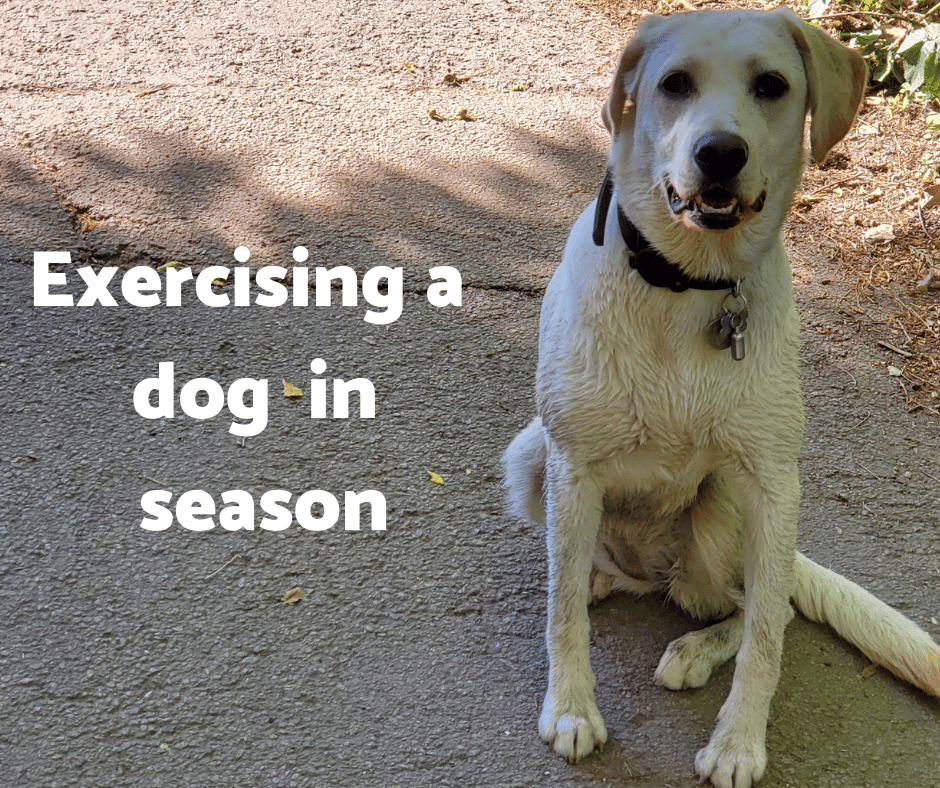
Yes, you can usually walk a female dog while she is in season, but you will need to change how, when and where you walk her.
Keep her securely on a lead, avoid busy dog-walking areas and prevent all contact with unneutered male dogs. Even a dog with reliable recall may behave differently during her season, while male dogs may become unusually persistent when they detect her scent.
Shorter, quieter walks combined with calm enrichment at home are often the safest and least stressful option.
Quick answer: walking a dog in season
When your dog is in season:
- keep her on a secure lead
- avoid off-lead dog areas
- walk at quieter times
- choose routes with good visibility
- create plenty of distance from other dogs
- supervise her in the garden
- check gates and fencing carefully
- use indoor enrichment when a normal walk is unsuitable
- contact your vet if she appears unwell
A season usually lasts between two and four weeks. Your dog may remain attractive to male dogs throughout that period, so do not assume the risk has passed simply because her bleeding has reduced or stopped. PDSA advises keeping a dog in season away from uncastrated males and taking her for walks away from other dogs.
This article contains Amazon affiliate links, which I may make a few pennies on to help test new products.
What does it mean when a dog is in season?
A season, sometimes called being “in heat”, is the fertile part of an unspayed female dog’s reproductive cycle.
During this time, she can become pregnant.
Common signs include:
- a swollen vulva
- blood-tinged or coloured discharge
- licking around her back end more than usual
- urinating or scent-marking more frequently
- increased interest in other dogs
- restlessness or changes in behaviour
- moving her tail to one side when approached by a male dog
- attempts to roam or escape
Some dogs become clingier or more anxious. Others appear quieter, more easily distracted or less tolerant of attention from other dogs.
Your dog is not being difficult. Her body and behaviour are being affected by hormonal changes so that she may need more patience and a slightly different routine. (PDSA)
How long does a dog’s season last?
A dog’s season commonly lasts around two to four weeks, although the timing varies between individuals.
Many dogs have a season approximately every six or seven months, but smaller breeds may cycle more frequently, and some larger breeds have longer gaps.
The first season often happens at around six months, but this varies considerably. Some large dogs may not have their first season until much later.
Keep a record of:
- the date you first notice bleeding or swelling
- any changes in discharge
- changes in behaviour
- when signs appear to have finished
This information can help you understand your dog’s normal pattern and may be useful if you ever need to speak to your vet. (PDSA)
Can I walk my dog while she is in season?
You do not normally have to stop walking your dog completely.
Walks can still give her:
- an opportunity to toilet
- gentle physical activity
- fresh air
- time to sniff
- a break from the house
- calm mental stimulation
The important difference is that the walk should be managed to prevent contact with male dogs and reduce the risk of escape or accidental mating.
This may mean walking for less time, using quieter streets and replacing some normal walks with enrichment at home.
The right balance will depend on your dog. Some dogs remain fairly relaxed during their season. Others become tired, unsettled or overwhelmed by the attention they receive from other dogs.
Read your dog rather than insisting on following her usual routine.
Keep your dog on a secure lead
Do not let your dog off lead while she is in season.
This applies even if she normally has excellent recall.
Hormonal changes may make her more interested in finding a mate, less responsive to familiar cues or more likely to move towards another dog. Male dogs may also approach her from a considerable distance.
Use:
- a secure, fixed-length lead
- a well-fitted harness
- a properly fitted flat collar with identification
- strong, undamaged clips and fastenings
Check the lead, harness and collar before every walk.
I do not recommend retractable leads. They can make it harder to bring a dog close quickly, allow a dog to build up speed and create injuries if the cord becomes wrapped around a person or animal.
My dog walking safety guide explains how to check leads, harnesses, clips and other equipment before leaving home.
Walk at quieter times
Choose times when fewer dogs are likely to be outside.
Depending on your area, this might mean:
- early in the morning
- between the main school and commuting periods
- later in the evening
- avoiding lunchtime dog-walking peaks
- changing your normal weekend routine
You know your local area best. A route that is quiet at 7 am may be full of dog walkers an hour later.
Quieter does not necessarily mean walking in an isolated location. You still need somewhere that feels safe, has suitable lighting and gives you enough space to change direction.
In Finchley and Muswell Hill, I would generally favour quieter residential streets and open routes with good visibility rather than narrow woodland paths where an approaching dog may suddenly appear.
Avoid busy parks and off-lead areas.
Busy parks are often difficult to manage when your dog is in season.
Even when your dog is securely on lead, off-lead dogs may approach her. Their owners may not realise that she is in season until their dog is already close.
This can create:
- unwanted mating attempts
- tangled leads
- frustrated or overexcited dogs
- conflict between male dogs
- stress for your dog
- difficulty moving away safely
Avoid popular dog-gathering points, enclosed dog fields and areas where owners routinely allow dogs to run up to others.
A quiet pavement walk with time to sniff can be far more useful than trying to complete a normal park circuit while repeatedly managing unwanted attention.
Give other dog owners space.
You are responsible for keeping your dog safe, but it helps to communicate clearly with other owners.
When another dog approaches, create distance early rather than waiting to see what happens.
You can say:
“She is in season, so we need some space, please.”
Most responsible owners will call their dog away or put them on a lead.
Cross the road, turn into another street or step behind a parked vehicle where safe. Do not feel that you need to continue along your planned route.
Changing direction is good management, not a failed walk.
Should I use a long line?
A long line may give your dog additional sniffing freedom, but it needs careful handling.
During a season, I would only consider one when:
- the area is quiet
- you have clear visibility
- there are no nearby dogs
- the line is attached to a suitable harness
- you can shorten it quickly
- you are experienced in using it safely
A long line does not mean your dog should be allowed to approach another dog.
Avoid wrapping the line around your hand. Keep it away from people, trees, benches, bikes and other animals.
For most everyday walks during a season, a normal fixed-length lead is simpler and safer.
Do not rely on scent-masking products
Some products claim to disguise or reduce the scent of a dog in season.
Do not treat sprays, tablets, wipes, clothing or home remedies as a reliable way to prevent male dogs from detecting her.
Even where a product reduces odour to a person, it cannot replace:
- keeping your dog on lead
- avoiding male dogs
- supervising outdoor access
- securing your home and garden
- changing your walking routine
I would not apply menthol, strongly scented oils or other household substances to a dog’s coat or skin. They may irritate, may be unpleasant for the dog and do not make contact with male dogs safe.
Physical separation and careful supervision remain important safeguards.
Supervise your dog in the garden
Do not assume that a fenced garden makes your dog completely safe.
Some dogs may try to escape while in season. Male dogs may also try to enter the garden by pushing through gaps, digging or jumping.
Before allowing your dog outside:
- check gates are properly closed
- inspect fences for gaps or damage
- move bins or furniture away from boundaries
- remain outside with her
- keep visits short when local dogs are nearby
- consider using a lead where the garden is not completely secure
Do not leave her alone outside, even for a short period.
If you live in a flat or share a communal garden, check the area before entering and keep her on lead throughout.
Should I stop walking my dog completely?
Some dogs can continue with short, quiet walks every day.
Others may benefit from fewer outdoor walks, particularly if:
- many off-lead dogs live nearby
- your dog is attracting constant attention
- she appears tired or unsettled
- she becomes anxious around other dogs
- your usual routes are narrow or busy
- you cannot safely avoid male dogs
Missing or shortening an occasional walk will not harm a healthy dog when you provide suitable alternatives.
Exercise is not only about distance. Sniffing, searching, gentle training and enrichment feeding can provide useful mental activity without exposing your dog to a busy environment.
My complete guide to dog walking and everyday exercise explains why the quality of an activity can matter more than the number of miles covered.
Indoor exercise and enrichment ideas
A dog in season may appreciate calm activities rather than highly energetic games.
Try:
Find it
Ask your dog to wait while you hide a few pieces of her normal food around a room. Release her to search for them.
Start with easy hiding places so she does not become frustrated.
Scatter feeding
Scatter some dry food across a clean floor, a towel, a snuffle mat, or a secure garden area.
Let your dog work at her own pace.
Simple scent trails
Drag a dog-safe treat across the floor before hiding it at the end of a short trail.
Keep the route simple when introducing the game.
Cardboard searches
Place food in several open cardboard boxes and let your dog investigate.
Remove tape, staples and loose pieces, and supervise throughout.
Gentle training
Practise familiar skills such as:
- touch
- settle
- go to bed
- chin rest
- find it
- loose-lead positioning
- waiting calmly at a doorway
Keep sessions short and enjoyable.
Stuffed feeding toys
Use part of your dog’s normal meal in a suitable food toy.
Make the activity easy enough for her to succeed. Enrichment should not leave her frustrated or frantic.
My brain games for dogs and enrichment feeding guide contain further ideas.
Keep activities calm
A dog in season may already feel restless or uncomfortable.
You do not need to tire her out with constant physical activity.
Avoid turning every day into a packed programme of games. Dogs also need quiet time, sleep and the opportunity to settle without being disturbed.
Watch for signs that an activity is becoming too much:
- frantic searching
- barking or whining
- grabbing at toys
- pacing
- inability to settle afterwards
- walking away from the activity
- increased irritability
Stop, make the activity easier or allow your dog to rest.
Managing discharge indoors
Some dogs keep themselves very clean, while others leave small spots of discharge on bedding, carpets or furniture.
You may find it helpful to:
- use washable blankets
- protect your dog’s normal resting areas
- wash bedding more frequently
- gently clean around her back end when necessary
- use dog season pants for short supervised periods
Season pants are designed to manage discharge. They do not prevent mating and should never be treated as contraception.
Remove them regularly so your dog can toilet and keep herself clean. Make sure they fit without rubbing or restricting movement.
What if I have an unneutered male dog at home?
An unneutered male and a female in season need complete separation.
A baby gate or closed internal door may not be enough on its own.
Dogs can become highly persistent, and mating can happen very quickly.
Use several layers of management where possible:
- separate rooms
- securely closed doors
- separate garden visits
- separate walks
- supervision whenever either dog is moving around the home
- different arrangements with a trusted carer when safe separation is not possible
Do not rely on verbal cues, clothing or the fact that the dogs are related. Dogs from the same family can mate.
PDSA advises keeping dogs in season away from uncastrated males to prevent an unwanted pregnancy.
What if my dog mates accidentally?
Contact your vet as soon as possible.
Do not wait to see whether your dog becomes pregnant. Your vet can discuss the available options and the timing involved.
Do not give your dog medication or attempt any home treatment.
If two dogs are physically tied together after mating, do not forcibly pull them apart. Keep the situation as calm as possible and telephone your vet for advice.
Blue Cross advises contacting a vet promptly following an accidental mating because veterinary options may be available to prevent pregnancy.
When should I contact my vet?
A season itself is normal, but seek veterinary advice if:
- your dog appears very unwell
- she is unusually lethargic
- she stops eating
- she is vomiting
- she drinks or urinates much more than normal
- her abdomen appears swollen or painful
- the discharge smells unpleasant
- the discharge contains pus
- bleeding seems unusually heavy
- her season lasts much longer than expected
- her seasons become irregular
- you are unsure whether the discharge is normal
- she has mated accidentally
Unspayed dogs can develop pyometra, a serious infection of the womb that commonly occurs after a season. Symptoms can include lethargy, increased drinking, vomiting, abdominal swelling and abnormal discharge. It requires urgent veterinary treatment. (
Should I have my dog spayed?
Spaying prevents future seasons and unwanted pregnancies, but the right timing should be discussed with your vet.
The advice should be based on factors including:
- breed
- size
- age
- physical maturity
- general health
- lifestyle
- previous seasons
- behaviour
- risk of accidental mating
The older idea that every female dog must have one season before being spayed is too simplistic.
Updated 2026 guidance from the British Veterinary Association and British Small Animal Veterinary Association recommends an individual, contextualised discussion rather than applying the same timing to every dog. Their guidance generally supports spaying female dogs but considers breed, maturity, health and lifestyle when deciding when the operation should take place.
Can a dog walker walk a dog in season?
A professional dog walker may be able to continue walking your dog, but you should tell them as soon as you notice that her season has started.
The walker may need to:
- change the route
- adjust the walk time
- keep the walk shorter
- avoid parks and woodland bottlenecks
- replace part of the walk with enrichment
- decline shared or group walks
- take additional safety precautions
A dog in season should not be added to a group walk.
I offer one-to-one dog walks in Finchley and nearby areas so that I can continue an existing dog’s walks with a quieter route and an adapted routine.
Every dog and every location is different. I will always put safety before completing a normal route or duration.
Learn more about my solo dog walks in Finchley.
Frequently asked questions
Can I walk my dog when she is bleeding?
Yes, you can usually take her for a quiet, controlled walk. Keep her on a secure lead and away from other dogs.
Bleeding does not reliably indicate whether she is at the most fertile point in her cycle, so use the same precautions throughout the entire season.
Can my dog go off lead while she is in season?
No. Keep her on a lead throughout her season, even if her recall is normally reliable.
Can my dog get pregnant when the bleeding stops?
Yes, pregnancy may still be possible after the visible bleeding changes or stops. Continue precautions throughout the complete season.
How long should I keep my dog away from male dogs?
Keep her completely separated from unneutered male dogs throughout the season. A season commonly lasts two to four weeks, but timings vary between dogs. Speak to your vet when you are unsure whether it has finished. (PDSA)
Can a neutered male dog be around a female in season?
A neutered male cannot normally make her pregnant, but he may still show significant interest, become overexcited or attempt to mount her.
Separate them if either dog appears stressed or unable to settle.
Can I take my dog to a secure dog field?
I would avoid shared fields and any field where another dog may arrive immediately before or after your booking.
Even a privately hired field can leave scent trails that attract attention. You also need to be completely confident that the fencing, gates and booking arrangements are secure.
Do dog nappies prevent pregnancy?
No. Dog pants or nappies only help manage discharge. They do not prevent mating.
Should I use a scent-masking spray?
Do not rely on one. No spray replaces physical separation, secure lead handling and careful supervision.
Does my dog need more exercise because she is restless?
Not necessarily.
Restlessness may be hormonal rather than evidence that she needs a longer walk. Try a quiet sniff walk, a simple scent game, or a calming enrichment activity, and allow plenty of rest.
Can I still attend a dog training class?
Tell the trainer before attending.
Many classes do not allow dogs in season because their presence can distract or unsettle other dogs. The trainer may suggest a temporary break or an individual session.
My approach to walking dogs in season
I have lived with female dogs and understand that a season can make normal routines more complicated.
I do not believe a dog needs to be confined indoors for several weeks without stimulation. I also do not believe completing the usual park walk is worth creating unnecessary risks.
My approach is to:
- keep the dog securely on lead
- choose quiet, familiar routes
- avoid dog-gathering areas
- allow plenty of calm sniffing
- turn away early when another dog approaches
- shorten the walk when necessary
- use enrichment as part of the dog’s daily routine
The aim is not to cover a particular distance.
It is to give your dog a safe, calm and useful experience while preventing accidental mating and unnecessary stress.
Related dog-care guides
Continue with these guides:
- Dog Walking and Everyday Exercise
- Dog Walking Safety Tips
- Brain Games to Mentally Entertain Your Dog
- Ditch the Bowl: Dog Enrichment Feeding
- Solo Dog Walks in Finchley
Final thoughts
You can usually continue walking your dog while she is in season, but the walk needs to be managed differently.
Keep her on lead, avoid busy dog areas, supervise her outdoors and be prepared to replace some walks with calm enrichment at home.
Do not rely on scent-masking products or season pants to prevent mating.
When you are unsure whether your dog’s season is progressing normally, or if an accidental mating has happened, contact your vet.
Veterinary disclaimer
I am a professional dog walker with an Ofqual Level 3 Canine First Aid qualification, but I am not a veterinary surgeon.
This article provides general educational information and does not replace veterinary advice, diagnosis or treatment. Under the Veterinary Surgeons Act 1966, veterinary diagnosis and treatment must be provided by an appropriately qualified veterinary professional.
Contact your vet if you are concerned about your dog’s season, discharge, behaviour, general health, neutering or possible mating.