
15 Calm Indoor Enrichment Ideas
Updated July 2026
It is hot.
Your dog’s normal walk has been shortened or cancelled.
They are staring at you.
You are now feeling guilty.
I see this every summer.
Owners worry that missing a walk will somehow ruin their dog’s routine, leave them bouncing off the walls or make them a bad dog owner.
It will not.
Sometimes the safest dog walk is the walk that does not happen. After all, no dog has died from missing a walk, but they have from heatstroke.
When the weather becomes dangerously hot, you do not need to recreate a sixty-minute walk in your living room or create some kind of boot camp to tire your dog out.
You do not need an indoor boot camp.
A short toilet opportunity, fresh water, a cool place to rest and a little calm mental enrichment may be more than enough for the day.
In this guide, I will share 15 simple things you can do with your dog when it is too hot for their normal walk.
Most need very little equipment.
Some use part of your dog’s normal food.
And number one is completely free.
As an Amazon Associate, I earn from qualifying purchases. Some links on this page may be affiliate links. If you buy through them, I may earn a small commission at no extra cost to you. I only recommend products or types of enrichment that fit my calm, practical approach to dog care.
Quick answer: What can I do with my dog when it is too hot to walk?
When it is too hot for your dog’s normal walk, try calm indoor activities such as:
- letting your dog sleep
- scatter feeding
- playing Find It
- hiding food around a room
- making a cardboard search box
- using a muffin tin game
- rolling food in a towel
- giving a frozen Kong
- using a frozen lick mat
- trying a snuffle mat
- making a simple scent trail
- teaching an easy trick
- asking your dog to find a favourite toy
- giving a suitable chew
- spending a few calm minutes together
The aim is not to physically tire your dog out.
It is to give them something safe and appropriate to do without adding more heat or over-excitement.
For full hot-weather advice, including heatstroke, hot pavements and vulnerable dogs, read my Summer Dog Safety Guide.
Your dog does not need an indoor workout because they missed a walk
I think this is the most important part of this guide.
A lot of dog advice still focuses on tiring dogs out.
Walk them further.
Throw the ball more.
Give them more exercise.
Keep them busy.
I do not think that approach works for every dog.
It certainly is not the approach I use with nervous, reactive, rescue or older dogs.
And during a heatwave, trying to replace outdoor physical exercise with intense indoor physical exercise rather misses the point.
The RSPCA warns that exercise is the leading trigger of heatstroke in UK dogs and recommends home activities such as puzzle toys, training games and scent work when walks are unsafe.
If your dog wants to sleep because it is warm, let them sleep.
That may sound too simple.
But rest is a genuine need.
Your dog does not have to be entertained every minute of the day.
My Enrichment for Dogs: A Weekly Routine That Works guide looks at the importance of balancing activity with proper rest and decompression.
Sometimes doing less really is the better choice.
Before you start: Is your dog simply warm, or are they unwell?
Indoor enrichment is for a dog who is comfortable enough to participate and has simply missed or shortened their usual walk.
It is not a treatment for heatstroke.
Possible signs of heat-related illness can include:
- heavy panting
- breathing difficulties
- excessive drooling
- unusual tiredness
- confusion
- stiffness or being unwilling to move
- vomiting
- diarrhoea
- wobbling
- collapse
- seizures
Heatstroke is a veterinary emergency.
If you think your dog may be suffering from heatstroke, start cooling them and contact your vet urgently.
Do not give them a puzzle toy and wait to see whether they improve.
You can read more in my Summer Dog Safety Guide and the Royal Kennel Club’s heatstroke advice.
Now, assuming your dog is comfortable and simply needs a calmer day, here are my favourite alternatives to a long walk.
1. Let your dog sleep
Yes.
This is genuinely number one.
Do nothing.
Move the dog bed somewhere cooler if your dog likes their bed.
Make sure fresh drinking water is available.
Close curtains or blinds where direct sunlight is heating the room.
Allow your dog to choose a comfortable resting place.
You may find them stretched out on a tiled floor, in a hallway or somewhere they usually ignore.
Let them choose.
Do not keep waking them up because you feel guilty about the missed walk.
Dogs need rest.
Some nervous and reactive dogs may benefit in particular from the occasional quieter day, as their normal walks can involve a lot of information to process.
People.
Dogs.
Traffic.
Noise.
Smells.
Unexpected movement.
A day at home is not automatically a wasted day.
Ask yourself:
Does my dog need entertaining?
Or do I feel guilty because I think I should be entertaining them?
There is a difference.
2. Scatter part of your dog’s normal meal
Scatter feeding is one of the simplest enrichment activities I use.
Take a small amount of your dog’s normal dry food and scatter it across a safe, clean area.
That might be:
- a cool kitchen floor
- a rug
- a towel
- a snuffle mat
- a shaded garden, where conditions are safe
Start with the food close together.
Let your dog sniff and search.
Once they understand the idea, you can spread the food out a little further.
The important bit is the sniffing.
Your dog is using their nose to find the food rather than simply watching a bowl appear in front of them.
You do not necessarily need extra treats.
Use some of their normal food allowance.
My Ditch the Bowl at Mealtimes guide has more simple enrichment-feeding ideas.
3. Play Find It
This is probably one of the games I use most.
It is incredibly simple.
Start by dropping or gently throwing a piece of food nearby.
Say:
“Find it.”
Let your dog sniff it out.
Repeat.
Once your dog understands the game, make it slightly harder.
Put a treat:
- beside a chair leg
- near a doorway
- beside a toy
- on the edge of a rug
- behind a safe object
Do not start by hiding one tiny piece of kibble somewhere impossible and expecting your dog to solve the Crystal Maze.
Make it easy.
Let them win.
Then gradually make the game more interesting.
Dogs Trust also uses Find It as a simple scent game for dogs.
I regularly use variations of this idea on walks.
Rudy has his Magic Tree in Coldfall Wood.
Treats are hidden around the tree.
Easy finds might just be kibble.
Harder finds may involve something much more exciting, such as a sprat.
The crows have also learnt about the Magic Tree, but that is another story.
You can use exactly the same principle at home.
No tree required.
4. Hide small amounts of food around one room
This is the next step up from Find It.
Ask your dog to wait outside a room or have someone keep them with them for a moment.
Hide a few pieces of their normal food in easy, safe places.
For example:
- beside a table leg
- on a dog bed
- near a toy
- beside the skirting board
- behind an open door
Then let your dog into the room and encourage them to search.
Keep the first game very easy.
I want dogs to think:
“This is brilliant. I know how this works.”
Not:
“Del has invented an impossible exam.”
If your dog starts getting frustrated, make the hiding places easier.
Mental enrichment should be enjoyable.
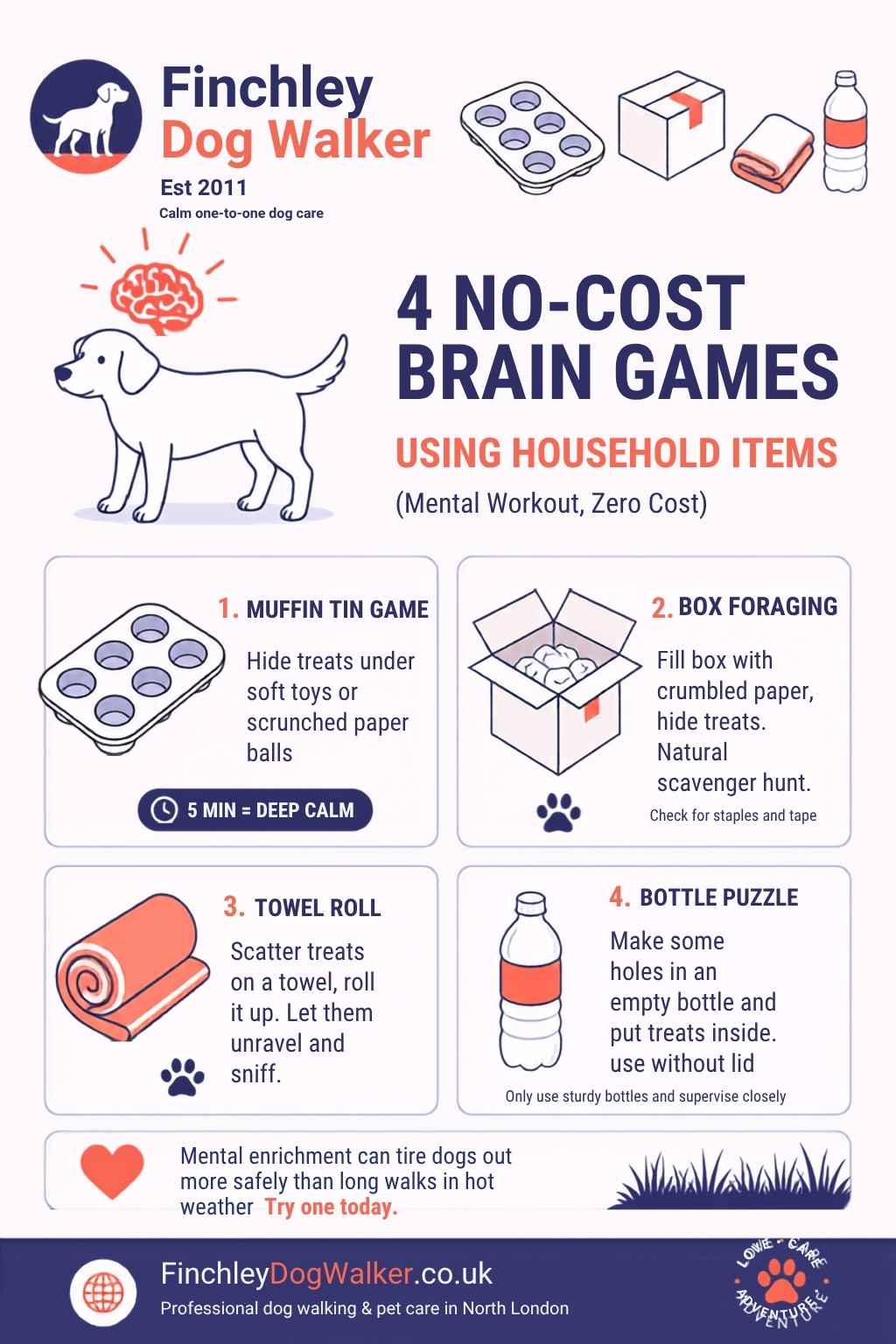
5. Make a cardboard search box
Before buying another dog toy, check your recycling.
A cardboard box can make a brilliant, simple search game.
You will need:
- a suitable cardboard box
- scrunched plain paper
- empty cardboard tubes
- part of your dog’s normal food or a few treats
Put the paper and cardboard tubes in the box.
Scatter food among them.
Let your dog sniff, move and investigate the contents.
Dogs Trust suggests a similar dig-box activity using newspaper, cardboard and hidden kibble.
Supervise your dog.
Some dogs carefully search.
Some stick their entire head in the box.
Some believe cardboard must be turned into confetti immediately.
If your dog is likely to eat cardboard or other non-food items, choose a different game.
Know the dog in front of you.
6. Try the muffin tin game
The muffin tin game is another very simple activity.
Take a muffin tin.
Put a few pieces of food into some of the holes.
Cover the holes with suitable dog-safe balls or other safe covers that your dog cannot swallow.
Let your dog work out where the food is.
They may:
- sniff
- nudge
- move the balls
- use a paw
- stare at you accusingly
Again, start easy.
The game should not become an exercise in frustration.
I have a full guide to the Muffin Tin Game for Dogs if you want step-by-step instructions.
This is a particularly useful activity when a long walk has been cancelled, and you want five or ten minutes of gentle brain work.
7. Roll food in a towel
You do not need to buy a puzzle feeder.
Take an old clean towel.
Lay it flat.
Scatter a small amount of dry food across it.
Loosely roll the towel.
Let your dog sniff and work out how to unroll it.
For a beginner, keep the roll very loose.
You can even fold the towel once rather than rolling it.
As your dog becomes more confident, you can make it slightly more difficult.
I would always supervise this game.
It is not suitable for a dog who is likely to tear up and swallow the towel.
And please do not tie the towel into impossible knots.
The aim is sniffing and problem-solving.
It is not an escape room.
8. Give your dog a frozen Kong or stuffable toy
A frozen Kong is one of my favourite hot-weather enrichment options.
You can use part of your dog’s normal food.
Depending on what your dog normally eats, suitable fillings might include:
- soaked kibble
- their normal wet food
- a little mashed banana
- a small amount of plain dog-safe yoghurt
- a suitable dog-safe food your dog already tolerates
Fill the toy and freeze it.
For dogs new to stuffed toys, do not pack it as tightly as physically possible.
Make the first few easy.
A dog who has never used a Kong before may give up if the food is frozen solid into an impossible lump.
You can gradually make it last longer as your dog learns how the toy works.
My Complete Kong Guide explains how I introduce stuffed toys and choose fillings.
You can also see the Kong and other enrichment products I recommend in my Dog Care Recommendations.
Remember to account for the food in your dog’s normal daily intake.
A hot day should not accidentally turn into a six-course tasting menu.
9. Use a frozen lick mat
A lick mat can be a useful quieter activity.
Spread a thin layer of suitable food across the mat.
You could use:
- your dog’s normal wet food
- soaked and mashed kibble
- a small amount of plain dog-safe yoghurt
- a suitable mashed food your dog already eats
Freeze the mat flat.
Then offer it to your dog in a cool room.
Licking can be a calmer activity for many dogs.
But I do not describe lick mats as a cure for anxiety.
They are an enrichment tool.
Some dogs love them.
Some finish them incredibly quickly.
Some are not interested.
And some dogs decide the silicone mat itself looks delicious.
Supervise your dog, especially when using a new product.
You can find more frozen ideas in my Healthy Summer Treats to Keep Your Dog Cool guide.
10. Use a snuffle mat
A snuffle mat gives your dog an opportunity to sniff and search for food hidden between strips or folds of material.
Add a small amount of dry food.
Start with pieces that are relatively easy to find.
Let your dog sniff them out.
Snuffle mats can work particularly well for:
- dogs who enjoy searching
- older dogs who need gentler activities
- dogs living in flats
- dogs who become frustrated by complicated puzzle toys
- rainy days
- hot days when normal walks are restricted
You can buy a snuffle mat or make one.
Dogs Trust has instructions for making a simple DIY snuffle mat.
I have also included suitable enrichment products in my Dog Care Recommendations.
Always choose a mat suitable for your dog’s size and behaviour, and supervise them until you know how they use it.
11. Make a simple scent trail
Take a small piece of food and lightly move it along a safe floor before placing it a short distance away.
Let your dog investigate.
You can gradually make a simple trail from one part of a room to another.
Or place tiny pieces of food at intervals for your dog to follow.
Do not turn your entire house into a complex tracking course on the first attempt.
Keep it simple.
Watch your dog.
Some dogs immediately understand scent games.
Others look at you as though you have finally lost the plot.
That is fine.
Try something else.
Enrichment should suit the individual dog.
12. Teach a simple hand touch
Hot weather can be a good time for very short, reward-based training sessions.
I mean short.
Two or three minutes may be enough.
One simple game is teaching a hand touch.
Hold out your hand near your dog.
When they investigate or touch it with their nose, reward them.
Once they begin to understand the game, you can add a cue such as:
“Touch.”
Dogs Trust has a full step-by-step guide to teaching a hand target.
This can be a useful little confidence-and-focus game.
Keep it easy.
If your dog becomes confused or frustrated, stop or take a step back.
There is no prize for squeezing a twenty-minute training session into a heatwave afternoon.
13. Ask your dog to find a favourite toy
Food is not the only enrichment option.
Some dogs love toys.
Start with a favourite toy your dog knows well.
Show them the toy.
Place it nearby.
Encourage them to find it.
Once they understand, make the hiding place slightly harder.
You can gradually introduce the toy’s name if you want.
For example:
“Find Duck.”
“Find Ball.”
“Where’s Teddy?”
This can become a lovely search game.
It also means you may eventually have a dog capable of finding the toy that you have just spent twenty minutes looking for.
Possibly.
I make no promises.
14. Offer a suitable chew or calm food activity
Sometimes your dog does not need a game involving you.
A suitable chew or food activity may give them something quiet to do.
What is appropriate depends on:
- your dog’s size
- chewing style
- health
- teeth
- diet
- previous experience
Choose items designed for dogs and supervise where appropriate.
Check toys and chews regularly for damage.
PDSA advises checking dog toys and removing anything with pieces that could be chewed off or swallowed.
For nervous or rescue dogs, I often prefer simple, calm enrichment to activities that create more noise and excitement.
My Best Enrichment Toys for Rescue Dogs guide explains the types of toys I tend to start with.
You do not need a cupboard containing thirty-seven dog puzzles.
A few useful options are normally enough.
15. Spend five calm minutes with your dog
Not every activity has to be a game.
Sit with your dog.
Talk to them.
Offer calm company.
Groom them if they genuinely enjoy being groomed.
Practise a little gentle handling if this is already something they are comfortable with.
Watch the world from a cool, shaded window where this does not trigger barking or frustration.
Let your dog lie beside you.
Sometimes companionship is enough.
This is particularly worth remembering with older dogs.
They may not want a puzzle.
They may not want training.
They may not want you enthusiastically presenting a muffin tin at them.
They may just want to be somewhere cool and comfortable near you.
Listen to the dog in front of you.
How much indoor enrichment does my dog need during a heatwave?
There is no magic number.
You do not need to complete all 15 activities.
Please do not turn this article into a checklist and announce:
“Right, Bert. We have done the Kong. Fourteen to go.”
Choose one or two ideas.
See how your dog responds.
A simple hot-weather day might look like:
Early morning
A short walk or sniff outside while conditions are cooler, where safe and appropriate for your dog.
Breakfast
Part of their normal meal in a snuffle mat or scatter feed.
Late morning
Rest.
Afternoon
Rest.
Fresh water.
Cool room.
Possibly a frozen Kong or lick mat.
More rest.
Evening
A Find It game or two-minute training session.
A later toilet break or short sniff outside only if conditions are suitable.
That may be enough.
Your dog’s needs will depend on their:
- age
- breed
- health
- normal activity
- temperament
- fitness
- response to heat
A young working breed may want more mental engagement than an elderly dog.
A nervous dog may benefit from a genuinely quiet day.
A puppy will still need appropriate opportunities to go to the toilet and care.
A dog with a health condition may need specific veterinary advice.
Adapt.
Do not simply follow somebody else’s timetable because it appeared on the internet.
What I would avoid indoors on a dangerously hot day
Personally, I would not replace a cancelled hot-weather walk with frantic indoor exercise.
I would avoid:
- repeatedly throwing a ball down a hallway
- encouraging endless sprinting
- intensive stair repetitions
- energetic obstacle courses
- prolonged tug designed to exhaust the dog
- lengthy training sessions
- anything that leaves the dog heavily panting
- games on slippery floors
- forcing a dog to take part
- making food puzzles deliberately frustrating
There may be a place for some energetic indoor games at other times.
This article is specifically about days when physical activity has been reduced due to heat.
The goal is calm engagement.
Not replacing one overheating risk with another.
My dog is still asking for a walk. What should I do?
Some dogs are very attached to their normal routine.
They know what time the lead comes out.
They know when you put your shoes on.
They may stand by the door.
That does not mean the normal walk is automatically safe.
You are still responsible for making the safety decision.
Try changing the normal sequence.
Instead of preparing for a walk:
- scatter part of their meal
- play a short Find It game
- offer a frozen food toy
- allow a brief toilet opportunity where safe
- encourage your dog to settle somewhere cool
Some dogs adjust quickly.
Others may remain restless.
Keep things calm and predictable.
One missed walk is not a disaster.
If your dog is persistently unable to settle, suddenly behaves differently, or shows signs of distress, pain, or illness, speak to your vet.
Are these games suitable for nervous and rescue dogs?
Many of them can be.
But start easy.
One of the biggest mistakes I see with enrichment is making it too difficult.
Someone buys the hardest puzzle available.
The dog cannot solve it.
The dog becomes frustrated.
The owner says:
“He isn’t very good at enrichment.”
The dog is not the problem.
The puzzle was too hard.
For a nervous or newly rescued dog, I would usually start with:
- easy scatter feeding
- a few visible treats
- a simple Find It game
- a loosely rolled towel
- an easy stuffed toy
- quiet sniffing
- rest
Give them choice.
Do not force them to approach a strange new toy.
Do not surround them with fifteen new enrichment products on their first day home.
Simple is often better.
You can read more in my Rescue Dog Support Guide and Best Enrichment Toys for Rescue Dogs.
Do puppies need a walk every day during a heatwave?
Puppies still need appropriate care, toilet opportunities, rest and gentle mental engagement.
But a puppy does not need to be dragged around hot streets because you are worried about missing a walk.
Puppies can be particularly vulnerable in hot weather.
Use cooler times of day for appropriate outdoor experiences where conditions are safe.
At home, keep activities short and simple.
Good options include:
- basic Find It games
- easy food searches
- very short reward-based training
- suitable chew activities
- gentle play
- lots of rest
My Bringing a Puppy Home guide covers puppy routines in more detail.
I also offer Puppy Visits in Finchley where a young dog needs a toilet break, feeding, calm company or age-appropriate enrichment while you are out.
What if I am at work when my dog’s walk is cancelled?
This is one reason I introduced more flexible hot-weather care.
When conditions are not safe for a normal walk, simply cancelling can leave owners worried about:
- toilet breaks
- water
- feeding
- medication
- dogs being alone
- how their dog is coping indoors
Where appropriate, I may adapt a booked dog walk into a calmer home visit.
Depending on the dog and conditions, that may include:
- a short toilet opportunity
- fresh drinking water
- calm indoor enrichment
- a scent game
- feeding
- agreed medication
- preparing an owner-supplied Kong or lick mat
- a general welfare check
- a photograph and update
I explain this in my Hot-Weather Dog Comfort Visits and Pet Care Add-ons page.
The dog’s safety always comes first.
I would much rather explain why a walk has been changed than take a dog out simply because the diary says “60-minute walk”.
My favourite five ideas if you do not know where to start
Feeling overwhelmed by 15 ideas?
Start here.
1. Let your dog rest
Free.
Easy.
Often underestimated.
2. Play Find It
A few pieces of normal food.
No special equipment.
3. Scatter feed
Use part of breakfast or dinner.
4. Freeze a Kong or lick mat
Prepare it the night before when hot weather is forecast.
5. Make a cardboard search box
Use suitable recycling and supervise your dog.
That is enough.
You can always try something different tomorrow.
A missed walk is not a disaster
I have worked professionally with dogs since 2011.
One of the biggest changes in my own approach has been learning that more activity is not always better.
Dogs need walks.
They need appropriate physical exercise.
They need opportunities to sniff and explore.
But they also need rest.
They need mental engagement.
And they need us to make sensible decisions when normal routines are not safe.
During a heatwave, please do not feel guilty because your dog missed a full walk.
Give them water.
Give them somewhere cool.
Offer a little calm enrichment if they want it.
Let them sleep.
Then walk again when conditions are safer.
Your dog does not measure your love in miles walked.
Related hot-weather and enrichment guides
- Summer Dog Safety Guide
- Hot Weather Dog Kit
- Hot Weather Dog Care Myths
- Healthy Summer Treats to Keep Your Dog Cool
- Ditch the Bowl at Mealtimes
- The Muffin Tin Game for Dogs
- Complete Kong Guide
- Enrichment for Dogs: A Weekly Routine That Works
- Best Enrichment Toys for Rescue Dogs
- Rescue Dog Support in Finchley
Need calm hot-weather care in Finchley?
During very hot weather, some normal dog walks may need to be shortened, moved to a cooler time where practical or adapted into calmer care.
I offer one-to-one dog walking and home-based pet care in Finchley and nearby areas.
There are no group walks.
No vans.
No cars used to collect several dogs.
I work locally and adapt care to the dog in front of me.
Where a normal walk is not safe, a visit may include a brief toilet break, fresh water, calm enrichment, and a welfare check.
Read more about Hot-Weather Dog Comfort Visits and Pet Care Add-ons.
You can also read my Extreme Weather Policy or Contact Del if you are looking for calm, one-to-one pet care.
Frequently asked questions
No. A normal full walk may not be safe during very hot weather. The RSPCA advises that exercise is a leading trigger of heatstroke in UK dogs and recommends safer indoor activities when conditions are hot. Adjust care to your individual dog and the conditions.
Try scent games, scatter feeding, Find It, a frozen Kong, a lick mat, a snuffle mat, a cardboard search box or a very short reward-based training game. Your dog may also simply need to res
For most healthy dogs, missing an occasional walk because conditions are unsafe is not a disaster. Provide fresh water, appropriate toilet opportunities, a comfortable place to rest and suitable calm enrichment. Speak to your vet if your dog has a health condition or specific exercise requirements.
Do not focus only on physically tiring your dog. Sniffing, searching, simple problem-solving and reward-based training can provide mental engagement. Rest is also an important part of a dog’s routine.
Calm indoor games can be useful when physical activity is reduced due to heat. Avoid activities that cause frantic running, heavy panting or overheating. Make sure the room is comfortable, and your dog has access to fresh drinking water.
A suitable frozen-food toy can be used by many dogs when appropriately sized, filled with foods suitable for the individual dog, and supervised as needed. Introduce new toys gradually and check them regularly for damage
Find It, or scatter feeding, are two of the easiest options. You can use part of your dog’s normal food and need no specialist equipment.
Move your dog somewhere cooler and monitor them closely. Heavy panting can be a sign of heat-related illness, particularly if accompanied by breathing problems, confusion, weakness, vomiting, wobbling or collapse. If you suspect heatstroke, start cooling your dog and contact your vet urgently.
Disclaimer
This guide provides general dog-care information and does not replace advice from your vet. Every dog’s health, age, exercise needs and ability to cope with heat are different. If your dog is showing signs of heat-related illness or you are worried about their health, contact your vet urgently.

