Updated October 2026
A dog can still have a varied, enjoyable and worthwhile walk while staying on the lead.
Off-lead exercise can give suitable dogs more freedom to run and explore, but it is not appropriate for every dog or every location. Dogs with unreliable recall, a strong chase instinct, nervousness, reactivity, health restrictions or legal requirements may need to remain on a lead or long line. The key is to match the exercise to the individual dog, rather than assuming off-lead automatically means a better walk.
On-lead exercise can include steady movement, sniffing, exploration, short training exercises, changes of pace and safe opportunities to investigate the environment.
I have walked dogs professionally around Finchley and North London since 2011, and some of the most satisfying walks I see are not the ones covering the greatest distance. A dog quietly investigating a hedge, exploring a new smell, or moving calmly through an environment can get far more from the outing than the mileage alone suggests.
For the wider question of how much exercise an individual dog needs, read my Dog Walking and Everyday Exercise Guide.
Key Takeaways
- Dogs can enjoy fulfilling walks while on a lead, as they still receive physical activity and mental stimulation.
- The type and amount of exercise should suit individual dogs based on their age, health, and behaviour, not just the walk’s duration.
- Many dogs need to stay on a lead because of unreliable recall, nervousness, or legal restrictions; these walks can still be rewarding.
- Sniffing enriches a dog’s walk by allowing them to explore their environment, which is valuable mental exercise.
- Small adjustments to on-lead walks, such as varying the pace and allowing sniffing time, can significantly enhance the experience for dogs.
Can a dog get enough exercise while staying on the lead?
Yes, many dogs can get useful physical activity and valuable mental stimulation while remaining on the lead.
That does not mean every dog needs the same type or amount of exercise.
Age, health, fitness, body condition, confidence, personality and the type of activity all matter. PDSA advises that exercise needs vary between individual dogs and that both physical exercise and opportunities to sniff and explore contribute to wellbeing. PDSA
A young, physically fit dog may need a different routine from an older dog who enjoys several shorter walks.
A nervous rescue dog may benefit from a quiet half-hour of walking and sniffing rather than an hour in a busy park.
A dog recovering from illness or injury may need a veterinary exercise plan.
No useful rule says a dog on a lead needs to be walked longer to compensate for not running free.
The quality and suitability of the activity matter too.
Why might a dog need to stay on the lead?
There are many perfectly sensible reasons.
Your dog may:
- have unreliable recall
- chase wildlife
- be newly adopted
- be nervous or reactive around dogs or people
- become overwhelmed in busy environments
- be recovering from an injury
- have reduced mobility
- be in an area where dogs must remain on leads
- be close to roads, livestock or other hazards
- be safer on the lead in that particular environment
Blue Cross specifically recognises that dogs may need to remain on lead because of fear, prey drive, unreliable recall or legal restrictions. It recommends making those walks interesting rather than seeing them as second best.
I would much rather keep a dog safely on a suitable lead than let them off because somebody else thinks that is what a “proper” dog walk should look like.
On-lead does not mean marching beside your leg
This is an important distinction.
Being on a lead does not mean your dog needs to spend the whole walk in a formal heel position.
There will be moments when I want a dog close to me, particularly beside a road, on a narrow pavement or when passing something that needs space.
But away from those situations, a dog can still:
- stop and sniff
- investigate safe areas
- change pace
- pause and look around
- explore the edge of a path
- choose between suitable directions
- practise simple training skills
- take a sniff break
- move at a comfortable pace
My aim is safe connection, not military precision.
If pulling is the problem rather than exercise itself, my Loose-Lead Walking Guide explains how I teach a dog to move, sniff and explore without maintaining constant tension on the lead. I substantially updated the current guide in September 2026.
Sniffing is part of exercise.
One of the easiest ways to improve an on-lead walk is to stop treating sniffing as wasted time.
Dogs experience a huge amount of their environment through scent.
A slow walk where your dog investigates grass, trees, lamp posts, and hedges may cover less distance, but it can provide considerable mental stimulation.
Blue Cross describes slow sniff walks as mentally stimulating and particularly useful for dogs who need to remain on lead. PDSA similarly recommends slow, meandering walks where dogs can sniff and explore.
On my walks, I often joke that dogs are reading the local “wee-mail”.
We may have passed the same tree yesterday.
To your dog, it may contain completely new information today.
If you want to explore this further, read the Sniff and Decompression Walks guide.
Seven ways to make an on-lead walk more satisfying
You do not need to buy lots of equipment or turn every outing into a training session.
Small changes can make a substantial difference.
1. Allow proper sniffing time
Give your dog opportunities to stop and investigate safe smells rather than continually pulling them away because you want to complete a particular route.
You can still have sections where you need to move on.
The balance matters.
2. Change the route occasionally
A familiar route can be reassuring, particularly for a nervous dog.
But confident dogs may also enjoy exploring a different quiet street, path or section of woodland.
You do not need to travel miles to find novelty.
Around Finchley, even changing which side street you use or approaching a familiar walking area from a different direction can create new smells and experiences.
3. Vary the pace
Not every part of the walk needs to happen at the same speed.
You might have:
- a steady walking section
- a slower sniffing section
- a short period of slightly brisker movement
- a pause to observe something
- another relaxed walk home
Adapt the pace to the dog.
Don’t force a senior dog, puppy, or unfit dog to match a pace that is unsuitable for them.
4. Build in a little training
A normal walk gives you plenty of opportunities to reinforce useful everyday behaviours.
That could include rewarding:
- checking in with you
- a loose lead
- responding to their name
- changing direction with you
- waiting briefly at a road
- moving away from a distraction
- a few steps of calm walking
- a recall on a long line
Keep the training sections short.
A dog still needs time to be a dog.
My Dog Training Rewards Guide explains how food, play, sniffing and access to the environment can all be used as rewards.
5. Use simple scent games
Where it is safe and appropriate, a short “find it” game can add another dimension to a walk.
You might scatter a few suitable treats into clean grass and let your dog search for them.
Check the area first.
I would not scatter food where there is rubbish, broken glass, other dogs crowding the space or anything else I would not want the dog investigating.
Some dogs become so interested in searching that you need to keep the game very short.
The aim is enrichment, not turning the entire walk into a food hunt.
6. Give your dog appropriate choices
Choice doesn’t mean letting your dog drag you wherever they want.
It can be something as simple as reaching a safe junction and letting your dog choose which of two suitable routes you take.
You might also let them decide whether to investigate a particular hedge or move on.
Small amounts of appropriate choice can make the walk feel less like something being done to the dog.
7. Know when enough is enough
The longest walk is not automatically the best walk.
Notice what happens during and after exercise.
Is your dog moving comfortably?
Are they enjoying themselves?
Can they still think and respond?
Are they unusually stiff or exhausted afterwards?
Do they come home able to settle?
If a dog suddenly struggles with an activity they previously managed comfortably, slows down dramatically, becomes reluctant to walk or shows another unexplained change, speak to your vet rather than assuming they are lazy or stubborn.
Does my dog need to run?
Running can be enjoyable and appropriate exercise for some dogs.
That does not mean every dog needs to run around a park every day.
PDSA recommends introducing running gradually and adapting exercise to the individual dog’s age, health and fitness
Running may be unsuitable for:
- very young puppies
- dogs with certain medical or mobility problems
- unfit dogs
- some senior dogs
- dogs recovering from injury
- dogs who find the environment stressful
If you specifically want to begin jogging or running with your dog, build fitness gradually rather than suddenly expecting them to keep pace over a long distance.
Ask your vet for individual advice if you have concerns about their joints, heart, breathing, fitness or general health.
Can a long line give my dog more freedom?
A long line can be extremely useful when you have enough safe space to use one properly.
It gives a dog more opportunity to sniff and explore while maintaining a physical connection.
I use long lines where appropriate for dogs who:
- are practising recall
- are newly rescued
- have unreliable recall
- have a strong chase instinct
- need more space to sniff
- are not ready for off-lead freedom
Dogs Trust recommends attaching a long line to a harness when practising recall. Dog
A long line is not suitable everywhere.
I would not use one trailing freely:
- beside a road
- on a crowded pavement
- around lots of people
- amongst several unfamiliar dogs
- where it could become tangled around cyclists or other path users
I also do not attach a long line to an ordinary collar. If the dog suddenly reaches the end of the line, I do not want that force concentrated through their neck.
For fitting, lead choice and long-line handling, read my Best Dog Leads and Harnesses Guide.
What equipment do I need for exercising a dog on the lead?
You do not need complicated equipment.
For most everyday walks, a practical starting point is:
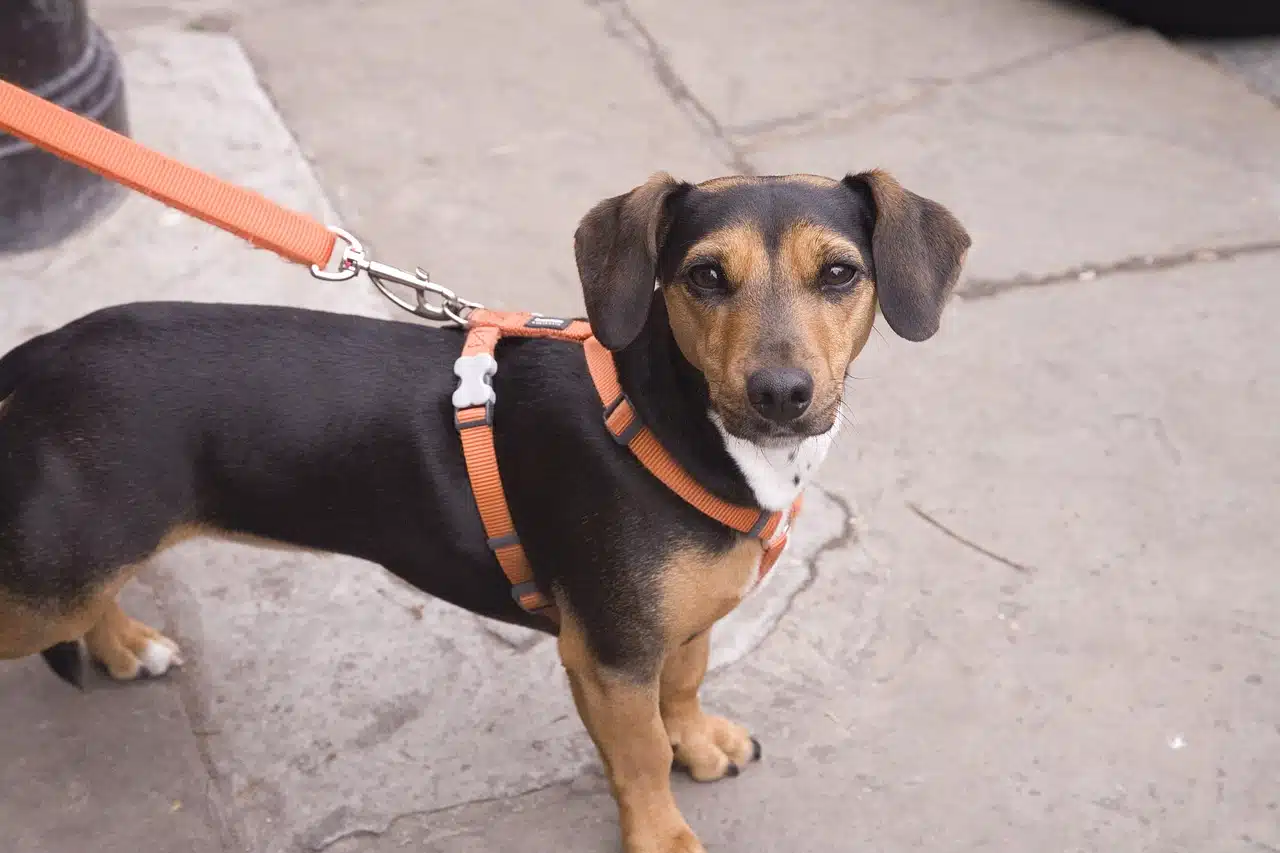
- a comfortable, secure and properly fitted harness
- a suitable fixed or adjustable lead
- your dog’s normal identification collar and tag
- suitable rewards if you are training
- a long line only where the environment and dog make it appropriate
I do not use retractable leads for my routine professional walks, and I do not recommend choke chains, check chains, prong collars or electronic collars.
Equipment helps you manage the walk safely.
It cannot teach your dog on its own.
If you are choosing equipment, use my Best Dog Leads and Harnesses: A Practical UK Guide rather than buying something simply because it promises to stop pulling.
What about a dog who pulls all the time?
Pulling and exercise are related, but they are not the same problem.
A dog can be physically fit and still pull.
They may pull because:
- moving forward has been rewarding
- they are excited
- they naturally move faster than you
- they desperately want to reach a smell
- they are worried and trying to leave
- another dog or person has caught their attention
- the environment is too difficult
I use reward-based loose-lead work rather than jerking or checking the lead.
That means rewarding useful moments, practising somewhere the dog can cope, allowing appropriate sniffing and gradually building the skill into normal walks.
For the complete process, read Loose-Lead Walking: A Calm, Reward-Based Guide.
What if my dog is nervous or reactive on the lead?
For a nervous, reactive,, or awkward-but-awesome dog, adding more exercise in’t automatically the answer.
A dog who spends an hour feeling threatened by traffic, people or other dogs has not necessarily had a better walk than a dog who spends twenty or thirty minutes somewhere they can actually cope.
Sometimes the useful thing is to:
- choose a quieter route
- go out at a quieter time
- create more distance
- cross the road
- turn around
- let the dog sniff
- reduce unnecessary greetings
- shorten the outing
- use enrichment at home afterwards
Blue Cross advises avoiding situations known to make an on-lead dog overly worried or stressed, where possible.
The right equipment can improve safety, but it does not cure fear or reactivity.
If everyday walks are difficult for your dog, see my Walking Kit for Nervous or Reactive Dogs and Rescue Dog Support information.
Should dogs meet other dogs while they are on the lead?
They do not have to.
One old assumption about dog walking is that every dog should greet other dogs to be properly socialised.
I do not work that way.
Some dogs enjoy appropriate social contact.
Others prefer space.
A worried dog cannot easily move away while attached to a lead, and face-to-face greetings can create pressure. Blue Cross recommends giving dogs appropriate space during on-lead encounters rather than forcing interactions.
If another dog is on lead, I do not assume they want my dog approaching them.
A perfectly successful walk may involve seeing another dog, giving them plenty of room and carrying on.
Exercising a puppy on the lead
Puppies need opportunities to explore, move and learn about the world, but they do not need exhausting walks.
Keep outings age-appropriate.
PDSA advises limiting high-impact exercise such as repeated jumping, twisting and skidding in puppies, allowing plenty of rest and avoiding long walks or running activities until they are physically ready.
A puppy walk can include:
- a short period of walking
- lots of sniffing
- watching the world
- a few reward-based training moments
- learning to wear a harness
- calmly passing people
- practising a loose lead for a few steps
- going home before they become exhausted or overwhelmed
For the wider subject, read Tips for Walking Your New Puppy.
What about senior dogs?
Older dogs still benefit from suitable opportunities to move, sniff and explore.
But the walk may need to change.
A senior dog may prefer:
- shorter outings
- flatter routes
- a slower pace
- more sniffing
- fewer steep slopes
- more recovery time
- several shorter walks instead of one demanding outing
Do not judge their needs purely by age.
Look at the individual dog and how they cope during and after activity.
If their mobility or willingness to exercise changes, discuss it with your vet.
My Senior Dog Exercise and Enrichment Guide looks at this in more detail.
What if my vet has restricted my dog’s exercise?
Follow the veterinary advice you have been given.
Do not try to compensate for restricted physical exercise by secretly adding longer walks because your dog seems bored.
Instead, ask your vet what movement is permitted and use appropriate mental enrichment within those restrictions.
Depending on your dog’s condition and your vet’s instructions, this might include quiet sniffing, food enrichment, very short training exercises, or calm activities at home.
My Dog Enrichment Guide includes ideas that are not based simply on adding more miles.
Hot weather changes the answer
Keeping a dog on lead does not make a hot walk automatically safe.
During warm weather, I adjust the timing, route, duration and sometimes the activity itself.
PDSA recommends shorter, slower walks during suitable cooler periods and advises that in very hot or humid conditions it may be safer to miss the normal walk altogether.
A short toilet outing followed by suitable enrichment at home can be a better decision than insisting on completing the usual route.
How I exercise dogs on my one-to-one walks
I walk one dog at a time.
I do not collect several dogs in a van and take them all to the same park.
The walk starts and finishes at the dog’s home, which means I can build the outing around that individual dog rather than the needs of a group.
Depending on the dog and the day, that might mean:
- a steady local walk
- a slower sniff-focused route
- quieter residential streets
- more space from other dogs
- a suitable section of Coldfall Wood, Highgate Wood, Cherry Tree Wood or the Parkland Walk
- a little loose-lead practice
- recall foundations on a long line where agreed
- simple enrichment
- changing the route because something ahead does not suit the dog
I am not trying to clock up the greatest number of miles possible.
I am trying to give the dog in front of me a suitable walk.
Sometimes that means covering plenty of ground.
Sometimes it means spending five minutes investigating one exceptionally interesting hedge.
Both can have value.
Need help with regular one-to-one walks?
If your dog would benefit from individual walks with plenty of time for appropriate movement, sniffing and enrichment, read about my Solo Dog Walks in Finchley and Muswell Hill.
My walks start and finish at your dog’s home. There are no vans, collection rounds or unrelated dogs added to the walk.
If the main issue is learning practical skills such as loose-lead walking or recall, my One-to-One Dog Training Support in Finchley may be a better option. I can also help you practise exercises your trainer or behaviourist has already given you.
Frequently asked questions
Can a dog be happy if they are always walked on a lead?
Yes. A dog who needs to remain on lead can still enjoy walking, sniffing, exploring, training and appropriate enrichment.
The aim is not simply to remove the lead.
It is to make sure the dog’s physical, behavioural and mental needs are being met in safe and appropriate ways.
Does an on-lead dog need a longer walk?
Not automatically.
Exercise needs depend on the individual dog and the type and intensity of activity.
Don’t simply add more minutes because your dog stays on lead.
Is sniffing really exercise?
Sniffing is primarily mental and sensory enrichment rather than vigorous physical exercise, but that does not make it unimportant.
A balanced walk can include both suitable physical movement and time to explore through scent.
Should I let my dog off lead so they can burn off energy?
Only when it is safe, legal and appropriate for that dog and environment.
If recall is unreliable, or your dog may chase wildlife, approach other dogs, or run toward danger, use management such as a suitable lead or long line while continuing your training.
Is a long line better than a retractable lead?
I prefer a properly handled fixed long line in suitable open areas because I can manage the available length directly.
I do not use retractable leads for normal professional walks.
A long line still requires space, safe handling and a suitable harness.
How can I tire my dog out without letting them off lead?
I would change the question slightly.
The goal should not always be to make your dog exhausted.
Aim for an appropriate combination of movement, sniffing, exploration, simple training and opportunities to use natural behaviours.
A dog who comes home able to settle comfortably has often had a more useful outing than one who has simply been run until they are physically exhausted.
Final thoughts
A lead is a safety tool.
It should not turn your dog’s walk into a march.
Dogs can move, sniff, explore, learn and make appropriate choices while remaining safely connected to you.
Some dogs will also benefit from off-lead exercise where it is safe and appropriate.
Others may spend most or all of their walks on a lead or long line.
Neither tells you whether the walk was good.
Look at the dog in front of you.
Choose the right environment.
Give them time to sniff.
Provide suitable movement.
Use safe equipment.
Change the plan when you need to.
And remember that the purpose of the walk is not to reach the end of a predetermined route.
It is to give your dog an outing that meets their needs.
Further guidance from trusted organisations
For additional independent guidance, I would link to:
Blue Cross: Life on a Lead, Keeping Walks Fun for Your Dog
Veterinary disclaimer
This guide provides general dog-care information and does not replace individual veterinary advice.
If your dog has a medical condition, is recovering from illness or injury, suddenly becomes reluctant to exercise, shows pain or has an unexplained change in movement, ask your vet what exercise is appropriate.