

Updated July 2026
This guide provides general information about dog walking, exercise and enrichment. It does not replace advice from your vet, veterinary physiotherapist or a qualified reward-based behaviour professional. Speak to your vet before changing the exercise routine of a puppy, senior dog, unwell dog or a dog recovering from injury.
How much exercise does a dog need each day?
It sounds like a simple question, but there is no single number that suits every dog.
A healthy young adult may enjoy a mixture of longer walks, sniffing, play and training. A nervous rescue dog may gain far more from a short, quiet walk than an hour in a busy park. An older dog may prefer several gentle outings with plenty of time to stop and investigate.
The right amount also changes.
Age, health, fitness, confidence, weather, sleep and recent activity can all affect what your dog needs on a particular day.
I have provided professional dog walking and pet care in Finchley and surrounding areas since 2011. One of the most important things I have learnt is that a successful walk cannot be measured by minutes or miles alone.
I look at the dog in front of me.
Are they enjoying the walk?
Can they move comfortably?
Are they able to sniff and explore?
Do they return home settled, or are they more frantic than when they left?
This guide will help you understand how walking, physical exercise, sniffing, mental enrichment and rest fit together. It will also direct you towards more detailed guides for puppies, senior dogs, rescue dogs, nervous dogs and dogs whose normal exercise needs to be adjusted.
You can also visit my main Dog and Cat Care Guides page for advice about dog care, enrichment, seasonal safety, puppies, rescue dogs, cats and pet sitting.
Quick answer: how much exercise does a dog need?
Most dogs benefit from regular opportunities to walk, move, sniff and experience the world outside their home.
However, the correct amount depends on:
- age
- health and mobility
- current fitness
- breed traits and body shape
- confidence outside the home
- personality
- the type and intensity of exercise
- the walking environment
- weather conditions
- how well the dog rests and recovers afterwards
A suitable routine may include more than one outing, mixed with rest, play, training and calm mental enrichment.
Longer is not automatically better.
A calm 30-minute walk that allows your dog to sniff and explore may be more useful than an hour spent pulling through crowded streets, repeatedly chasing a ball, or struggling with triggers.
The PDSA’s dog exercise guidance also stresses that exercise needs vary according to factors such as age, breed, health, fitness and personality.
If your dog is unwell, recovering from an injury or showing signs of discomfort, follow your vet’s advice rather than a general exercise chart.
Contents
- What counts as exercise for a dog?
- Why regular walks matter
- Why quality matters more than distance
- What affects your dog’s exercise needs?
- Exercise for adult dogs
- Exercise for puppies
- Exercise for adolescent dogs
- Exercise for senior dogs
- Nervous, rescue and reactive dogs
- Dogs on restricted exercise
- How weather changes a walk
- On-lead and off-lead exercise
- Sniffing, enrichment and choice
- Signs your dog may need more activity
- Signs your dog may be doing too much
- What a balanced day might look like
- When to shorten or replace a walk
- Solo walks and group walks
- My approach to one-to-one walking
- Frequently asked questions
What counts as exercise for a dog?
When people think about exercising a dog, they often picture a brisk walk around the park.
Walking is important, but it is only one form of activity.
Exercise can include:
- lead walks
- off-lead movement in a suitable secure area
- sniffing and exploring
- gentle play
- short training sessions
- searching for food or toys
- appropriate tug and retrieve games
- controlled running with a suitably mature and fit dog
- swimming where the water and location are safe
- age-appropriate canine activities or sports
- movement around the home or garden
These activities do not all affect a dog in the same way.
A brisk walk mainly adds physical movement. A sniffing walk engages the nose, brain, and body. Training requires concentration. Searching and problem-solving can provide mental enrichment without demanding a long distance.
Most dogs benefit from a variety of activities rather than a single repeated activity.
For example, endlessly throwing a ball may make a dog physically tired, but it can also create intense excitement and encourage repetitive high-impact movement.
A more balanced outing might include:
- steady walking
- time to sniff
- a few calm training moments
- brief play where appropriate
- quiet exploration
- time to recover afterwards
My guide to one-to-one enriched dog walks explains how I combine suitable movement with sniffing, exploration, choice and simple engagement.
Why regular walks matter
For many dogs, a walk is much more than a chance to burn calories.
It provides opportunities to:
- move their joints and muscles
- maintain suitable fitness
- use the toilet away from the garden
- sniff and gather information
- experience different surfaces and surroundings
- spend focused time with their owner or walker
- practise calm everyday skills
- build confidence at a suitable pace
- express normal dog behaviour
Smell is particularly important.
Dogs experience much of the world through their noses. A lamppost, tree or patch of grass can contain information left by other animals and changes in the surrounding environment.
This is why I do not view every pause for a sniff as wasted walking time.
Allowing a dog to investigate can make the walk more satisfying and reduce the pressure to cover a fixed route.
You can read more in my guide to sniff and decompression walks for dogs.
The RSPCA’s dog behaviour guidance recommends giving dogs regular exercise, play and opportunities for suitable activity, unless a vet advises otherwise.
That does not mean every dog needs the same walk each day.
My separate guide, Should I Walk My Dog Every Day?, looks at occasions when a shorter outing, a quiet toilet break, or a suitable home activity may be the more responsible choice.
Why the quality of a walk matters more than distance
Counting steps can be useful for monitoring your own activity, but it does not tell you whether your dog had a good walk.
Two walks of the same length can feel completely different to a dog.
One may involve:
- a quiet route
- relaxed lead walking
- plenty of sniffing
- space from unfamiliar dogs
- comfortable movement
- time to make simple choices
The other may involve:
- constant pulling
- heavy traffic
- crowded paths
- repeated close encounters
- frustration
- too much excitement
- pressure to keep moving
Both may last 45 minutes, but they are not equivalent.
A successful walk should suit the dog’s physical and emotional needs.
For some dogs, this means a steady walk through a local park. For others, it means a short route around familiar streets with plenty of distance from triggers.
Some dogs enjoy variety. Others feel safer when the route is predictable.
This is also why I choose each route around the dog rather than taking every dog to the same park. You can read more about this in Where I Walk Dogs in Finchley and How I Choose the Route.
More exercise does not always create a calmer dog
It is tempting to assume that a restless or excitable dog simply needs a longer walk.
Sometimes that is true. A dog receiving very little suitable activity may genuinely need more opportunities to move and explore.
However, restlessness can also be connected to:
- overstimulation
- poor-quality sleep
- pain or discomfort
- fear or anxiety
- frustration
- a walk that was too intense
- repetitive high-arousal play
- difficulty settling after activity
A dog that returns home pacing, barking, mouthing or demanding more activity may not always need another walk.
They may need help calming down and recovering.
My guide to understanding whether a dog is bored, overstimulated or overtired explains why these behaviours can look similar even though the dog may need a very different response.
What affects how much exercise your dog needs?
Breed is only one part of the picture.
It can indicate broad physical traits or activities a dog may be inclined to enjoy, but it should not be used as a complete exercise prescription.
Two dogs of the same breed can have very different needs.
One may be confident, healthy and used to long country walks. The other may be older, recently rehomed, worried by traffic or recovering from surgery.
I would consider the following factors together.
Age
Puppies, adolescents, adults and senior dogs require different approaches.
A growing puppy should not be expected to cope with the same sustained exercise as a fit adult dog.
An older dog may still enjoy daily walks but need a slower pace, a shorter route or more recovery time.
Health
Heart, breathing, joint, neurological and other medical conditions can affect what is safe and comfortable.
If your dog has a diagnosed condition, follow the exercise guidance given by your vet or other appropriately qualified veterinary professional.
Sudden changes in stamina, movement or willingness to walk should not simply be put down to laziness or old age.
Current fitness
A dog should build fitness gradually.
A normally sedentary dog should not suddenly be taken on a long hike because the family has a free weekend.
Increase activity steadily and watch how your dog moves during the walk and recovers afterwards.
Body shape and size
A dog’s build can influence movement, stamina and heat tolerance.
Very young dogs, heavier dogs, dogs with short legs, very large breeds and flat-faced dogs may require particular care.
Weight also matters. Overweight dogs benefit from appropriate exercise, but forcing intense exercise on an unfit dog may cause discomfort and increase the risk of injury.
Personality and confidence
A confident dog may enjoy exploring new places.
A nervous dog can find the same environment exhausting because they are continually monitoring people, dogs, vehicles and noises.
Emotional effort matters even though it cannot be measured in miles.
The environment
A woodland path, a busy high street, and a crowded dog field create very different experiences.
Noise, traffic, narrow paths, off-lead dogs and the availability of space can all change how demanding a walk feels.
The type of activity
Ten minutes of sprinting, jumping or repetitive chasing is not equivalent to ten minutes of gentle sniffing.
High-impact and high-arousal activities usually need more careful management and recovery.
Weather
Heat, humidity, ice, strong winds and extreme cold may require shorter walks or a complete change of plan.
Your dog does not need to complete a normal route simply because that is what usually happens.
Recent activity and recovery
Look at the whole week rather than treating every day in isolation.
A dog that completed a long walk, a training session, or a busy family day may need a quieter follow-up day.
Rest is not a failure to provide enrichment. It is an important part of a balanced routine.
How much exercise does an adult dog need?
A healthy adult dog will usually benefit from regular daily opportunities to move, sniff and explore.
However, I would avoid promising that a particular number of minutes is correct for every adult dog.
Instead, look at:
- how comfortably your dog moves
- whether they remain interested in the walk
- whether they can sniff and engage normally
- whether they are becoming increasingly frantic
- how they behave when they return home
- whether they are stiff or unusually tired later
- whether they recover before their next outing
A balanced adult routine may include a longer main walk and a shorter outing later in the day.
Another dog may prefer two similar walks.
A nervous dog might cope better with several shorter, quieter outings. A calm, fit dog may enjoy a longer countryside walk when the conditions are suitable.
Do not focus entirely on tiring your dog out.
The aim is to provide appropriate physical movement and mental engagement while allowing enough time for sleep and recovery.
Should every adult dog go for a long walk?
No.
Long walks can be enjoyable for suitable dogs, but they are not compulsory.
A dog may need a shorter walk because of:
- fitness
- pain
- age
- weather
- fear
- recent illness
- veterinary restrictions
- an unusually demanding previous day
When a normal walk is not suitable, you can use gentle activities such as scent searches, food enrichment or short training sessions where appropriate.
My weekly dog enrichment routine provides examples of how walks, games, feeding activities and rest can be spread across the week.
How much exercise does a puppy need?
Puppies need opportunities to explore the world, but they do not need to be marched for long distances.
A puppy walk is partly about learning.
Your puppy is taking in:
- new smells
- people
- traffic
- dogs
- different surfaces
- movement
- sounds
- lead and harness sensations
This can be mentally tiring even when the route is short.
Focus on calm, positive experiences rather than covering as much ground as possible.
The PDSA’s puppy exercise advice recommends avoiding long walks, running, cycling, and demanding hikes until a puppy is fully grown, while gradually building fitness.
Your vet can advise you about exercise that is suitable for your puppy’s breed, health and stage of development.
Puppy exercise can include more than walks
Suitable puppy activity may include:
- short exploratory outings
- gentle play
- brief training sessions
- sniffing in safe places
- food searches
- learning to settle
- carefully managed social experiences
- rest and sleep
Puppies need a great deal of sleep.
An overtired puppy may become mouthy, frantic, noisy or unable to settle. Adding another exciting activity may make the problem worse.
Read my tips for walking your new puppy for practical guidance on early walks, equipment, sniffing and keeping experiences manageable.
You can also visit my main Puppy Care and Puppy Support Guide for advice about routines, visits, settling and early confidence.
Avoid comparing your puppy with adult dogs
An adult dog may appear to cope easily with a route that is too physically or emotionally demanding for a puppy.
You do not need to tire a puppy into complete exhaustion.
A better aim is to finish while your puppy is still coping well.
That helps keep early walking experiences positive and gives them time to rest afterwards.
Exercise for adolescent dogs
Adolescent dogs can be challenging because their physical energy often increases before their self-control has fully developed.
They may appear to need endless exercise.
Common adolescent behaviours include:
- pulling towards distractions
- becoming highly excited around dogs
- struggling to respond outside
- frustration on the lead
- difficulty settling after activity
- increased interest in smells
- testing previously learnt routines
The answer is not always to make every walk longer or faster.
An adolescent dog also needs opportunities to practise:
- checking in with you
- moving away from distractions
- walking at a manageable pace
- sniffing calmly
- waiting briefly
- recovering after excitement
- settling and sleeping at home
Repeated high-intensity activity can create a dog that becomes fitter but still struggles to relax.
Mix suitable physical exercise with calm exploration, simple reward-based training and proper rest.
Adolescent dogs and group walks
Some adolescent dogs enjoy carefully managed social walking.
Others become increasingly overexcited, copy unhelpful behaviour or find it impossible to disengage from the other dogs.
Being young and sociable does not automatically mean a dog is suited to a large walking group.
My guide to why group walks are not right for every dog explains when a quieter, more individual approach may be more helpful.
Exercise for senior dogs
Older dogs still benefit from regular movement, fresh air and opportunities to sniff.
However, the way they exercise often needs to change.
A senior dog may prefer:
- shorter walks
- a slower pace
- familiar routes
- more time to sniff
- flatter surfaces
- several gentle outings instead of one long walk
- more rest between activities
Do not assume that a dog should stop walking simply because they are getting older.
Appropriate movement can help maintain muscle strength, mobility, confidence and interest in daily life.
At the same time, an older dog should not be pushed to keep up with a younger companion or complete a route they once managed easily.
Watch the dog in front of you rather than comparing it to its younger self.
Signs that a senior dog may need a gentler routine
Changes can be gradual, so they are sometimes easy to miss.
Look for:
- slowing down
- stiffness after rest
- hesitation on steps
- difficulty getting into a car
- lagging behind
- more frequent stops
- reluctance to leave home
- changes in posture
- licking particular joints
- needing longer to recover
- restlessness during the night
- changes in mood or tolerance
These changes should not automatically be dismissed as normal ageing.
Pain, arthritis and other medical problems can affect movement and behaviour. Speak to your vet if your dog’s walking ability, stamina or willingness to exercise changes.
The PDSA’s guidance on caring for an older dog recommends regular veterinary checks and adapting exercise to suit the individual dog’s health and mobility.
Let older dogs set the pace
A senior dog may spend more time sniffing and less time travelling.
That does not make the walk unsuccessful.
Sniffing provides interest without requiring speed or distance. Familiar routes can also help older dogs who are becoming less confident or whose sight and hearing are changing.
I often allow senior dogs to choose whether we continue, pause or begin heading home.
That small amount of choice can make the outing more comfortable and enjoyable.
My guide to exercise and enrichment for an elderly dog includes more ideas for adapting walks, play and mental activity.
You can also read five things your older dog may want you to understand.
Weather matters more as dogs age
Older dogs may find heat, cold, wind and slippery conditions harder to manage.
Hot weather can increase fatigue, while cold conditions may make stiff joints less comfortable.
Shorten walks when necessary and provide a warm, comfortable resting area afterwards.
During icy weather, choose routes with safer footing and avoid forcing a dog over slippery surfaces.
Exercise for nervous, rescue and reactive dogs
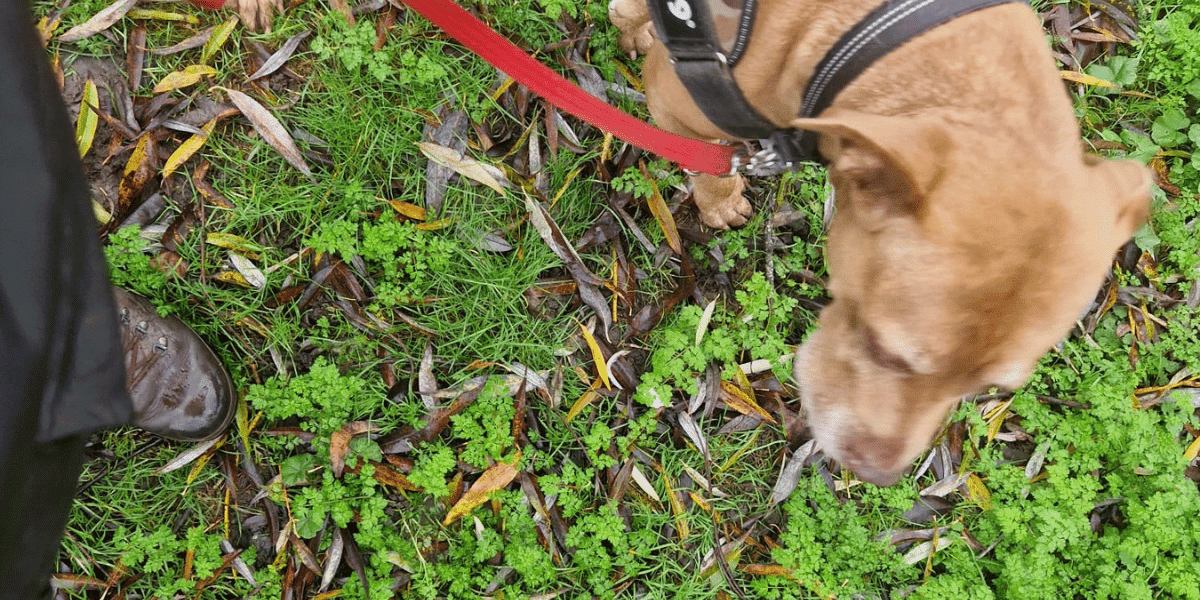
A nervous or reactive dog may not need the longest walk.
They need a walk they can cope with.
Busy roads, narrow paths, unfamiliar dogs, runners, bicycles, loud noises and unexpected approaches can make an ordinary route emotionally exhausting.
A dog may walk several miles while remaining highly stressed throughout.
Distance alone does not tell you whether that outing was suitable.
What a successful walk may look like
For a nervous dog, a good walk may include:
- a quiet route
- more distance from other dogs
- time to stop and observe
- freedom to move away from pressure
- calm sniffing
- predictable routines
- shorter periods outside
- returning home before the dog becomes overwhelmed
A 20-minute successful walk can be more useful than an hour spent struggling.
Confidence grows through manageable experiences, not by repeatedly placing a dog in situations they cannot handle.
Watch for early signs of stress
Do not wait for barking, lunging or complete panic before changing the situation.
Earlier signs may include:
- slowing down
- freezing
- turning away
- refusing food
- scanning the environment
- panting when it is not hot
- lip licking
- lowering the body
- pulling towards home
- becoming unable to sniff
- fixating on a person, dog or object
These signs can indicate that your dog needs more distance, a quieter route or an earlier return home.
My Rescue Dog Support Guide brings together advice for newly rehomed, nervous and sensitive dogs.
You can also read about walking nervous and reactive dogs in Finchley.
Short walks can still be useful
A short walk may allow a nervous dog to:
- toilet outside
- sniff familiar areas
- practise leaving and returning home calmly
- build confidence around one manageable situation
- experience the outside world without becoming overwhelmed
You can then provide suitable mental activity at home rather than trying to complete an arbitrary distance.
Dogs that refuse to walk
A dog that stops, sits down or tries to return home is communicating something.
Possible reasons include:
- fear
- pain
- fatigue
- heat
- uncomfortable equipment
- a frightening previous experience
- an overwhelming environment
- uncertainty about leaving home
Dragging the dog forward may increase fear and damage trust.
My guide to why a dog may refuse to walk explains how to look at the wider situation.
Reactive dogs still need appropriate exercise
Reactive dogs are sometimes walked less because owners understandably want to avoid difficult encounters.
Reducing unnecessary exposure can be sensible, but the dog still needs suitable opportunities to move, sniff and engage with their environment.
This may involve:
- walking at quieter times
- choosing wider paths
- using familiar routes
- crossing the road early
- turning away before the dog becomes overwhelmed
- using a secure long line where appropriate
- combining shorter walks with home enrichment
Where behaviour has changed suddenly or appears linked to pain, speak to your vet.
For persistent or serious behaviour concerns, seek help from a suitably qualified reward-based behaviour professional.
Dogs recovering from injury or on restricted exercise
A dog may need restricted exercise after surgery, injury or because of an ongoing medical condition.
Follow the instructions given by your vet.
Do not increase activity because your dog appears energetic or frustrated without checking that it is safe to do so.
Dogs do not always understand why their normal walks have stopped. A dog may feel ready to run before tissues have healed properly.
Restricted exercise may mean different things
Depending on the condition, your vet may recommend:
- toilet breaks only
- short lead walks
- avoiding stairs
- preventing jumping
- no off-lead exercise
- no running or rough play
- gradually increasing walking time
- specific physiotherapy exercises
Ask for clarification if you are unsure what “rest” or “lead exercise only” means for your dog.
Mental enrichment during restricted exercise
Suitable mental activity can help a dog cope with a temporary reduction in physical exercise.
Depending on veterinary advice, ideas may include:
- scattering part of a meal on a towel
- using a lick mat
- simple scent searches
- calm food puzzles
- brief reward-based training
- settling on a mat
- watching the world from a safe resting place
- gentle handling exercises if approved
Avoid activities that encourage twisting, jumping, rushing or frantic movement.
The right enrichment depends on the injury and the restrictions your vet has given.
Read my guide to brain games for dogs on restricted exercise for low-pressure ideas.
Build exercise back gradually
When your vet allows you to increase activity, do so steadily.
Do not move from several weeks of rest to a long walk or energetic game.
Muscle strength and fitness may have declined during recovery, even when the original injury has improved.
Watch for:
- limping
- stiffness
- slowing down
- reluctance to move
- changes in posture
- difficulty settling afterwards
- licking or guarding an area
Report concerns to your vet.
How weather changes your dog’s exercise needs
A normal walking routine should never take priority over safety.
Heat, humidity, frozen ground, storms and poor visibility can all change what is suitable.
The responsible option may be to shorten the walk, change the time, use a different route or replace the main outing with calm activity at home.
Walking dogs in hot weather
Dogs can overheat more quickly than people expect.
Risk can be affected by:
- temperature
- humidity
- direct sunlight
- lack of shade
- hot pavements
- age
- weight
- fitness
- coat
- breed and body shape
- heart or breathing conditions
Flat-faced dogs, older dogs, puppies, overweight dogs and dogs with medical conditions may be at greater risk.
During hot weather, I may:
- walk earlier
- choose shaded routes
- shorten the outing
- slow the pace
- provide a toilet break instead of a normal walk
- use calm indoor or garden enrichment
- cancel or rearrange when conditions are unsafe
Do not try to make up missed miles later in the same day if conditions remain unsuitable.
Your dog will not lose fitness because one walk was shortened for safety.
My Summer Dog Safety Guide covers heatstroke, pavements, hydration, shaded walks and safer alternatives.
You can also read whether dogs need less exercise in warm weather.
The RSPCA’s advice on dogs in hot weather includes guidance on avoiding exercise during the hottest part of the day and recognising signs of heat-related illness.
Signs that a dog may be overheating
Warning signs may include:
- heavy or persistent panting
- drooling
- slowing down
- seeking shade
- bright red gums
- weakness
- vomiting
- confusion
- collapse
Heatstroke is an emergency.
Move the dog away from the heat, begin appropriate cooling and contact a vet immediately.
Do not delay veterinary help while waiting to see whether the dog improves.
Wet weather and standing water
Rain does not automatically make a walk unsafe, but conditions may create additional risks.
These can include:
- slippery surfaces
- reduced visibility
- fast-flowing water
- deep mud
- hidden debris
- standing water
- contaminated ponds or streams
During long dry periods, low water levels and slow-moving streams can become particularly unpleasant or unsafe.
Do not allow dogs to drink from or jump into water that looks stagnant, discoloured, polluted or affected by algae.
Choose clean drinking water carried from home.
Cold, frost and ice
Some dogs cope well with cold conditions. Others become uncomfortable quickly.
Consider:
- age
- coat type
- body size
- health
- wind chill
- how wet the dog becomes
- the condition of paths and pavements
Older dogs and dogs with short coats may benefit from a suitable coat.
Ice can create a slipping risk, especially for dogs with reduced mobility.
Rock salt and de-icing products may irritate paws and can be harmful if licked in significant quantities. Check and clean paws after winter walks.
Storms and strong winds
Strong winds can increase noise, move objects unexpectedly and make woodland routes unsafe.
Nervous dogs may also react to bins, branches, signs and other objects moving differently.
A shorter route through a safer, more sheltered area may be preferable.
During thunderstorms or extreme weather warnings, follow local safety advice and do not enter woodland or exposed areas simply to maintain a normal routine.
My Extreme Weather Policy explains how I adapt professional walks during unsafe conditions.
On-lead and off-lead exercise
A dog does not have to run off-lead to get useful exercise.
Lead walks can provide:
- steady movement
- sniffing
- exploration
- training
- confidence building
- safe exposure to the environment
This is particularly important for dogs who:
- have unreliable recall
- are nervous or reactive
- are newly adopted
- are recovering from injury
- may chase wildlife
- are walking near roads
- are subject to local restrictions
- need carefully controlled exercise
Do not feel pressured to let your dog off lead because other owners do.
Safety and suitability matter more.
My guide to exercising dogs on the lead explains how lead walks can still provide movement, choice and enrichment.
Using a long line
A long line can provide additional freedom while maintaining a physical connection.
It may be useful for:
- recall practice
- nervous dogs
- newly adopted dogs
- dogs with a strong chase instinct
- open spaces where off-lead freedom is not suitable
A long line should be attached to a well-fitting harness rather than used to stop a fast-moving dog suddenly by the neck.
It also requires careful handling.
Avoid wrapping it around your hand, and watch for people, dogs, trees and legs becoming caught in the line.
Use it only where there is enough safe space.
Off-lead exercise
Off-lead activity can be enjoyable for dogs with suitable recall and awareness.
Before unclipping the lead, consider:
- roads and exits
- livestock
- wildlife
- other dogs
- children
- cyclists
- visibility
- local rules
- whether your dog will return when called
Off-lead exercise should not mean allowing a dog to run up to every person or animal.
Other dogs may be nervous, elderly, recovering from surgery or being trained.
Call your dog back early and give others space.
Retractable leads
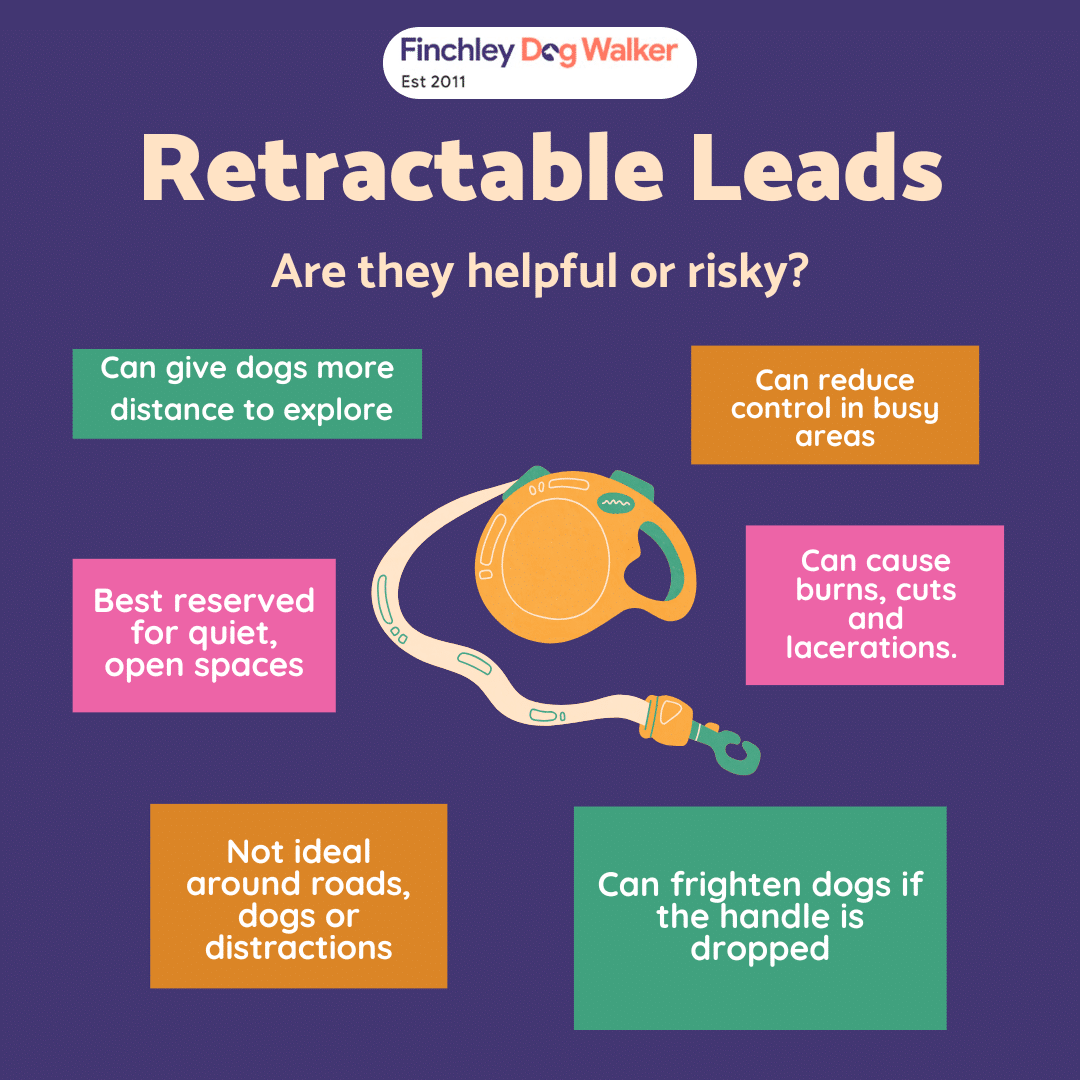
Retractable leads can create problems because the dog may build speed before reaching the end, the thin cord can cause injuries, and the locking mechanism can fail or be difficult to operate quickly.
I prefer a standard fixed-length lead or an appropriately handled long line.
You can read my guide to why I do not use retractable leads.
Sniffing, enrichment and choice on walks
A good walk does not need to be packed with commands, games and constant activity.
For many dogs, simply being allowed to sniff and explore is valuable.
Sniffing can:
- provide information about the environment
- encourage a slower pace
- support natural behaviour
- make a short route more interesting
- help some dogs settle into the walk
- provide mental engagement without high impact
I do not rush dogs past every tree or patch of grass simply to cover more distance.
There are times when we need to move on for safety, but sniffing is normally part of the walk rather than an interruption.
Simple enrichment during a walk
Suitable ideas may include:
- scattering a few treats in clean grass
- asking the dog to find a treat near a tree
- using different safe routes
- allowing the dog to choose between two directions
- pausing in a quiet place to watch the world
- practising a few simple reward-based cues
- walking over different safe surfaces
- using natural features for gentle exploration
Keep activities appropriate for the individual dog.
A nervous dog may find new places stressful rather than enriching. A dog with joint problems should not be encouraged to jump onto walls or logs.
Enrichment should add interest, not pressure.
My guide to things to do while walking your dog includes practical ideas for making walks more varied.
Choice does not mean a lack of boundaries
Giving a dog choice does not mean letting them do anything they want.
You can offer safe, limited choices such as:
- which of two routes to take
- whether to pause and sniff
- whether to continue or turn towards home
- which side of a wide path feels more comfortable
You still manage roads, other dogs, wildlife, unsafe food and the overall direction of the walk.
The aim is to include the dog in the experience while keeping everyone safe.
Food enrichment on walks
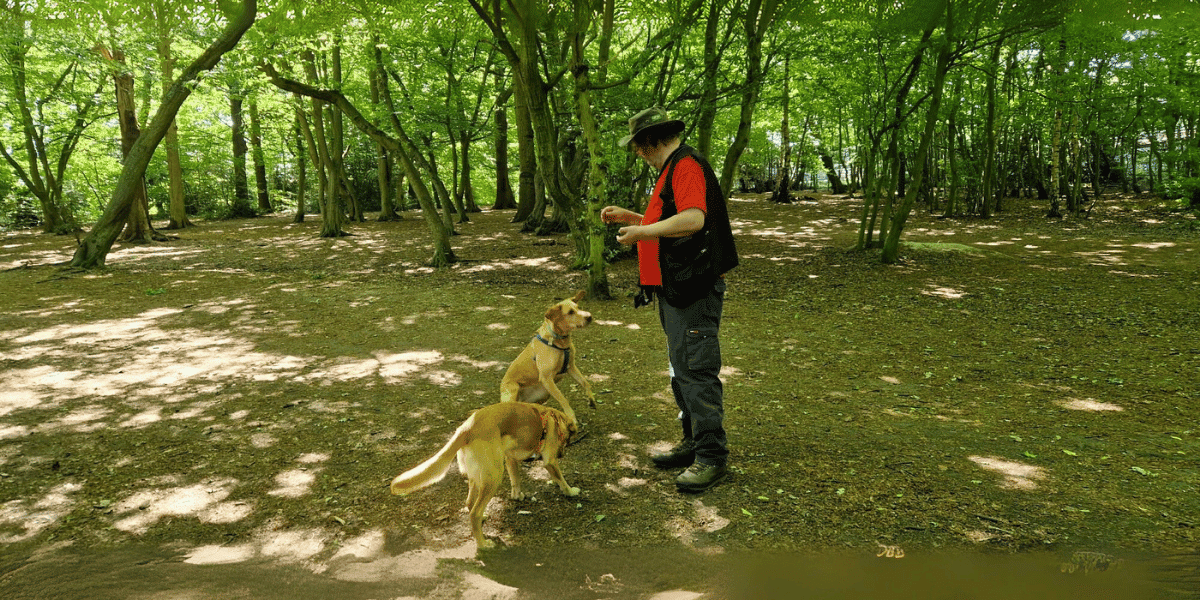
Treats can support calm walking, recall, checking in and simple searches.
Take the treats from your dog’s normal daily food allowance where appropriate, particularly if weight is a concern.
Do not scatter food where there is:
- broken glass
- litter
- stagnant water
- unknown chemicals
- heavy dog fouling
- other dogs competing nearby
Dogs with allergies, medical diets or digestive problems may need specific treats approved by their vet.
Visit my Dog Food and Nutrition Guide for more information about treats, portions and feeding enrichment.
Rest is part of enrichment
A dog does not need entertainment every waking minute.
Constant games, training, food puzzles and activity can make it harder for some dogs to switch off.
A balanced routine includes:
- activity
- quiet time
- sleep
- predictability
- opportunities to recover
After a stimulating walk, your dog may need a calm environment rather than another activity immediately.
Observe whether your dog can drink, settle and sleep comfortably after returning home.
Signs your dog may need more suitable activity
Dogs need appropriate outlets for movement, sniffing, exploration and engagement.
A dog receiving too little suitable activity may show changes such as:
- restlessness
- pacing
- repeated attention-seeking
- difficulty settling
- destructive behaviour
- increased barking
- weight gain
- reduced fitness
- constant interest in going outside
- searching for their own entertainment
However, none of these signs proves that your dog simply needs a longer walk.
Similar behaviour can also be connected to:
- pain or illness
- fear or anxiety
- frustration
- poor sleep
- overstimulation
- changes in routine
- toileting needs
- hunger
- separation-related distress
Look at the full picture before increasing exercise.
If your dog’s behaviour changes suddenly, speak to your vet. Medical problems can affect sleep, tolerance, movement and behaviour before an obvious physical sign appears.
More activity should still suit the dog
If your dog would benefit from more activity, increase it gradually.
This might mean:
- adding a short sniffing outing
- making an existing walk more interesting
- introducing a simple food search
- varying safe routes
- including brief reward-based training
- allowing more time to explore
- adding suitable play
It does not automatically mean doubling the length of every walk.
A previously inactive or overweight dog should build fitness steadily. Sudden long walks can leave them sore and reluctant to exercise again.
Consider the quality of the current routine
Before adding more, ask:
- Does my dog get time to sniff?
- Are the walks calm enough for them to think?
- Is the environment suitable?
- Are they frightened or frustrated outside?
- Do they receive enough sleep?
- Is most activity highly exciting?
- Can they settle after returning home?
- Has their health or mobility changed?
Sometimes the answer is not more exercise.
It is a better balance between movement, enrichment and rest.
Signs your dog may be doing too much exercise
Dogs do not always stop when they have had enough.
Some remain excited by a game, another dog or an interesting environment even when their body needs rest.
This is particularly relevant to:
- puppies
- adolescent dogs
- highly driven dogs
- dogs that repeatedly chase balls
- overweight or unfit dogs
- senior dogs
- dogs recovering from injury
- dogs that hide pain
Signs during a walk
Your dog may need to slow down, rest or return home if they:
- lag behind
- sit or lie down
- repeatedly stop
- seek shade
- pant heavily
- appear unsteady
- change the way they walk
- lift a paw
- refuse to continue
- become unusually irritable
- try to turn towards home
Heavy panting, weakness, confusion or collapse during warm conditions may indicate heat-related illness and require urgent veterinary help.
Signs after exercise
Problems may not become obvious until later.
Watch for:
- stiffness after sleeping
- limping
- difficulty getting up
- reluctance to use stairs
- sore or damaged paws
- unusual tiredness
- restlessness instead of sleep
- reduced appetite
- licking a particular area
- avoiding the harness or lead the next day
- being less willing to walk
A dog that repeatedly struggles after normal activity should be checked by a vet.
Do not rely on pain tolerance or enthusiasm as proof that the exercise was safe.
Overstimulation can look like excess energy
A dog that returns home running around, barking, grabbing the lead or mouthing may appear to need even more exercise.
They may actually be struggling to come down from an intense outing.
Look at what happened during the walk.
Was it:
- very busy?
- full of repeated dog encounters?
- dominated by ball chasing?
- noisy?
- longer than usual?
- physically demanding?
- frustrating?
A calmer route, additional sniffing and a quieter recovery period may help more than another exciting activity.
What might a balanced day look like?
There is no universal timetable that every dog should follow.
The examples below show how physical activity, mental engagement and rest might be combined.
They are not fixed prescriptions.
A healthy adult dog
- A morning walk with time to move, sniff and explore.
- Breakfast, followed by quiet time and sleep.
- A brief training or food-search activity later in the day.
- A second outing for walking, sniffing and toileting.
- A calm evening with suitable rest.
The length and intensity of each outing should depend on the individual dog.
A nervous or reactive dog
- A short walk at a quieter time.
- A familiar route with space from triggers.
- Time to sniff without being rushed.
- A calm return home before the dog becomes overwhelmed.
- Plenty of undisturbed rest.
- A simple scent or food activity later if the dog is relaxed.
- A brief toilet outing during a quiet period.
This routine may provide less distance but a much more manageable day.
A senior dog
- A gentle morning outing on a familiar route.
- Time to sniff and move at a comfortable pace.
- A warm, supportive resting area.
- One or more short toilet or exploration breaks.
- Low-impact enrichment suited to mobility and health.
- Plenty of recovery time.
Some older dogs prefer several small outings rather than one long walk.
A puppy
- A short age-appropriate outing or safe exploratory experience.
- A brief training or play session.
- Food, toileting and plenty of sleep.
- Another short activity later in the day.
- Calm opportunities to learn about everyday sights and sounds.
Puppies can become overtired quickly. Rest should form a large part of their routine.
A dog on a hot day
- An early walk before conditions become unsafe.
- Short shaded toilet breaks where needed.
- Fresh water and a cool place to rest.
- Calm indoor enrichment instead of a normal afternoon walk.
- A later outing only if the temperature, humidity and ground conditions are suitable.
There is no need to replace every missed minute of walking.
A dog after a particularly active day
- A shorter, slower walk.
- More time to sniff.
- Less high-impact play.
- Additional sleep and recovery.
- Observation for stiffness or unusual fatigue.
Look at activity across the week, not only within one day.
When a dog is in season
Dogs may also need temporary changes to their routine during illness, recovery or a season. Read my guide to walking a dog safely while she is in season.
When should a walk be shortened or replaced?
Dogs benefit from routine, but routines must remain flexible.
A normal walk may need to be shortened, delayed or replaced when:
- the weather is dangerously hot
- pavements are too hot
- there is ice or unsafe footing
- there are severe storms or high winds
- your dog is unwell
- your dog is injured
- your vet has restricted exercise
- your dog appears unusually tired
- your dog is showing signs of pain
- your dog is frightened by fireworks or another unusual event
- the intended location is unsafe
- your dog is already overwhelmed
Skipping or shortening one unsuitable walk will not harm a healthy dog.
Forcing a walk in unsafe conditions may.
Suitable alternatives to a normal walk
Depending on your dog’s health and the reason for changing the walk, alternatives may include:
- a short toilet break
- a calm sniff around the garden
- scattering part of a meal
- a simple search game
- a lick mat
- a suitable food puzzle
- brief reward-based training
- settling exercises
- quiet companionship
- additional sleep
Choose low-pressure activities.
Do not try to compensate for a missed walk by creating hours of frantic indoor entertainment.
My Extreme Weather Policy explains when and why I adapt professional walks for safety.
Solo dog walks or group dog walks?
Group walks suit some dogs.
Other dogs are safer, calmer and happier with individual attention.
The right choice depends on the dog rather than what appears most social or convenient.
A dog may enjoy a suitable group when they:
- are comfortable around the other dogs
- can move away and rest when needed
- do not become excessively excited
- respond reliably to the walker
- are physically suited to the pace
- can travel safely if transport is involved
- are not frightened or overwhelmed by the arrangement
A solo walk may be more suitable when a dog:
- is nervous around dogs or people
- is reactive
- is newly adopted
- needs a slower pace
- is elderly
- is recovering from injury
- has unreliable recall
- becomes overexcited in groups
- needs individual training support
- has specific handling requirements
- does not cope well with vehicles or crates
A dog does not need to walk in a group to receive companionship, enrichment or a valuable outing.
Some dogs gain far more from a predictable one-to-one relationship.
You can read my full comparison of solo dog walks and group walks.
My guide to why group walks are not right for every dog looks more closely at dogs that need space, a slower pace or an individual routine.
Ask who will actually walk your dog
Before choosing a walking service, ask:
- How many dogs are walked together?
- Are dogs transported?
- How long are they in a vehicle?
- Are crates used?
- How are dogs matched?
- What happens if a dog is frightened or overwhelmed?
- What equipment is used?
- How are emergencies handled?
- Will the same person usually walk the dog?
The cheapest or longest walk is not automatically the best value if the arrangement does not suit your dog.
My approach to one-to-one dog walking
I provide solo dog walks for one household at a time in Finchley, Muswell Hill and selected nearby areas.
I do not collect groups of dogs in a van.
The walk begins and ends at your dog’s home. This means the booked time is spent caring for your dog rather than travelling around collecting and returning several dogs.
My walks are adapted around:
- age
- health
- fitness
- confidence
- weather
- walking pace
- preferred routes
- reactions to dogs, people and traffic
- how the dog appears on that particular day
I include time for sniffing, exploration and simple enrichment where suitable.
I do not force dogs to complete a fixed distance or route.
If a senior dog needs to slow down, we slow down.
If a nervous dog needs space, I change direction or choose a quieter route.
If the weather is unsafe, I shorten or adapt the visit.
Dogs my solo walks may suit
One-to-one walking can be particularly helpful for:
- rescue dogs
- nervous dogs
- reactive dogs
- senior dogs
- adolescent dogs that become overexcited in groups
- dogs with specific routines
- dogs that dislike vehicles
- dogs that need a slower, calmer approach
Read more about my solo dog walking service in Finchley and Muswell Hill, including how the service works and the areas I cover.
You can also visit my Rescue Dog Support Guide if your dog is newly rehomed, worried outside or unsuitable for group walking.
Related dog walking and exercise guides
Use these guides to explore the subjects most relevant to your dog.
Understanding exercise and rest
- Is Your Dog Bored, Overstimulated or Overtired?
- A Weekly Mental and Physical Enrichment Routine
- Should I Walk My Dog Every Day?
Making everyday walks more useful
- What Are One-to-One Enriched Dog Walks?
- Sniff and Decompression Walks
- Things to Do While Walking Your Dog
- How to Exercise a Dog on the Lead
- Where I Walk Dogs and How I Choose Routes
- Dogs and obesity
Walking different dogs
- Tips for Walking Your New Puppy
- Exercise and Enrichment for an Elderly Dog
- Walking Nervous and Reactive Dogs
- Why Does My Dog Refuse to Walk?
Choosing a professional walking service
- Solo Dog Walks vs Group Walks
- Why Group Walks Are Not Right for Every Dog
- Solo Dog Walking in Finchley and Muswell Hill
- Dog Walking and Pet-Care Services
Walking safely in different weather
Frequently asked questions about dog walking and exercise
Is one walk a day enough for a dog?
It depends on the dog and the rest of their routine.
Some dogs may be comfortable with one main walk plus shorter toilet-and-sniffing outings. Others benefit from two or more walks spread across the day.
Consider age, health, fitness, access to a garden, confidence and the quality of the main walk.
A single long walk does not necessarily compensate for spending the rest of the day without toileting opportunities, interaction or suitable activity.
Is an hour’s walk enough for a dog?
An hour may be too much for one dog and too little for another.
The number alone does not tell you whether the walk is suitable.
Consider the pace, terrain, weather, opportunities to sniff, the dog’s health and how they recover afterwards.
How often should I walk my dog?
Most healthy adult dogs benefit from regular daily outings, but the number and length should suit the individual.
Puppies, senior dogs, nervous dogs and dogs with health conditions may need shorter or differently structured outings.
Does playing in the garden replace a walk?
Garden activity can provide movement, toileting and enrichment, but it does not always replace the variety of smells and experiences available during a suitable walk.
There are occasions when garden activity is the safer choice, including during extreme weather, illness, or veterinary restrictions.
Does sniffing count as exercise?
Sniffing provides mental engagement and often involves gentle physical movement.
It should be considered a valuable part of a walk, though it does not replace all forms of physical exercise.
Can dogs have too much exercise?
Yes.
Too much distance, high-impact movement or repetitive activity can cause fatigue, pain or injury. Puppies, seniors, unfit dogs and dogs recovering from medical problems require particular care.
Why is my dog more excitable after a walk?
The walk may have been highly stimulating, frustrating or physically demanding.
Busy environments, repeated dog encounters and intense games can leave some dogs struggling to settle.
Try a calmer route, reduce repetitive high-arousal play and allow quiet recovery time.
Should puppies be walked every day?
Puppies need regular opportunities to explore and learn, but walks should remain short and appropriate for their development.
Follow veterinary advice around vaccinations and avoid demanding distances, repetitive jumping or forced running.
Do older dogs still need daily walks?
Many older dogs benefit from regular gentle movement and sniffing.
The pace, route and duration may need to change. Speak to your vet if mobility or willingness to walk changes.
Can an on-lead walk provide enough exercise?
Yes.
A well-managed lead walk can include steady movement, sniffing, exploration and training. Dogs do not have to run off lead to receive a valuable outing.
Should every sociable dog join a group walk?
No.
A dog may enjoy meeting other dogs but still become overwhelmed, overexcited or unable to rest during a group walk.
Suitability depends on temperament, recall, physical ability, the group size and how the service operates.
What can replace a walk during hot weather?
Use early or late toilet outings when conditions are safe, along with calm indoor enrichment, food searches, appropriate training, and additional rest.
Do not exercise a dog during unsafe heat simply to maintain a timetable.
How do I know if my dog is in pain?
Possible signs include stiffness, limping, slowing down, reluctance to move, changes in posture, difficulty getting up, irritability and reduced interest in walks.
Dogs can show pain in subtle ways. Contact your vet if you notice a change in movement or behaviour.
Final thoughts
The right walk is not always the longest walk.
It is the walk that suits the dog in front of you.
Age, health, confidence, weather, environment and recent activity all matter. So do sniffing, choice and the ability to rest afterwards.
Try not to judge a walk only by distance, speed or the number on a fitness tracker.
Instead, ask:
- Was my dog comfortable?
- Did they have time to sniff?
- Could they cope with the environment?
- Did they move safely?
- Were they able to settle afterwards?
- Would I make the same choices tomorrow based on how they recovered?
Those questions tell you far more than minutes alone.
If your dog would benefit from calm, individual walks without group pressure, vehicles or a fixed route, visit my Solo Dog Walking service.
You can also browse my Dog and Cat Care Guides for practical advice about rescue dogs, puppies, senior dogs, enrichment, seasonal safety, pet sitting and everyday care.
This article provides general information only. Contact your vet if your dog is unwell, in pain, struggling to breathe, showing reduced stamina or recovering from an injury. Always follow veterinary exercise restrictions and rehabilitation advice.


