Updated October 2026 | By Derek (Del) Chambers, Finchley Dog Walker
Christmas trees and cats can be an entertaining combination, although perhaps not always for the reasons we’d like.
You spend ages decorating the tree, arranging the lights and making everything look lovely. Then your cat appears, studies your hard work and decides you’ve installed a particularly interesting climbing frame in the living room.
Some cats are content to sit underneath the tree and watch. Others seem determined to investigate every branch, bauble and piece of ribbon.
I’ve been caring for cats professionally around Finchley and Muswell Hill since 2011, and I’ve learnt that trying to stop a curious cat being curious is rarely the most useful approach.
Instead, I would concentrate on making the Christmas tree safer, removing the most tempting hazards and giving your cat suitable alternatives.
You may not achieve a completely cat-proof Christmas tree, but you can make accidents considerably less likely.
Quick answer: How do you cat-proof a Christmas tree?
The safest approach is to make the tree stable, remove hazardous decorations, protect electrical cables and manage your cat’s access when you cannot supervise them.
I recommend:
- Choosing a sturdy tree stand and a suitable location.
- Securing the tree so it cannot easily topple.
- Avoiding tinsel, loose ribbon and fragile glass decorations.
- Keeping electrical cables inaccessible and lights switched off when unattended.
- Preventing access to Christmas tree water.
- Regularly clearing fallen needles from real trees.
- Providing familiar scratching, climbing and play opportunities elsewhere.
- Using a separate room for the tree if your cat is particularly determined to climb it.
Avoid citrus sprays, essential oils, sticky deterrents or anything designed to frighten your cat away.
The aim is a safer environment, not a stressful Christmas.
Affiliate disclosure: This article may contain affiliate links to suitable cat-care products. If you buy through one of these links, I may earn a small commission at no additional cost to you. As an Amazon Associate, I earn from qualifying purchases. I only recommend products that I believe are appropriate for the individual cat.
1. Choose the right place for your Christmas tree
Where you put your Christmas tree can make a considerable difference.
Cats are excellent climbers and jumpers. A tree positioned beside a sofa, bookshelf or windowsill may be especially easy to investigate.
If possible, choose a location that:
- Is away from shelves and furniture that provide easy jumping points.
- Has enough room for a stable tree stand.
- Keeps cables away from normal walking routes.
- Doesn’t block your cat’s access to food, water, litter trays or favourite resting areas.
- Can be separated from your cat when you’re not supervising.
A room with a closing door can be particularly helpful if you have a persistent tree climber.
Don’t disturb your cat’s favourite places unnecessarily
Cats often rely on familiar routes and resting spots.
If your cat normally sleeps in a particular corner of the living room, placing a tree directly in that space may create unnecessary disruption.
I would rather adapt the tree’s location than expect the cat to give up an important part of their normal routine.
This is particularly relevant for nervous and older cats.
For wider advice about comfortable home environments, visit my Cat Care Advice Hub.
2. Make sure the Christmas tree cannot fall over
Tree stability is one of the first things I would check.
Even a cat who isn’t normally interested in climbing may suddenly decide the branches look inviting.
A falling tree can injure a cat, damage electrical equipment, or break decorations.
Start with a sturdy base
Use a stand designed for your tree’s size and weight.
Make sure it sits on a firm, level surface and cannot easily wobble.
If you’re using a real tree, follow the stand manufacturer’s instructions.
Should you attach the tree to a wall?
For some households, an additional secure wall fixing may be useful.
Choose a suitable anchoring arrangement that is installed correctly and that your cat cannot access or chew.
Avoid leaving exposed fishing line, hanging string or loops around the tree.
These can create entanglement and swallowing hazards.
If you cannot secure a large tree reliably, consider a smaller tree or a different position.
What about small Christmas trees?
A smaller tree may be easier to manage, but it isn’t automatically safe.
A lightweight tabletop tree can still be knocked over, chewed or pulled down.
Keep any decorations suitable and the tree stable.
The Cats Protection Christmas safety guide also recommends using a secure base and avoiding fragile decorations.
3. Choose safer Christmas tree decorations
To a cat, a dangling bauble can look remarkably like a toy.
Anything that swings, sparkles or moves may invite investigation.
I would concentrate on decorations that are unlikely to shatter or break into small pieces.
Decorations I would avoid
- Glass baubles that may break into sharp fragments.
- Tinsel and decorative strands.
- Loose ribbon and string.
- Decorations with bells or tiny detachable pieces.
- Easily broken ornaments.
- Edible decorations such as chocolate.
- Decorations containing accessible button batteries.
- Artificial snow or loose glitter that your cat may lick or swallow.
Fabric, wood or suitably robust decorations may be more practical, but the material alone doesn’t guarantee safety.
A fabric decoration with a long hanging cord, for example, could still cause problems.
Keep decorations higher up
If you choose to decorate the tree, place ornaments higher on the branches and avoid putting tempting decorations near the bottom.
Check that hooks and fastenings cannot easily come loose.
However, remember that determined cats can climb.
Moving a hazardous decoration higher up doesn’t necessarily make it safe.
4. Why I wouldn’t use tinsel on a Christmas tree with cats
Tinsel is one festive decoration I would avoid entirely in a household with cats.
Long, shiny strands can be especially tempting.
If swallowed, tinsel can cause serious digestive problems, including intestinal obstruction or injury.
This is not simply a matter of your cat having an upset stomach.
A swallowed strand can create a veterinary emergency.
What if your cat swallows tinsel?
Contact your vet promptly if you know or suspect that your cat has swallowed tinsel, ribbon, string or another long decoration.
Don’t wait until they start vomiting.
And never pull on string or tinsel protruding from your cat’s mouth or bottom.
Doing so could cause serious internal injury.
The PDSA’s guide to dangerous Christmas decorations covers these risks in more detail.
5. Are real Christmas trees safe for cats?
Real Christmas trees can introduce additional hazards.
Cats may chew the branches, investigate the tree stand or drink water from the base.
The needles can also fall onto the floor.
Fallen needles
Tree needles can be sharp and may injure paws or cause problems if swallowed.
Vacuum or sweep around the tree regularly, particularly if it is shedding heavily.
If your cat repeatedly chews the tree, preventing access may be the safest option.
Tree sap and oils
Some substances found in real Christmas trees can irritate a cat’s mouth or digestive system and may cause illness if swallowed.
Don’t assume that a natural tree is harmless simply because it doesn’t contain artificial materials.
Christmas tree water
Water in a real tree stand may contain preservatives, fertilisers or other additives.
Even without additives, stagnant water is not something you want your cat drinking.
Use a properly fitted cover or another secure arrangement that prevents access to the water without introducing loose netting or swallowing hazards.
Provide plenty of fresh drinking water in your cat’s usual locations.
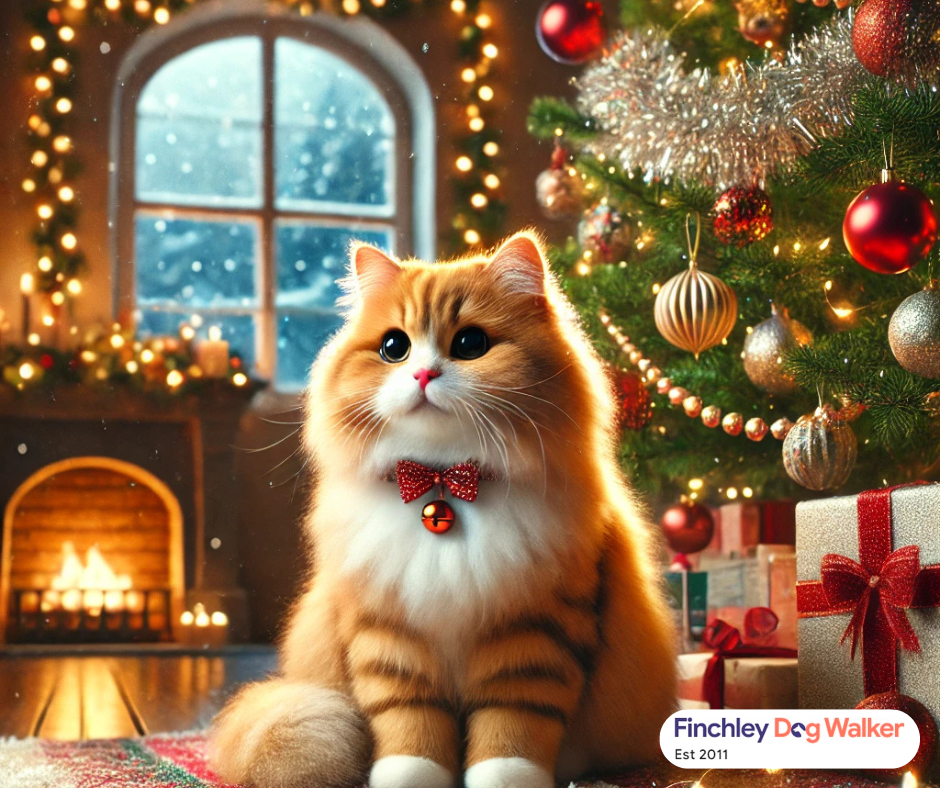
Artificial trees aren’t risk-free
An artificial tree avoids falling natural needles and tree water, but it still has potential hazards.
Plastic branches, loose sections, decorations and electrical cables can all cause problems.
The safest choice depends on your cat’s behaviour and how the tree is set up.
For independent guidance, see Cats Protection: Cats at Christmas.
I do have clients that have brought a Paw Hunt Festive cat tree from Amazon
6. Protect Christmas lights and electrical cables
Fairy lights can look beautiful, but electrical cables can be dangerous if a cat chews or becomes tangled in them.
Before switching on your lights:
- Check for frayed or damaged wiring.
- Keep cables away from your cat’s usual play areas.
- Use suitable protective cable covers where appropriate.
- Avoid loose dangling wires.
- Keep plugs and connections secure and dry.
- Follow the manufacturer’s installation instructions.
- Switch lights off at the mains when the tree is unattended.
If your cat regularly chews cables, I’d seriously consider whether a lit tree is suitable in an accessible room.
What if your cat chews an electrical cable?
Switch off the electricity before touching a cat or damaged cable if there may be an electrical hazard.
Seek urgent veterinary advice if you suspect an electrical injury, even if there is no obvious burn.
Electrical injuries can have consequences that are not immediately visible.
7. Don’t use citrus sprays, essential oils or sticky deterrents
You may see online suggestions to use citrus sprays, essential oils, aluminium foil, or double-sided tape to discourage cats from approaching Christmas trees.
I wouldn’t use these methods.
Citrus essential oils and other scented products can harm cats, especially if residue gets onto their coat and they swallow it while grooming.
Sticky surfaces may also cause distress or leave materials attached to a cat’s fur.
And frightening a cat away from the tree doesn’t address the underlying problem.
What would I do instead?
I would make the tree less accessible, remove dangerous decorations and provide suitable alternatives.
If the cat continues to climb the tree, I’d use a room separation arrangement when supervision isn’t possible.
This is much more predictable than hoping a smell or uncomfortable surface will deter a determined cat.
Read Cats Protection’s guidance on essential oils and cats for more information.
8. Give your cat somewhere better to climb and play
Sometimes a Christmas tree attracts attention because it’s the most interesting new object in the room.
Cats benefit from suitable opportunities to climb, scratch, investigate, play and rest throughout the year.
Rather than purchasing lots of Christmas-themed toys, start with familiar activities your cat already enjoys.
Suitable alternatives might include
- A stable scratching post.
- A secure cat tree or climbing platform.
- A comfortable elevated resting place.
- A cardboard box with no dangerous staples or loose attachments.
- Short supervised play sessions.
- A familiar food puzzle.
- A suitable hideaway in a quiet part of the home.
Not every cat will want the same activities.
A young, active cat may enjoy climbing and chasing toys.
An older cat with arthritis may prefer a low, comfortable resting area.
A nervous cat might simply want a safe place away from visitors.
What about a cat hut or hideaway?
A comfortable cat hut may provide an additional resting or hiding place for a cat who enjoys enclosed spaces.
However, it isn’t a guaranteed way to stop Christmas tree climbing.
It should be stable, appropriately sized, easy to access and free from loose cords or swallowable pieces.
There’s no need to buy one if your cat already has a favourite place to rest.
For more ideas, see my Indoor Cat Enrichment Guide.
9. Helping nervous cats cope with Christmas decorations
For some cats, the biggest issue isn’t climbing the tree.
It’s the sudden change to their home.
A large unfamiliar object appears in the living room. Furniture moves. Lights flash. Visitors arrive.
This can be unsettling, particularly for nervous, rescue or older cats.
I would introduce decorations gradually where possible.
Keep your cat’s familiar resources accessible.
Avoid blocking their normal routes.
And make sure they have somewhere quiet to retreat.
Signs your cat may be uncomfortable
Look for changes such as:
- Hiding more than usual.
- Avoiding a familiar room.
- Reduced interest in play.
- Changes in appetite.
- Increased tension around visitors.
- Changes in toileting.
- Reluctance to approach familiar areas.
Don’t assume every change is caused by Christmas stress.
Persistent changes in eating, drinking, toileting or behaviour warrant veterinary advice.
Cats should be free to move away from the tree, decorations or visitors without being followed or forced to interact.
For broader Christmas advice, read my How to Keep Your Cats Safe at Christmas guide.
10. What if your cat keeps climbing the Christmas tree?
Some cats simply find Christmas trees irresistible.
If you’ve already secured the tree, removed hazardous decorations and provided alternative activities, but your cat still climbs, I’d concentrate on management rather than punishment.
You could:
- Keep the tree in a room your cat cannot enter unsupervised.
- Reduce the size or number of decorations.
- Consider a smaller, securely positioned tree.
- Remove especially tempting moving decorations.
- Supervise access when practical.
- Accept that this particular cat may not be suited to an accessible floor-standing tree.
Don’t shout, spray water or frighten your cat.
And don’t assume that a cat who ignored the tree yesterday will continue ignoring it tomorrow.
11. What to do if your cat has an accident involving the tree
Despite sensible precautions, accidents can happen.
Contact your vet promptly if your cat:
- Swallows tinsel, ribbon, string or part of a decoration.
- Chews an electrical cable.
- Has a painful injury from broken decorations.
- Swallows tree water containing additives.
- Appears to have eaten part of the tree and becomes unwell.
- Has repeated vomiting, significant abdominal discomfort or unusual lethargy.
If your cat collapses, has difficulty breathing or appears seriously injured, seek emergency veterinary care.
Don’t try to make your cat vomit unless a vet specifically tells you to.
If possible, tell your vet exactly what was swallowed or involved in the accident.
Take product packaging or a photograph where helpful.
Christmas hazards can become serious quickly, so early professional advice matters.
12. My Christmas tree safety checklist
Before switching on the lights and leaving your cat to inspect the finished tree, I’d check the following.
- The tree stand is stable and suitable.
- Any additional anchoring is secure and out of reach.
- The tree is away from obvious jumping points where practical.
- No tinsel or loose decorative string is present.
- Fragile glass baubles have been removed.
- Decorations have no accessible small parts.
- Electrical cables are secure and undamaged.
- Lights are switched off at the mains when unattended.
- Real tree water is inaccessible.
- Fallen needles are cleared regularly.
- Your cat’s food, water, litter tray and resting areas remain accessible.
- Safe alternative play and resting spaces are available.
- You can separate the tree from the cat if needed.
The checklist takes only a few minutes, but it may prevent a considerable amount of trouble.
13. Going away over Christmas? Keep your cat’s routine familiar
Christmas is also a busy time for travel and visiting family.
If you’re going away, consider whether your cat would be happier staying at home rather than moving into unfamiliar accommodation.
For many cats, staying in familiar surroundings can reduce disruption, provided you arrange suitable care visits.
Before leaving, tell your cat sitter:
- Whether the Christmas tree will remain up.
- Whether the lights must stay switched off.
- Which rooms your cat can access.
- Whether there are fragile or dangerous decorations.
- Where your cat normally hides.
- What to do if decorations have fallen.
- Where the cat carrier is kept.
- Your veterinary and emergency contact arrangements.
I’d recommend removing unsafe decorations and making sure the tree is stable before travelling, rather than expecting a sitter to supervise it continuously.
Cat sitting in Finchley and Muswell Hill
I provide Cat Sitting and Feeding Visits in Finchley, including East Finchley, North Finchley, Finchley Central, Muswell Hill and selected nearby areas.
I’ve cared for cats professionally since 2011, and I work with one household at a time.
Visits follow your cat’s usual routine and can include feeding, water, litter care, suitable play, agreed medication support, and photographs.
Some cats welcome company enthusiastically. Others prefer to keep their distance.
I respect both.
If you’re preparing for a Christmas holiday, my What to Leave for Your Cat Sitter Checklist explains what to organise before going away.
Frequently asked questions
How do I stop my cat climbing the Christmas tree?
Use a sturdy base, remove tempting or dangerous decorations, provide suitable alternative activities and limit access to the tree when you cannot supervise. For persistent climbers, a separate room is often the most reliable solution.
Are artificial Christmas trees safer for cats?
They remove some risks associated with natural needles and tree water, but artificial branches, loose plastic pieces, decorations and cables can still be dangerous.
Is tinsel dangerous to cats?
Yes. Swallowed tinsel can cause serious digestive injuries or blockages. I recommend avoiding it entirely in homes with cats.
Can I use citrus spray to keep my cat away from the tree?
I wouldn’t recommend citrus essential oil sprays or scented deterrents. Some ingredients can harm cats, and they may be exposed through their coat or grooming.
Should I put aluminium foil around the tree?
I wouldn’t rely on foil as a deterrent. It may not stop climbing, and loose or chewed pieces may introduce other risks. Physical access management is more dependable.
Can cats drink Christmas tree water?
Prevent access to it. Tree water may contain additives or bacteria, and drinking it can cause illness. Keep ordinary fresh water available elsewhere.
Is it safe to leave Christmas tree lights on overnight?
I recommend switching lights off at the mains when you’re asleep or unable to supervise, particularly in a home with curious cats.
Can a cat sitter look after my cat over Christmas?
Yes, if the care arrangements meet your cat’s individual needs. Leave clear instructions, remove avoidable hazards and discuss any seasonal changes to the home before the booking.
Final thoughts
A Christmas tree can be a lovely part of the festive season, but cats don’t see decorations in quite the same way we do.
A bauble might look like a toy.
A branch might look like somewhere to climb.
And a cardboard box that arrived with the decorations may become the most exciting thing in the room.
Rather than trying to stop your cat from being curious, I’d concentrate on providing a safe environment.
Secure the tree.
Remove the obvious dangers.
Offer suitable alternatives.
And be prepared to change your plans if your cat has other ideas.
After all, a slightly less elaborate Christmas tree is a small price to pay for a safer and more relaxed cat.
Further reading
Finchley Dog Walker
- How to Keep Your Cats Safe at Christmas
- Cat Care Advice Hub
- Indoor Cat Enrichment
- Cat Sitting in Finchley
Independent welfare advice
- Cats Protection: Cats at Christmas
- Cats Protection: Essential Oils and Cats
- PDSA: Dangerous Christmas Decorations
- PDSA: Keeping Pets Calm at Christmas
Veterinary disclaimer: This article provides general educational pet-care information based on professional pet-care experience and established UK welfare guidance. It does not replace veterinary diagnosis or treatment. If you suspect poisoning, an electrical injury or a swallowed decoration, contact your vet promptly.
Originally published December 2024. Substantially rewritten October 2026.