Christmas can be a lovely time of year, but if you share your home with a cat, you’ll know that festive decorations don’t always survive their first encounter with feline curiosity.
You spend ages decorating the Christmas tree, carefully arranging the baubles and lights, only for your cat to decide you’ve installed a new climbing frame in the living room.
Some cats take very little notice of Christmas. Others investigate absolutely everything.
The good news is that you can enjoy Christmas without putting your cat at unnecessary risk. A little preparation, sensible decoration choices and respect for your cat’s normal routine can make a real difference.
I’ve been caring for pets professionally around Finchley and North London since 2011. My approach is to keep things familiar, provide choice and avoid forcing animals into situations they find uncomfortable.
This guide covers the main Christmas hazards for cats, including trees, decorations, poisonous plants, festive foods, visitors and what to do if you’re travelling over the holidays.
Affiliate disclosure: This article contains an affiliate link to an optional cat enrichment product. As an Amazon Associate, I earn from qualifying purchases. If you buy through my link, I may receive a small commission at no extra cost to you. You do not need to buy anything to follow the safety advice in this guide.
Christmas cat safety at a glance
The most important precautions are straightforward:
- Secure your Christmas tree and avoid decorations that can break or be swallowed.
- Keep tinsel, ribbons and loose string away from your cat.
- Never bring true lilies or daylilies into a home with cats.
- Keep chocolate, onions, garlic, grapes, raisins and alcohol out of reach.
- Protect electrical cables and switch off Christmas lights when unattended.
- Provide quiet hiding places away from visitors and noise.
- Maintain familiar feeding, play and litter-tray routines.
- Arrange appropriate care if you’re going away.
- Know your vet’s Christmas emergency arrangements.
Most importantly, if you suspect your cat has eaten something poisonous or swallowed a dangerous object, contact your vet immediately rather than waiting for symptoms.
The Cats Protection Christmas safety guide provides further practical advice.
1. Christmas trees and cats: Making your decorations safer
Christmas trees can be irresistible to cats.
They introduce unfamiliar smells, dangling objects, interesting textures and plenty of opportunities for climbing.
Whether you choose a real or artificial tree, aim to make it safer rather than expecting your cat to ignore it.
Secure your Christmas tree
Start with a heavy, stable tree stand. If necessary, secure the tree to prevent it from toppling.
Avoid placing it next to furniture that gives your cat an easy jumping-off point, particularly if they’re an enthusiastic climber.
Consider putting the tree in a room where you can manage access when nobody is around.
Are real Christmas trees dangerous to cats?
Real Christmas trees introduce a few additional considerations.
Some oils and resins can irritate a cat’s mouth or digestive system if chewed. Fallen needles may also cause irritation or injury.
Keep the floor around the tree clean and prevent your cat from drinking water from the stand, especially if preservatives or other additives have been used.
A non-drop tree may reduce the amount of cleaning required, but it doesn’t remove every risk.
Choose Christmas decorations carefully
Avoid decorations that can easily break, shatter or be swallowed.
Particular hazards include:
- Fragile glass baubles
- Tinsel
- Long ribbons and bows
- Loose hanging string
- Small detachable decorations
- Edible decorations, particularly chocolate
- Electrical cables within chewing distance
Place safer, lightweight decorations higher up where practical, although remember that some cats are excellent climbers.
If your cat is determined to investigate the tree, supervision and managing access may be more effective than constantly trying to discourage them.
For a more detailed guide, including safe tree placement and decoration choices, read my How to Cat-Proof Your Christmas Tree.
2. Tinsel, ribbon and wrapping string: Small objects, serious risks
Tinsel and wrapping ribbon may look harmless, but they’re among the decorations I would be particularly careful about around cats.
Cats are naturally attracted to moving, dangling objects.
If a cat swallows a length of ribbon, tinsel or string, it can become trapped in the digestive system.
Veterinary professionals call this type of problem a linear foreign body.
As the intestines move, the trapped material can cause serious injury and potentially life-threatening complications.
What should I do if my cat swallows tinsel or ribbon?
Contact your vet immediately.
Do not assume the material will pass naturally, and don’t try to make your cat vomit.
If string or ribbon is protruding from your cat’s mouth or bottom, do not pull it. Doing so could cause internal injury.
Follow your vet’s instructions.
The PDSA guide to intestinal blockages in cats explains why swallowed string and similar objects require prompt veterinary attention.
I prefer to leave tinsel off the Christmas tree entirely.
It might not be the most festive opinion, but it is considerably easier than trying to explain to a cat why they cannot eat the decorations.
3. Christmas plants that can be poisonous to cats
Festive greenery can look beautiful, but different plants carry very different risks.
Don’t assume every Christmas plant is equally dangerous.
Some are more likely to cause irritation or digestive upset, while others can cause severe poisoning.
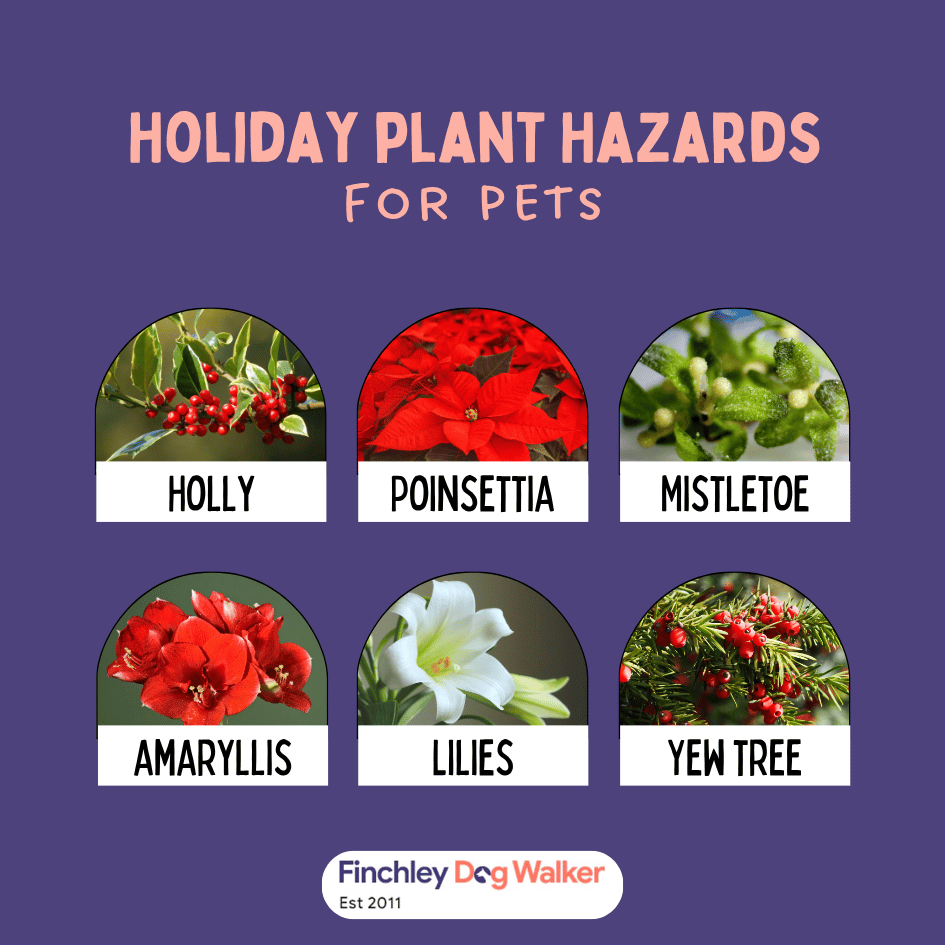
Lilies: A veterinary emergency
True lilies and daylilies are extremely poisonous to cats.
Even a small exposure can cause serious kidney injury.
The danger is not limited to chewing the flowers.
Cats can be exposed by:
- Eating or licking leaves or petals
- Getting lily pollen on their fur and grooming it off
- Drinking water from a vase containing lilies
This is one Christmas hazard I would avoid completely.
If you share your home with cats, do not bring true lilies or daylilies into the house.
If you suspect exposure, contact your vet immediately, even if your cat appears completely normal.
The PDSA’s veterinary guidance on lily poisoning in cats explains why rapid treatment is so important.
Poinsettias
Poinsettias have a reputation for being extremely poisonous, but their effects are generally much less severe than lily poisoning.
Their sap can irritate the mouth and digestive system, sometimes causing drooling, vomiting or diarrhoea.
That doesn’t mean they’re suitable for cats to chew.
Keep them inaccessible and ask your vet for advice if your cat has eaten any.
Holly and mistletoe
Both holly and mistletoe can cause illness if eaten.
Their berries and other plant parts may cause digestive symptoms, and some exposures can be more serious.
Avoid leaving fallen berries where your cat can investigate them.
Amaryllis and other seasonal plants
Amaryllis can also cause poisoning, including digestive upset.
Festive arrangements may contain several different plant species, not all of which will be immediately recognisable.
If you cannot identify a plant confidently, the safest option is not to bring it into an area your cat can access.
For a more detailed explanation, including the differences between plant risks, read my updated guide to Christmas Plants Poisonous to Dogs and Cats.
4. Christmas food: What should cats avoid?
Christmas usually means more food around the house, often left within reach while everyone is busy.
Although cats are generally more selective about food than dogs, that doesn’t make them immune to poisoning or digestive problems.
Dangerous Christmas foods for cats
Keep your cat away from:
- Chocolate: Contains substances that are toxic to cats.
- Onions and garlic: Can damage red blood cells and cause anaemia, including when cooked or included in sauces.
- Grapes, raisins and sultanas: Treat suspected ingestion as potentially dangerous and seek veterinary advice.
- Alcohol: Can cause serious poisoning.
- Christmas pudding and mince pies: May contain dried vine fruits, alcohol and other unsuitable ingredients.
- Cooked bones: Can splinter, cause injuries or become lodged.
- Rich, fatty or heavily seasoned foods: May cause digestive upset and are unsuitable as regular cat treats.
Be particularly careful with leftovers, gravy, stuffing and food left on plates after Christmas dinner.
Can cats have Christmas turkey?
A little plain, thoroughly cooked, boneless and skinless turkey may be suitable for a healthy cat.
It should be free from gravy, onions, garlic, seasoning and cooked bones.
However, not every cat can tolerate dietary changes.
Cats with food allergies, digestive problems, prescribed veterinary diets or certain medical conditions may need to avoid additional foods entirely.
Personally, I would rather give a cat something familiar that I know agrees with them.
Christmas is rarely the best time to experiment with their diet.
For further guidance, see the RSPCA’s Christmas dangers for pets.
5. Christmas visitors, children and changes to routine
Some cats love visitors.
Others disappear upstairs before the first guest has finished taking off their coat.
Neither response is wrong.
Christmas often means unfamiliar people, different smells, extra noise, furniture being moved and changes to established routines.
For some cats, that can be stressful.
Give your cat somewhere quiet to retreat
Make sure your cat can reach a familiar hiding place where guests will not disturb them.
Suitable areas might include:
- A favourite quiet room
- An accessible bed or covered hiding place
- A familiar cardboard box
- A safe, elevated resting spot
- A quiet part of the house away from the main gathering
Make sure your cat still has suitable access to food, fresh water and litter trays.
A separate quiet room can be helpful if your cat prefers it, but avoid unnecessarily confining a cat who becomes distressed when shut away.
Let your cat choose whether to join the festivities.
Help visitors understand your cat
I would make a few simple requests of guests:
- Don’t chase or pick up a cat who wants to hide.
- Let the cat approach people voluntarily.
- Don’t allow children to follow a hiding cat.
- Avoid offering food from the Christmas table.
- Keep doors and windows secure.
- Don’t bring visiting pets into the house without considering how your cat will cope.
A cat who chooses to spend Christmas asleep under the bed isn’t missing out.
They may simply have decided they’ve had quite enough of Christmas for one day.
Watch for changes in behaviour
Signs that your cat may be unsettled include:
- Hiding more than usual
- Becoming unusually withdrawn
- Reduced appetite
- Changes in toileting
- Increased grooming
- Restlessness or unusual vocalisation
- Greater sensitivity to handling
However, these changes aren’t always caused by stress.
Cats often hide signs of illness, so persistent or significant changes should be discussed with your vet.
You can find more information about feline behaviour and routine in my Cat Care Advice Hub.
6. Fairy lights, candles and other household hazards
Christmas decorations can introduce hazards beyond the tree itself.
Electrical lights and cables
Cats may investigate or chew dangling wires, which can cause burns or electrical injuries.
Keep cables safely routed and inaccessible.
Switch off Christmas lights at the mains when you’re away or unable to supervise.
If your cat has chewed a live electrical cable, seek veterinary advice urgently, even if there are no obvious injuries.
Candles and open fires
A flicking tail and an open candle flame are not a good combination.
Use flameless candles where practical, keep real flames out of reach and supervise cats around lit fires.
Snow globes and festive ornaments
Some snow globes contain harmful liquids, including products that may contain ethylene glycol.
If one breaks, keep pets away from the spill and clean up safely. Seek immediate veterinary advice if you suspect your cat has swallowed or licked the liquid.
Wrapping paper and Christmas packaging
Clear away ribbon, elastic, plastic ties, small pieces of tape and other packaging after opening presents.
Don’t leave cats unattended with string-handled gift bags or toys containing loose cords.
If your cat swallows a potentially harmful object, seek veterinary advice rather than waiting for symptoms.
7. Fun and safe ways to treat your cat at Christmas
Your cat doesn’t need expensive presents to enjoy Christmas.
Often, familiar activities, a comfortable sleeping place and a little extra playtime are far more valuable.
Here are a few ideas.
Try a simple food-search game
Hide small portions of your cat’s normal dry food around an appropriate, familiar area, where your cat can safely search for them.
Start with easy hiding places so they can succeed.
Use food from their normal daily allowance rather than adding lots of extra calories.
This gives them a chance to explore and use natural searching behaviour.
Consider a cat puzzle feeder
For cats who enjoy working for food, a puzzle feeder may provide additional mental stimulation.
One option from my approved cat-care product recommendations is the Nina Ottosson Buggin’ Out cat puzzle (Amazon affiliate link).
This is an optional enrichment idea, not something every cat needs.
Introduce puzzle feeders gradually, make them easy enough to avoid frustration and supervise initial use. They should never be your cat’s only way of accessing essential food.
Use familiar toys
A favourite toy may be just as appealing as a new one.
Interactive wand toys can be enjoyable when supervised, but put them away afterwards so your cat cannot swallow string or loose attachments.
Check toys regularly for damage.
Don’t underestimate a cardboard box
Sometimes the best Christmas present is the empty box that something else arrived in.
A clean cardboard box without staples, handles, string or plastic attachments can make an excellent hiding or exploring space.
No complicated instructions required.
For more everyday enrichment and welfare advice, visit my Cat Care Advice Hub.
8. Planning to be away over Christmas
If you’re visiting family or travelling over Christmas, make arrangements for your cat well in advance.
Many cats are strongly attached to familiar surroundings, so remaining at home with suitable care can be less disruptive than moving somewhere unfamiliar.
However, staying at home doesn’t mean simply leaving out extra food and water.
Cats need regular human welfare checks, feeding, fresh drinking water, clean litter facilities and attention appropriate to their individual needs.
Cats Protection recommends arranging for someone to visit at least twice a day when you’re away, with more frequent care for some kittens, senior cats and cats with medical needs.
What should you leave for your cat sitter?
Before travelling, prepare:
- Your cat’s normal feeding instructions
- Enough food and litter for the entire booking
- Medication and written instructions, if required
- Your veterinary practice and emergency contact details
- Information about hiding places and usual routines
- Details of any existing medical conditions
- Contact information for someone authorised to make decisions if you’re unavailable
- Clear instructions about doors, windows, keys and access
Make sure the person caring for your cat knows what is normal for them, including appetite, toileting and behaviour.
If you use an automatic feeder or water fountain, treat these as additional support rather than substitutes for human visits.
Cat sitting in Finchley and North London
I provide calm, individual cat-sitting and feeding visits in Finchley, Muswell Hill and selected nearby areas.
My approach is to work around your cat’s normal routine rather than expecting them to adapt to mine.
Visits can include feeding, fresh water, litter-tray care, welfare observations, medication where agreed, quiet company and photo updates.
Some cats enjoy attention and play.
Others prefer me to leave their food, clean the litter tray and give them some space. That’s fine too.
If you’re making Christmas travel arrangements, you can find out more about my Cat Sitting Service in Finchley.
For owners outside my service area, the Cats Protection guide to arranging cat care while you’re away is a useful starting point.
9. New Year’s Eve fireworks and cats
Christmas isn’t the end of the festive challenges for some cats.
New Year’s Eve fireworks can be unsettling, particularly for animals sensitive to unexpected noise.
If your cat is frightened by fireworks:
- Plan to have them indoors before dark.
- Keep windows, doors and cat flaps secure.
- Provide a clean litter tray, water and familiar resting places.
- Allow access to safe hiding spots.
- Close curtains to reduce flashes.
- Consider gentle background noise if your cat is accustomed to it.
- Don’t pull your cat out of hiding or force them to accept cuddles.
If your cat has a history of significant firework anxiety, speak to your vet ahead of time about an appropriate plan.
For more detailed guidance, see Cats Protection’s advice on cats and fireworks.
You can also explore my Seasonal Pet Safety Hub for year-round advice.
10. What to do if your cat has a Christmas emergency
It is worth checking your veterinary practice’s Christmas and New Year opening arrangements before the holidays begin.
Save the emergency contact number somewhere easy to find.
Contact your vet immediately if:
- You suspect your cat has eaten or licked a lily, including lily pollen.
- Your cat has eaten something potentially toxic, such as chocolate, onions or alcohol.
- Your cat has swallowed tinsel, ribbon, string or another potentially dangerous object.
- Your cat has chewed a live electrical cable.
- Your cat has difficulty breathing, collapses, has seizures or shows other signs of serious illness.
Do not try to make your cat vomit or give home remedies.
If you know what your cat may have eaten, keep the packaging or take a photograph of the ingredients.
Most importantly, don’t wait for symptoms to appear before asking for advice.
The PDSA’s guide to what to do if your cat has eaten something harmful explains why prompt veterinary attention matters.
Frequently asked questions about cats at Christmas
Are Christmas trees safe for cats?
You can make Christmas trees safer, but no tree is completely risk-free. Use a stable stand, remove dangerous decorations, protect cables and prevent access to tree water. Supervise curious cats and manage access when necessary.
Are poinsettias poisonous to cats?
Poinsettias can cause mouth irritation and digestive upset if eaten, but they are generally much less dangerous than true lilies. Keep them out of reach and contact your vet for advice if your cat eats one.
Are lilies dangerous to cats even if they don’t eat them?
Yes. True lilies and daylilies are extremely dangerous. Cats can ingest pollen while grooming, and drinking contaminated vase water can also be hazardous. Suspected exposure requires immediate veterinary advice.
Should I let my cat hide when visitors arrive?
Yes, provided your cat is otherwise well and has a safe hiding place. Don’t force them to come out or interact with guests. If hiding is new, persistent or accompanied by other changes, speak to your vet.
Can I leave my cat alone over Christmas with an automatic feeder?
An automatic feeder cannot replace regular human welfare checks. Cats need fresh water, litter care and someone able to notice illness or problems. Cats Protection recommends arranging at least twice-daily visits when you’re away.
What is a safe Christmas present for a cat?
A familiar toy, supervised play, a suitable food puzzle, a scratching surface or a clean cardboard box may all be worthwhile. Choose according to your individual cat and avoid loose string, small detachable parts and unsuitable food treats.
A calmer Christmas for you and your cat
Keeping cats safe at Christmas doesn’t mean removing every decoration or turning the house upside down.
It means recognising the genuine hazards, keeping dangerous items inaccessible and respecting your cat’s need for familiar routines and quiet spaces.
Christmas trees can be secured. Harmful foods can be put away. Guests can learn to give cats some space.
And sometimes, the nicest thing you can do for your cat is let them sleep peacefully while everyone else gets on with Christmas.
For more advice, visit my Cat Care Advice Hub, or if you’re arranging a trip, find out about my Cat Sitting Service.
I hope you and your pets have a safe, peaceful Christmas.
About the author: I’m Derek (Del) Chambers, the owner of Finchley Dog Walker. I’ve been providing professional pet care in North London since 2011, with a calm, patient approach that respects each animal’s individual needs.
Veterinary disclaimer: I am a professional pet carer, not a veterinary surgeon. This guide provides general information and does not replace individual veterinary advice. Contact your vet immediately if you suspect poisoning, an obstruction or another medical emergency.
First published: 15 December 2024
Substantially updated: 23 October 2026