Updated October 2026 | By Derek (Del) Chambers, Finchley Dog Walker
You’ve booked your holiday, arranged somebody to care for your cat and started thinking about packing.
But there’s one more important job before you leave.
What does your cat sitter actually need?
The answer involves more than leaving a few food pouches, a litter scoop and a spare key.
A good sitter needs to understand your cat’s normal routine, where everything is kept, what makes them comfortable and what to do if something unexpected happens.
I’ve been providing professional pet care around Finchley and Muswell Hill since 2011, and I’ve learnt that clear instructions make a real difference.
Some cats greet me enthusiastically at the door. Others prefer to supervise proceedings from the stairs or a favourite hiding place.
Neither approach is wrong.
My job is to maintain their familiar routine, respect their preferences and make sure they’re properly cared for while you’re away.
This guide explains what I recommend preparing before your cat sitter arrives, including a checklist you can work through before your holiday.
If you’re still looking for somebody to care for your cat, you can read about my Cat Sitting in Finchley service.
Quick checklist: What should you leave for your cat sitter?
If you’re short of time, start with these essentials.
- Enough of your cat’s usual food for the whole booking, plus a sensible reserve.
- Written feeding instructions and portion sizes.
- Fresh water bowls and instructions for fountains, if used.
- Litter trays, spare litter, scoop and waste bags.
- Medication, instructions and veterinary details where applicable.
- Your contact details and an alternative emergency contact.
- Written veterinary emergency arrangements and agreed authorisation.
- Working keys, entry details and alarm instructions.
- Your cat’s normal routine, including hiding places and behaviour.
- Safe toys, grooming equipment and familiar bedding.
- Cleaning supplies and waste disposal instructions.
- Details about windows, cat flaps and outdoor access.
- The location of a suitable cat carrier.
- Your return date and what to do if you are delayed.
You don’t need to buy anything special simply because you’re going away.
The aim is to make your cat’s usual care straightforward and safe.
1. Enough of your cat’s normal food
Food is the first thing most people remember, but a little preparation makes feeding much easier.
Before leaving, make sure there is enough food for the whole booking, with a reasonable reserve in case your return is delayed.
Avoid changing brands or introducing a new diet immediately before your holiday unless your vet has recommended it.
What feeding instructions should include
Write down:
- Your cat’s usual feeding times.
- The type and brand of food.
- Exact portions or measured quantities.
- Whether wet and dry food are given separately.
- Where food is stored.
- How leftovers should be handled.
- Any known food allergies or intolerances.
- Whether treats are allowed.
- Which cat eats which food in a multi-cat household.
If your cat follows a prescription diet, make that particularly clear.
Multi-cat households
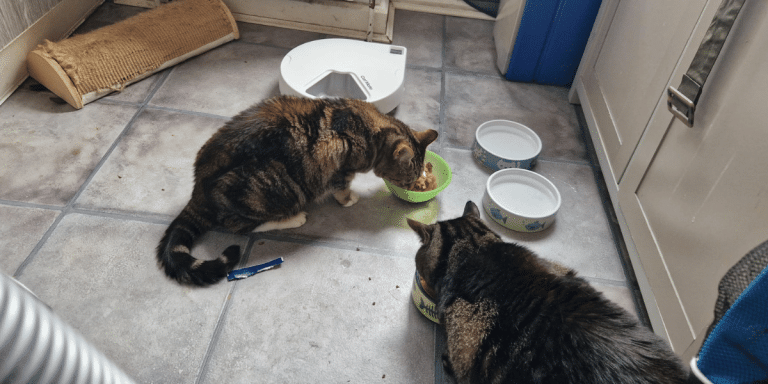
If you have several cats, tell your sitter whether they need separate feeding areas.
Some cats happily eat alongside one another.
Others may guard food, eat too quickly or try to steal another cat’s meal.
I would rather know about these habits beforehand than discover them halfway through a visit.
Do you need an automatic feeder?
Not necessarily.
Automatic feeders can help maintain established feeding times, but they can malfunction or run out of power.
They shouldn’t replace appropriate care visits.
If your cat already uses one, show the sitter how it works and explain what to do if it stops dispensing food.
For more information, see my Best Cat Care Products for When You Go Away guide.
2. Fresh water and drinking arrangements
Make sure your sitter knows where your cat’s water bowls are and how often they should be refreshed.
If your cat uses a fountain, explain how to:
- Check that it is running.
- Refill it safely.
- Clean it.
- Recognise when something is wrong.
- Find an ordinary backup water bowl.
I recommend leaving an additional suitable water source where practical.
Some cats prefer drinking from particular bowls or locations.
Others have very strong opinions about a bowl being moved three inches to the left.
Keeping familiar arrangements helps avoid unnecessary changes.
If your cat has a medical condition affecting drinking or urination, make sure your sitter understands your vet’s advice and which changes need attention.
3. Litter trays and cleaning supplies
A clean, accessible litter tray is essential, including for cats who normally go outdoors.
Before leaving, make sure there is enough of your cat’s usual litter.
Leave the following together:
- Spare litter.
- Litter scoop.
- Waste bags.
- A suitable bin or disposal instructions.
- Kitchen roll.
- Pet-safe cleaning products.
- Instructions for washing trays or replacing litter.
Tell your sitter where every litter tray is located.
Don’t change the litter just before your holiday
Some cats are very particular about litter texture, scent and tray location.
Introducing a different product immediately before travelling may discourage them from using their tray.
If you need to make a change, introduce it gradually while you’re still at home.
What should the sitter watch for?
Changes in toileting can provide important health information.
Tell your sitter if your cat has a history of urinary problems, constipation or litter-tray avoidance.
Repeated attempts to urinate, straining with little or no urine, crying in the tray or other signs of urinary obstruction require urgent veterinary attention.
This is particularly important because a blocked bladder can become life-threatening.
A litter tray is not just something to clean. It’s also an opportunity to notice whether your cat appears comfortable and is toileting normally.
4. Clear written instructions about your cat’s routine
One of the most useful things you can leave is a short explanation of your cat’s normal day.
Even if the routine seems obvious to you, it may not be obvious to somebody visiting for the first time.
Include:
- Usual feeding times.
- Favourite sleeping places.
- Preferred play activities.
- How your cat normally greets people.
- Whether they enjoy being stroked.
- Any handling they dislike.
- Whether they hide when visitors arrive.
- Whether they are usually vocal or quiet.
- Anything unusual the sitter should watch for.
Explain what is normal for your cat
A cat who normally hides under the bed when visitors arrive may not be behaving unusually when they do the same with a sitter.
But if a normally sociable cat suddenly refuses food, hides continuously or behaves very differently, that could be significant.
Knowing the individual cat is important.
I would much rather receive a detailed but practical explanation than have to guess.
5. Medication and veterinary instructions
If your cat requires medication, discuss this with your sitter before confirming the booking.
Not every pet sitter can safely provide every form of medication or treatment.
Where medication support has been agreed, leave written instructions covering:
- Medication name.
- Prescribed dose.
- Administration method.
- Exact timing.
- Storage requirements.
- Relevant veterinary instructions.
- What to do if a dose is refused, missed or vomited.
- Which veterinary practice to contact if there is a problem.
Keep medication in its original labelled packaging.
Don’t leave loose tablets without clear identification.
Don’t rely on verbal instructions alone
It’s easy for important details to be forgotten during a busy meet-and-greet.
Written instructions give both owner and sitter something to refer to.
Where necessary, demonstrate the agreed procedure in advance.
If your cat has a complex medical condition, ask your vet whether a veterinary nurse or another appropriately qualified professional would be a better option.
Never assume you can hide medication in food without checking whether that is suitable.
My guide to giving medication to cats while you’re away is part of my wider Cat Care resources. The specific medication-support article can be accessed through that hub.
6. Veterinary details and emergency contacts
Hopefully, your sitter will never need to contact your vet.
However, good preparation means having a clear plan before anything goes wrong.
Leave:
- Your usual veterinary practice’s name, address and telephone number.
- Out-of-hours emergency veterinary details.
- Your cat’s relevant medical history.
- Current medication information.
- Insurance details, if applicable.
- Microchip details or the database contact, where relevant.
- Your own contact numbers.
- A trusted alternative emergency contact.
- Agreed arrangements for authorising emergency veterinary care.
Veterinary authorisation
Discuss in advance what the sitter should do if your cat becomes unwell and you cannot be contacted.
Confirm whether the sitter is authorised to transport your cat to a veterinary practice, seek emergency advice or approve treatment within specifically agreed limits.
Make any financial arrangements clear in writing.
A sitter should not have to improvise these decisions during an emergency.
The Cats Protection holiday-care guidance also recommends leaving veterinary and emergency contact details.
Leave the cat carrier accessible
One thing that’s easily forgotten is the cat carrier.
Don’t lock it in a cupboard that your sitter cannot access.
Make sure it is in safe working condition and that the sitter knows where to find it.
7. Keys, alarms and access to your home
Before travelling, confirm that your sitter can enter and secure the property.
This sounds straightforward, but new locks, stiff doors, faulty keys and unfamiliar alarms can cause problems.
I would check:
- The correct keys have been supplied.
- Doors can be opened and locked reliably.
- Alarm instructions have been agreed securely.
- The sitter knows which entrance to use.
- Internal doors can be accessed where necessary.
- Any relevant building entry systems are explained.
- Backup access arrangements have been discussed.
I recommend checking access during the meet-and-greet rather than discovering a problem on the first booked visit.
Avoid leaving alarm codes or spare keys in obvious locations outside the property.
What about household checks?
If agreed, a sitter may also deal with basic practical matters such as bringing in post, adjusting curtains or checking that doors and windows are secure.
Make sure those arrangements are discussed beforehand rather than assumed.
8. Windows, cat flaps and outdoor access
This is particularly important if your cat normally goes outdoors.
Your sitter should know whether your cat is allowed outside while you’re away.
Don’t assume the usual arrangement is obvious.
Explain:
- Whether your cat is currently indoor-only or has outdoor access.
- Whether the cat flap should remain open.
- Any curfew arrangements.
- How the cat flap operates.
- Whether other neighbourhood cats sometimes enter.
- What to do if your cat hasn’t returned when expected.
- Whether any doors or windows must remain closed.
If your cat has recently moved home, is newly adopted or has been advised to remain indoors, make that clear.
Also check windows for escape risks.
Tilt-and-turn windows can be particularly hazardous to cats if they become trapped.
For information about managing the home environment, see my Cat Care Advice in Finchley hub.
9. Familiar bedding, hiding places and safe enrichment
Cats often appreciate their familiar surroundings.
You usually don’t need to rearrange the house or buy a collection of new toys right before you leave.
Keep their usual sleeping places accessible.
Tell your sitter where your cat likes to hide.
And leave familiar, suitable enrichment activities that your cat already enjoys.

What about play?
Some cats enjoy playing during a sitting visit.
Others prefer quiet companionship.
And some will wait until the sitter leaves before emerging from behind the sofa.
I don’t force interaction.
Where appropriate, I might use a familiar toy or simple food-search activity.
However, put away fishing-rod toys, string, and ribbons after supervised play because they pose a risk of entanglement or swallowing.
Read my Indoor Cat Enrichment While You’re Away guide for more ideas.
10. Special instructions for nervous and rescue cats
If your cat is nervous around unfamiliar people, share some background with the sitter.
Explain what helps your cat feel comfortable and what tends to worry them.
For example:
- Do they hide when the doorbell rings?
- Are they frightened by sudden movements?
- Do they avoid being picked up?
- Are they comfortable eating with somebody nearby?
- Do they need extra time before approaching?
- Have they previously tried to escape through doors?
I believe a good sitter should work at the cat’s pace.
That may mean sitting quietly while the cat watches from a distance.
It may mean not attempting a stroke.
And it may mean recognising that the most helpful thing is to complete the care tasks calmly without disturbing the cat.
The sitter must still be able to carry out an appropriate welfare check. If a cat cannot be located or appears unwell, there should be an agreed plan for what happens next.
11. What if you have more than one cat?
Multi-cat households may require additional instructions.
It’s important to know whether the cats get along, whether they share resources and whether any need separate care.
Explain:
- How many cats are in the home.
- Their names and identifying features.
- Whether each cat has a different diet.
- Where each cat normally sleeps.
- Any tension between the cats.
- Whether some cats need separate feeding.
- Where the litter trays and water sources are.
- Whether medication applies to one cat or several.
A labelled photograph of each cat may be useful if they look similar.
This is particularly helpful when individual cats have medication or feeding requirements.
12. How often should your cat sitter visit?
One important decision needs to be made before your holiday.
How many visits does your cat need?
Cats Protection, Battersea and PDSA generally recommend at least two visits a day for cats staying at home during holidays.
Kittens, senior cats and cats with medical conditions may require more frequent attention or different arrangements.
Some established adult cats may have individual routines, but the suitability of any proposed schedule should be judged on welfare rather than simply whether enough food and water can be left out.
An automatic feeder or pet camera doesn’t replace in-person checks.
My How Often Should a Cat Sitter Visit? guide discusses the factors worth considering.
When arranging visits with me, I discuss the individual cat’s needs and whether the proposed care arrangement is appropriate.
13. Seasonal preparations before you leave
Certain times of year require additional preparation.
Summer
During hot weather, your sitter should understand:
- Which rooms become warm.
- Where your cat normally rests.
- How ventilation is managed safely.
- Whether extra drinking water is available.
- Any heat-related veterinary concerns.
My Summer Cat-Sitting Checklist covers those considerations.
Winter
In colder weather, check that your cat has a comfortable resting area and that any heating arrangements are suitable.
Give clear instructions for thermostats, heating timers and safe access to rooms.
Fireworks and celebrations
If you’re travelling around Halloween, Bonfire Night, Christmas or New Year, tell your sitter how your cat normally reacts to unusual noise.
Explain their favourite hiding places, whether curtains should be closed and whether any veterinary advice or agreed preparations apply.
Don’t introduce sedatives or calming medication without veterinary direction.
14. What should you prepare for the meet-and-greet?
A meet-and-greet is an opportunity for both owner and sitter to discuss the practical details of care.
It’s more useful than simply handing over a key.
Before the meeting, consider:
- Your travel dates and expected return time.
- Your cat’s normal routine.
- Food, medication and litter arrangements.
- Any behaviour concerns.
- Home entry and security.
- Emergency contacts.
- Veterinary arrangements.
- Visit frequency and duration.
- What updates you would like to receive.
If possible, show the sitter where food, litter, cleaning materials and the cat carrier are kept.
You should also discuss how the sitter will communicate with you.
For my own visits, I normally provide photographs and updates through WhatsApp, while respecting cats who don’t want to be approached for photographs.
15. What you don’t need to do before a cat sitter arrives
Preparing properly doesn’t mean turning your home upside down.
You generally don’t need to:
- Deep clean every room.
- Buy expensive new equipment.
- Replace familiar bowls.
- Rearrange your cat’s furniture.
- Introduce a different diet.
- Change litter brands without a reason.
- Leave out dozens of toys.
- Force your cat to meet the sitter before they feel ready.
In fact, too many changes can make the experience harder for your cat.
I would concentrate on the essentials: reliable care, familiar routines, useful information and a safe environment.
Your final 24-hour cat-sitting checklist
The day before you travel, run through this list.
Cat care
- Food and water arrangements checked.
- Leave sufficient food, litter, and medication.
- Written feeding instructions available.
- Litter trays cleaned and supplies accessible.
- Familiar resting places left undisturbed.
- Put away unsafe toys and household hazards.
Emergency arrangements
- Veterinary details confirmed.
- Emergency contact details checked.
- Relevant veterinary authorisation agreed.
- Cat carrier accessible.
- Medication instructions confirmed.
Home access
- Keys tested.
- Alarm instructions agreed securely.
- Windows and doors checked.
- Cat flap arrangements confirmed.
- Cleaning equipment available.
Communication
- Visit schedule confirmed.
- Travel and return dates shared.
- WhatsApp or other update arrangements agreed.
- Alternative contact available if you’re unreachable.
- Contingency plan agreed if you are delayed.
Once those details are covered, you can concentrate on your trip rather than wondering whether you’ve forgotten something.
Cat sitting in Finchley and Muswell Hill
Although my business is called Finchley Dog Walker, cat sitting is an important part of the care I provide.
I offer calm, individual cat-sitting and feeding visits in Finchley, East Finchley, North Finchley, Finchley Central, Muswell Hill and selected nearby areas, subject to availability.
Visits can include:
- Feeding and fresh drinking water.
- Litter-tray care.
- Agreed medication support.
- Quiet companionship.
- Supervised play and enrichment where appropriate.
- General wellbeing observations.
- Basic agreed home checks.
- Photographs and updates.
I care for one household at a time and aim to keep your cat’s routine as familiar as possible.
Some cats want plenty of attention.
Others would rather I simply provide their dinner, sort out the litter tray and let them get back to being mysterious.
I’m happy to work with both.
For availability, prices and booking details, visit my Cat Sitting in Finchley page.
You can also contact me to discuss your cat’s needs.
Frequently asked questions
What is the most important thing to leave for a cat sitter?
Clear instructions about your cat’s normal routine, enough food and litter, emergency contact information, veterinary arrangements and reliable home access are the essentials.
Should I leave written instructions if we’ve already discussed everything?
Yes. Written information provides a useful reference if a detail is forgotten or an unexpected situation occurs.
Do I need to buy extra toys before going away?
Usually not. Familiar, safe toys and resting places are generally preferable to introducing lots of new equipment immediately before travelling.
Should I leave my cat’s medication out?
Leave it securely stored, appropriately labelled and accessible to the sitter under the agreed arrangements. Include the veterinary instructions and make sure the sitter is able to administer it safely.
What if my cat hides from the sitter?
Many cats are cautious around unfamiliar people. Tell your sitter about normal hiding places and behaviour. They should respect your cat’s preferences while still ensuring proper welfare checks.
Can I leave my cat alone with an automatic feeder?
An automatic feeder can support an established routine, but it cannot replace appropriate daily care, welfare checks, litter cleaning and emergency observation.
What if my flight is delayed?
Arrange a contingency plan before travelling. Confirm who the sitter should contact and whether additional visits can be provided if your return changes.
Should I leave cash for veterinary emergencies?
Discuss financial and emergency authorisation arrangements with your sitter beforehand. A written agreement is preferable to assuming how unexpected veterinary costs will be managed.
Final thoughts
The best thing you can leave for your cat sitter isn’t an expensive gadget or a cupboard full of new toys.
It’s a clear understanding of your cat.
What they eat.
Where they sleep.
What makes them comfortable.
What they find worrying.
And what to do if something isn’t quite right.
When those details are in place, your sitter can concentrate on providing calm, consistent care.
And your cat can carry on with their own familiar routine, including the very important business of sleeping in exactly the same spot for most of the afternoon.
Further reading and trusted guidance
Finchley Dog Walker
- Cat Care Advice in Finchley
- Cat Sitting in Finchley
- How Often Should a Cat Sitter Visit?
- Indoor Cat Enrichment While You’re Away
- Summer Cat-Sitting Checklist
- Pet Sitter Preparation Checklist
UK animal welfare guidance
- Cats Protection: Going on Holiday Without Your Cat
- Battersea: What Should I Do With My Cat When I Go on Holiday?
- PDSA: What to Do With Your Cat When You Go on Holiday
Veterinary disclaimer: This guide provides general pet-care information, not veterinary diagnosis or treatment. Cats with medical conditions, complex medication requirements or changing health needs may require a veterinary-led care plan or specialist support.
Originally published April 2026. Updated September 2026 and substantially improved October 2026.