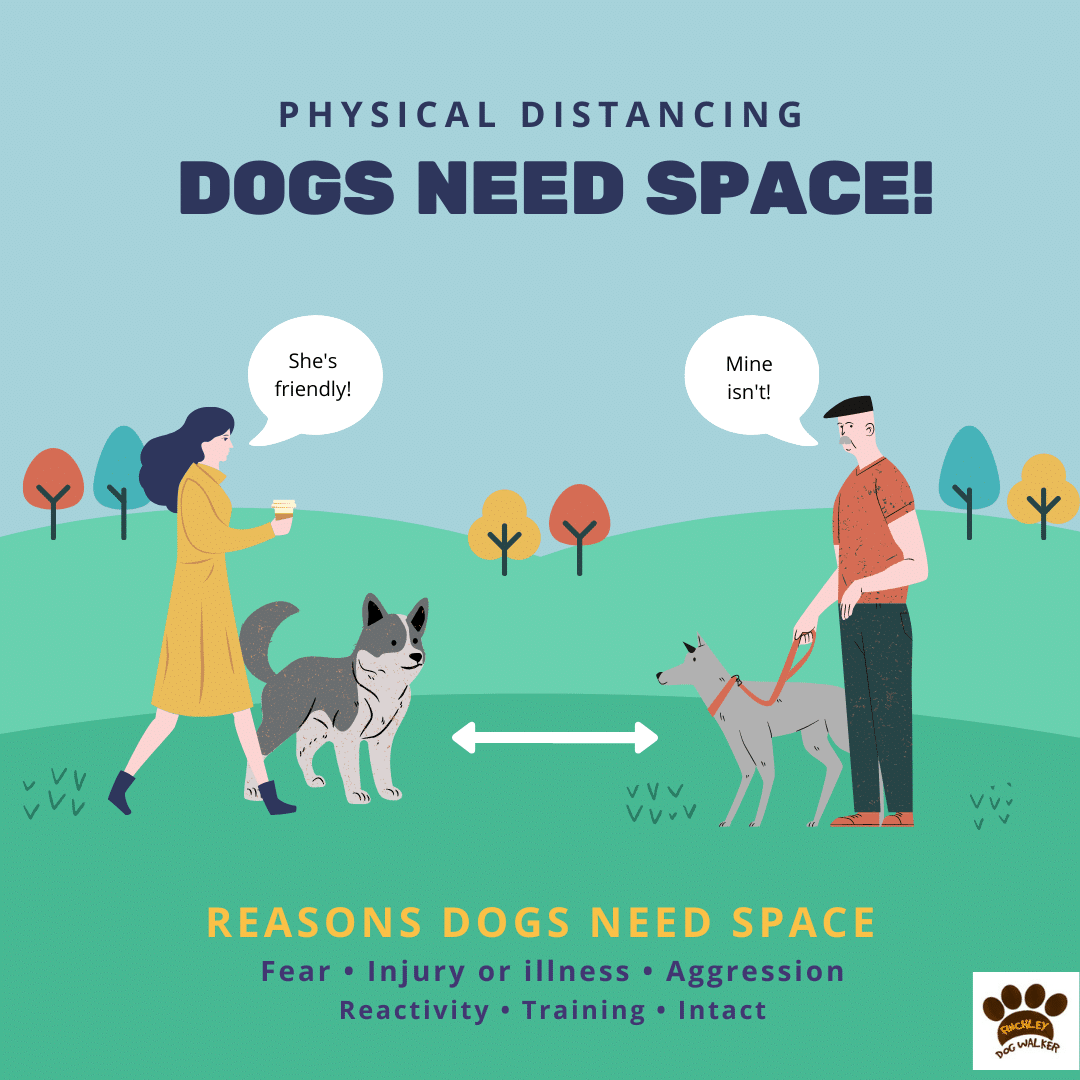
A dog being on a lead does not mean they want to meet you, your child or your dog.
They may be friendly in some situations but uncomfortable in others. They may be frightened, frustrated, in pain, recovering from an operation or learning how to cope around unfamiliar dogs.
You cannot tell everything about a dog by looking at them.
If a handler crosses the road, turns around or asks you to call your dog away, please help them create the space their dog needs.
In summary
- A dog on a lead may need space for various reasons, including fear, pain, or being in training.
- Handlers should not have to justify their dog’s need for space; simply stating, “My dog needs space” is sufficient.
- Respecting the lead means allowing dogs to create distance and avoiding forced interactions.
- Always ask the handler for permission before approaching a dog on a lead; this ensures everyone’s safety.
- Remember, a wagging tail alone does not mean a dog is friendly or wants to interact.
Table of contents
- Why Might a Dog on a Lead Need Space?
- “My Dog Is Friendly”
- A Lead Changes the Interaction
- A Quiet Dog Is Not Necessarily Comfortable
- A Wagging Tail Does Not Provide Permission
- Should Dogs Meet While on the Lead?
- Direct Approaches Can Add Pressure
- What to Do When You See a Dog on a Lead
- Keep Your Dog Under Control
- Ask Before Approaching
- Give Them Room to Pass
- Keep Moving When Appropriate
- Avoid Staring
- What If an Off-Lead Dog Approaches?
- What If the Other Dog’s Recall Fails?
- Please Do Not Touch a Dog Without Permission
- Children and Dogs on Leads
- Do Yellow Leads, Ribbons or Jackets Mean a Dog Needs Space?
- Advocating for Your Own Dog
- Plan Routes with Escape Options
- Keep the Lead Secure but Comfortable
- Should I Distract My Dog with Treats?
- Do Not Punish a Dog for Asking for Space
- When Your Dog Reacts Despite Your Efforts
- When to Contact Your Vet
- When to Seek Behaviour Support
- How I Support Dogs Who Need Space
- Related Guides
- Frequently Asked Questions
- Why does a dog on a lead need space?
- Is it safe if my dog is friendly?
- Should dogs greet each other on the lead?
- What should I do if someone says their dog needs space?
- Does a yellow lead mean a dog is aggressive?
- Is a wagging tail a sign that I can approach?
- Should I keep my dog’s lead very short?
- What should I say when an off-lead dog approaches?
- Should I punish my dog for barking at an approaching dog?
- Can a dog walker support a dog who needs space?
- Final Summary
- Veterinary and Behaviour Disclaimer
Why Might a Dog on a Lead Need Space?
There are many reasons.
The dog may:
- Be nervous or reactive
- Be newly rescued
- Have poor eyesight or hearing
- Be elderly
- Be in pain
- Be recovering from surgery
- Have an infectious illness
- Be frightened of particular dogs
- Struggle with close greetings
- Be learning to ignore other dogs
- Have been attacked previously
- Guard their personal space
- Become frustrated when restrained
- Be uncomfortable around children
- Be wearing unfamiliar equipment
- Simply not want to interact
The handler should not have to explain their dog’s medical or behavioural history before you respect the request.
“My dog needs space” is enough.
“My Dog Is Friendly”
Your dog may genuinely be friendly.
However, the approaching dog is only half of the interaction.
The dog on the lead may:
- Feel frightened
- Freeze
- Attempt to escape
- Bark or lunge
- Become overexcited
- Be unable to cope with direct approaches
- React when their escape route is blocked
- Be physically uncomfortable
- Need a carefully controlled introduction
A friendly dog rushing towards a worried dog can still cause distress or provoke a defensive response.
The Dogs Trust advises calmly creating distance from triggers before a reactive dog becomes overwhelmed. It also recommends keeping the lead secure but as relaxed as safety allows because excessive tension can make a dog feel trapped. Read its guidance about reactive dogs and how to help them.
A Lead Changes the Interaction
Dogs naturally use movement to communicate.
Where space permits, they may:
- Approach in a curve
- Slow down
- Pause
- Turn away
- Increase distance
- Move behind their handler
- Decide not to approach
- End the interaction
A lead can restrict these choices.
This does not mean dogs should simply be let off the lead. It means handlers should avoid forcing close interactions when either dog cannot move freely.
Walls, gates, narrow paths, parked vehicles and busy pavements can make the restriction more difficult.
Read Why Dogs React Differently on a Lead.
A Quiet Dog Is Not Necessarily Comfortable
Some dogs communicate discomfort loudly by barking or growling.
Others become very quiet.
Watch for:
- A suddenly closed mouth
- Staring
- Freezing
- Moving slowly
- Leaning away
- Turning the head
- Lip licking
- Yawning
- Lowering the body
- Tucking the tail
- Refusing food
- Hiding behind the handler
- Attempting to retreat
A frozen dog should not be treated as though they have calmly accepted the greeting.
Dogs Trust explains that being trapped or restrained on a lead can limit a dog’s ability to increase distance, making a defensive response more likely. Read its guide to understanding canine body language.
My guide to dog stress and threshold signs explains how to recognise when a dog is beginning to struggle.
A Wagging Tail Does Not Provide Permission
A wagging tail does not automatically mean:
- “I am friendly”
- “Come closer”
- “Touch me”
- “Let your dog approach”
- “I am relaxed”
Tail movement must be considered alongside:
- The height of the tail
- The speed and style of the wag
- Body tension
- Facial expression
- Weight distribution
- Movement
- The surrounding situation
The safest approach is to ask the handler and then pay attention to the dog’s response.
Should Dogs Meet While on the Lead?
Some dogs can have calm, appropriate lead greetings.
That does not mean every dog should greet.
A greeting should not happen when:
- Either handler says no
- One dog is trying to move away
- A dog becomes still or tense
- The leads are tight or tangled
- One dog is pulling directly towards the other
- The location is narrow
- Traffic or other hazards are nearby
- One dog is barking, lunging or hiding
- Either handler appears unable to control the situation
- There is a substantial size or strength difference that creates concern
- The dogs have no safe way to disengage
A calm pass without contact is a perfectly successful outcome.
Dogs do not need to greet every dog they see.
Direct Approaches Can Add Pressure
A fast, straight-line approach can be difficult for an uncertain dog.
Where possible:
- Slow down
- Create a wider gap
- Avoid following the other dog
- Do not block their escape route
- Keep your own dog under control
- Pass calmly
- Allow the other handler to move away
If someone crosses the road to avoid you, do not cross after them.
They are probably creating the distance their dog needs.
What to Do When You See a Dog on a Lead
Keep Your Dog Under Control
Do not allow your dog to rush over.
If your dog is off lead, call them back early rather than waiting until they are already beside the other dog.
Use a lead where necessary.
A reliable recall must work around distractions, not only when nothing interesting is happening.
Ask Before Approaching
You can ask:
“Would you like some space?”
or:
“Is your dog happy to say hello?”
Accept the answer immediately.
Do not attempt to persuade the handler that their dog will be fine.
Give Them Room to Pass
Depending on the location, you might:
- Move to the side
- Pause at a wider point
- Cross the road
- Put your dog back on lead
- Turn onto another path
- Avoid blocking a gate
- Move away from a narrow entrance
A few extra metres can make an enormous difference to a worried dog.
Keep Moving When Appropriate
Stopping directly opposite a reactive dog can increase the duration of the pressure.
If there is enough room, continue past calmly rather than standing and watching.
Avoid Staring
Do not stand close by while you or your dog stare at the other dog.
Give the handler time to leave without feeling observed or judged.
What If an Off-Lead Dog Approaches?
If you are handling the dog who needs space:
- Remain as calm as you can.
- Ask the other person to call their dog.
- Create distance where it is safe.
- Use a hedge, a parked vehicle, a gate, or another visual barrier.
- Avoid wrapping the lead around your hand.
- Do not place yourself where you could be pulled into traffic.
- Keep moving away if your dog can move.
- Leave the area when necessary.
You can say clearly:
“Please call your dog. Mine needs space.”
There is no need to provide a lengthy explanation during a developing situation.
Avoid lifting a dog unless there is an immediate safety reason and you can do so without being bitten or injured. Picking up a frightened dog may leave them feeling trapped and could place your hands near either dog’s mouth.
What If the Other Dog’s Recall Fails?
The owner should move promptly to retrieve their dog.
Repeating “They are friendly” does not resolve the problem.
A failed recall may place:
- The approaching dog at risk
- The leaded dog under pressure
- Both handlers at risk of injury
- Cyclists, runners or children nearby at risk
- Either dog at risk of escaping into a road
If your dog does not reliably return around other dogs, use a secure long line attached to a suitable harness in appropriate open spaces.
Do not attach a long line to a choke, slip or other tightening collar.
Please Do Not Touch a Dog Without Permission
A dog may look appealing and still not want contact.
Do not:
- Reach over their head
- Put your face close to theirs
- Hug them
- Follow them when they move away
- Offer your hand directly towards their nose
- Bend over them
- Allow a child to run up
- Touch a dog while they are eating or resting
Ask the handler first.
If permission is given, allow the dog to choose whether to approach. Keep your body slightly angled and your hands relaxed rather than reaching into the dog’s space.
The RSPCA’s handling guidance advises against approaching a dog face-on or assuming that a wagging tail means the dog wants contact. It recommends allowing the dog to approach rather than pushing a hand towards them. Read the RSPCA dog-handling guidance.
Read Does My Dog Want to Be Petted?.
Children and Dogs on Leads
Children should be taught that a dog being on a lead does not make them safe to approach.
Encourage children to:
- Ask the adult with the dog before approaching
- Walk rather than run past
- Avoid shouting close to the dog
- Keep scooters and bicycles at a sensible distance
- Avoid hugging or kissing dogs
- Stop if the dog moves away
- Leave assistance dogs and working dogs alone
- Tell an adult if a loose dog concerns them
Adults must supervise actively.
Do not ask a child to stroke a nervous dog as a way of “socialising” either of them.
Read Dogs and Children: Staying Safe Together.
Do Yellow Leads, Ribbons or Jackets Mean a Dog Needs Space?
Yellow equipment is sometimes used to indicate that a dog needs additional space.
The dog might be:
- Nervous
- Reactive
- Recovering
- Elderly
- In training
- Uncomfortable with other dogs
- Uncomfortable with people
Not every dog who needs space wears yellow equipment, and the meaning may not be understood by everyone.
Handlers should continue to use suitable management rather than relying entirely on a colour.
However, if you see wording such as “needs space”, “nervous” or “do not touch”, respect it.
Advocating for Your Own Dog
You are allowed to say no to an interaction.
Useful phrases include:
“Sorry, my dog needs space.”
“Please keep your dog back.”
“We’re not saying hello today.”
“Please ask your child not to touch them.”
“Could you give us a moment to pass?”
You do not need to apologise for protecting your dog, although calm, clear language usually helps the other person understand what you need.
Try to advocate early, before your dog has to bark or lunge.
Plan Routes with Escape Options
For a dog who struggles around other dogs, route planning can help.
Look for:
- Wider pavements
- Roads that are safe to cross
- Open paths with good visibility
- Gaps between parked vehicles
- Hedges and walls that provide visual cover
- Quiet times of day
- Alternative routes home
- Places where you can pause safely
Avoid becoming trapped at:
- Narrow gates
- Blind corners
- Alleyways
- Busy café entrances
- School gates
- Constricted paths
- Areas where uncontrolled dogs regularly gather
Avoidance is not the whole long-term plan, but preventing unnecessary overwhelming encounters is sensible management.
Keep the Lead Secure but Comfortable
A dog near a road or unfamiliar animal must be safely controlled.
That does not mean keeping the lead pulled tight throughout every interaction.
Continuous pressure can:
- Restrict movement
- Prevent the dog from turning away
- Increase frustration
- Make the handler feel less steady
- Contribute to a sense of being trapped
Aim for secure handling with enough lead for comfortable movement when the environment allows it.
Never wrap the lead around your fingers or wrist.
Read Walking Equipment for Nervous and Reactive Dogs.
Should I Distract My Dog with Treats?
Food can be useful, but the goal is not to make your dog stare continuously at you while every concern passes nearby.
Food may help you:
- Reward a voluntary check-in
- Reinforce turning away
- Support a calm exit
- Build a positive association at a safe distance
- Encourage searching after the trigger has passed
Do not use food to lure a frightened dog towards another dog or person.
If your dog cannot eat comfortably, the situation may be too difficult. Create distance rather than repeatedly offering food.
Do Not Punish a Dog for Asking for Space
Barking, growling, freezing and moving away provide information.
Punishing these behaviours may:
- Increase fear
- Add frustration
- Create worse associations
- Suppress warning signals
- Make future behaviour harder to predict
A growl should be taken seriously, but it should not be punished.
Stop increasing the pressure and move away safely.
When Your Dog Reacts Despite Your Efforts
Not every encounter can be avoided.
If your dog reacts:
- Concentrate on leaving safely
- Avoid shouting or lead corrections
- Do not force them to sit beside the trigger
- Create distance
- Choose a quieter route home
- Allow time to recover
- Consider whether the next walk should be easier
- Record what happened if reactions are becoming frequent
One reaction does not mean that all your previous work has failed.
It provides information about what your dog found too difficult on that occasion.
Read How Long Dogs May Need to Recover After Stress.
When to Contact Your Vet
Speak to your vet if your dog:
- Suddenly becomes reactive
- Becomes less tolerant of other dogs
- Reacts when touched
- Appears stiff or painful
- Starts refusing walks
- Has difficulty seeing or hearing
- Becomes unusually withdrawn
- Shows changes in eating, sleeping or toileting
- Struggles to settle
- Reacts increasingly intensely
Pain, illness and sensory changes can affect how safe a dog feels during an interaction.
Read Can Pain Change a Dog’s Behaviour?.
When to Seek Behaviour Support
Begin with your vet when there is:
- Persistent fear
- Regular barking or lunging
- Growling or snapping
- A bite history
- Panic
- Redirected behaviour towards the handler
- Difficulty walking the dog safely
- A rapidly worsening problem
The Animal Behaviour and Training Council practitioner directory can help you find appropriately assessed professionals.
Avoid anyone who promises an instant cure or relies on pain, intimidation, flooding or forced interactions.
How I Support Dogs Who Need Space
I provide calm, one-to-one walks for suitable nervous, rescue and reactive dogs in Finchley, Muswell Hill and selected nearby areas.
Every walk begins and ends at the dog’s home.
I do not use:
- Vans
- Cars
- Crates
- Groups of unrelated dogs
- Forced greetings
- Punishment-based equipment
Working with one dog allows me to:
- Notice subtle changes
- Adjust the route
- Cross the road early
- Use visual barriers
- Reduce the number of greetings
- Allow suitable sniffing
- Return home before the dog becomes overwhelmed
- Keep the walk appropriate for that particular day
Changing direction is not a failed walk.
Sometimes the best decision I can make is to notice a difficult situation early and avoid it.
Read about my one-to-one walks for nervous and reactive dogs.
Related Guides
- Dog Behaviour, Body Language and Emotional Wellbeing Hub
- What Is a Reactive Dog?
- Why Dogs React Differently on a Lead
- Dog Stress and Threshold Signs
- Dog Displacement Behaviours
- Does My Dog Want to Be Petted?
- How to Greet a Dog Properly
- How to Walk an Anxious Dog
- Giving Dogs Choice and Control
Frequently Asked Questions
Why does a dog on a lead need space?
The dog may be nervous, reactive, elderly, in pain, recovering, in training or uncomfortable with close greetings. The handler does not have to provide a detailed explanation.
Is it safe if my dog is friendly?
Your dog’s friendliness does not tell you whether the other dog is comfortable. Keep your dog under control and ask before allowing an approach.
Should dogs greet each other on the lead?
Not automatically. Lead greetings can restrict movement and increase pressure. A calm pass without contact is often preferable.
What should I do if someone says their dog needs space?
Call your dog away, shorten the interaction and provide as much room as the location safely allows. Do not follow or question the handler.
Does a yellow lead mean a dog is aggressive?
No. Yellow equipment may indicate that a dog needs space for many possible reasons. It should not be interpreted as a diagnosis.
Is a wagging tail a sign that I can approach?
No. Tail movement must be considered with the dog’s whole body and the situation. Ask the handler and allow the dog to choose whether to approach.
Should I keep my dog’s lead very short?
Keep the dog safely controlled, particularly near roads. However, unnecessary continuous tension can restrict movement and increase pressure. Aim for secure but comfortable handling.
What should I say when an off-lead dog approaches?
Use a clear request such as, “Please call your dog. Mine needs space.” Concentrate on creating distance rather than explaining your dog’s complete history.
Should I punish my dog for barking at an approaching dog?
No. Punishment can increase fear or frustration. Create distance and seek suitable professional help if reactions persist.
Can a dog walker support a dog who needs space?
A suitable one-to-one walker can use quieter routes, distance, predictable handling and fewer forced interactions. This does not replace veterinary or clinical behaviour support.
Final Summary
A dog on a lead does not automatically want to meet.
They may be:
- Nervous
- Reactive
- Recovering
- In pain
- Elderly
- In training
- Uncomfortable with close contact
- Simply uninterested in greeting
Keep your own dog under control, ask before approaching and respond promptly when someone requests space.
A calm pass at a comfortable distance is a successful interaction.
Return to the Dog Behaviour, Body Language and Emotional Wellbeing Hub.
And please make sure you read my article on yellow ribbon awareness
Veterinary and Behaviour Disclaimer
This guide provides general educational information. It cannot diagnose fear, pain, aggression or a behavioural condition.
Contact your vet if your dog’s behaviour changes suddenly, becomes more intense or appears connected to pain, illness or sensory changes.
Where there is snapping, biting, severe fear or a risk to people or animals, seek advice from your vet and an appropriately accredited behaviour professional.