
Updated July 2026
Summer dog walks sound easy.
Longer days and Lighter evenings.
Greener parks.
More time outside.
Alas, this is not always the case, as warm-weather walks need more thought than many people realise.
A route that felt fine in April may be too much in July.
A pavement that looked harmless in the morning may be uncomfortable by lunchtime.
And a dog who normally enjoys an hour outside may need a very different plan when the temperature, humidity and ground conditions change.
I have walked dogs professionally since 2011.
During the summer, I do not follow the usual route.
I start with the dog.
Then I look at the weather, the ground, the shade, the time of day and what that dog can comfortably cope with.
Sometimes the answer is a normal walk.
Sometimes it is a slower sniff walk.
Sometimes it is a short toilet opportunity.
And sometimes the kindest choice is no walk at all.
This page is a simple guide to planning safer summer dog walks.
For the full summer hub, read my Summer Dog Safety Guide.
Some links on this page may be affiliate links. If you buy through them, I may earn a small commission at no extra cost to you. As an Amazon Associate, I earn from qualifying purchases. I only recommend products that fit the practical advice on this page.
Start by changing the question
The wrong question is:
“Can I still do the normal walk?”
The better question is:
“What does my dog actually need today?”
That small change matters.
Your dog may not need the usual distance.
They may not need to chase a ball.
They may not need to keep your walking pace.
They may not need to go out at the normal time.
In warm weather, I think about:
- the individual dog
- the time of day
- the ground surface
- shade
- humidity
- the route
- how intense the activity will be
- whether the dog has struggled in heat before
- what I will do if the plan needs to change
A summer dog walk should be flexible.
Not forced.
When is the best time to walk your dog in summer?
Early morning is often the best option.
The sun has not spent the whole day heating roads, pavements and buildings.
The air may feel fresher.
The streets can be quieter too.
That can be useful for nervous and reactive dogs.
Late evening may also work, but do not assume it is automatically safe.
Pavements can hold heat.
Flats and buildings can stay warm.
Humidity may still be uncomfortable.
Dogs Trust advises walking dogs at cooler times of day, such as early morning or late evening. The Royal Kennel Club gives similar advice and recommends avoiding the midday sun.
You can read the Dogs Trust hot-weather dog advice and the Royal Kennel Club advice on walking dogs on warm days.
My own preference is simple.
If the day is going to be hot, I would rather go early than try to squeeze the walk in later when the ground has already been baking for hours.
How hot is too hot to walk your dog?
There is no single safe temperature for every dog.
That can be frustrating.
People like clear rules.
But dogs are not all the same.
A young, fit dog walking slowly in shade is not the same as an older dog walking on open pavement.
A French Bulldog is not a Labrador.
A senior rescue dog is not the dog they were five years ago.
Humidity matters.
Direct sun matters.
Ground temperature matters.
The dog’s health matters.
And the type of exercise really matters.
The Royal Kennel Club says most dogs are comfortable between 15°C and 25°C, but this depends on age, breed, size, coat, exercise, health and fitness. It also says some dogs may struggle even in lower temperatures.
That is why I do not use one number as a universal cut-off.
My full guide How Hot Is Too Hot to Walk Your Dog? explains this in more detail.
For this page, remember one thing.
If you are already wondering whether it is too hot, pause and change the plan.
Check the ground before you check the route
We wear shoes.
Dogs do not.
That sounds obvious, but hot pavements are among the easiest summer risks to overlook.
Tarmac, paving slabs, concrete and artificial grass can heat up quickly in direct sun.
The air temperature may feel manageable.
The ground may not be.
Dogs Trust recommends a five-second tarmac test.
The Royal Kennel Club recommends placing the back of your hand on the pavement for seven seconds.
I use the hand test as a warning check.
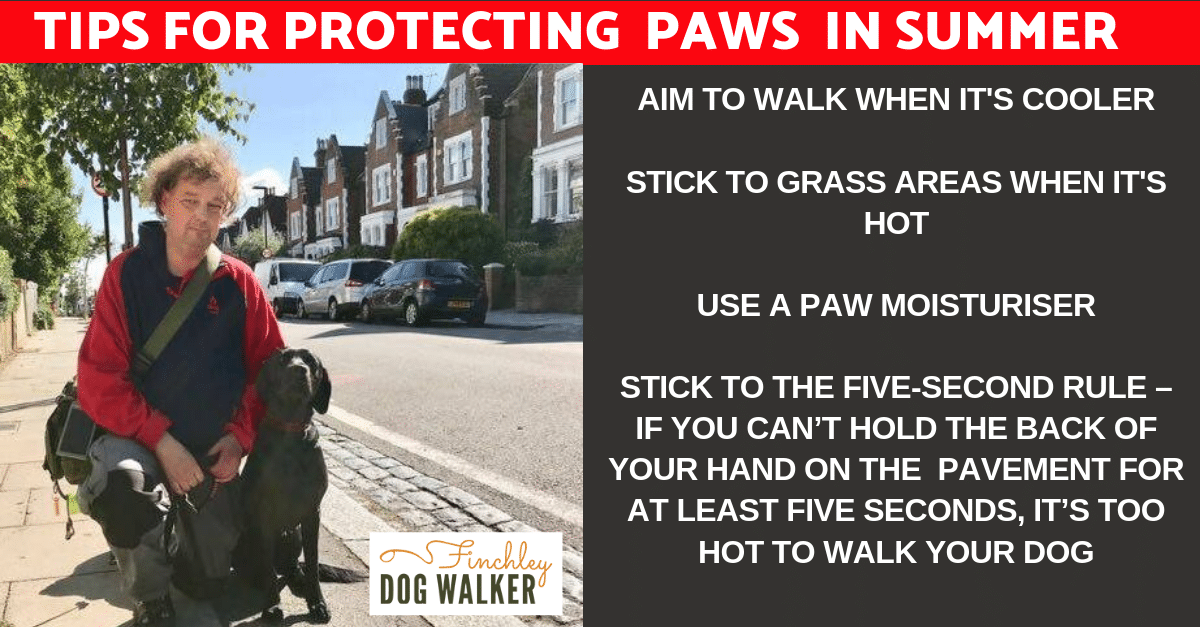
If the surface is too hot for my hand, it is not suitable for the dog’s paws.
But I also look at the whole route.
It is not enough to say:
“We are going to the woods.”
How do we get there?
Will the dog need to cross open roads?
Walk along exposed pavement?
Stand at crossings?
Pass over artificial grass?
Read my full guide to Walking Dogs on Hot Pavements.
If you have artificial grass at home, read Artificial Grass and Dogs in Hot Weather.
Choose the route before you leave
Summer walks work better when you plan the route.
I think about:
- shade
- grass or natural surfaces
- water access if appropriate
- quietness
- how busy the route may be
- whether there are escape routes if another dog appears
- how quickly we can get home
- whether the dog has coped there before
I may use local places such as Cherry Tree Wood, Coldfall Woods, Highgate Woods or Parkland Walk.
But I do not use one favourite route for every dog.
Some dogs love woodland.
Others find narrow paths and surprise dog encounters difficult.
Some nervous dogs are calmer on familiar local streets than in a busy park.
The route needs to suit the dog.
Not your idea of a perfect summer walk.
My guide to where I walk dogs in Finchley and how I choose the route explains how I make those decisions.
Shorter does not mean faster
This is a common mistake.
The weather is hot.
So the owner decides to do the normal route in half the time.
Faster pace.
Fewer sniff stops.
More pulling.
More rushing.
That is not what I would do.
In summer, I usually want less intensity.
A shorter route.
A slower pace.
More shade.
More sniffing.
More time to stop.
Less physical pressure.
Your dog does not need to complete your step target.
My guide Stop Counting Steps: Why Your Dog Needs Time to Sniff on Walks explains why I think many owners need to stop treating dog walks like a human fitness task.
A slow, sniff-friendly walk can be a good option in warmer weather.
But only where conditions are suitable.
A sniff walk does not make dangerous heat safe.
What I avoid on summer dog walks
During warm weather, I avoid:
- walking during the hottest part of the day
- long pavement routes in direct sun
- ball throwing
- running beside bikes
- repeated chasing games
- expecting older dogs to keep up
- rushing a shorter walk
- forcing a dog to continue when they slow down
- relying on shade as the whole safety plan
- assuming water makes every walk safe
That last point matters.
Carrying water is sensible.
It does not make an unsafe walk safe.
The Royal Kennel Club says heatstroke can still happen even when a dog has access to water.
So yes, take water.
But also make better decisions.
Dogs who need extra care in summer
Any dog can struggle in warm weather.
Some dogs need more caution.
I pay particular attention to:
- puppies
- older dogs
- overweight dogs
- flat-faced dogs
- large dogs
- thick-coated dogs
- unfit dogs
- dogs with heart problems
- dogs with breathing difficulties
- dogs recovering from illness
- dogs who have struggled in heat before
- nervous or reactive dogs who work hard emotionally on walks
PDSA says flat-faced breeds, overweight dogs, older dogs and dogs with ongoing health problems may find it harder to manage their body temperature.
You can read the PDSA hot-weather advice for pets.
Please do not compare your dog with the dog running around the park.
That dog is not your dog.
Nervous and reactive dogs may work harder than they look
This often gets missed.
A nervous or reactive dog may not be physically running.
But they may still be working hard.
They may be:
- scanning
- pulling
- barking
- freezing
- rushing
- trying to avoid other dogs
- constantly checking the environment
That can be tiring.
Add heat and humidity, and the walk may become too much sooner than expected.
For some dogs, a short, quiet route with plenty of space may be better than a long walk through a busy park.
I sometimes use slower sniff walks or decompression-style walks for dogs who need less pressure.
Read Sniff and Decompression Walks for Dogs.
You can also read How to Walk an Anxious Dog Without Making It Worse.
What should you wear for a summer dog walk?
Choose clothing for the route and conditions, not just the air temperature.
I would usually suggest:
- Lightweight, breathable clothing
- Comfortable footwear with a secure grip
- A hat where appropriate
- Suitable sun protection
- A light waterproof if rain is forecast
- Pockets or a small bag for your phone, keys and poo bags
Flip-flops and loose sandals may provide less grip if your dog suddenly pulls, changes direction or you need to move quickly away from a hazard.
Your own comfort and safety matter too. If you are becoming excessively hot, dizzy or uncomfortable, shorten the walk and return somewhere cool. Do not continue simply because you planned a particular route.
What should you carry on a summer dog walk?
You do not need loads of equipment.
But a few practical items help.
I would usually have:
- water
- something suitable for the dog to drink from
- poo bags
- phone
- house keys
- suitable lead and harness
- ID tag on the dog
- small rewards if I am using food
- a plan to shorten or change the route
A portable dog water bottle can be useful because it lets you offer water without relying on communal bowls.
A dog walking treat pouch with poo bag holder can also be useful if you use rewards for check-ins, moving away from distractions or simple Find It games.
I would not carry loads of treats in hot weather and then keep adding extra food throughout the day.
Use tiny pieces.
Or part of your dog’s normal food where suitable.
And always consider your dog’s diet, allergies and health needs.
For more practical product ideas, read my Hot Weather Dog Kit.
A cooling mat belongs at home, not in your excuse list
I like cooling mats for some dogs.
They can provide another resting option at home.
But they do not make a hot walk safe.
The same goes for cooling coats, cooling bandanas, frozen treats and fancy water bottles.
Useful?
Sometimes.
A replacement for sensible judgement?
No.
If it is too hot for a normal walk, change the walk.
Do not buy a gadget and then push through the same routine.
My Hot Weather Dog Care Myths guide looks at some of the advice that gets shared online every summer.
What if your dog slows down?
Listen to them.
A dog slowing down in summer is not automatically being stubborn.
They may be hot.
Tired.
Uncomfortable.
Overwhelmed.
Or they may simply need the walk to change.
I would rather stop early than push a dog until they are clearly struggling.
Watch for:
- heavier panting than normal
- repeated shade seeking
- slowing down
- reluctance to continue
- wobbliness
- drooling
- confusion
- vomiting
- diarrhoea
- collapse
If your dog looks wrong, stop the walk.
Move them out of the heat.
Offer water if they can drink.
Start appropriate cooling where needed.
Contact a vet urgently if you are concerned.
My Heatstroke in Dogs: Signs and First Aid guide explains this in more detail.
What should you do instead of a normal summer walk?
Sometimes the answer is not a different walk.
Sometimes it is no normal walk.
That may mean:
- a short toilet break
- a shaded garden potter
- Find It games
- scatter feeding
- a cardboard box search
- a frozen Kong
- a lick mat
- calm training
- rest
Rest matters.
Your dog does not need to be exhausted every day.
A missed long walk does not have to become an hour of frantic indoor activity.
My guide What to Do Instead of Walking Your Dog in a Heatwave gives you practical options.
You can also read Ditch the Bowl at Mealtimes for simple food-based enrichment ideas.
What I do as a professional dog walker in summer
I do not offer group walks.
I do not use vans.
I work locally and care for one household at a time.
That helps in summer.
I can change the pace.
Change the route.
Shorten the walk.
Add more sniffing.
Stay closer to home.
Or turn the booking into a calm home-based visit when a normal walk is not suitable.
My Extreme Weather Policy explains how I adapt care when weather conditions create a risk.
I also offer Hot-Weather Dog Comfort Visits in Finchley.
These may include:
- a brief toilet opportunity where safe
- fresh water
- calm indoor enrichment
- feeding
- agreed medication
- preparing an owner-supplied Kong or lick mat
- quiet companionship
- a general welfare check
- a photo update
The aim is not to exhaust your dog indoors.
It is calm, useful care when the normal walk is not the best option.
A simple summer dog walk checklist
Before you leave, ask:
- Is this the coolest sensible time?
- Is the pavement safe?
- Is the route shaded enough?
- Is my dog higher risk in warm weather?
- Will this be calm or intense?
- Am I trying to do too much?
- Do I have water?
- Can I shorten the walk easily?
- Do I know what I will do if my dog struggles?
- Would a toilet break and home enrichment be safer?
If the answers make you pause, change the plan.
That is not overreacting.
That is good dog care.
My honest rule for summer walks
I would rather a dog missed a walk than be pushed through one they did not need.
Dogs do not understand human guilt.
They do not know you feel bad because they usually go out for an hour.
They know how they feel in that moment.
Hot.
Tired.
Uncomfortable.
Overwhelmed.
Or perfectly happy and ready for a suitable walk.
Look at the dog in front of you.
Not the clock.
Not the step counter.
Not what you did yesterday.
Summer walks can still be lovely.
But only if we are prepared to change the plan.
For the full summer hub, start with my Summer Dog Safety Guide.
For temperature advice, read How Hot Is Too Hot to Walk Your Dog?
For surface risks, read Walking Dogs on Hot Pavements.
For slower walks, read Stop Counting Steps: Why Your Dog Needs Time to Sniff on Walks.
And if you need calm, one-to-one dog walking in Finchley or Muswell Hill, read about my solo dog walks in Finchley and Muswell Hill.
Frequently asked questions
Should I walk my dog every day in summer?
Not always.
Many dogs benefit from routine and daily movement, but safety comes first.
During very hot weather, a short toilet opportunity, calm enrichment and rest may be more appropriate than a normal walk.
What time is best to walk a dog in summer?
Early morning is often best.
Later evening may also work, but check the ground and the actual conditions.
Pavements and buildings can hold heat after a hot day.
Is it okay to walk my dog at midday in summer?
I would avoid midday walks in hot weather.
The sun is stronger, surfaces may be hotter, and many dogs will find the conditions harder.
Use cooler times where possible.
Can I walk my dog if I carry water?
Water is important, but it does not make an unsafe walk safe.
Dogs can still overheat even when water is available.
Use water alongside sensible timing, shade, reduced intensity and careful observation.
Is a short walk safe in hot weather?
Sometimes.
A short, calm toilet walk may be suitable for some dogs in some conditions.
But if the heat, humidity or ground conditions are unsafe, even a short walk may be too much for some dogs.
Are sniff walks good in summer?
A slower sniff-focused walk can reduce intensity when conditions are suitable.
But sniffing does not make dangerous heat safe.
If it is too hot, skip or adapt the walk.
Can dogs burn their paws on pavements?
Yes.
Tarmac, paving and other surfaces can become hot enough to hurt paws.
Use the hand test as a warning check and think about the whole route.
What are the signs my dog is too hot?
Signs can include heavy panting, slowing down, seeking shade, drooling, weakness, wobbliness, vomiting, diarrhoea, confusion or collapse.
If you are worried, stop the activity, move your dog out of the heat and contact a vet urgently.
Can a dog walker change the walk because of hot weather?
A careful dog walker should adapt care when needed.
That may mean a shorter walk, a different route, a cooler time where practical or a home visit instead.
My Extreme Weather Policy explains how I make these decisions.
Related guides
You may also find these useful:
- Seasonal Pet Safety in Finchley
- Finchley Dog Walker Extreme Weather Policy
- Hot Weather Dog Kit
- Walking Dogs on Hot Pavements
- How the Weather Affects Dog Walks
- Healthy Summer Treats to Keep Your Dog Cool
- Dog and Cat Care Guides in Finchley
Disclaimer
This article provides general dog-care and dog-walking information based on my professional experience and publicly available animal-welfare guidance. It does not replace veterinary advice, diagnosis or treatment.
Every dog is different. If your dog has a medical condition, breathing difficulty, mobility problem or has struggled in heat before, speak to your vet about their individual exercise needs.
Heatstroke is an emergency. If you think your dog is overheating, start appropriate cooling where advised and contact a vet urgently.

