A countryside walk can be a wonderful change from busy streets and familiar local parks.
There are new smells, open spaces and quieter paths to explore. However, rural walks also bring responsibilities that may not arise during an ordinary walk around Finchley.
Livestock, horses, wildlife, working farms, unfamiliar water, changing weather and poorly marked routes can all affect the walk.
A well-trained dog can still become excited by sheep, startled by cattle or distracted by an unfamiliar scent. Good countryside walking is therefore not about proving how reliable your dog is. It is about preventing avoidable problems.
This guide explains how to follow the Countryside Code, keep your dog under control around livestock, protect wildlife and prepare for a safer rural walk.
What does the Countryside Code say about dogs?
The official Countryside Code applies in England and Wales.
Its main message is to:
- respect everyone
- protect the environment
- enjoy the outdoors responsibly
- follow local signs
- keep to marked routes where required
- keep dogs under effective control
- leave gates and property as you find them
- take litter and dog waste home when no bin is available
The code covers parks, waterways, coast and countryside. Local restrictions may also apply, so the signs at the location remain important. (GOV.UK)
Plan the walk before leaving home
A countryside walk should not begin with simply choosing a direction and hoping the path leads somewhere suitable.
Before leaving, check:
- the complete route
- the expected distance
- parking arrangements
- public transport options
- local weather
- sunset time
- paths and rights of way
- livestock warnings
- seasonal dog restrictions
- access closures
- water and flood conditions
- where you could shorten the walk
Download or carry a map rather than relying entirely on a phone signal.
Tell someone where you are going when the route is remote, and let them know when you expect to return. The Countryside Code recommends checking the route and local conditions in advance because weather and access can change quickly. (GOV.UK)
A route that seems straightforward online may include:
- steep ground
- muddy fields
- difficult stiles
- livestock
- narrow bridges
- flooded paths
- fast roads without pavements
- sections unsuitable for an older or less mobile dog
It is sensible to have an alternative route and be prepared to turn back.
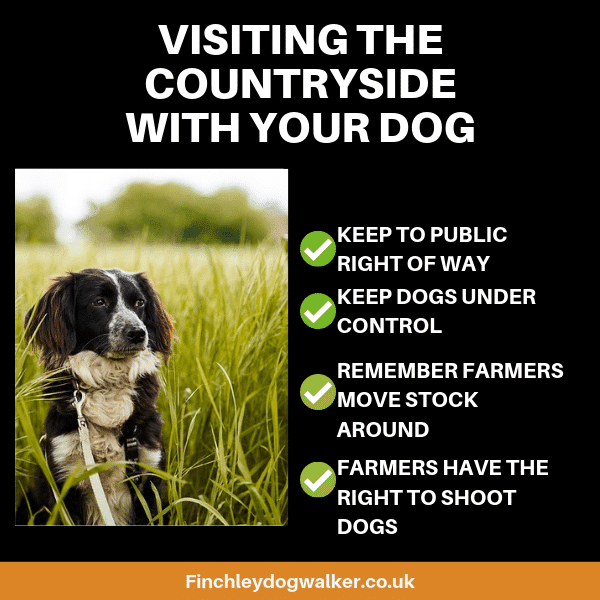
Follow signs and public rights of way
Countryside signs tell you where you may walk and whether restrictions apply.
A public footpath does not give you permission to wander across the complete field. Stay on the marked route unless wider public access is clearly available.
Signs may also tell you:
- dogs must remain on leads
- livestock are present
- ground-nesting birds are nearby
- a route is temporarily closed
- forestry work is taking place
- dogs are excluded from a particular area
- cattle or horses are being moved
- shooting or another land-management activity is underway
Do not climb over fences, walls or locked gates because the path looks more direct.
Use the gate, stile or marked gap provided. This helps protect boundaries, crops and livestock.
When should your dog be on a lead?
I would keep a dog on a lead whenever:
- livestock are present
- livestock may be hidden beyond a rise or hedge
- signs instruct owners to use leads
- the path runs close to a road
- wildlife is nearby
- nesting birds may be present
- recall is uncertain
- the dog has a strong chase instinct
- the area is unfamiliar
- visibility is limited
- other walkers, horses or dogs need space
A dog does not have to be aggressive to cause harm.
Chasing may begin as excitement, play or curiosity, but livestock cannot understand the dog’s intention.
Your dog should remain in sight and under effective control throughout the walk. Effective control means being confident that your dog will return when called and will not approach livestock, wildlife, horses or people without permission. (GOV.UK)
A standard fixed-length lead is normally the most manageable option close to livestock.
I would not use a retractable lead around farm animals. The thin line, changing length and locking mechanism can make close control more difficult.
Lead rules on open-access land
Open-access land can include areas of mountain, moor, heath, down and registered common land.
Between 1 March and 31 July, dogs must be kept on a lead on open-access land, even when livestock are not visible. This helps protect ground-nesting birds.
Dogs must also be on a lead around livestock on open-access land and at the coast.
Additional local restrictions can apply at other times, so always read the signs rather than relying only on the general dates.
Also worth reading the RSPCA guide
Walking your dog near sheep
Keep your dog on a short lead before entering a field containing sheep.
Do not wait until the sheep begin running.
Even a small dog can cause panic by:
- staring
- stalking
- barking
- rushing forwards
- chasing
- circling
- approaching lambs
Move quietly and steadily along the public route. Give the flock as much space as the path allows.
Do not let your dog sniff, approach or attempt to play with sheep. Do not feed the sheep or encourage children to touch lambs.
During lambing season, sheep may be particularly vulnerable. A dog does not need to bite an animal to cause serious distress.
What is livestock worrying?
Livestock worrying includes more than a physical attack.
A dog may worry livestock by chasing, attacking or causing them distress.
Any dog can be involved, including one that has never previously chased an animal.
New protections applying in England and Wales came into force on 18 March 2026. The maximum penalty for livestock worrying is now an unlimited fine, and police have stronger powers to investigate incidents and seize or detain dogs where the legal conditions are met. The law also covers incidents involving livestock on roads and paths and extends protection to farmed camelids such as llamas and alpacas.
The safest approach is straightforward:
- keep your dog under control and in sight
- use a lead near livestock
- follow local signs
- prevent your dog escaping near farmland
- report an incident to the farmer and police
Do not assume your dog will lose interest once the livestock runs. Movement can make chasing more likely.
What should you do if cattle approach?
Cattle can be curious, but their size and speed mean they must be treated carefully.
Be particularly cautious around cows with calves.
When entering a field:
- look for cattle before opening the gate
- keep your dog close
- avoid walking between a cow and her calf
- give the animals plenty of space
- remain on the public route
- avoid sudden movements
- do not run
- do not feed or touch the cattle
Choose an alternative route when this can be done safely and legally.
When cattle approach, remain calm and move away steadily.
If you feel threatened or cattle begin chasing you, official government advice is to release your dog’s lead rather than risk being injured while trying to hold onto it. The dog will usually have a better chance of moving away from the cattle than a person will. (GOV.UK)
This is an emergency measure, not a reason to allow dogs to run freely around livestock.
Give horses plenty of space
You may meet ridden horses on bridleways, lanes and rural paths.
Bring your dog close and place them on a lead before the horse reaches you.
Stand somewhere visible and allow enough space for the horse to pass. Avoid sudden movement, barking, or letting the dog rush behind the horse.
Speak calmly to the rider when necessary. A brief conversation can help you both manage the situation.
Do not:
- approach an unfamiliar horse
- feed it
- let your dog sniff its legs
- walk directly behind it
- block the route
- assume the horse is comfortable around dogs
Horses can react quickly when frightened. The Countryside Code advises giving horses, livestock and wild animals plenty of room because their behaviour can be unpredictable. (GOV.UK)
Protect wildlife and nesting birds
The countryside is a home and feeding area for wildlife.
Dogs may disturb:
- ground-nesting birds
- deer
- rabbits
- waterfowl
- young animals
- animals resting in long vegetation
A chase does not need to end with physical contact to cause distress or separate a young animal from its parent.
Keep your dog on the route and under close control.
This matters particularly when your dog:
- has a strong prey drive
- disappears into undergrowth
- follows scents for long distances
- has unreliable recall around wildlife
- becomes highly excited by movement
Do not allow your dog to enter nests, burrows, crops or areas set aside for wildlife.
If the safest option is a lead walk, use the lead.
Your dog can still sniff, explore and enjoy the environment without running loose.
Leave gates as you find them
The old advice to “always close every gate” is too simplistic.
A gate may have been deliberately left open so livestock can reach food, water or another part of the field.
The Countryside Code says to leave gates and property as you find them unless signs or a farmer’s instructions tell you otherwise. (GOV.UK)
When walking in a group, make sure the last person knows whether the gate was open or closed.
Do not:
- prop a closed gate open
- shut a gate that was clearly open
- climb over gates
- damage latches
- allow your dog through before checking the next field
- block farm entrances when parking
Farm access may be needed by tractors, livestock vehicles and emergency services.
Pick up dog waste
Pick up after your dog in the countryside just as you would on a pavement or in a park.
Dog waste can affect:
- livestock
- wildlife
- farm workers
- other visitors
- crops and grazing land
Bag it and place it in a public waste bin. When there is no bin, carry it home.
Do not hang bags from trees, leave them beside a gate or place them somewhere with the intention of collecting them later.
The Countryside Code states that dog waste should be bagged and binned or taken home because it can cause illness in people, livestock and wildlife. (GOV.UK)
Do not allow your dog to scavenge
Rural paths and picnic locations can contain:
- food waste
- cooked bones
- fishing hooks
- discarded packaging
- animal remains
- farm chemicals
- slug pellets
- dead wildlife
- mushrooms and fungi
- rubbish left by other visitors
Keep your dog close enough for you to notice sudden interest in something on the ground.
Signs that often appear before a dog grabs food include:
- lowering the head
- slowing down
- pulling towards vegetation
- sniffing one spot intensely
- suddenly ignoring you
- chewing before you have seen what was found
Management is more reliable than waiting until an unsafe object is already in the dog’s mouth.
My Environmental Risks for Dogs on Walks guide covers scavenging, grass seeds, plants, chemicals and other less obvious outdoor hazards.
Be cautious around unfamiliar water
A stream, pond or river may look inviting, but you may not know:
- the depth
- the strength of the current
- whether the bank is stable
- what lies beneath the surface
- whether the water is contaminated
- whether fishing equipment is present
- whether livestock have access to it
- whether algae or other hazards are present
Do not encourage your dog into unfamiliar water simply because they enjoy swimming.
Keep them on a lead around steep banks, fast-flowing water and frozen ponds.
After prolonged dry weather, I am also cautious around stagnant or slow-moving streams. Read Why I Avoid Streams During Dry Weather for more information.
Check the weather and ground conditions
Countryside weather can change quickly, particularly in exposed areas.
Check:
- temperature
- rain
- wind
- thunderstorms
- flood warnings
- visibility
- ground conditions
- sunrise and sunset
Turn back when conditions are becoming unsafe.
Do not continue merely because you planned a particular distance.
Heat can be especially difficult on routes with little shade. Mud, ice and wet slopes can create problems for senior dogs, puppies and dogs with mobility difficulties.
My Extreme Weather Policy explains why I adapt professional walks when heat, cold, storms, flooding or poor surfaces make the normal plan unsuitable.
What should you take on a countryside dog walk?
A practical countryside kit may include:
- a standard fixed-length lead
- a spare lead
- a well-fitted harness or collar
- poo bags
- fresh drinking water
- a collapsible bowl
- suitable food or treats
- a charged phone
- an offline map
- weather-appropriate clothing
- a small towel
- a tick-removal tool
- basic first-aid supplies
- any medication your dog needs
- an emergency contact
- a recent photograph of your dog
Take more water than you expect to need during warm weather.
Do not rely on streams, troughs or puddles as drinking-water sources.
Check that identification and microchip contact details are current before travelling away from home.
Countryside walks with nervous or rescue dogs
Open space does not automatically make an environment easy for a nervous dog.
A countryside walk may include:
- livestock
- gunshots
- farm machinery
- horses
- loose dogs
- cyclists
- narrow paths
- unfamiliar gates and stiles
- sudden wildlife movement
- areas with no easy escape route
A newly adopted dog should not be given off-lead freedom simply because the field appears empty.
I would begin with:
- a secure harness
- a standard lead
- a quiet route
- a manageable distance
- plenty of space
- no pressure to greet animals or people
- an early return if the dog becomes overwhelmed
A long line may be useful in a suitable open area away from livestock, roads and other hazards, but it must be handled carefully.
My Rescue Dog Support in Finchley guide explains why predictability, suitable equipment and gradual exposure matter more than forcing a nervous dog through difficult situations.
Watch children carefully around livestock
Children may be excited by lambs, horses or cattle.
Explain before entering a field that they should:
- stay close to an adult
- walk rather than run
- speak quietly
- avoid feeding animals
- avoid approaching young animals
- leave gates alone
- keep away from farm machinery
- never hold the dog’s lead around livestock unless they can safely manage it
An adult should retain control of the dog.
A child should not be expected to manage a large, strong or excited dog when livestock suddenly moves.
What should you do if your dog escapes?
Do not chase the dog across a field while shouting continuously.
Try to:
- Remain calm.
- Use your normal recall cue.
- Move away rather than running directly after them.
- Use familiar food or another previously practised reward.
- Tell the farmer immediately if livestock may be at risk.
- Report livestock worrying to the police.
- Contact the microchip database if the dog remains missing.
- Notify nearby vets and local dog wardens where appropriate.
Do not leave the location without informing the relevant landowner when livestock may have been chased or injured.
This is also why you should practise recall before a countryside trip rather than test it for the first time beside sheep.
Check your dog after the walk
Countryside walks can expose dogs to things that are easy to miss while moving.
Once home, check:
- paws and pads
- between the toes
- ears
- eyes
- legs
- armpits
- belly
- groin
- beneath the collar and harness
- the complete coat
Look for:
- ticks
- grass seeds
- burrs
- thorns
- small cuts
- damaged nails
- swelling
- limping
- skin irritation
My Fleas and Ticks on Dogs guide explains how to check for ticks and remove one with a suitable tool.
You can also use my post-walk dog check as a simple routine after woodland, countryside and longer-grass walks.
Countryside-style walks near Finchley
You do not always need to travel a long distance from North London to encounter working land, horses, wildlife and rural-style paths.
Routes around Totteridge and Darlands can feel very different from an ordinary pavement or park walk.
My older Totteridge Fields country walk passes close to fields, bridleways, horses and working farmland. Conditions and access can change, so follow current signs rather than relying entirely on an old route description.
My professional dog walks remain local and begin and end at the client’s home. I do not transport groups of dogs to countryside locations.
However, the same principles guide my everyday walks:
- assess the environment
- keep the dog under suitable control
- avoid unnecessary risks
- respect other animals and people
- change the route when conditions are unsuitable
Frequently asked questions
Must dogs always be on leads in the countryside?
Not everywhere, but they must remain under effective control. Leads are legally required in some locations and during certain periods. They are also good practice around livestock, wildlife, horses, roads and whenever recall is uncertain.
Must dogs be on leads on open-access land?
Between 1 March and 31 July, dogs must be on a lead on open-access land, even when livestock are not present. Dogs must also be on leads around livestock on open-access land and at the coast. Local restrictions may go further. (GOV.UK)
Can my dog walk through a field containing sheep?
Use the public route, keep your dog on a short lead and give sheep as much space as possible. Do not allow your dog to stare, bark, chase or approach the animals.
What should I do if cattle chase me?
Release your dog’s lead if you feel threatened or cattle begin chasing you. Move towards safety without trying to protect the dog by holding on. This follows current Countryside Code and government advice. (GOV.UK)
What is livestock worrying?
It includes a dog chasing, attacking or causing distress to livestock. A dog does not need to bite an animal for a serious incident to occur.
What is the penalty for livestock worrying?
In England and Wales, the maximum penalty became an unlimited fine in March 2026. Police also have stronger investigation, seizure and detention powers under the updated legislation. (GOV.UK)
Should I close every countryside gate?
Leave gates as you find them unless a sign or farmer tells you otherwise. A gate may have been deliberately left open so livestock can reach food or water.
Can I leave bagged dog waste beside a path?
No. Place it in a public bin or carry it home. Do not leave filled bags beside gates, paths or trees.
Is a countryside walk suitable for every dog?
No. Long routes, livestock, stiles, unfamiliar dogs, weather and uneven ground may make the walk unsuitable for some puppies, senior dogs, nervous dogs and dogs with health or mobility problems.
Respect, protect and enjoy
A countryside walk should be enjoyable without creating problems for farmers, livestock, wildlife or other visitors.
Plan your route. Read the signs. Keep your dog under control and use a lead before a situation becomes difficult.
Give livestock and horses space. Pick up dog waste. Leave gates as you find them. Be willing to turn around when the route or weather is no longer suitable.
Your dog does not need to run loose through every field to enjoy the countryside.
A calm walk with time to sniff, explore and remain safely connected to you can be just as rewarding.
For wider planning advice, read my Travelling with a Dog guide.
For everyday walking, exercise and enrichment advice, visit Dog Walking and Everyday Exercise.
This article provides general information about visiting the countryside with dogs. Follow current signs, local restrictions and official guidance at the location you visit.