Updated November 2026
A good dog walk does not have to be about covering as many miles as possible.
For many dogs, stopping to sniff, searching for something, exploring a safe environment or practising one simple skill can make an ordinary walk much more worthwhile.
You also do not need to entertain your dog every minute.
Sometimes the best part of a walk is simply giving your dog time to investigate the world at their own pace.
I have worked professionally with dogs since 2011, and on my one-to-one walks around Finchley and Muswell Hill I regularly adapt the route, pace and activity to the dog in front of me.
Some dogs want to explore.
Some enjoy a short search game.
Some need a quieter walk with fewer demands.
And some days, a dog simply needs to sniff.
Summary
You can make a dog walk more interesting without turning it into a constant training session.
Simple ideas include:
- allowing more time to sniff
- scattering a few pieces of food to search for
- hiding a familiar toy
- letting your dog choose between two safe directions
- practising one easy skill
- changing pace briefly
- exploring different surfaces
- having a short observation break
- using a familiar route in a slightly different way.
The activity should always suit your dog’s age, health, confidence and physical ability.
The aim is not to exhaust your dog.
It is to make the walk safe, enjoyable and worthwhile.
Does my dog need entertainment during every walk?
No.
Your dog does not need you to organise an activity every few minutes.
Walking already offers plenty of natural enrichment through:
- smells
- movement
- sounds
- changes in the environment
- watching other animals and people
- exploring different surfaces
- making choices.
Dogs Trust recommends allowing dogs plenty of opportunity to sniff on walks and describes sniffing as an important way dogs gather information about their surroundings.
For some dogs, slowing down and giving them more freedom to investigate is more valuable than adding another game.
The question I ask is not:
“How can I keep this dog entertained for the whole hour?”
It is:
“What would make this walk useful for this dog today?”
That may be an activity.
It may also be doing less.
1. Let your dog have a proper sniff
This is the easiest outdoor enrichment activity because your dog is probably already trying to do it.
Instead of repeatedly encouraging them to move on, allow some parts of the walk to happen at their pace.
That might mean letting them investigate:
- a tree
- a patch of grass
- fallen leaves
- a hedge
- a familiar lamppost
- an area another dog has recently passed through.
Dogs experience a huge amount of their environment through scent.
The RSPCA’s current dog education guidance also encourages owners to include time to sniff during walks rather than treating every walk purely as physical exercise.
You don’t need to let your dog investigate everything.
Move them away from rubbish, food scraps, unsafe plants, broken glass or anything else that could cause harm.
But where it is safe, give them some time.
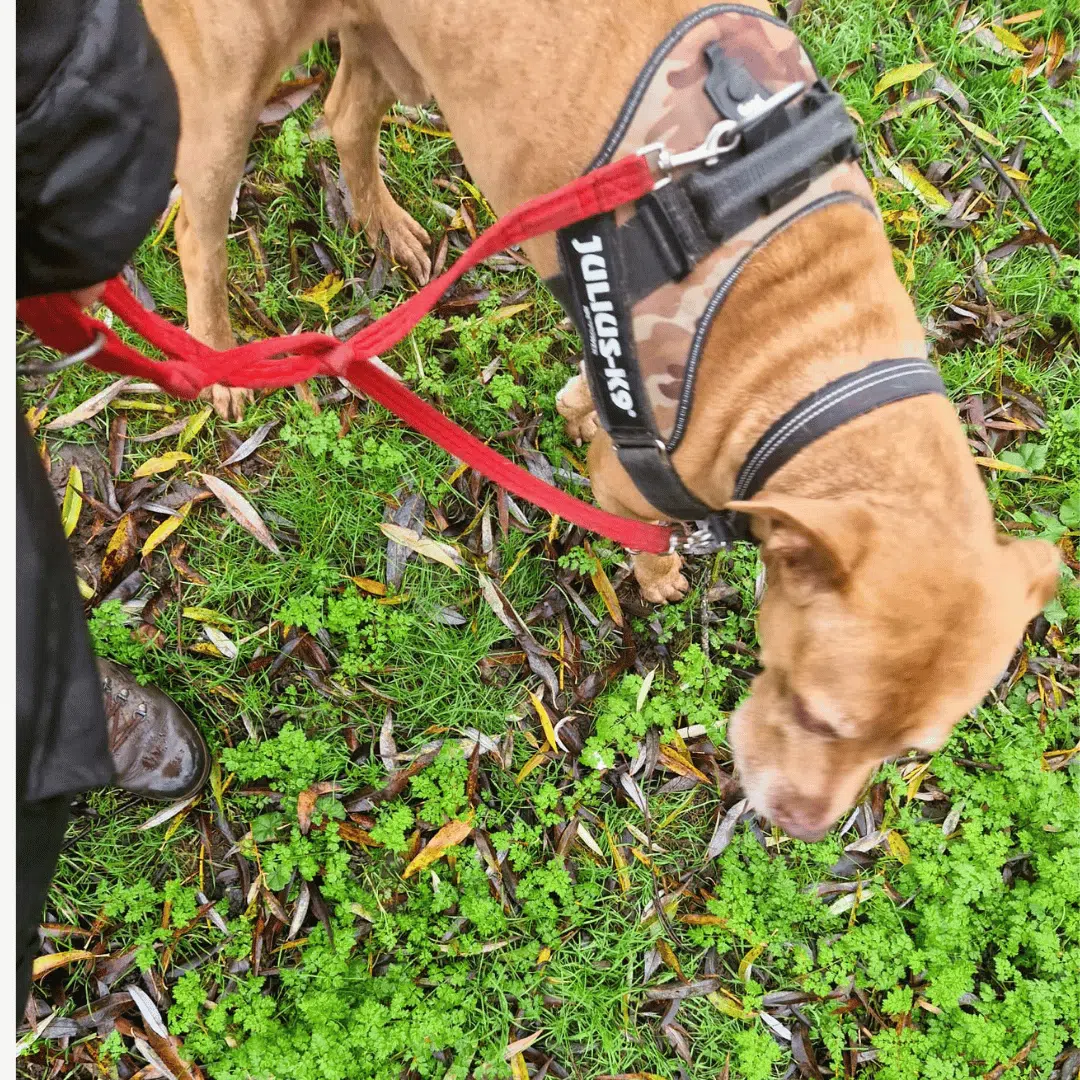
Try a short sniffari
For five or ten minutes, let your dog’s nose influence the pace.
You still decide what is safe and where you are going overall.
But instead of measuring success by distance, notice what interests your dog.
On some of my local walks, a dog may spend several minutes investigating one small part of Coldfall Woods.
We may cover less ground.
That doesn’t mean the walk was wasted.
2. Play a simple “find it” game
One of the easiest ways to add enrichment to a walk is a small food search.
Start somewhere clean and safe.
Let your dog see you drop one or two pieces of their normal food or a suitable treat onto short grass.
Say something like “find it” and let them search.
Once your dog understands the game, you can make it slightly less obvious.
Keep the search small.
You are not trying to make it so difficult that your dog becomes frustrated.
Dogs Trust includes food searches and scent trails among its enrichment suggestions and recommends accounting for the food used rather than simply adding extra calories on top of the dog’s normal diet.
Keep outdoor food searches sensible
Avoid scattering food:
- near roads
- close to unknown dogs
- where rubbish or discarded food is present
- into dense vegetation where you cannot see what your dog is eating
- where wildlife may be disturbed
- where several dogs are competing for the same food.
If your dog has dietary restrictions, allergies or is on a veterinary diet, use food already approved for them.
3. Hide a familiar toy
If your dog enjoys toys, you can use a favourite toy for a simple search.
Start very easily.
Let your dog see you place the toy partly behind a tree or other safe object.
Then encourage them to find it.
As they understand the game, you can gradually make the hiding place less obvious.
Blue Cross recommends simple search games using either a familiar toy or food and advises keeping the early stages easy enough that the dog does not become worried or frustrated.
Do not hide toys:
- close to traffic
- in deep water
- somewhere your dog has to climb dangerously
- in dense brambles
- in areas where your dog should not be going.
The game should be easy to abandon if the environment changes.
4. Let your dog choose the route
You do not have to surrender control of the whole walk.
But at a safe junction, you can sometimes give your dog a choice.
If both directions are suitable, pause and see which way they naturally investigate.
You might be surprised.
A dog who normally follows the same route every day may choose a completely different direction when given the opportunity.
Choice can be a useful part of enrichment.
It also gives you information about what your dog finds interesting or comfortable.
I use this cautiously.
If one direction takes us towards a busy road, a dog that worries mine, livestock or another unsuitable situation, then I make the decision.
Choice still sits inside safe boundaries.
5. Practise one easy skill
A walk can be a useful place to practise training your dog already understands.
That might be:
- responding to their name
- a voluntary check-in
- touching your hand
- walking with you for a few steps
- waiting briefly
- a simple recall on a suitable long line
- changing direction with you.
Keep it short.
You do not need to turn the whole walk into a training class.
I would rather practise one thing successfully for 30 seconds than keep asking for the same behaviour until the dog switches off.
Reward-based training can also use things your dog values beyond food.
For some dogs, the reward for checking in with you might simply be being released to go back to sniffing.
6. Change your pace for a short section
The original version of this article suggested repeatedly changing from slow walking to jogging.
I would use this much more selectively now.
For a fit, healthy dog who enjoys it, you might briefly:
- walk slowly
- return to your normal pace
- take several quicker steps
- change direction
- stop and wait.
This can help make movement with you more interesting.
But it should not become frantic.
Avoid sudden running, twisting or repeated sharp turns with:
- puppies
- senior dogs
- dogs with joint or mobility problems
- dogs recovering from injury
- dogs whose vet has restricted exercise.
If you are unsure whether faster exercise is appropriate for your dog, ask your vet.
The aim is engagement, not physical exhaustion.
7. Explore different safe surfaces
A walk naturally gives dogs opportunities to experience different textures under their feet.
Depending on where you are, that might include:
- grass
- woodland paths
- leaves
- firm earth
- gravel
- wooden surfaces
- shallow mud.
Dogs Trust includes safe environmental exploration as a form of enrichment, provided the activity suits the individual dog’s health and confidence.
I would not deliberately encourage a dog to scramble onto unstable objects just because it looks like enrichment.
The old version of this article suggested climbing onto benches and crawling underneath them.
I would no longer make that a general recommendation.
For some dogs, carefully stepping onto a low, stable surface might be appropriate.
For others, it is unnecessary or physically unsuitable.
Watch the dog rather than trying to complete the activity.

8. Use fallen trees carefully
Woodland environments can offer plenty to investigate without creating an obstacle course.
A fallen tree may provide:
- interesting smells
- different textures
- small areas to investigate
- natural places to pause.
I would not wedge food deep inside loose bark or holes where a dog could ingest rotten wood, fungi or something you cannot see.
Instead, if the area is clean and suitable, you might place a visible piece of food beside the log or simply allow your dog to sniff around it.
Natural enrichment does not have to be complicated.
9. Have an observation break
Some dogs enjoy stopping somewhere quiet and simply watching what is happening.
You might sit or stand for a couple of minutes at a comfortable distance from:
- people passing
- dogs in the distance
- birds
- traffic
- activity in a park.
Do this only where your dog appears comfortable.
For a nervous or reactive dog, staying still too close to a trigger may make things harder, not easier.
Watch their body language.
If your dog becomes tense, stops taking food, stares, freezes or appears to need more distance, move away.
My Dog Behaviour, Body Language and Emotional Wellbeing guide explains why I look at the whole dog and the surrounding situation rather than relying on one isolated signal.
10. Use the environment for easy recall practice
If your dog is already learning recall, suitable walks can provide opportunities to practise without immediately jumping to the hardest possible situation.
This might mean:
- calling them a short distance on a long line
- rewarding them
- releasing them back to sniff
- repeating only occasionally.
Do not repeatedly call your dog away from everything they enjoy and then immediately end the walk.
Coming back to you should not always mean the interesting part of life disappears.
If your recall is still developing, use appropriate management rather than testing whether your dog will return around traffic, wildlife or other major distractions.
11. Play hide-and-seek with a person
If you are walking with another person and you have a safe environment, one person can briefly hide while the other remains with the dog.
Start very easily.
Hide partly behind a tree and call your dog.
Reward them when they find you.
Blue Cross includes hide-and-seek as a scent-based game and advises keeping it easy enough that the dog does not become worried when searching.
I would not suddenly disappear from a nervous dog or a dog with separation concerns.
The game should be enjoyable, not a test.
12. Use toys without turning the walk into endless fetch
A toy can make part of a walk enjoyable for dogs who genuinely like toy play.
You might use:
- a short tug game
- searching for a toy
- carrying a favourite toy for part of the walk
- a brief reward game.
I am much more cautious about repetitive ball throwing.
Repeated sprinting, twisting and sudden stopping can put considerable physical demands on a dog, and some dogs will keep chasing long after they should have stopped.
Blue Cross similarly advises against overdoing repetitive fetch because of the physical strain created by repeated turns and sudden stops.
A toy is one option.
It does not need to dominate the walk.
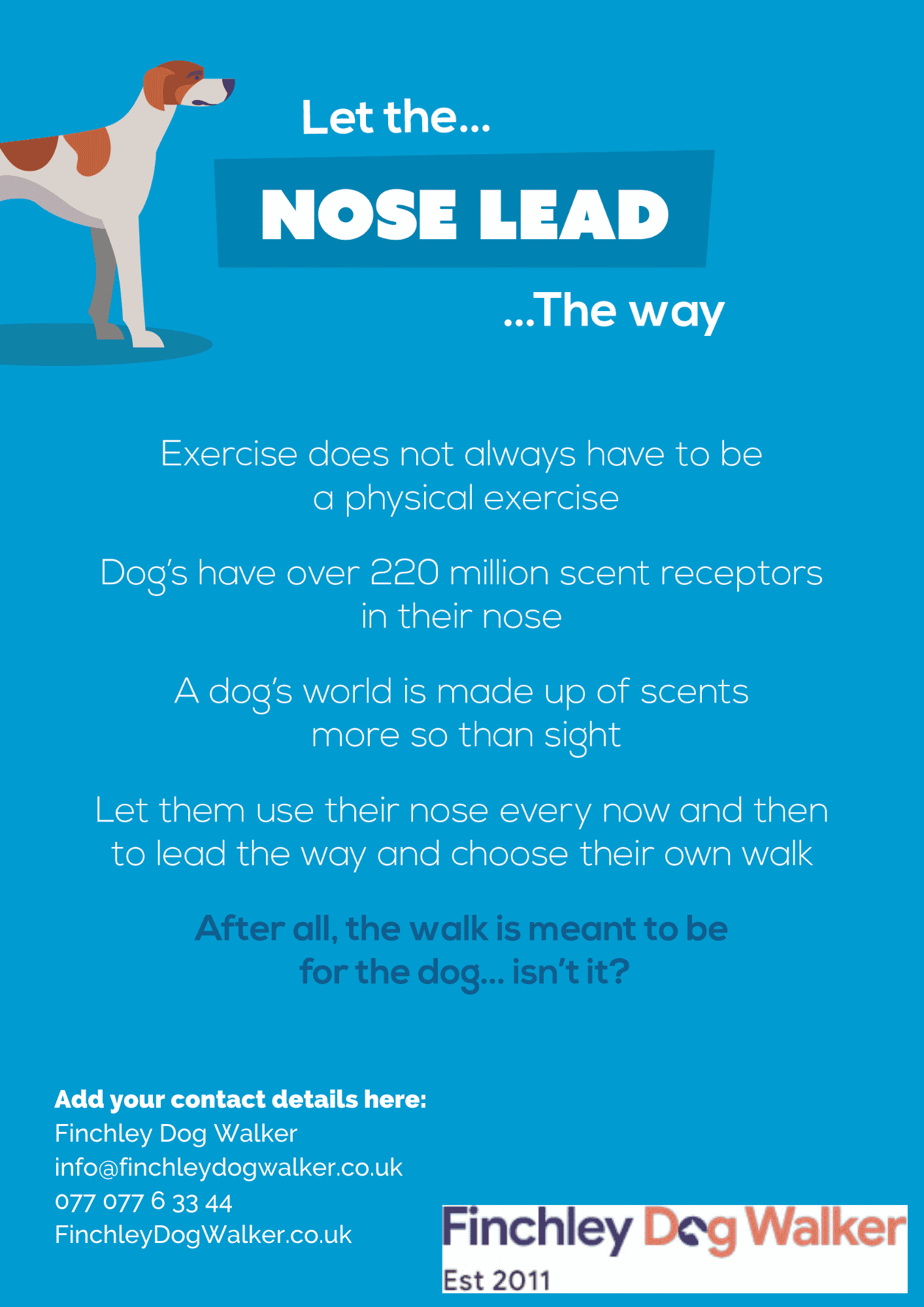
Your dog does not need entertaining every minute
This is probably the biggest change I would make from the original version of this article.
There is a difference between enrichment and constant stimulation.
A dog does not need:
walk
then training
then searching
then fetch
then tricks
then another game.
Sometimes dogs need time to simply be dogs.
That may mean:
- sniffing
- wandering
- watching
- walking beside you
- drinking
- pausing
- going home.
My Dog Enrichment Guide looks at enrichment as part of a wider balance that also includes rest, routine and appropriate choice.
A dog who expects constant entertainment can find it increasingly difficult to switch off.
More activity is not automatically better.
How do I know whether my dog is enjoying the activity?
Look at what your dog does.
Useful signs may include:
- willingly joining in
- relaxed movement
- choosing to continue
- sniffing naturally
- taking food normally
- being able to disengage afterwards.
Stop or make the activity easier if your dog:
- repeatedly walks away
- becomes frantic
- starts grabbing at you or equipment
- appears confused
- freezes
- becomes unusually tense
- barks repeatedly through frustration
- cannot settle afterwards.
Do not assume persistence means enjoyment.
Your dog should be allowed to say no.
What if my dog gets overexcited on walks?
Adding more games is not always the answer.
A dog who is already highly aroused may benefit more from:
- a quieter route
- additional distance from triggers
- slower movement
- more sniffing
- fewer interactions
- predictable routines
- going home earlier.
Dogs Trust also recommends opportunities to sniff and appropriate calming activities for dogs who struggle to settle, rather than simply adding more energetic exercise.
If your dog regularly becomes frantic, lunges, barks, struggles to respond or cannot settle after walks, look at the wider picture rather than assuming they need to be tired out.
Are enrichment walks suitable for every dog?
Outdoor enrichment can usually be adapted, but the type of activity matters.
Puppies
Keep activities short.
Puppies need exploration and learning, but they also need a great deal of sleep and should not be encouraged into unnecessary repetitive impact or jumping.
Senior dogs
A senior dog may enjoy sniffing and searching even if they no longer want long walks.
Move at their pace and adapt activities around mobility, hearing, eyesight and health.
Nervous or rescue dogs
Do not turn enrichment into another challenge they are expected to complete.
A nervous dog may get more from a predictable route, extra space and time to investigate familiar smells.
Dogs recovering from injury or surgery
Follow your vet’s exercise restrictions.
A scent game can still involve bending, twisting and movement, so “mental exercise” does not automatically mean medically appropriate.
What I do on one-to-one dog walks
I don’t have a list of activities every dog has to complete.
My one-to-one enriched dog walks are built around the individual dog.
One dog might spend quite a lot of time sniffing.
Another might enjoy a short search game.
A senior dog may want a gentle local walk.
A nervous dog may need a quieter road and more distance.
A young dog might practise a few seconds of loose-lead walking before being released to explore again.
The aim is not constant entertainment.
It is a useful walk.
My solo walks start and finish at your dog’s home. I do not use vans, collection rounds or groups of unfamiliar dogs.
That gives me much more freedom to change the pace, route or plan according to the dog in front of me.
One-to-one dog walking in Finchley and Muswell Hill
If your dog would benefit from individual attention rather than a group walk, I provide solo one-to-one dog walks in Finchley and Muswell Hill.
Walks can include:
- sniffing
- exploration
- simple enrichment
- confidence-building
- reward-based engagement
- quieter routes
- changes of pace.
There is no requirement to cover a particular number of miles.
The walk should fit your dog.
Want to practise these skills with your own dog?
I also offer one-to-one dog training support in Finchley for owners who want practical help with everyday skills.
That can include:
- engagement
- voluntary check-ins
- recall foundations
- loose-lead walking
- confidence
- appropriate enrichment
- practising exercises from an existing trainer or behaviourist.
Sessions are reward-based and can begin in a private venue in N6 before moving into normal local environments where appropriate.
This is practical support rather than clinical behaviour work.
Frequently asked questions
How can I make my dog’s walk more interesting?
Give your dog more time to sniff, use simple search games, occasionally let them choose between safe routes and include short reward-based training where appropriate.
You do not need to organise an activity throughout the whole walk.
Does sniffing tire a dog out?
Sniffing provides mental and sensory activity, but I would avoid treating it as another way to exhaust your dog.
The aim is to allow natural exploration, not find the fastest possible way to make your dog tired.
Should I take treats on every walk?
You do not have to.
Food can be useful for training and simple searches, but some dogs value sniffing, toys, movement or access to an interesting area just as much.
If you use food regularly, account for it within your dog’s overall diet.
Are games better than a normal walk?
Not necessarily.
Games can add variety, but they are not automatically better than simply walking, sniffing and exploring.
The right balance depends on your dog.
Is fetch good exercise?
Some dogs enjoy fetch, but I would avoid repetitive high-speed ball throwing.
Repeated sprinting, twisting and sudden stopping can be physically demanding.
Use variety rather than relying on one repetitive activity.
Should I make every walk different?
No.
Some dogs enjoy novelty.
Others, particularly nervous dogs, may prefer familiar and predictable routes.
Different does not automatically mean better.
What if my dog is not interested in games outside?
That is fine.
Your dog may already find the environment itself interesting enough.
Allow them to sniff and explore rather than trying to force interaction.
Can I use these ideas with a reactive dog?
Possibly, but managing the environment comes first.
If your dog is worried about other dogs, people or traffic, creating enough distance may be far more useful than adding a game.
Do not use food to lure a frightened dog closer to something they are trying to avoid.
Final thoughts
You do not need special equipment to make a dog walk more interesting.
You often do not need to do very much at all.
Give your dog time to sniff.
Notice what they are interested in.
Use simple games when they add something useful.
Keep training short.
Let your dog make safe choices.
And remember that a successful walk doesn’t have to be fast, long, or packed with activities.
Sometimes the best walk is the one where your dog gets to explore the world without being rushed.
For more ideas, visit my Dog Enrichment Guide.
You can also read What Are One-to-One Enriched Dog Walks? to see how I use the same principles during professional walks around Finchley and Muswell Hill.
- Dog Enrichment Ideas That Actually Help Calm and Tire Your Dog
- What Are One-to-One Enriched Dog Walks?
- Dog Walking and Everyday Exercise
- Dog Behaviour, Body Language and Emotional Wellbeing
- One-to-One Dog Training Support in Finchley
VETERINARY DISCLAIMER: This guide provides general information about walking and enrichment. Adjust activity for your dog’s age, health, mobility and fitness. Speak to your vet before changing the exercise routine for a puppy, senior dog, unwell dog, or dog recovering from injury.