Summer Dog Safety Guide: Hot Weather, Walks and Heatstroke
Updated July 2026
Summer can be brilliant for dogs.
Longer daylight.
More time outside.
Early morning walks when North London is still relatively quiet.
And, for some dogs, plenty of time to stop and investigate every hedge on the way.
But summer also catches people out.
A walk that felt fine last week suddenly becomes too much.
The pavement is hotter than expected.
The dog who normally runs everywhere starts slowing down.
Or we become so determined to keep the normal routine that we miss the dog telling us the plan needs to change.
I have walked dogs professionally since 2011.
The biggest lesson hot weather has taught me is simple.
Don’t wait for a problem to adapt the day.
Your dog does not need to complete the normal route.
They don’t need their usual sixty minutes just because the clock says so.
And missing one walk during dangerous heat won’t ruin their life.
Heat-related illness can be serious.
So my summer approach is usually quite boring.
Check the conditions.
Look at the dog.
Slow down.
And change the plan early.
This is my main summer dog safety guide.
For detailed answers, I have linked to the more specific guides throughout the page.
Some links on this page may be affiliate links. If you buy through them, I may earn a small commission at no extra cost to you. As an Amazon Associate, I earn from qualifying purchases. I only recommend products that fit the practical advice on this page.
The quick summer dog safety checklist
In a hurry?
Before you take your dog out, ask yourself:
- What are the conditions now?
- How does it actually feel outside?
- Is there direct sun?
- Is it humid?
- Will the route have shade?
- What are the pavements like?
- Is my dog more vulnerable to heat?
- Am I expecting too much physical exercise?
- Do I have water?
- Could I go earlier?
- Could I shorten the walk?
- Could we do something at home instead?
- Do I know the signs of heat-related illness?
And one final question.
Does my dog actually need this walk now?
Sometimes the safest answer is no.
Summer dog safety is mostly about changing the plan
I think this is where dog owners sometimes struggle.
Dogs like routine.
So do we.
Your dog normally goes out at midday.
They normally walk for an hour.
They normally chase the ball.
They normally run through the park.
Then summer arrives.
And we try to keep doing exactly the same thing.
The weather has changed.
Why would the walk stay identical?
My guide to how weather affects dog walks explains how I change routes, pace and activity depending on the conditions.
In summer that might mean an early start.
A shorter route.
More shade.
More stopping.
Or no normal walk at all.
That is not letting your dog down.
It is knowing when routine needs to be flexible.
How hot is too hot to walk your dog?
I used to give much more fixed temperature advice.
Twenty degrees.
Twenty-three degrees.
Twenty-five degrees.
The problem is dogs do not work like a traffic-light chart.
No single temperature is safe for every dog.
The Royal Kennel Club says a dog’s ability to cope with heat can depend on age, breed or type, size, coat, health, fitness, and the amount of exercise.
That makes sense to me.
A young dog walking slowly in shade is not doing the same activity as a dog repeatedly chasing a ball across an open field.
A senior dog is not the dog they were five years ago.
A French Bulldog may struggle differently from a longer-muzzled dog.
Humidity matters.
Direct sunlight matters.
The surface matters.
Your individual dog matters.
I have written a full answer in How Hot Is Too Hot to Walk Your Dog?
That is the page I would read if you are looking for temperature guidance.
My simple version here is this.
As conditions get warmer, I become increasingly cautious.
I reduce intensity before I wait for the dog to struggle.
And when I think the normal walk is not sensible, I change it.
Which dogs need extra care during hot weather?
Any dog can develop heat-related illness.
Some dogs need more caution.
I pay particular attention to:
- flat-faced dogs
- older dogs
- overweight dogs
- dogs with low fitness levels
- large dogs
- dogs with longer or thicker coats
- dogs with heart problems
- dogs with breathing difficulties
- dogs who are unwell or dehydrated
- puppies
- dogs who have struggled in heat before
That does not mean every dog on that list stays indoors from May until September.
It means I do not compare them with the dog running around the park.
The Royal Kennel Club heatstroke advice for dogs explains the known risk factors in more detail.
PDSA’s current summer guidance also specifically highlights flat-faced, overweight, and older dogs, as well as dogs living with ongoing health problems.
Read the PDSA hot-weather advice for pets.
If your dog has a medical condition or has previously struggled in hot weather, speak to your vet about their individual exercise needs.
I am a dog walker.
Your vet knows your dog’s medical history.
Walking your dog safely in hot weather
The first thing I change is usually timing.
Early morning is often my preference.
The sun has not spent the whole day heating roads, pavements and buildings.
The streets are usually quieter too.
That can be useful for some of the nervous and reactive dogs I work with.
Evening may be an option.
But do not look at the clock and automatically assume 8 pm means safe.
Pavements can still be warm.
The air may feel heavy and humid.
A flat can also remain hot long after the outdoor temperature starts falling.
Check the actual conditions.
Then check your dog.
Shorter does not mean faster
This is another easy mistake.
You normally have an hour.
It is hot.
So you decide to squeeze the normal route into thirty minutes.
Faster pace.
Fewer stops.
Come on.
Keep moving.
I would do the opposite.
Less distance.
Less intensity.
A calmer pace.
Give the dog time.
My new guide, Stop Counting Steps: Why Your Dog Needs Time to Sniff on Walks, explains why I do not judge a good dog walk by miles or human step targets.
A slow, sniff-walk may be a better option in warmer conditions.
But please read that sentence carefully.
Suitable conditions.
A sniff walk does not make dangerous heat safe.
Sniff walks are useful, but they are not a heatwave loophole
I like sniff walks.
I use slower walks with many of the dogs I care for.
And I think owners often hurry dogs far too much.
But I do not want my sniff-walk advice misused.
If it is unsafe to walk your dog, do not go out at midday and say:
“It’s okay. We’re only sniffing.”
A slow walk is still activity.
Your dog is still outside in the heat.
They are still producing body heat.
The pavement may still be hot.
Instead, read How Hot Is Too Hot to Walk Your Dog?
When conditions are suitable, a shorter sniff-focused route may be an option.
For dogs who need a lower-pressure walking style, my guide to Sniff and Decompression Walks for Dogs explains how I approach them.
When conditions are not suitable, stay home.
Simple.
Hot pavements can change the whole route
I work locally and on foot.
That means I think about the whole journey.
It is no good saying:
“Highgate Woods will be shady.”
How does the dog get there?
Do they have to walk along exposed pavement?
Cross a hot road?
Stand at crossings?
Walk across artificial grass?
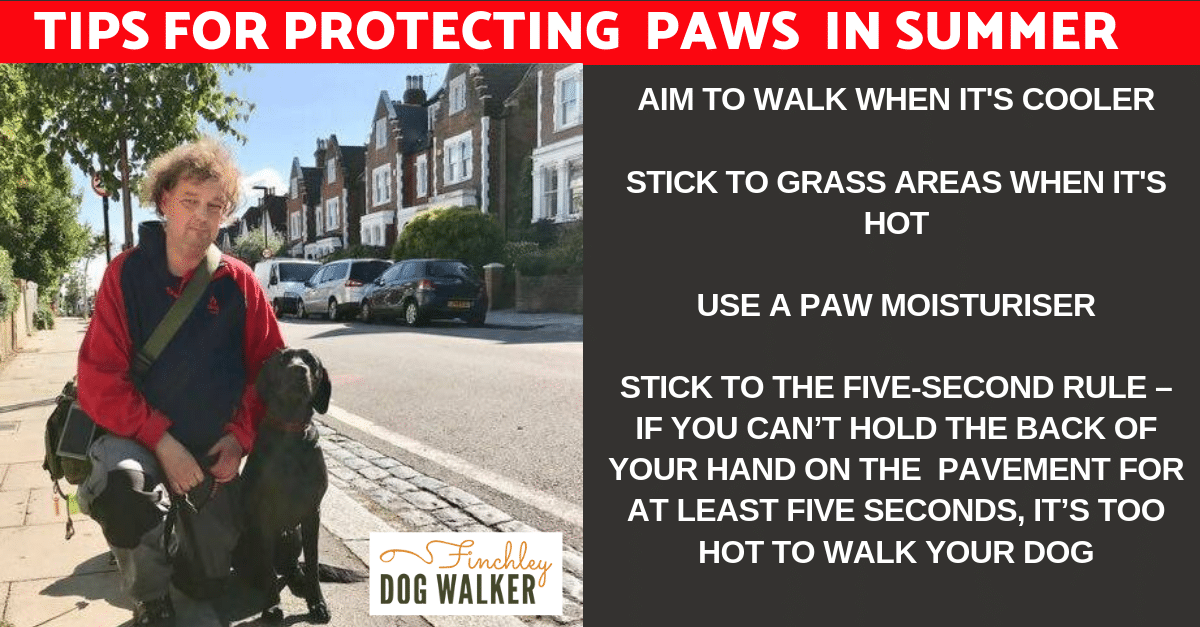
Tarmac and other surfaces can become uncomfortable or hot enough to injure paw pads.
Dogs Trust recommends a five-second hand test.
The Royal Kennel Club uses seven seconds.
I see the hand test as a useful warning check rather than a magical guarantee of safety.
If the surface feels painfully hot to me, the dog is not walking on it.
I also watch the dog.
Are they:
- lifting a paw
- stepping unusually quickly
- pulling towards grass
- stopping
- refusing to continue
- licking their feet afterwards
Do not immediately label that stubborn behaviour.
Something may be uncomfortable.
Read my complete guide to walking dogs on hot pavements.
Artificial grass deserves its own mention too.
It can get surprisingly hot in direct sunlight.
Read Artificial Grass and Dogs in Hot Weather if you have it in your garden.
Heatstroke in dogs is an emergency
This is the section I hope you never need.
But please read it before a heatwave.
Not while your dog is collapsing.
Heat-related illness can progress quickly.
Signs can include:
- heavy or continuous panting
- changes in breathing
- bright pink or red gums
- excessive drooling
- tiredness or drowsiness
- stiffness or reluctance to move
- repeatedly seeking shade
- wobbling or poor coordination
- vomiting
- diarrhoea
- confusion
- collapse
- seizures
Not every dog will show every sign.
Please don’t wait for collapse.
A dog who suddenly looks wrong deserves your attention.
My detailed guide, Heatstroke in Dogs: Signs and First Aid, covers the subject in more detail.
What should I do if I think my dog has heatstroke?
Stop the activity.
Move your dog out of the heat.
Start cooling them.
Contact a vet urgently.
First-aid advice has changed over the years, so I am careful about reusing old graphics from Facebook.
Dogs Trust uses the phrase “cool first, transport second”.
Their current advice offers different cooling approaches depending on whether a dog is young and healthy, older, or living with health conditions.
The Royal Kennel Club also advises beginning cooling immediately and contacting a vet.
Read the current Dogs Trust heatstroke cooling first-aid advice.
You can also read the Royal Kennel Club heatstroke advice for dogs.
One important point.
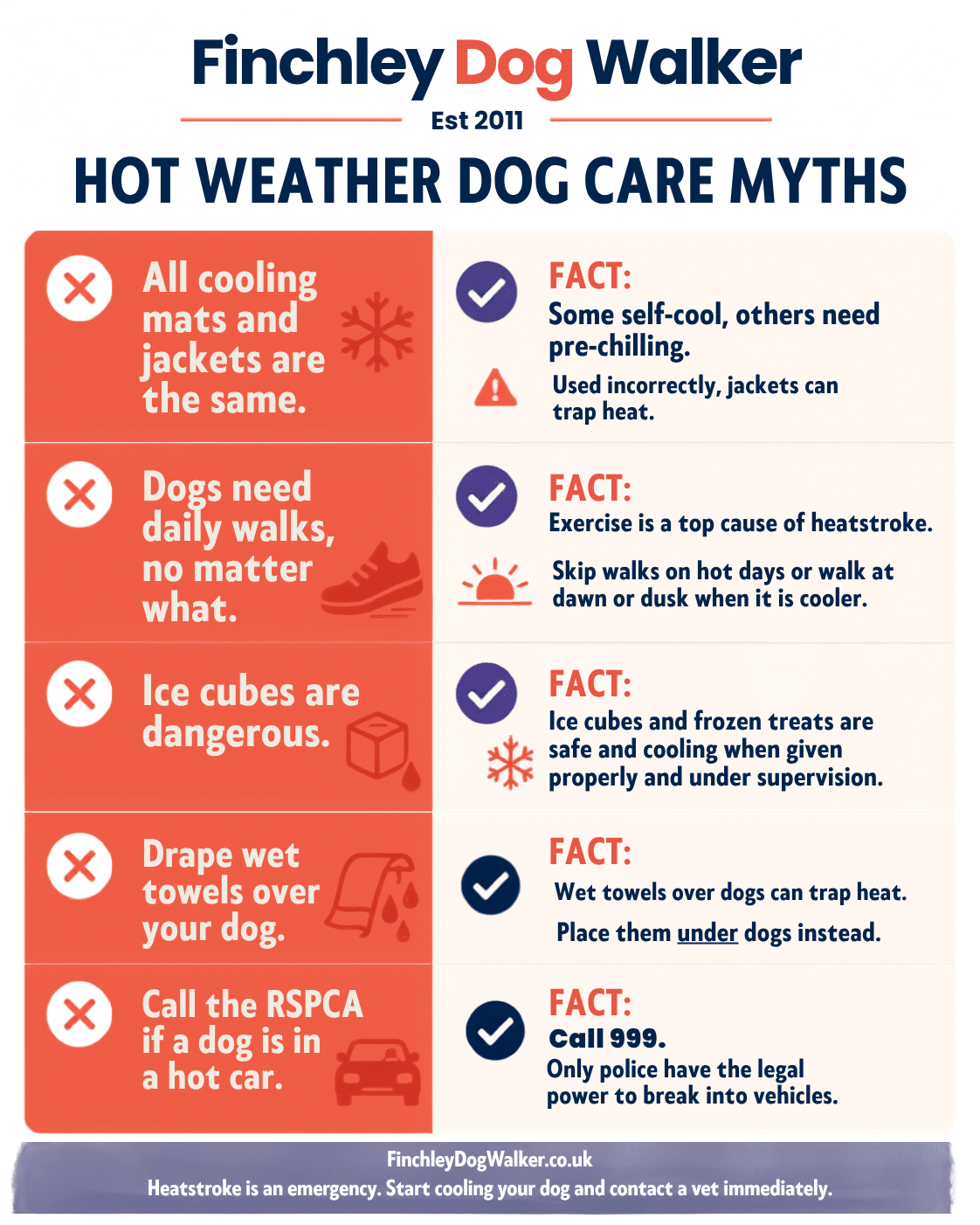
Do not place a wet towel over an overheating dog.
It can trap heat.
Do not spend twenty minutes arguing online about whether the water is precisely the right temperature either.
Start appropriate cooling.
Phone your vet.
Follow current veterinary first-aid guidance.
Heatstroke is not something to watch and wait on.
Keeping dogs cool at home
Sometimes people focus so much on walks that they forget the house.
North London flats can become hot.
Top-floor rooms.
Large windows.
Conservatories.
Poor airflow.
Rooms that receive direct sun for hours.
Your dog may spend much more time at home than they do walking.
I focus on the basics:
- fresh drinking water
- more than one water location where practical
- shade
- airflow
- closing curtains or blinds against direct sun
- access to cooler flooring
- letting the dog choose a comfortable resting place
- reducing unnecessary activity
I do not force a dog to lie on a cooling mat.
Give them the choice.
Some dogs love them.
Others move straight back onto the sofa.
My guide to Dogs and Heat in a Flat is particularly useful if you live in a warmer flat or apartment.
For simple cooling ideas, read my Hot Weather Dog Care Myths guide.
That page also tackles some of the advice that gets copied and pasted across social media every summer.
Water matters, but carrying water does not make an unsafe walk safe
I carry water in warmer conditions.
A portable dog water bottle is useful because I can offer water without relying on a communal bowl.
But let us keep this in perspective.
Carrying water is sensible.
It does not turn a dangerous walk into a safe one.
The same applies to cooling jackets.
Cooling bandanas.
Cooling mats.
Fancy water bottles.
Products can help.
Decisions matter more.
That is why my Hot Weather Dog Kit is deliberately simple.
Water.
Cooling options.
Calm enrichment.
And a lot of common sense.
At home, a cooling mat for dogs may give your dog another cool surface to choose.
Supervise dogs who chew equipment and follow the manufacturer’s instructions.
Your dog does not need to be exhausted every day
This is probably one of the biggest changes in the way I think about dog walking.
I used to hear:
“A tired dog is a happy dog.”
So we walked further.
Threw the ball more.
Tried to wear dogs out.
But why does your dog have to finish every day exhausted?
Summer is a good time to rethink that.
A missed long walk does not need to be replaced with an hour of frantic activity in the living room.
Your dog can rest.
You can also offer calm mental activity.
Depending on the dog, I might use:
- Find It
- scatter feeding
- a cardboard box search
- hiding food around a room
- a stuffed Kong
- a lick mat
- a short training session
- gentle scent work
My guide to what to do instead of walking your dog in a heatwave has more ideas.
You can also read Ditch the Bowl at Mealtimes for simple food-based enrichment.
And if you are interested in why I give dogs more time to investigate smells, read Why Dogs Need Sniff Walks, Not Human Step Targets.
Do not make enrichment difficult for the sake of it.
The aim is not to frustrate your dog.
Start easy.
Frozen treats and summer food enrichment
Frozen food activities can be useful for some dogs.
But, again, they are not a heatstroke prevention plan.
Shade still matters.
Water matters.
The environment matters.
A frozen treat will not make a hot conservatory safe.
I may use part of the dog’s regular food in a Kong or on a lick mat.
That helps avoid turning every hot day into hundreds of extra calories.
My “Healthy Summer Treats for Dogs” guide offers practical food ideas.
You can also find the enrichment items I use or recommend in my Hot Weather Dog Kit.
Please consider your dog’s normal diet, allergies and medical needs.
When in doubt, speak to your vet.
Summer dangers are not only about heat
This is where the old version of my guide was a little too focused on temperature.
Heat is a major summer risk.
It is not the only one.
Summer walks can also mean:
- grass seeds
- blue-green algae
- busy picnic areas
- barbecue rubbish
- insect bites and stings
- hot cars
- busier travel
- open garden gates
- more time near ponds, lakes and rivers
A thirty-second check after a walk can be useful.
My Check Your Dog After Walks guide explains what I look for.
Grass seeds can cause much bigger problems than their size suggests
Grass seed season catches owners out every year.
The seeds can lodge in places such as:
- paws
- ears
- eyes
- skin
Their shape can allow them to work deeper into tissue.
After walks through long or rough grass, I check dogs.
Particularly around the paws and between the toes.
I also pay attention to sudden changes.
Head shaking.
Sneezing.
Licking one paw.
Limping.
A sore or weepy eye.
Do not spend days hoping an embedded grass seed will sort itself out.
Read my full guide Grass Seeds Are a Danger to Your Dog.
PDSA also includes grass seeds among its recognised summer and garden hazards.
You can read the PDSA advice on grass seed risks.
Be careful around ponds, lakes and slow-moving water
Dogs and water can be a brilliant combination.
Some dogs are apparently born believing every pond belongs to them.
But open water needs thought.
Blue-green algae is particularly serious.
PDSA warns that blue-green algae can occur in still or slow-flowing water and that some types release toxins capable of causing severe illness, organ damage and death.
If you suspect exposure, contact your vet immediately.
Read the PDSA blue-green algae advice for dogs.
I would also look for local warning signs and avoid water that concerns me.
Do not assume swimming is automatically a safe cooling activity.
Think about:
- water quality
- currents
- steep banks
- hidden debris
- fishing hooks
- whether your dog can swim confidently
- whether they can get back out
My guide Does Your Dog Love to Play in Water? covers water safety in more detail.
Picnics and barbecues create their own dog hazards
Warm weather brings people outside.
Parks get busier.
Food appears everywhere.
And some dogs become professional picnic inspectors.
I pay attention to:
- barbecue scraps
- corn cobs
- cooked bones
- onions
- grapes
- alcohol
- food wrappers
- wooden skewers
- discarded napkins
The problem is not always the food deliberately given to the dog.
It is the rubbish left behind.
Or the guest who says:
“One little bit won’t hurt.”
Before taking your dog to a busy gathering, ask whether they will actually enjoy it.
A nervous dog, surrounded by strangers, children, food, and other dogs, may prefer to stay at home.
Read my guide to Dogs and Picnics: Summer Safety Tips.
My broader Top Summer Dangers for Dogs guide also covers seasonal hazards away from home.
Never leave a dog in a hot car
I wish we did not need to keep saying this.
We do.
Do not leave your dog alone in a car during warm weather.
An open window is not enough.
Shade is not a guarantee.
And “I’ll only be five minutes” can turn into longer very easily.
Dogs Trust says a dog can die in a hot car in minutes and advises calling 999 for the police if you see a dog in distress in a vehicle in England or Wales.
Read the Dogs Trust hot car advice.
You can also read my guide Dogs Die in Cars.
And no.
The viral Facebook post saying you should take a photograph, take a screenshot of the temperature, and then automatically smash the window is not reliable legal advice.
Call 999.
Explain the situation.
Follow the police’s advice.
Think before taking your dog on a summer journey
A day out sounds lovely.
Then you add:
Traffic.
A hot car.
A busy train.
The Tube.
Crowds.
A dog who cannot settle.
Summer journeys need planning.
Before travelling, think about:
- whether the journey is necessary
- the weather
- the hottest part of the day
- water
- rest stops
- where your dog will be when you arrive
- shade
- medication
- an emergency vet
- whether dogs are actually allowed at the destination
My “Travelling With Your Dog This Summer” guide covers car, train, and day-trip planning.
Living in London?
Read Dogs and the London Tube in Hot Weather before taking your dog underground on a warm day.
Sometimes the best dog-friendly day out is the one where your dog stays comfortably at home.
Puppies need a different summer routine
Puppies do not need adult dog walks.
They certainly do not need long hot walks to “wear them out”.
A puppy may need:
- a toilet opportunity
- gentle exploration
- feeding
- short training moments
- calm play
- rest
Lots of rest.
During warm weather, I would rather adapt a puppy’s day than force their normal routine.
My Puppy Visits in Finchley can include home visits, toilet breaks, and calm care tailored to the puppy’s age and normal routine.
For general puppy advice, read my Puppy Support Guide.
Speak to your vet about exercise where your puppy has health concerns.
Older dogs may tell us to slow down before we notice
I have written about this recently because it matters.
We have a bad habit of expecting the same dog year after year.
They walked an hour at five.
Now they are twelve.
And we still expect the hour.
Hot weather can make changes in exercise tolerance more obvious.
Your dog may:
- slow down
- stop more often
- hesitate
- lag behind
- seek shade
- take longer to recover
Please look at them.
Do not simply pull harder on the lead.
My guide to senior dog exercise and enrichment has practical ideas for adapting activity.
And if your dog’s movement or normal exercise tolerance changes, speak to your vet.
Do not assume every change is “just old age”.
Summer can be harder for nervous and reactive dogs too
The heat is only part of summer.
Parks get busier.
Children are off school.
People stay outside later.
Barbecues.
Football.
Picnics.
More dogs.
More noise.
A familiar quiet route can suddenly feel completely different.
For some nervous or reactive dogs, I use quieter times and more carefully chosen routes.
I may create more distance.
Change direction.
Slow down.
Sometimes I use a sniff or decompression-style walk.
But sniffing does not fix reactivity.
My updated Sniff and Decompression Walks for Dogs guide explains this more carefully.
You can also read How to Walk an Anxious Dog Without Making It Worse.
For practical one-to-one help, see my Rescue Dog Support in Finchley.
The few hot-weather products I actually find useful
You do not need to buy a summer wardrobe for your dog.
My essentials are fairly boring.
Water.
A way to offer it.
Somewhere comfortable to rest.
A few calm enrichment options.
A portable dog water bottle is useful on warmer, suitable walks.
At home, a cooling mat for dogs can provide another resting option for some dogs.
For Kongs, lick mats, and the rest of the equipment, see my Hot Weather Dog Kit.
What I do as a professional dog walker in hot weather
My dog walking is one-to-one.
I work locally and on foot.
No van.
No group of dogs.
That gives me more flexibility when the weather changes.
Depending on the dog and conditions, a normal walk may be:
- moved to a cooler time where practical
- shortened
- slowed down
- taken on a different route
- changed to a short toilet opportunity
- replaced with calm care at home
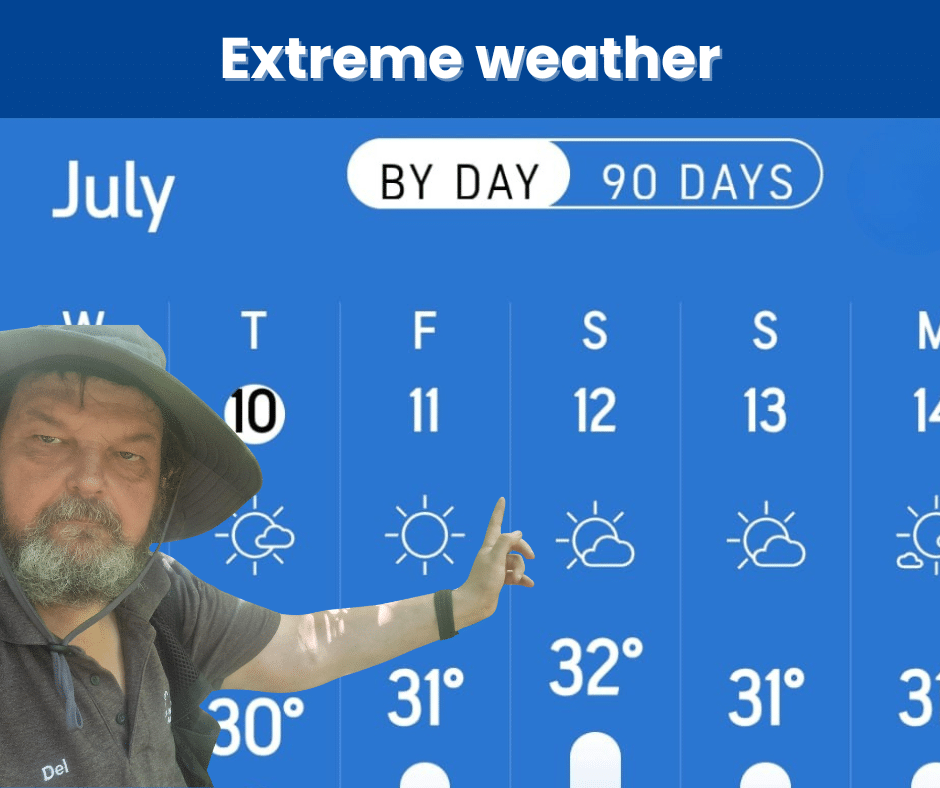
My Extreme Weather Policy explains how I make those decisions.
I also offer Hot-Weather Dog Comfort Visits in Finchley.
You do not need to be an existing dog-walking client.
If you are going out during hot weather and do not think your dog needs a normal walk, a visit may include:
- a brief toilet opportunity where safe
- fresh water
- calm indoor enrichment
- a simple scent game
- feeding
- agreed medication
- quiet companionship
- a general welfare check
- a photograph and update
The aim is not to exhaust your dog inside.
It is calm, practical care.
My simple approach to summer dog safety
I could turn summer dog safety into fifty rules.
I do not think that helps.
My approach is:
Check the conditions.
Know your dog.
Walk earlier where possible.
Reduce intensity.
Check the ground.
Carry water.
Watch for changes.
Do not force the normal routine.
Know the signs of heat-related illness.
Start cooling and contact a vet urgently if you suspect heatstroke.
Check your dog after walks.
Think about grass seeds, water, summer rubbish, and heat.
And let your dog rest.
That last one is important.
Your dog does not need to earn rest by completing a certain number of steps.
Sometimes doing less is the sensible choice.
Start with the summer guide you actually need
Not sure where to go next?
Worried about the temperature?
Read How Hot Is Too Hot to Walk Your Dog?
Not sure how weather should change a walk?
Read How Weather Affects Dog Walks.
Your dog keeps stopping to sniff?
Read Stop Counting Steps: Why Your Dog Needs Time to Sniff on Walks.
Your dog benefits from slower, quieter walks?
Read Sniff and Decompression Walks for Dogs.
Worried about hot pavements?
Read Walking Dogs on Hot Pavements.
Living in a warm flat?
Confused by cooling advice on Facebook?
Read Hot Weather Dog Care Myths.
Looking for simple hot-weather equipment?
Read my Hot Weather Dog Kit.
Need alternatives to a normal walk?
Read What to Do Instead of Walking Your Dog in a Heatwave.
Worried about heatstroke?
Read Heatstroke in Dogs: Signs and First Aid.
Are there poisonous snakes in the UK
Yes, but only the adder. Read my guide on what to do if your dog is bitten by a snake
Going away or out for the day?
Read about my Hot-Weather Dog Comfort Visits in Finchley.
Frequently asked questions
How hot is too hot to walk a dog?
There is no single safe temperature for every dog.
Age, breed or type, size, weight, health, fitness, coat, humidity, direct sunlight, surfaces and exercise intensity all matter.
Read How Hot Is Too Hot to Walk Your Dog? for my detailed answer.
Is 20°C too hot to walk a dog?
Some dogs may struggle at or below 20°C, particularly where they have additional risk factors or are exercising intensely.
Other dogs may cope with a suitable outing in the right conditions.
Do not use 20°C as a universal safe or dangerous cut-off.
Look at the individual dog and the whole situation.
Do dogs need a walk every day during a heatwave?
Your dog does not need to complete their normal walk during dangerous heat.
A short toilet opportunity, calm enrichment and rest may be more appropriate.
Speak to your vet if your dog has individual medical or exercise needs.
Is a sniff walk safer in hot weather?
A slower, lower-intensity walk may be a more suitable option than intense exercise when conditions are otherwise safe.
But a sniff walk does not make unsafe heat safe.
If conditions are unsuitable, skip or adapt the walk.
Can dogs get heatstroke in the shade?
Yes.
Shade can help, but dogs can still overheat through exercise and in warm or humid conditions.
Watch the individual dog.
Should I walk my dog early or late in summer?
Early morning is often my preference.
Evenings may be cooler than midday, but pavements and buildings can retain heat and humidity may remain uncomfortable.
Check the actual conditions.
Should I give a hot dog ice?
Social media claims that ice automatically makes dogs overheat are not correct.
However, solid ice can be a problem for enthusiastic chewers and frozen treats should be offered sensibly.
If you suspect heatstroke, do not rely on an ice cube or frozen treat.
Start appropriate cooling and contact a vet urgently.
Should I cover an overheating dog with a wet towel?
No.
Current Dogs Trust guidance specifically advises against placing a wet towel over an overheating dog because it can raise their temperature.
Start appropriate cooling and contact a vet urgently.
Can my dog swim to cool down?
Some dogs enjoy water, but check the water and location first.
Blue-green algae, currents, steep banks, hidden debris and fishing equipment can create serious risks.
What should I do if I see a dog in a hot car?
If a dog is in distress in a hot vehicle in England or Wales, call 999 and ask for the police.
Do not rely on viral Facebook posts telling you that taking a photograph automatically gives you permission to smash a window.
Explain the emergency and follow police advice.
Disclaimer
This guide provides general dog care and walking information based on my professional experience and publicly available animal welfare and veterinary guidance. It does not replace veterinary advice, diagnosis or treatment.
Every dog’s ability to cope with heat is different. If your dog has a medical condition, a breathing or mobility problem, or has struggled with heat before, speak to your vet about their individual needs.
Heatstroke and suspected blue-green algae poisoning are emergencies. If you think your dog is affected, begin appropriate first aid where advised and contact a vet urgently.