Updated July 2026
Not every dog needs to march around the same route at the same pace.
Some dogs need space.
Some need time.
And some need us to stop saying “Come on” every 30 seconds.
I work with a lot of rescue, nervous and sensitive dogs. Over the years, I have learnt that trying to get more distance out of a dog is not always the answer.
Sometimes I deliberately slow the walk down.
We may choose a quieter route. Stop more often. Let the dog look around.
And yes, there will probably be a lot of sniffing.
People often call these sniff walks or decompression walks.
I use both terms myself.
But I do not see a decompression walk as a special formula.
There is no stopwatch.
No compulsory woodland.
No rule that says your dog must sniff for twenty minutes before they are officially decompressed.
For me, it simply means taking some of the pressure off the walk and paying much more attention to the dog in front of me.
That can make a big difference.
Some links on this page may be affiliate links. If you buy through them, I may earn a small commission at no extra cost to you. I only recommend products that fit the practical advice on this page.
What is a decompression walk for dogs?
The term decompression walk is widely used in dog training and pet care.
There is no legally regulated or universally agreed definition.
When I use the term, I mean a slower, lower-pressure walk where the dog has more opportunity to explore, sniff and move at a pace that suits them.
The aim is not distance.
I am not trying to keep a perfect heel position for the entire walk.
And I am certainly not checking whether we have completed the same route as yesterday.
Depending on the dog, I might:
- choose a quieter location
- create more distance from other dogs
- use a longer lead where it is safe
- stop and let the dog investigate
- change direction
- avoid known busy areas
- allow more time to watch and process
- go home sooner
A decompression-style walk should still be managed.
I am responsible for the dog’s safety.
They do not get to chase wildlife, invade another dog’s space or drag me into the road because I have decided it is a relaxing walk.
But I can give the dog more appropriate choices.
That matters to me.
Is a sniff walk the same as a decompression walk?
Not necessarily.
A sniff walk is exactly what it sounds like.
You deliberately give your dog more time to use their nose.
My article, “Stop Counting Steps: Why Your Dog Needs Time to Sniff on Walks,” explains why I think owners sometimes become overly focused on pace and distance.
A decompression walk is a little broader.
Sniffing may be part of it.
Usually quite a big part.
But I am also thinking about the environment, pressure, distance from triggers and what the dog’s body language is telling me.
Imagine a nervous dog walking through a packed high street.
They are sniffing.
But they are also tense, scanning, jumping at noises and reacting to dogs passing two metres away.
I would not assume that dog is relaxed simply because their nose is on the ground.
Now put the same dog on a quieter route where they have more space.
Their pace may change.
They may pause.
Investigate.
Look around and then move on.
That is a very different picture.
The whole dog matters.
Why I started using slower walks more
Roxy probably had a lot to do with it.
She was my rescue dog.
Awkward but awesome.
And she did not always read the dog ownership handbook.
You could not simply decide what the walk would look like and expect her to agree.
She made me pay attention.
Then I started working professionally with more rescue and nervous dogs.
The same lesson kept coming back.
We ask dogs to cope with a lot.
Traffic.
People.
Scooters.
Dogs appearing around corners.
Bins moving.
Builders.
Children.
Delivery drivers.
A fox disappearing across the road.
For a confident dog, much of that may barely get a second glance.
Another dog notices everything.
My job is not to stand behind them chanting, “You’ll be fine.”
Sometimes my job is to make the situation easier.
That may mean giving them more distance.
Changing the route.
Or simply slowing down.
Sniffing is a big part of these walks
Dogs use scent to investigate their environment.
You can see it happening.
A dog’s nose drops.
Their pace changes.
They move back over the same patch of ground.
Perhaps they follow the edge of a hedge for a few metres before stopping again.
They are interested.
I give them time.
PDSA describes a slow, meandering walk with sniffing and exploring as good for a dog’s mental health.
You can read the PDSA advice on exercise for dogs.
There is also some interesting research into scent activities.
A 2019 study compared dogs that completed regular nosework activities with dogs that performed heelwork. After two weeks, dogs in the nosework group showed a more positive judgement bias in the study’s cognitive test.
The researchers discussed the opportunity to use natural behaviour and have more autonomy.
You can read the research paper Let Me Sniff! Nosework Induces Positive Judgment Bias in Pet Dogs.
But we need to keep this in context.
The dogs were doing structured nosework.
The study did not test whether sniffing a lamppost during a normal walk reduces stress.
That is why I am careful with claims such as “sniffing releases stress” or “ten minutes of sniffing calms every dog”.
It is not that simple.
A more recent scientific review, The Value of Sniffing: A Scoping Review of Scent Activities for Dogs, looked at 27 studies involving shelter, working and companion dogs.
The researchers found growing interest in scent-based activities.
They also pointed out that relatively little is known about exactly how these activities affect dogs’ behaviour and physiology.
There is evidence worth paying attention to.
There are also gaps.
I am comfortable saying both.
I watch what happens to the dog
Research matters.
So does observation.
When I walk a dog regularly, I get to know what is normal for them.
Some dogs start a walk quickly.
They leave the house and charge into the world.
After a while, their pace changes.
The lead may become looser.
They start investigating rather than simply moving.
With other dogs, I see the opposite.
They begin fairly settled.
Then something changes.
Their nose goes down and the sniffing becomes urgent.
They move faster.
Their body becomes tense.
Perhaps they are tracking the scent of another dog or animal.
I do not look at both dogs and say:
“They’re sniffing, so they’re calm.”
I look at the whole dog.
Their movement.
Their breathing.
Their tail.
Their ears.
Whether they can respond to me.
Whether they can disengage and move on.
That is one of the reasons I dislike simple social media rules.
Dog behaviour rarely fits neatly onto a graphic.
Sniffing is not automatically calming
I want to make this really clear.
Sniffing may be part of a slower, more settled walk for some dogs.
It is not a canine off switch.
Some dogs become highly aroused by scent.
You may have seen it with your own dog.
They suddenly find something.
The walk changes.
Their nose is glued to the ground and they are moving at speed.
You ask them to move on.
Nothing.
The rest of the world appears to have disappeared.
Another dog may become frantic when searching for dropped food.
A reactive dog may pick up information about another dog and become more vigilant.
Then there are dogs who investigate with their mouths and try to swallow everything they find.
Sniffing is natural.
That does not mean every sniff is relaxing or safe.
Watch your dog.
What about reactive dogs?
The old version of this article said sniffing helps redirect a reactive dog’s attention and gives them a natural coping strategy.
I think that was too definite.
I work with reactive dogs.
I do sometimes use slower walks and give dogs time to sniff.
But I would never tell you that sniffing treats reactivity.
It does not.
What I find more useful is reducing unnecessary pressure.
A dog who struggles around other dogs may cope better on a quieter route with more distance.
That dog may then have an opportunity to investigate their surroundings without being repeatedly pushed into difficult situations.
The important bit may not be the sniffing.
It may be the space.
The route.
The lower number of close encounters.
Or a combination of several things.
This is why I do not take every reactive dog to Coldfall Woods and simply tell them to sniff.
The woods may be quiet at one time.
At another time, dogs can appear from several paths with very little warning.
For the wrong dog, that is not decompression.
That is hard work.
Read my guide to walking an anxious dog without making it worse.
I also provide Rescue Dog Support in Finchley for dogs who benefit from a slower, one-to-one approach.
I am not a clinical behaviourist. If a dog’s fear, anxiety, or reactive behaviour requires a specialist assessment, I will say so.
Decompression walks for rescue dogs
Bringing a rescue dog home is exciting.
For the dog, it can also mean that almost everything has changed.
Home.
People.
Routine.
Smells.
Walking routes.
The place they sleep.
Even the sound of the boiler may be new.
Then, because we want to give them a lovely life, we take them everywhere.
The park.
The pet shop.
A café.
Our friend’s house.
A huge woodland walk.
I understand why.
But some dogs need less.
At least to start with.
A short, predictable walk around quieter local streets may suit the dog better than an exciting trip somewhere new.
You may only walk ten minutes.
Perhaps the dog spends much of that time investigating the same small area.
That is okay.
I am not trying to cram every possible dog experience into the first fortnight.
I would rather let the dog tell me what they can cope with.
My First Walks with a Rescue Dog guide goes into this in more detail.
Does a decompression walk build confidence?
It might be part of a confidence-building plan.
But I would not promise that a slow walk automatically builds confidence.
Confidence is more complicated than that.
What I can do is avoid unnecessarily overwhelming a dog.
I can give them appropriate choices.
Allow time to investigate.
Create distance.
Notice when their behaviour changes.
And try not to keep putting them into situations where they are clearly struggling.
For some dogs, that creates better opportunities to learn about their environment at a manageable pace.
Progress may be slow.
That does not bother me.
A nervous dog walking confidently to the end of their road can be a bigger achievement than another dog completing five miles.
It depends on the dog.
When might I choose a slower walk?
There is no fixed list.
However, I often think about slowing things down when a dog is:
- newly rescued or rehomed
- nervous in their environment
- easily overwhelmed
- older
- returning to normal routines after illness, with veterinary guidance
- having a particularly unsettled day
- struggling with busy walking routes
Weather can change the plan too.
During suitable warmer conditions, I may choose a shorter route with more shade and less intense activity.
That does not make sniff walks safe in dangerous heat.
Please read “How Hot Is Too Hot to Walk Your Dog?” before deciding to walk in warm weather.
My Summer Dog Safety Guide also covers heat, hot pavements and dogs who may be at additional risk.
In unsafe conditions, I skip or adapt the normal walk.
A slow walk is still exercise.
What does a decompression walk look like?
Honestly?
Sometimes it looks like a fairly boring dog walk.
There may be no dramatic training.
No perfect heelwork video.
No huge distance.
I collect the dog.
We leave home calmly.
The dog starts sniffing near the first hedge.
So we stop.
A person is coming towards us with another dog.
I change direction.
We find a quieter road.
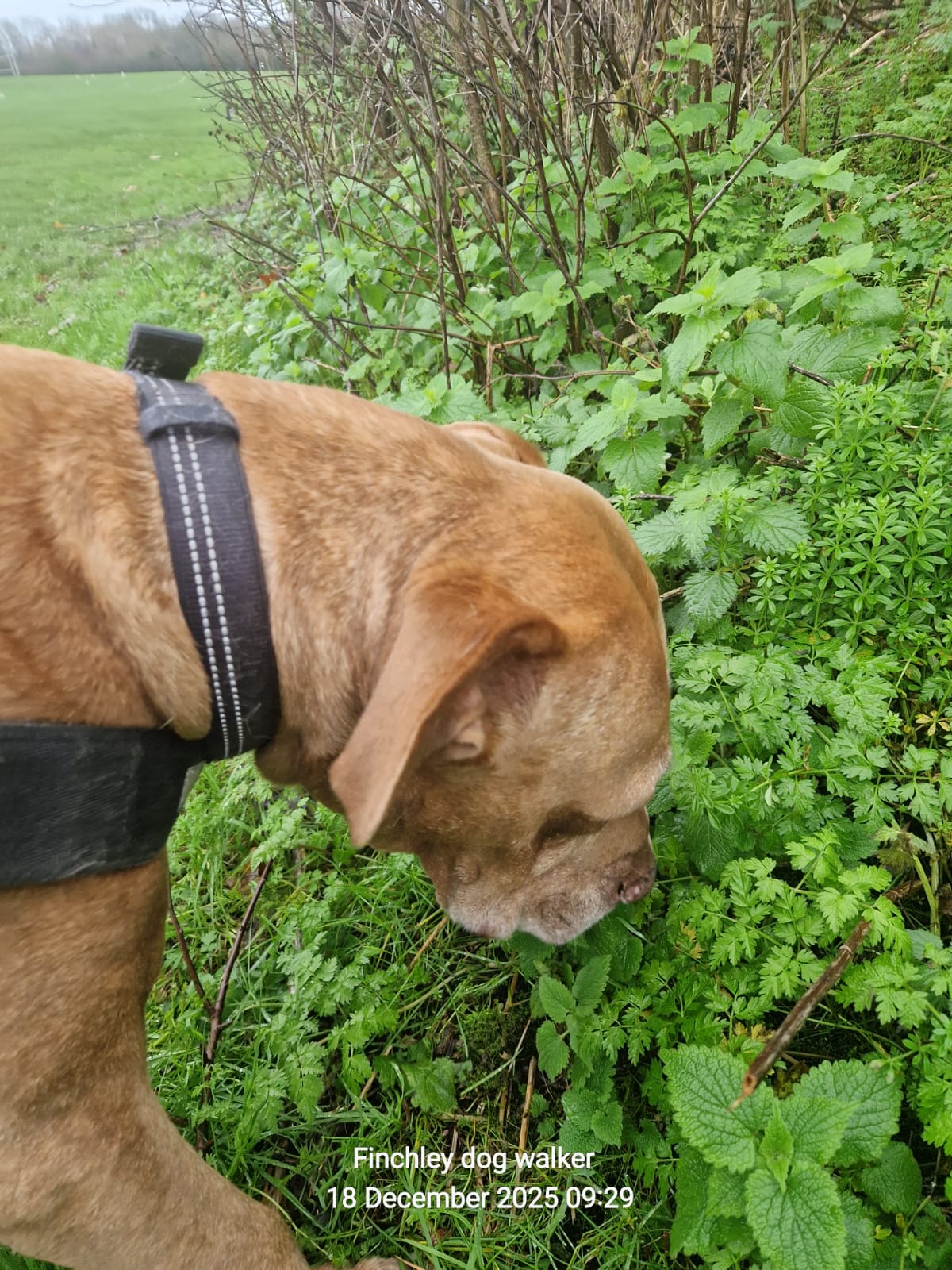
The dog wants to investigate a grass verge.
Fine.
We move on.
Stop again.
Walk.
Sniff.
Perhaps use a little food for a simple Find It game.
Then we head home.
That is it.
But during that walk I have been watching the dog.
I have noticed how they moved.
What got their attention.
Whether something seemed harder today.
Whether they were taking food normally.
Whether their gait looked different.
Whether they wanted to continue.
A dog walk does not have to look impressive to be useful.
How long should a decompression walk be?
There is no set time.
The old version of this article suggested anything from twenty minutes to an hour.
I am removing that.
Why twenty minutes?
Why an hour?
The right length depends on the dog.
A senior dog may enjoy a short local sniff.
A younger dog may happily explore for longer.
A nervous dog may manage ten calm minutes before the environment becomes too much.
Another dog may spend an hour wandering around woodland.
Do not force the walk to fit a label.
My new guide, Why Dogs Need Sniff Walks, Not Human Step Targets, explains why I think we need to stop measuring every walk by distance and pace.
Quality matters.
But so do your dog’s physical needs.
Sniffing does not mean dogs suddenly stop needing suitable physical exercise.
It is about balance.
Do decompression walks replace normal dog walks?
I do not really like the phrase “normal dog walk”.
Normal for which dog?
Some dogs naturally enjoy slow walks.
Others enjoy moving at a brisker pace.
You may have a dog who loves a mixture.
One day you walk further.
Another day you spend more time exploring.
Perhaps your dog swims.
Trains.
Plays.
Uses scent activities.
PDSA’s exercise advice makes a useful distinction between brisk walking for physical activity and slower walks that allow sniffing and exploration.
Dogs can need both.
Look at age.
Health.
Fitness.
Breed or type.
Personality.
And what your dog actually enjoys.
Speak to your vet if a health condition affects your dog’s exercise.
The equipment I use for slower walks
You do not need to go shopping before letting your dog sniff.
A secure lead and suitable walking equipment may be all you need.
For some dogs, however, a slightly longer lead makes exploring easier.
A long line
I sometimes use a waterproof long line for sniff and decompression walks in suitable locations.
The key words are suitable locations.
I am not using a ten-metre line on a busy Finchley pavement.
Long lines need space.
You also need to learn how to handle one safely.
Watch for people, dogs, bicycles and trees.
Do not wrap the line around your hand.
And I prefer to attach a long line to a suitable, properly fitted harness rather than a dog’s neck.
My guide to dog harnesses and collars explains more about the equipment I use.
A comfortable harness
I am a fan of the PerfectFit harness for many of the dogs I work with.
I like the modular design and the ability to adjust the fit.
That does not mean one harness suits every dog.
Check the fit.
Watch your dog’s movement.
And remember that a harness does not train loose-lead walking by itself.
A treat pouch
This is probably one of my most-used bits of dog walking equipment.
A dog-walking treat pouch keeps rewards within reach.
That matters.
If a dog checks in with me at exactly the right moment, I do not want to spend half a minute searching through three pockets.
I may use food for:
- rewarding check-ins
- simple Find It games
- moving away from something
- reinforcing calm choices
- short training moments
Food is not suitable in every situation or for every dog.
But when I use it, I want it ready.
Using food on a decompression walk
I sometimes scatter a few small treats or pieces of the dog’s normal food in a safe area and encourage them to search.
Keep this simple.
Check the ground first.
Do not scatter food somewhere covered in rubbish or anything toxic.
I am also careful around other dogs.
Food on the ground and an unknown dog approaching can create a problem.
This is another reason I like one-to-one walks.
I can focus on the dog in front of me.
For more food-based scent ideas, read my Ditch the Bowl at Mealtimes guide.
Where do I take dogs for decompression walks?
People often assume woodland is automatically the best place.
Not always.
I use local places such as:
- Coldfall Woods
- Cherry Tree Wood
- Highgate Woods
- Parkland Walk
But only when the location suits the dog and the conditions.
Highgate Woods on a quiet morning may feel very different from a busy weekend.
Parkland Walk may suit one dog.
Another dog may struggle with runners, bikes or dogs appearing nearby.
Some of my calmest walks happen on ordinary residential streets.
The dog knows the area.
We avoid busy routes.
They investigate familiar smells.
Nothing particularly exciting happens.
Perfect.
My guide to where I walk dogs in Finchley and how I choose the route explains why I do not have one favourite park for every dog.
The best route is the one that suits that dog on that day.
Indoor scent activities can be useful too
Weather sometimes shortens a walk.
A dog may be on restricted exercise following veterinary advice.
Or perhaps you simply want to offer another activity at home.
You can try:
- Find It
- scatter feeding
- a cardboard box search
- a snuffle mat
- a suitable food toy
Start easy.
I often see people make enrichment games far too difficult because they want the dog to work harder.
The dog does not understand the game yet.
Help them.
Let them succeed.
Then make it more challenging gradually.
My dog enrichment ideas for everyday life have more practical activities.
You can also read How to Tire a Dog Without Walking for Hours.
And no, I am not saying ten minutes of indoor sniffing magically replaces a sixty-minute walk.
Dogs are not calculators.
Are decompression walks good for senior dogs?
They can suit some older dogs very well.
Cuba, one of the older dogs I have walked, is a good example.
As dogs age, I do not expect them to keep following the same routine they had years earlier.
We slow down when they need to.
Stop.
Sniff.
Change the route.
Some older dogs still enjoy a good walk.
Others need shorter outings.
PDSA advises going at an older dog’s pace and stopping if they look tired or struggle.
If your older dog suddenly slows down, stops more often or changes the way they move, please do not simply assume they are being stubborn.
Speak to your vet.
My guide to senior dog exercise and enrichment has more ideas for older dogs.
Do sniff walks make dogs pull less?
Not automatically.
The old FAQ on this page suggested dogs given time to explore often become less frustrated and therefore pull less.
That might be what an owner observes with their individual dog.
But I would not promise it.
Some dogs pull because they are excited.
Some are trying to reach a scent.
Some have never learnt to walk on a loose lead.
Some are worried.
Some have spent years practising pulling because pulling gets them where they want to go.
Giving a dog time to sniff does not, by magic, teach loose-lead walking.
You can include sniff breaks within reward-based lead training.
The two are not opposites.
Read my guide to calm one-to-one enrichment walks for more on how I mix sniffing, searching and simple training into a walk.
What I look for on a slower walk
I watch the whole dog.
Not just the nose.
I notice:
- pace
- body tension
- movement
- breathing
- scanning
- response to sounds
- ability to move on
- interest in food, where food is normally used
- changes from previous walks
I am not standing there with a clipboard.
After walking dogs professionally since 2011, a lot of this has become part of how I work.
But I still make a conscious effort to pay attention.
A regular dog suddenly lagging behind matters.
A nervous dog becoming more confident in one part of the route matters.
A dog who normally takes food suddenly refusing it matters.
The walk gives me information too.
Why solo walks work well for this approach
I do not offer group dog walks.
That is a deliberate decision.
On my solo one-to-one dog walks, I work with one household at a time.
There is no van full of dogs.
No group route.
No younger dog setting the pace for a senior.
If a dog needs to slow down, we slow down.
If we need more space, I change direction.
If the route is not working, I change the route.
And if a dog spends several minutes investigating one hedge, nobody else is waiting for them to hurry up.
This approach works particularly well for some rescue, nervous, reactive and older dogs.
Not because sniff walks fix every problem.
They do not.
It works because I can pay attention to one dog.
A decompression walk should be about the dog in front of you
I like sniff walks.
I use slower walks.
And I think many dogs deserve far more time to investigate the world rather than being hurried around a human route.
But I am also wary of dog-care trends becoming fixed rules.
Not every dog needs an hour in the woods.
Sniffing is not always calming.
A long line is not suitable everywhere.
And a decompression walk does not treat a behavioural problem.
Look at your dog.
Are they coping?
Are they comfortable?
Can they move away?
Is the environment suitable?
Do they want to continue?
Perhaps the best walk today is a slow one.
Tomorrow may be different.
That is fine.
Walk the dog you have in front of you.
For more on sniffing, pace and step targets, read Stop Counting Steps: Why Your Dog Needs Time to Sniff on Walks.
For anxious dogs, read How to Walk an Anxious Dog Without Making It Worse.
And if your dog needs a calmer, one-to-one walking service in Finchley or Muswell Hill, you can read about my solo dog walking service and Rescue Dog Support in Finchley.
Frequently asked questions
What is a decompression walk for dogs?
I use the term for a slower, lower-pressure walk where a dog has more opportunity to explore, sniff and move at a suitable pace.
There is no single formal definition or fixed formula.
Are sniff walks and decompression walks the same?
Not always.
A sniff walk focuses on giving a dog more opportunities to use their nose.
A decompression-style walk also considers the environment, pace, space from triggers and the pressure being placed on the dog.
Are decompression walks good for reactive dogs?
Some reactive dogs may cope better on quieter, less pressured walks with more space.
Sniffing does not treat reactivity and is not automatically calming.
Dogs with significant reactive behaviour may need support from their vet and an appropriately qualified reward-based behaviour professional.
Does sniffing reduce stress in dogs?
I would be careful with this claim.
Some dogs appear more settled during or after slower sniffing activities.
Research into structured nosework has found a more positive judgement bias in dogs completing regular nosework than in those completing heelwork.
That does not prove every dog becomes less stressed whenever they sniff on a normal walk.
How long should a decompression walk last?
There is no fixed duration.
Base the walk on your dog’s age, health, fitness, behaviour and ability to cope with the environment.
Do sniff walks tire dogs out?
Scent activities give dogs opportunities to use their nose and investigate.
Many owners notice their dog settles well afterwards.
However, there is no scientific formula showing that a certain number of minutes sniffing equals a specific amount of physical exercise.
Do decompression walks replace physical exercise?
Not necessarily.
Dogs need activities suited to their age, health, fitness and individual preferences.
A slower exploratory walk and a brisker walk meet different needs.
Do I need a long line for a decompression walk?
No.
You can slow down and give a dog time to sniff on a normal lead.
A long line may give some dogs more freedom in a suitable open location, but it needs to be handled safely and used with appropriate equipment.
Are decompression walks good for rescue dogs?
Some rescue dogs may benefit from quieter, predictable walks with fewer demands while they adjust to a new home and environment.
Do not assume every rescue dog needs the same type of walk.
Where can I do a decompression walk?
Choose somewhere that suits your individual dog.
That may be woodland, a quiet park or familiar residential streets.
A location is only relaxing if your dog can cope with what happens there.
Why not contact me and find out about decompessions walks
Disclaimer
This article provides general information on dog care and walking, based on my professional experience and publicly available animal welfare research and guidance. It does not replace veterinary advice, diagnosis or an individual behavioural assessment. Every dog is different. If your dog’s movement, exercise tolerance or behaviour changes, speak to your vet. Dogs with significant fear, anxiety or reactive behaviour may also need support from an appropriately qualified reward-based behaviour professional.