Some dogs love heading out for a walk.
Others find parts of the outside world genuinely difficult.
Traffic, sudden noises, unfamiliar people, other dogs, narrow pavements, bicycles, children, roadworks or simply leaving the security of home can make an ordinary walk feel very different to a nervous dog.
If your dog is anxious on walks, the aim is not to force them through as much as possible until they “get used to it”.
I would rather make the walk manageable enough that the dog can notice what is around them, make choices, move away when necessary and gradually build confidence.
Sometimes that means a shorter walk.
Sometimes it means crossing the road, turning around or going home.
For more help interpreting what your dog may be communicating, start with my Dog Behaviour and Body Language Guide.
Table of contents
- What Does an Anxious Dog Look Like on a Walk?
- What Does “Threshold” Mean?
- If the Anxiety Is New, Think About Health
- A Walk Is Not a Distance Target
- Set the Walk Up Before You Leave
- Use Secure, Comfortable Equipment
- Give Your Dog Time at the Start of the Walk
- What Should I Do When My Dog Suddenly Gets Scared?
- Using Visual Barriers
- Should I Ask My Dog to Do Something?
- What if My Dog Won’t Eat Outside?
- What Should I Do if My Dog Freezes?
- Do Not Drag a Frightened Dog Towards Something
- Management Is Not the Same as Giving Up
- Walking a Nervous Dog in Busy Areas
- What if My Dog Is Reactive on the Lead?
- Walking an Anxious Rescue Dog
- Should My Anxious Dog Walk Every Day?
- What About Enrichment Instead of a Walk?
- Give Your Dog Time to Recover
- What Not to Do With an Anxious Dog on a Walk
- What Progress Can Look Like
- When Should I Speak to My Vet?
- When Do I Need a Behaviour Professional?
- How I Approach Nervous Dogs on Walks
- Calm One-to-One Walking Support
- A Simple Checklist Before an Anxious Dog Walk
- Frequently Asked Questions
- How do I calm an anxious dog on a walk?
- What should I do if my dog freezes on walks?
- Should I make my nervous dog face their fears?
- Should I walk my anxious dog every day?
- Why will my dog take treats at home but not outside?
- Should I pick my small dog up when they are frightened?
- Will more socialisation fix an anxious adult dog?
- Does creating distance reward fear?
- Is my anxious dog actually reactive?
- Final Thoughts
- Related Guides
- Veterinary and Behaviour Disclaimer
What Does an Anxious Dog Look Like on a Walk?
Anxiety does not always look dramatic.
Some dogs bark or lunge.
Others become very quiet.
Possible signs that your dog is finding the walk difficult include:
- slowing down
- repeatedly looking around
- becoming unusually still
- freezing
- trying to turn home
- pulling hard to get away
- crouching
- lowering or tucking their tail
- suddenly closing their mouth
- panting when they are not hot
- trembling
- refusing food they would normally enjoy
- becoming unable to respond to familiar cues
- staring at another dog, person or object
- barking, growling or lunging
- frantic-looking movement
- trying to hide behind you
- repeatedly stopping
One signal on its own does not tell you exactly how your dog feels.
A dog may stop because they have found an interesting smell. They may pant because they have been exercising. They may refuse food because they simply are not hungry.
Look at the whole dog, what is happening around them and what is normal for that individual.
Dogs Trust explains that fear, anxiety and frustration can produce a wide range of subtle and more obvious behavioural changes, and recommends giving dogs space and choice rather than forcing interaction. Read the Dogs Trust guidance on fear, stress and big emotions.
My Dog Stress and Threshold Signs guide goes into these early signs in much more detail.
What Does “Threshold” Mean?
You may hear people talk about keeping a nervous dog “under threshold”.
In simple terms, I use the term “threshold” to describe the dog’s coping limit in that particular situation.
When your dog is coping, they may still notice something worrying but remain able to:
- look away
- move normally
- sniff
- respond to you
- eat comfortably
- choose another direction
- recover once the trigger has passed
As the situation becomes more difficult, you might see increasing tension, staring, freezing, trying to leave, barking or lunging.
Threshold is not a fixed distance.
A dog might cope with another dog twenty metres away one day and need considerably more space the next.
Sleep, pain, previous stressful experiences, noise, the environment and how suddenly something appears can all affect how much the dog can manage.
That is why I watch the dog in front of me rather than trying to follow a fixed formula.
If the Anxiety Is New, Think About Health
If your dog has always been confident on walks and suddenly becomes frightened, reluctant to walk or much more reactive, speak to your veterinary practice.
Behaviour changes can sometimes be connected to:
- pain
- injury
- illness
- changes in hearing
- changes in vision
- discomfort from equipment
- ageing
- other physical problems
A dog who is uncomfortable may become less tolerant or more worried about situations they previously managed easily.
Dogs Trust advises speaking to a vet when behaviour changes because medical problems may contribute to what you are seeing. (Dogs Trust)
My What to Do When Your Dog Refuses to Walk guide also covers some of the physical and environmental reasons a dog may suddenly stop outside.
A Walk Is Not a Distance Target
With a nervous dog, I do not think a successful walk should automatically be measured in miles or minutes.
A calm twenty-minute walk can sometimes be more useful than an hour spent struggling from one frightening situation to another.
I am more interested in whether the dog:
- had opportunities to sniff
- could move comfortably
- had enough space
- recovered after something worried them
- made voluntary choices
- could disengage from things around them
- returned home without becoming completely overwhelmed
You do not have to complete a particular route simply because you planned it.
Turning around is not failure.
Neither is going home early.
My Dog Walking and Everyday Exercise Guide looks more closely at why appropriate exercise depends on the individual dog rather than a universal number of minutes.
Set the Walk Up Before You Leave
A great deal of nervous-dog walking is actually planning.
You cannot control everything that happens outside, especially on North London streets, but you can sometimes make the odds considerably better.
Choose a Quieter Time
If your dog struggles with other dogs, school traffic, delivery vehicles or busy pavements, try walking when the area is quieter where your routine allows.
That might mean avoiding:
- the school run
- commuter times
- the busiest park periods
- narrow routes at popular dog-walking times
This is management.
You are not promising to avoid the world forever.
You are making the current walk easier enough for your dog to cope.
Choose Routes With Space
I prefer routes where I can see what is coming and change direction early.
Helpful features can include:
- wider pavements
- open sight lines
- quieter side streets
- several places to turn off
- enough room to cross the road safely
- natural or physical barriers
A narrow path with nowhere to go can make a dog feel very different from an open space where they have options.
Familiar Routes Can Be Useful
Some nervous dogs cope more easily when at least part of the walk is predictable.
A familiar route can reduce the number of surprises while you learn what your dog finds difficult.
That does not mean your dog must follow exactly the same route forever.
It simply means that novelty is not always helpful when the dog is already struggling.
Use Secure, Comfortable Equipment
Equipment cannot cure anxiety.
It can, however, make a walk safer and reduce unnecessary physical pressure.
For many dogs I prefer:
- a properly fitted harness
- a comfortable fixed or double-ended lead
- secure identification
- a long line in an appropriate open space
- rewards the dog genuinely values
Dogs at risk of bolting or reversing out of equipment may need additional safety arrangements.
I do not recommend using:
- choke or check chains
- prong collars
- electronic collars
- repeated lead corrections
- equipment designed to hurt or frighten
- retractable leads for nervous dogs in busy environments
Rather than turning this behaviour article into a shopping page, I have a separate Walking Kit for Nervous or Reactive Dogs guide covering harnesses, leads, long lines, backup connections and the equipment I use or recommend.
That guide contains any relevant affiliate product links and its own disclosure. (Finchley Dog Walker)
Give Your Dog Time at the Start of the Walk
I do not expect every nervous dog to leave the front door and immediately march along beside me.
For some dogs, the first few minutes are a useful time for information gathering.
Where it is safe, I may allow them to:
- look around
- sniff
- move at a slower pace
- choose between two safe directions
- pause briefly
- check in with me
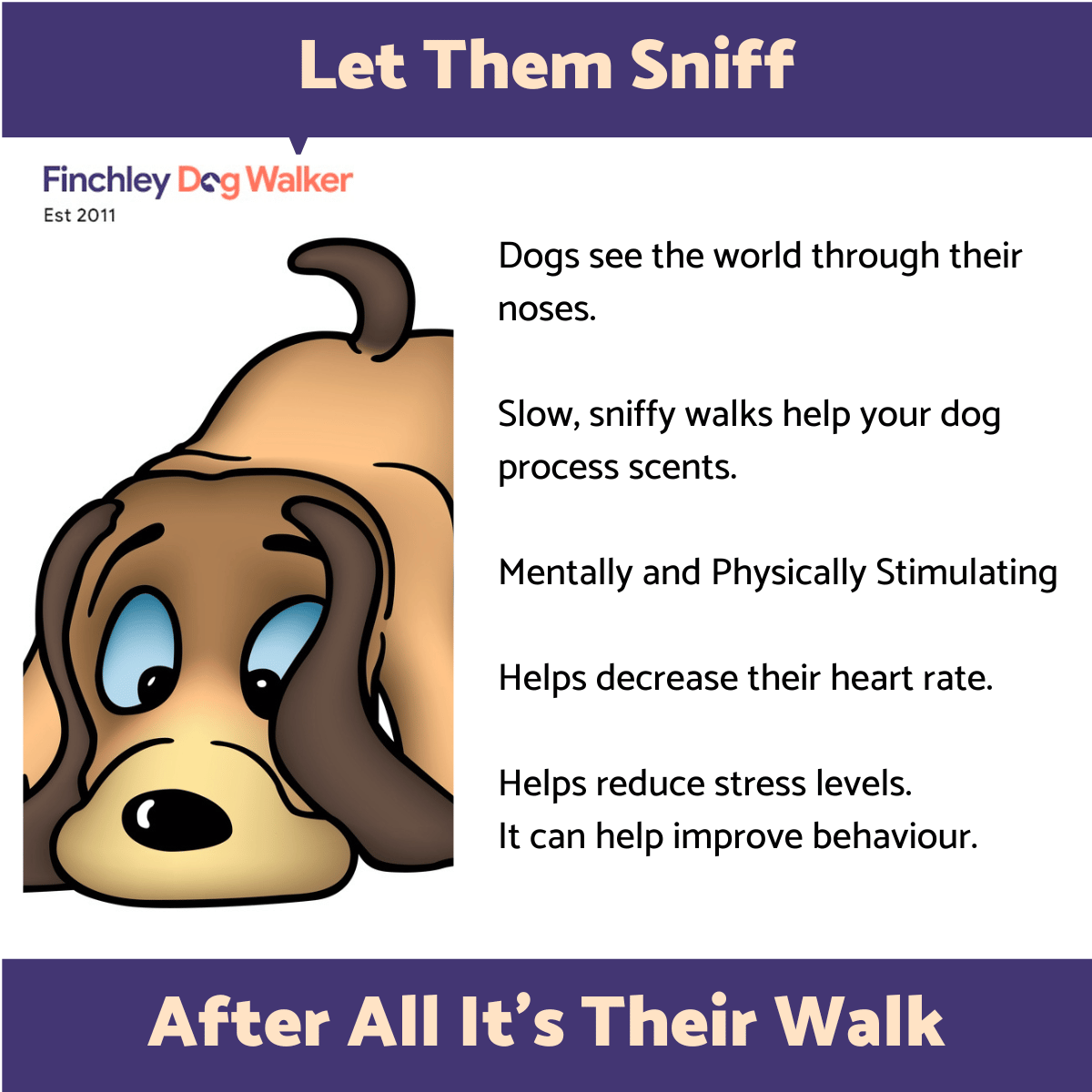
Sniffing is a normal part of exploring the environment.
It can also tell you something about how your dog is coping.
The important distinction is that sniffing itself does not prove that a dog is relaxed. Look at the rest of their body and the situation.
What Should I Do When My Dog Suddenly Gets Scared?
My priority is usually simple:
Create more space.
If another dog, person, vehicle or sudden event has worried your dog, you may be able to:
- cross the road
- turn around
- move into a wider area
- step behind a parked vehicle
- use a hedge or wall as a visual barrier
- take a quieter side street
- allow the trigger to pass before continuing
Dogs Trust specifically recommends increasing distance and allowing dogs to move away when they are frightened or overwhelmed.
Do not wait for barking or lunging if your dog has already shown you that they are uncomfortable.
The quieter signals are often your opportunity to act.
Using Visual Barriers
Sometimes simply reducing what the dog can see can help.
A parked car, wall, hedge or other safe barrier can give you a few moments while another dog or person passes.
This is particularly useful where immediately leaving the area is difficult.
The aim is not to permanently hide your dog from the world.
It is to prevent an already difficult moment from becoming harder.
Should I Ask My Dog to Do Something?
Sometimes a familiar, well-practised behaviour can be useful when your dog is still able to engage with you.
For example:
- following you on a U-turn
- looking towards you
- touching your hand
- searching for scattered food
- following a familiar simple pattern
But I would not describe these behaviours as a cure for anxiety.
And I would not keep asking for cues while a dog is clearly panicking.
If your dog can comfortably perform a familiar task, it may help you move through the situation.
If they cannot, make the environment easier to navigate.
Training is most useful when the dog still has enough capacity to learn.
For everyday reward-based skills, visit my Dog Training Hub.
What if My Dog Won’t Eat Outside?
Treat it as information rather than a test your dog has failed.
Some dogs value food less outdoors.
But if your dog normally takes treats comfortably and suddenly cannot eat when another dog, person or noise appears, the situation may have become too difficult.
Do not respond by repeatedly pushing increasingly exciting food towards their face.
Create space first.
Then see whether your dog’s behaviour changes.
Food is a useful training tool, but it does not replace the need to help a frightened dog feel safer.
What Should I Do if My Dog Freezes?
A dog stopping suddenly does not automatically mean stubbornness.
If your dog freezes:
- Stop pulling forwards.
- Keep the lead secure without dragging them.
- Look at what is around you.
- Check their body language.
- Consider whether they are frightened, uncomfortable, tired or physically sore.
- Create more distance from anything that may be worrying them.
- Try a different direction if appropriate.
- Go home if continuing is making things harder.
Do not turn the moment into a battle.
If your dog repeatedly freezes or refuses to walk, read Dog Refuses to Walk? What to Do and When to Get Help.
That article also explains when a veterinary check should come before more training.
Do Not Drag a Frightened Dog Towards Something
I do not recommend physically pulling or dragging a frightened dog towards whatever worries them.
Likewise, I would not deliberately place them very close to a trigger simply because somebody has told you they need to “face their fear”.
Dogs Trust advises introducing difficult experiences gradually and specifically warns against forcing dogs to interact with things they find frightening.
Creating distance does not mean that you can never work on the problem.
It means you start from somewhere your dog can cope.
Management Is Not the Same as Giving Up
This distinction matters.
Suppose your dog is frightened of other dogs and you cross the road whenever you see one.
Someone might tell you that you are “reinforcing the fear” or “avoiding the problem.”
But if the alternative is repeatedly allowing dogs to approach until your dog barks, lunges or panics, creating space may be exactly the sensible thing to do.
Management can:
- prevent unnecessary frightening experiences
- keep people and dogs safer
- reduce repeated rehearsal of unwanted behaviour
- give you opportunities to train at an easier level
- make ordinary daily life more manageable
You can work on skills and confidence while also managing situations your dog is not ready for.
Walking a Nervous Dog in Busy Areas
Sometimes you cannot avoid every difficult environment.
That is particularly true in London.
If you have to pass through a busier section, plan.
Avoid Pinch Points Where You Can
A narrow pavement between a road and a wall gives you very little room if another dog appears.
Where possible, choose a route that gives you more options.
The slightly longer route may be much easier for the dog.
Know Where You Can Move
When I am walking a nervous dog, I notice possible exits before I need them.
That might be:
- a side road
- a wide driveway
- an entrance
- an open section of pavement
- somewhere safe to cross
- a visual barrier
You are much better placed to act early if you already know where you can go.
You Can Say No to Greetings
Your dog does not have to meet every person or dog who wants to say hello.
Useful phrases can be as simple as:
- “He needs some space, thank you.”
- “Not today, thanks.”
- “We’re going to keep moving.”
You do not owe a stranger a long explanation.
For more on this, read My Dog Is on a Lead: Please Give Us Space.
What if My Dog Is Reactive on the Lead?
Not every dog who barks or lunges on a lead is frightened.
Some dogs are frustrated because the lead prevents them from reaching another dog or person.
Others feel trapped because the lead limits their ability to move away.
Fear, frustration and excitement can look surprisingly similar.
My Why Is My Dog Reactive on the Lead? guide looks specifically at how restriction, distance and reduced choice can affect behaviour on lead. (Finchley Dog Walker)
Avoid deciding that your dog is “aggressive” purely because the behaviour is loud.
Look at the context.
Walking an Anxious Rescue Dog
A newly adopted rescue dog may need more time than you expected before ordinary walks feel ordinary.
They may be adjusting to:
- a new home
- unfamiliar people
- different roads
- traffic
- household noises
- unfamiliar equipment
- new walking routines
- dogs they have never met
- an environment completely different from their previous one
You may also know very little about their previous experience.
Do not rush through a checklist of places and people because you feel your rescue dog needs to “catch up”.
Start with what they can manage.
My Rescue Dog Help Hub covers settling in, first walks, building confidence, and the wider transition into a new home.
If you are local and need practical one-to-one support, you can also read about Rescue Dog Support in Finchley.
Should My Anxious Dog Walk Every Day?
There is no useful universal answer.
Dogs need appropriate opportunities for movement, toileting, sniffing and activity, but that does not mean every dog benefits from being pushed through the same type or length of walk every day.
If a particular walk is repeatedly leaving your dog extremely frightened or overwhelmed, consider whether it needs to be:
- shorter
- quieter
- at a different time
- on a different route
- temporarily replaced with suitable activity at home or in a secure space
One shortened or missed walk is not a catastrophe.
If your dog is persistently unable or unwilling to leave home, however, I would look more closely at why rather than stop walking indefinitely.
That may include veterinary assessment and appropriately qualified behavioural support.
What About Enrichment Instead of a Walk?
Enrichment can be very useful on days when a full walk would be too much.
Depending on your dog, that might include:
- sniffing games
- food searches
- gentle training
- chewing
- appropriate play
- simple scent activities
- exploring a secure garden
- quiet rest
But enrichment should not become another pressure-filled programme where your dog is constantly expected to perform.
My Dog Enrichment Guide explains how I use enrichment as part of a dog’s overall routine.
Give Your Dog Time to Recover
A difficult encounter does not necessarily end the moment the other dog, person or vehicle disappears.
After a stressful walk, some dogs may benefit from:
- a quieter journey home
- fewer interactions
- access to water
- calm sniffing
- somewhere comfortable to rest
- fewer demands
- an easier next outing
There is no universal number of hours a dog must recover.
It depends on the individual dog and what happened.
Read How Long Does a Dog Need to Recover After Stress? for more on recognising when your dog may still need things to be easier.
What Not to Do With an Anxious Dog on a Walk
I would avoid:
- dragging them forwards
- deliberately forcing close exposure
- shouting
- lead jerks
- prong collars
- choke or check chains
- electronic collars
- rattle bottles
- forcing greetings
- repeatedly putting them in situations where they panic
- punishing barking or growling caused by fear
- expecting perfect obedience while they are overwhelmed
Blue Cross also advises recognising signs of stress and reducing the pressure rather than punishing behaviour linked to fear or anxiety. Read the Blue Cross guide to stress in dogs.
What Progress Can Look Like
Progress with a nervous dog is not always dramatic.
It might be:
- noticing a dog and looking away
- recovering more quickly
- walking past a previously difficult location with less tension
- choosing to sniff
- voluntarily approaching something at a comfortable pace
- being able to turn away with you
- needing a little less distance
- remaining comfortable when something unexpected happens
And progress is rarely perfectly linear.
A dog may have an excellent week and then struggle on a day when the environment, their health, or their previous experiences make things harder.
Look for the longer-term pattern rather than expecting every walk to be better than the last.
When Should I Speak to My Vet?
Contact your veterinary practice if:
- anxiety appears suddenly
- existing behaviour becomes significantly worse
- your dog appears painful
- they become sensitive to touch
- they repeatedly refuse to walk
- their gait or movement changes
- their appetite changes
- sleep changes
- they seem unusually tired
- their hearing or vision appears different
- they develop new aggressive behaviour
- something simply seems different from normal
Do not assume every walking problem is a training problem.
Physical health and behaviour are closely connected.
When Do I Need a Behaviour Professional?
Seek individual professional help if your dog:
- experiences persistent or severe fear
- regularly panics
- repeatedly freezes or shuts down
- growls or snaps
- has bitten
- redirects onto you or the lead
- cannot be safely walked
- is becoming progressively more restricted by fear
- poses a risk to people or other animals
- is getting worse despite sensible management
Your vet is a sensible starting point, particularly when health is involved.
The Animal Behaviour and Training Council practitioner directory can help you find appropriately assessed professionals.
I am not a clinical animal behaviourist.
My role is practical, calm one-to-one support for suitable dogs, not diagnosis or treatment of serious behavioural disorders.
How I Approach Nervous Dogs on Walks
I have worked professionally with dogs since 2011, including many rescue, nervous, sensitive and easily overwhelmed dogs.
One thing I have learned is that a successful walk is not always the one that goes furthest.
I would rather notice a dog becoming uncomfortable and change the plan early than keep pushing until they bark, lunge or panic.
On an everyday walk that might mean:
- crossing the road
- turning around
- slowing down
- finding a wider route
- waiting somewhere quiet
- letting a dog sniff
- shortening the walk
- heading home
That is not giving the dog control of everything.
It is responding to useful information.
Calm One-to-One Walking Support
Some dogs do better without a group of unfamiliar dogs around them.
My Solo Dog Walks in Finchley and Muswell Hill are one household at a time.
Walks start and finish at your dog’s home. I do not collect dogs in vans or add unfamiliar dogs to the walk.
That allows me to adapt:
- the route
- pace
- distance
- amount of sniffing
- number of interactions
- when we turn around
- how long the outing lasts
For suitable nervous or newly adopted dogs, my Rescue Dog Support in Finchley may also be relevant.
If your main goal is practising everyday reward-based skills with you and your dog together, see One-to-One Dog Training Support in Finchley. The service includes confidence-building and understanding body language, but it is not clinical behaviour treatment.
A Simple Checklist Before an Anxious Dog Walk
Before leaving home, ask:
- How has my dog been today?
- Is anything physically different?
- Is this likely to be a particularly busy time?
- Where can I create space on this route?
- Is the equipment secure and comfortable?
- Do I have suitable rewards for my dog if my dog wants them?
- Am I prepared to change the plan?
- What will I do if another dog suddenly appears?
- Is my goal to have a useful experience rather than cover distance?
- Am I willing to go home if that is the best decision today?
The last question is often the most useful one.
Frequently Asked Questions
How do I calm an anxious dog on a walk?
Start by making the environment easier.
Create more distance from anything that worries your dog, reduce pressure, allow appropriate sniffing, and avoid forcing interactions.
If your dog is still able to engage with you, familiar reward-based skills can help you move through the situation.
If they are panicking, concentrate on getting somewhere safer and quieter.
What should I do if my dog freezes on walks?
Stop pulling.
Give your dog a moment and look at the environment and their body language.
Create distance from anything they may be worried about and try another direction where appropriate.
Repeated or sudden freezing can also be connected with pain or discomfort, so speak to your vet if you are concerned.
Should I make my nervous dog face their fears?
I would not force a frightened dog into close contact with whatever worries them.
Work from a distance and at a level of difficulty they can manage.
Dogs Trust similarly advises against forcing dogs to face frightening situations. (Dogs Trust)
Should I walk my anxious dog every day?
Your dog needs appropriate physical activity and opportunities to toilet, sniff and explore, but that does not mean every outing has to be a long conventional walk.
Shorter or quieter outings and suitable home enrichment may sometimes be more appropriate.
If your dog regularly cannot leave the house comfortably, investigate the reason with your vet and an appropriate behaviour professional.
Why will my dog take treats at home but not outside?
There can be several reasons, but if your dog normally enjoys food and stops eating when something worrying appears, that may be a clue that the situation has become difficult.
Look at the rest of their behaviour rather than using food refusal as a diagnostic test.
Should I pick my small dog up when they are frightened?
It depends on the situation and the dog.
If there is an immediate safety risk, getting your dog safely out of danger matters.
But repeatedly grabbing a dog that dislikes being picked up could increase stress.
Where possible, create distance in a way the individual dog is comfortable with.
Will more socialisation fix an anxious adult dog?
Simply exposing a worried adult dog to more dogs, people or busy environments is not the same as helping them feel safe.
Introduce experiences gradually and at a level your dog can manage.
Does creating distance reward fear?
Fear is an emotional response, not a naughty behaviour you reinforce by helping your dog feel safer.
Creating distance can prevent the situation from escalating and give you a better opportunity for appropriate reward-based training.
Is my anxious dog actually reactive?
Possibly, but “reactive” describes an intense response rather than explaining why it happens.
Fear, frustration, excitement, pain and feeling trapped can all contribute.
Read my Dog Behaviour and Body Language Guide for the wider picture.
Final Thoughts
Walking an anxious dog is not about being tougher or forcing them to complete a normal route.
It starts with observation.
Look at what your dog is communicating.
Notice the early changes.
Create distance before the situation becomes overwhelming.
Choose routes that give you options.
Allow appropriate choice.
Be willing to shorten a walk or go home.
And if something changes suddenly, consider your dog’s physical health as well as their behaviour.
Your dog does not need to bark, lunge or panic before you listen.
For more help interpreting what you are seeing, continue with my Dog Behaviour and Body Language Guide.
Related Guides
- Dog Stress and Threshold Signs
- What to Do When Your Dog Refuses to Walk
- Why Is My Dog Reactive on the Lead?
- How Long Does a Dog Need to Recover After Stress?
- Rescue Dog Help
- Walking Kit for Nervous or Reactive Dogs
Veterinary and Behaviour Disclaimer
This guide provides general educational information and cannot diagnose anxiety, fear, pain or a behavioural condition.
If your dog’s behaviour changes suddenly, they appear painful or unwell, or they repeatedly become reluctant to walk, contact your veterinary practice.
Where there is severe fear, aggression, snapping, biting, panic, redirected behaviour or a risk to people or animals, seek veterinary advice and support from an appropriately qualified behaviour professional.