

Updated July 2026
There will be days when your dog cannot have their usual walk, such as during a hot spell or stormy weather
It may be too hot, too icy or simply unsafe outside. Your dog may be recovering from an injury, you may be unwell, or your nervous dog may need a quieter day after becoming overwhelmed.
Missing or shortening one walk does not automatically mean your dog will be bouncing off the walls all day.
A combination of sniffing, searching, problem-solving, gentle training, chewing, licking and rest can help your dog have a satisfying day without walking for miles.
The aim is not to exhaust your dog.
It is to meet their needs in a safe and thoughtful way.
Some links on this page may be affiliate links. As an Amazon Associate, I earn from qualifying purchases. This does not affect the price you pay, and I only recommend products that I believe may be genuinely useful.
This guide provides general information and does not replace veterinary or behavioural advice. If your dog suddenly becomes restless, refuses to walk, appears unwell or shows a significant change in behaviour, contact your vet.
Can You Tire a Dog Without Walking?
You can provide valuable mental stimulation and gentle activity without taking your dog on a long walk.
However, indoor enrichment should not be presented as a permanent replacement for appropriate outdoor exercise.
Most healthy dogs still benefit from regular opportunities to:
- move their bodies
- sniff and explore
- experience different environments
- toilet outside
- spend time with you
- practise everyday skills
- enjoy safe social contact where appropriate
The amount and type of exercise needed will depend on your dog’s age, breed, health, fitness, personality and individual preferences.
The PDSA’s dog exercise guidance explains that walks should normally form part of a dog’s routine. It also recognises that a slower walk, with time to sniff and explore, can be valuable for a dog’s mental well-being.
When a full walk is not possible, indoor enrichment can help fill part of that gap.
It can be particularly useful during:
- hot weather
- storms or heavy rain
- snow and ice
- veterinary rest
- temporary illness
- recovery after surgery
- changes to your own mobility
- unsettled periods for rescue dogs
- days when a nervous dog needs less exposure to triggers
You can also read my Extreme Weather Policy to see how I adapt professional walks when conditions become unsafe.
Why Longer Walks Do Not Always Create Calmer Dogs
When a dog seems restless, the natural response is often to walk them further.
Sometimes that is appropriate.
At other times, repeatedly increasing the distance can simply create a fitter dog who expects more exercise.
A dog may return from a long walk still unsettled because the walk was:
- rushed
- repetitive
- highly stimulating
- filled with traffic or other triggers
- focused on distance rather than exploration
- dominated by repeated ball throwing
- too physically demanding
- lacking opportunities to sniff
- stressful rather than enjoyable
A dog can be physically tired while remaining mentally alert or emotionally unsettled.
This is particularly relevant for rescue dogs, reactive dogs and dogs who constantly scan their surroundings for potential threats.
These dogs may benefit more from a quiet walk with plenty of time to sniff than a fast march through a busy park.
My guide to one-to-one enriched walks explains how I combine movement, sniffing, exploration and gentle confidence-building during a walk.
Mental Stimulation Does Not Mean Constant Entertainment
Enrichment is not about filling every minute of your dog’s day.
Dogs also need opportunities to rest and sleep.
Constant games, puzzles and attention can leave some dogs expecting entertainment whenever they are awake. It may also make it harder for them to settle without your help.
A balanced day may include:
- an appropriate walk or toilet break
- a short scent game
- a meal
- gentle interaction
- quiet chewing or licking
- undisturbed rest
- time spent doing very little
Your dog does not need fifteen enrichment activities every day.
One or two well-chosen activities may be enough.
When Should You Replace or Shorten a Walk?
There are several situations in which a long walk may not be the safest or most useful choice.
Hot weather
During hot or humid conditions, a normal walk may place your dog at unnecessary risk.
The safest option may be:
- a very early walk
- a brief toilet break
- a shaded sniff outside
- calm garden time
- indoor enrichment
- a home welfare visit
Read my complete Summer Dog Safety Guide before deciding how to adjust your dog’s routine.
If you need a hot weather enrichment visit on a regular basis or off as you go to a wedding,
Snow, ice, storms or strong winds
Icy pavements, falling branches, flooding and thunderstorms can all make a normal walk unsafe.
Indoor games are often more sensible than attempting to maintain the usual schedule regardless of conditions.
For wet but otherwise safe days, you may also find my rainy day activities for dogs useful.
Veterinary rest or injury
Your vet may restrict your dog’s exercise after surgery or injury.
Do not introduce indoor agility, tug, searching on stairs or any other physical activity without checking whether it is suitable.
Mental enrichment may be helpful, but it must fit the restrictions given by your vet.
Nervous or reactive dogs
Some dogs occasionally need a quieter day after a stressful experience.
This does not mean avoiding the outside world forever. It means recognising when your dog may need time to recover.
A short toilet trip followed by calm scent work at home may be more useful than forcing another difficult walk through a busy area.
My rescue dog support service is designed around this calmer, individual approach.
When you are unwell
There may be times when illness, injury or limited mobility prevents you from completing your normal walk.
A combination of a professional visit, a toilet break and indoor enrichment can help you manage the day without placing yourself or your dog at risk.
Choose Activities That Suit Your Dog
Not every activity suits every dog.
Before setting anything up, consider:
- whether your dog tends to swallow objects
- whether they guard food or toys
- whether they become frustrated easily
- whether they have allergies or dietary restrictions
- whether they are allowed to jump or climb
- whether they are frightened by noises or moving objects
- whether the flooring provides enough grip
- whether they are a puppy, senior or recovering dog
- whether they prefer food, toys, people or scent-based activities
Start with an easy version.
Your dog should be able to succeed without becoming frantic or frustrated.
You can gradually make an activity more challenging once they understand it.
Fifteen Ways to Tire Your Dog Without a Long Walk
1. Play Find It
“Find it” is one of the simplest games you can teach.
Start in a quiet room with a few pieces of your dog’s normal food or small treats.
- Let your dog see you place a piece of food on the floor.
- Say “find it”.
- Allow them to eat it.
- Repeat several times.
- Gradually place the food slightly further away.
- Once your dog understands the game, begin hiding food behind furniture or around the room.
Keep the first searches very easy.
The aim is to encourage sniffing and problem-solving, not to make your dog search unsuccessfully for ten minutes.
You can use part of your dog’s normal meal rather than adding lots of extra treats.
2. Scatter Feed a Meal
Instead of placing all your dog’s food in a bowl, scatter some of it across:
- a clean floor
- a towel
- a snuffle mat
- short grass in a secure garden
- several small boxes
- a safe room
Your dog must use their nose to locate each piece.
Scatter feeding can turn a meal that takes less than a minute into a slower and more interesting activity.
Avoid scattering food in areas containing cleaning products, stones, toxic plants or objects your dog may swallow.
For more ways to make meals interesting, read Ditch the Bowl at Mealtimes.
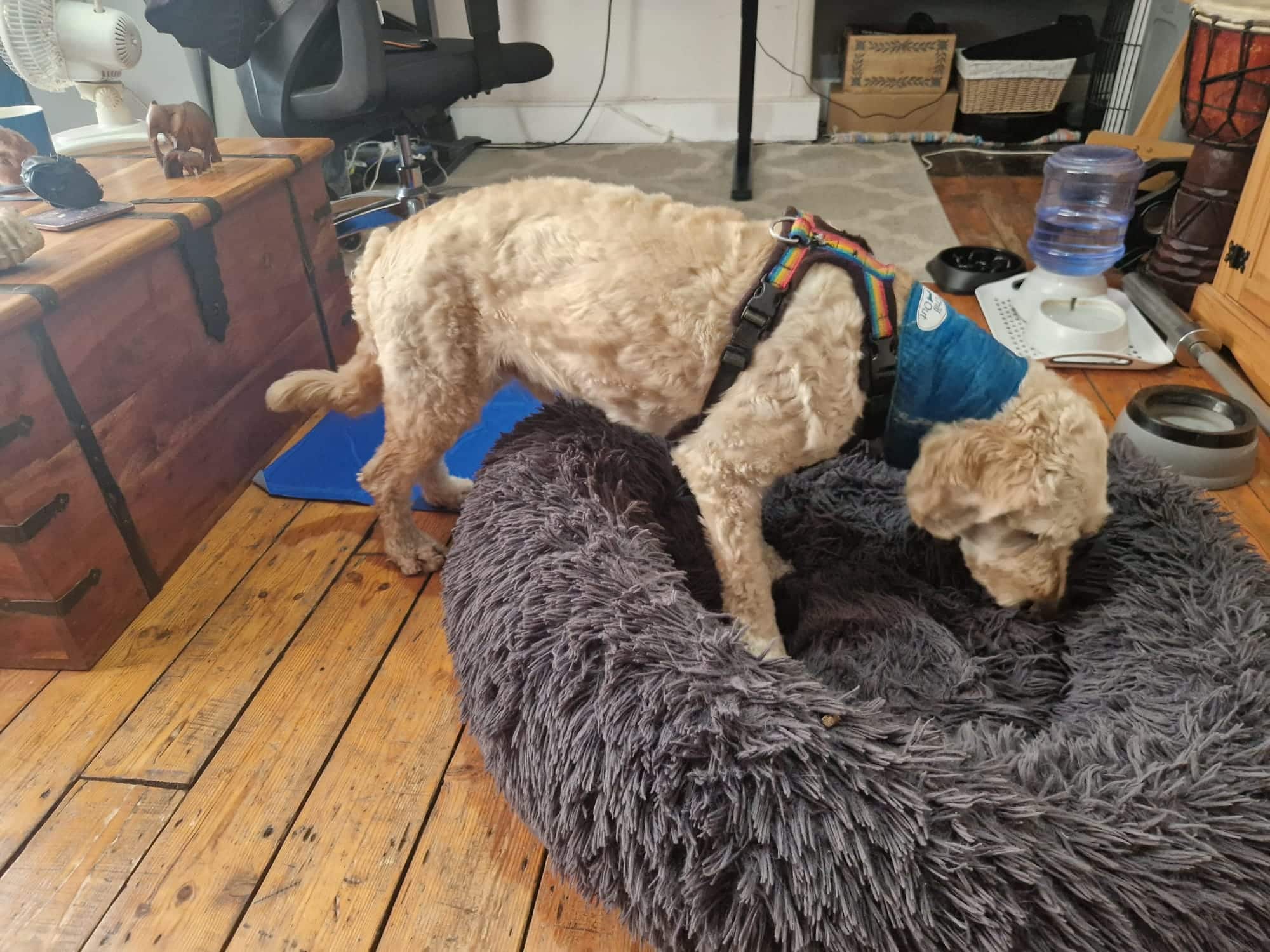
3. Make a Towel Roll
Place a few pieces of kibble or treats across an old towel.
Loosely roll the towel and allow your dog to investigate.
For beginners, keep the roll loose and leave food visible near the edges.
You can make it slightly harder as your dog becomes more confident.
Always supervise this activity.
It will not suit dogs who chew or swallow fabric.
Stop the game if your dog starts tearing pieces off the towel instead of searching for food.
4. Create a Cardboard Search Box
A cardboard search box can provide a simple sniffing-and-rummaging activity.
You will need:
- a cardboard box
- scrunched paper
- several smaller boxes or cardboard tubes
- part of your dog’s normal food
- enough floor space to supervise safely
Place food between the paper and boxes, leaving some pieces easy to find.
Allow your dog to investigate at their own pace.
Some dogs will carefully sniff through the box. Others may enjoy tearing the cardboard.
Both can be normal, but you must supervise closely and remove any pieces your dog attempts to swallow.
For full instructions, see my step-by-step guide to creating a scent box.
5. Play Hide and Seek
Ask your dog to wait with another person while you hide somewhere easy.
Call your dog and reward them when they find you.
Suitable hiding places might include:
- behind a door
- beside a sofa
- around the corner of a room
- behind a curtain that cannot become tangled
- in another room
Do not hide somewhere that encourages your dog to jump, climb dangerously or rush down slippery stairs.
If your dog finds waiting difficult, another person can gently distract them while you move away.
6. Hide a Favourite Toy
Some dogs prefer searching for toys rather than food.
Start by allowing your dog to watch you place the toy nearby.
Ask them to find it and reward them with a short game when they succeed.
You can gradually make the hiding place less obvious.
This works particularly well for dogs who have a favourite soft toy or tug toy.
Use an item that is an appropriate size and check it regularly for damage.
7. Teach a Hand Target
A hand target means teaching your dog to touch your open palm with their nose.
- Hold your open hand a few centimetres from your dog.
- When they investigate or touch it, mark the behaviour with “yes” or your usual marker.
- Give a reward.
- Repeat several times.
- Gradually move your hand to slightly different positions.
Hand targeting can become a useful everyday skill.
It can help you guide your dog without pulling or physically moving them.
Keep sessions short and stop while your dog is still enjoying the activity.
8. Practise Simple Reward-Based Training
Short training sessions can provide mental activity without requiring much space.
You could practise:
- responding to their name
- hand targeting
- going to a mat
- waiting at a doorway
- swapping an item
- looking at you
- finding a toy
- settling on a blanket
- placing paws on a low, stable object
- putting toys into a box
Use reward-based methods and avoid forcing your dog into positions.
Three minutes of calm, successful training is often more useful than a long session in which your dog becomes tired or confused.
9. Use a Stuffed Kong or Similar Toy
A correctly sized food toy can encourage licking, chewing and problem-solving.
Start with an easy filling that your dog can remove without becoming frustrated.
This may include part of their usual wet food or softened kibble.
Once your dog understands the toy, you can make it last longer by packing the food more firmly or chilling it.
A frozen toy may be useful for some dogs, but it should not be so difficult that your dog gives up or becomes agitated.
Choose the correct size and type for your dog, supervise early uses and replace damaged toys.
My complete guide to Kong toys, sizes and fillings covers this in more detail.
10. Use a Lick Mat
A lick mat can be spread with a thin layer of suitable food.
Possible options include:
- your dog’s normal wet food
- soaked and mashed kibble
- plain pumpkin
- a small amount of dog-safe yoghurt
- a suitable dog pâté
- another food approved for your dog
Check every ingredient before using it.
Avoid anything containing xylitol, onion, garlic, excessive salt or ingredients unsuitable for your individual dog.
Supervise your dog and remove the mat if they begin chewing it.
Include the food in your dog’s normal daily allowance.
11. Make a Safe Sniffing Trail
Place small pieces of food at intervals around one room.
Begin with a simple visible trail.
As your dog learns the game, leave larger gaps or place some pieces behind furniture.
Do not create a trail near:
- stairs
- electrical cables
- household chemicals
- fragile objects
- open doors
- areas where dogs may slip
You can also create a trail in a secure garden when the weather is suitable.
12. Play the Muffin Tin Game
Place a few pieces of food in the cups of a muffin tin.
Leave some cups open and loosely cover others with appropriately sized balls or safe toys.
Your dog must use their nose and paws to find the food.
Make sure the covers are too large to swallow.
Some dogs may attempt to pick up or tip the entire tray, so use it on the floor and supervise throughout.
13. Set Up a Gentle Indoor Obstacle Course
Indoor obstacle courses should focus on careful movement rather than speed.
Depending on your dog’s health and confidence, you might use:
- a line of cushions to walk around
- a wide cardboard box to step into
- a low broom handle placed on the floor
- a stable mat with a different texture
- chairs spaced widely enough to weave through
- a blanket used as a settling station
Do not encourage jumping on slippery flooring.
Avoid raised equipment, narrow spaces or unstable furniture.
This activity is not suitable for dogs on restricted exercise unless your vet has approved it.
14. Offer an Appropriate Chew
Chewing can provide dogs with a calm activity.
Choose a chew that suits your dog’s:
- size
- chewing style
- age
- dental health
- diet
- medical needs
Avoid items that are too small, extremely hard or likely to splinter.
Supervise your dog, particularly when introducing something new.
Ask your vet for advice if your dog has damaged teeth, digestive problems or a restricted diet.
15. Practise Settling
Learning to rest is a valuable skill.
Place a comfortable mat or blanket in a quiet part of the room.
Sit nearby without repeatedly talking to or touching your dog.
Calmly reward relaxed behaviour such as:
- looking away from you
- lowering their head
- lying on one hip
- sighing
- resting their chin
- remaining quietly on the mat
Do not continually ask your dog to sit, stay or watch you.
The aim is to help them discover that calm behaviour is rewarding.
The Dogs Trust guide to settle training provides a useful step-by-step starting point.
Enrichment That Does Not Involve Food
A lot of enrichment advice revolves around treats.
Food can be useful, but it is not the only option.
Non-food enrichment might include:
- hide and seek with a person
- searching for a favourite toy
- gentle tug
- brushing, if your dog enjoys it
- sniffing dog-safe objects brought in from outside
- exploring a cardboard box without food
- listening to calm sounds
- sitting together in the garden
- learning a toy’s name
- moving between different resting places
- watching the world from a safe distance
- gentle massage, if your dog enjoys being touched
- calm social time with a familiar person
Some dogs value interaction more than food.
Others prefer to investigate things independently.
Watch what your dog chooses rather than assuming every dog will enjoy the same activity.
A Simple 30-Minute Indoor Routine
You do not need to follow a complicated timetable.
Here is one example of a calm indoor session.
First five minutes: gentle engagement
Practise hand targeting, responding to your dog’s name or another familiar skill.
Keep it easy and reward frequently.
Next ten minutes: scent search
Use a towel roll, scent box or simple find-it game.
Stop before your dog becomes frantic or loses interest.
Next ten minutes: licking or chewing
Offer an appropriate filled toy, lick mat or chew.
Place it in a quiet area and allow your dog space.
Final five minutes: settle
Reduce activity and encourage your dog to relax on a comfortable bed or blanket.
The exact timing does not matter.
Some dogs will be satisfied after ten minutes. Others may prefer several short sessions across the day.
What to Do When It Is Too Hot to Walk
Hot weather is one of the main reasons a walk may need to be shortened or replaced.
Do not try to reproduce the intensity of a normal walk by encouraging vigorous indoor exercise in a hot room.
Focus on calm activities instead.
Suitable options may include:
- simple find-it games
- scatter feeding
- a lightly filled food toy
- a lick mat
- brief reward-based training
- quiet chewing
- calm company
- a toilet break where safe
- access to a cool resting place
- fresh drinking water
Avoid repetitive indoor fetch, frantic tug or anything that causes heavy panting.
Dogs can become dangerously unwell through heat and exercise. Read the RSPCA’s advice on recognising heatstroke in dogs and contact a vet urgently if you suspect your dog is overheating.
Signs that require immediate attention can include:
- heavy or unusual panting
- difficulty breathing
- excessive drooling
- weakness
- confusion
- wobbling
- vomiting
- collapse
Do not wait for a dog to display every possible symptom before seeking help.
Enrichment for Dogs Recovering From Injury
Always follow the restrictions provided by your vet or veterinary physiotherapist.
“Rest” can mean different things depending on the condition.
One dog may be allowed short lead walks. Another may need strict restriction.
Possible low-movement activities, where approved, include:
- food delivered through an easy puzzle
- a lick mat
- a simple stuffed toy
- scent pots placed within easy reach
- very short training sessions
- learning to rest on a mat
- calmly identifying different toys
- supervised cardboard investigation
- gentle grooming
- quiet companionship
Do not make food puzzles unnecessarily difficult.
A dog who is uncomfortable, wearing a collar or recovering from anaesthetic may find normal activities much harder.
The Blue Cross guide to caring for a dog on cage rest contains additional practical suggestions.
Contact your vet if your dog appears in pain, distressed, unusually restless, or unable to settle.
Enrichment for Puppies
Puppies need a balance of:
- short appropriate outings
- gentle exploration
- social learning
- play
- reward-based training
- food
- toilet breaks
- plenty of sleep
A tired puppy is not always an under-exercised puppy.
They may be overtired and unable to settle.
Keep enrichment simple.
Suitable puppy activities can include:
- easy food searches
- responding to their name
- following a hand target
- exploring different safe textures
- finding a visible toy
- gentle chewing
- short play sessions
- settling on a blanket
Avoid long sessions and activities involving repeated jumping or sharp turns.
My puppy visits in Finchley can include toilet breaks, gentle play, feeding, enrichment and support with your puppy’s normal routine.
Enrichment for Older Dogs
Senior dogs still benefit from mental stimulation, but activities may need to be adapted.
Consider:
- softer flooring
- larger food pieces that are easy to locate
- shallow boxes
- familiar games
- shorter sessions
- easy puzzles
- slower scent trails
- comfortable resting places
- avoiding stairs and slippery surfaces
Changes in sight, hearing, mobility or cognitive function may affect how your dog approaches an activity.
Do not assume that hesitation is stubbornness.
If your older dog suddenly appears confused, restless, reluctant to move or unable to complete familiar tasks, speak to your vet.
Enrichment for Nervous and Rescue Dogs
Choice matters.
A nervous dog should be allowed to approach an activity in their own time.
Avoid:
- pushing objects towards them
- surrounding them with unfamiliar items
- noisy puzzles
- narrow spaces
- moving boxes while they are investigating
- reaching into their space
- making the activity increasingly difficult too quickly
Start with one or two objects in a quiet area.
Place food where it is easy to reach and then step back.
Some nervous dogs may initially prefer to watch or sniff from a distance.
That is still information gathering.
My guide to calm rescue dog support in Finchley explains how I work at each dog’s pace without group walks, vans or pressure.
Common Enrichment Mistakes
Making the activity too difficult
Enrichment should involve some thought, but it should not leave your dog repeatedly failing.
If your dog walks away, barks at the puzzle, bites it forcefully or looks to you for constant help, make it easier.
Adding too many calories
Food used in puzzles, searches and training still counts.
Use part of your dog’s normal meal where practical.
Speak to your vet if your dog needs to lose weight or follows a specialist diet.
Assuming food is the only reward
Dogs may also value:
- play
- sniffing
- access to the garden
- your attention
- a favourite toy
- quiet time
- the opportunity to explore
Creating too much excitement
The goal is not always to make your dog faster or more animated.
Frantic games can leave some dogs more aroused than before.
Mix active games with licking, chewing and settling.
Using unsafe household objects
Do not assume an object is safe simply because it is commonly used in online enrichment videos.
Supervise activities involving:
- cardboard
- paper
- towels
- plastic containers
- muffin tins
- bottles
- boxes
- food toys
Remove anything your dog begins to swallow or destroy dangerously.
Leaving dogs unsupervised
A toy that is safe for one dog may not be safe for another.
Supervise new activities until you understand how your dog uses the item.
Expecting enrichment to solve a medical or behavioural problem
Restlessness can have many causes, including:
- pain
- digestive discomfort
- anxiety
- fear
- separation-related distress
- itching
- urinary problems
- cognitive changes
- medication side effects
- an unsuitable routine
Enrichment may support your dog, but it is not a substitute for diagnosis or professional treatment.
When Should You Contact Your Vet?
Speak to your vet if your dog:
- suddenly refuses to walk
- cannot settle despite being normally calm
- pants when the room is not warm
- repeatedly changes position
- cries, trembles or appears uncomfortable
- begins pacing at night
- seems weak or uncoordinated
- loses interest in food
- becomes unusually reactive
- shows a sudden change in behaviour
- is recovering from an injury and appears worse
- may be overheating
You can also read my guide on what to do when your dog refuses to walk.
For serious fear, anxiety, aggression or repeated behavioural difficulties, seek help from your vet and a suitably qualified reward-based behaviour professional.
Canine Enrichment Visits in Finchley
There are occasions when your dog may benefit more from a calm home visit than a long midday walk.
My canine enrichment visits in Finchley can be adapted to your dog’s routine and may include:
- a short toilet break
- fresh drinking water
- feeding
- agreed medication
- a scent game
- a food puzzle
- calm play
- gentle reward-based practice
- garden time
- quiet company
- a welfare check
- an update after the visit
These visits can be particularly useful for:
- dogs affected by hot weather
- puppies
- senior dogs
- nervous dogs
- rescue dogs
- dogs who do not cope well with groups
- dogs recovering from illness where appropriate
- owners who need temporary support
I also provide calm solo dog walks in Finchley and Muswell Hill for dogs who benefit from walking alone, directly from their own home.
There are no vans, crates or group collections.
Each service is based around the individual dog rather than trying to fit every dog into the same routine.
You can contact Del with your postcode and a brief description of your dog if you would like to discuss which service may be suitable.
Useful Equipment for Indoor Enrichment
You do not need to buy lots of equipment.
Many activities can be created using your dog’s normal food, a towel or a cardboard box.
Items that may be useful include:
- an appropriately sized food toy
- a lick mat
- a snuffle mat
- a treat pouch
- washable activity mats
- suitable chew toys
- food storage containers
- a non-slip mat
Choose products according to your dog’s size, chewing style and individual needs.
You can see the dog products I use and recommend for practical suggestions.
Frequently Asked Questions
Is it all right if my dog misses one walk?
For most healthy adult dogs, missing or shortening an occasional walk because of unsafe weather, illness or another genuine reason should not be a problem.
Provide toilet opportunities, calm mental stimulation and appropriate interaction.
Contact your vet for advice if your dog has specific medical or behavioural needs.
Can mental stimulation tire a dog?
Mental activities can help dogs feel satisfied and settled.
Searching, sniffing, learning and problem-solving all require concentration.
However, mental stimulation should form part of a balanced routine rather than replacing all physical exercise.
How long should an enrichment session last?
There is no single correct length.
Start with a few minutes and observe your dog.
Finish before they become frustrated, frantic or disengaged.
Several short sessions are often better than one long session.
Is sniffing tiring for dogs?
Sniffing gives dogs information about their surroundings and requires concentration.
A slow-sniffing walk or scent game can be mentally satisfying, but claims that a fixed number of minutes of sniffing always equals a particular length of physical exercise should be treated with caution.
Every dog is different.
What can I do if my dog is not interested in food?
Try:
- searching for a favourite toy
- gentle tug
- hide and seek with a person
- sniffing safe objects
- learning toy names
- exploring boxes
- calm garden time
- grooming or massage if your dog enjoys it
A sudden loss of appetite should be discussed with your vet.
Why is my dog still restless after a long walk?
The walk may have been overly stimulating, stressful or lacking in opportunities to sniff.
Your dog may also be overtired, uncomfortable, anxious or expecting constant activity.
Look at the whole routine rather than simply increasing the distance.
Contact your vet if the restlessness is new or unusual.
Can I use enrichment while my dog is on veterinary rest?
Possibly, but you must follow your vet’s restrictions.
Even simple games can involve twisting, standing, pulling or sudden movement.
Ask which activities are safe for your dog’s particular condition.
What should I do when it is too hot to walk?
Prioritise safety.
Depending on the conditions and your dog, this may mean a brief toilet break, fresh water, a cool resting area and calm indoor enrichment instead of a normal walk.
Read my Summer Dog Safety Guide and seek veterinary help immediately if you suspect heatstroke.
Final Thoughts
A satisfying day does not always require a long walk.
Dogs benefit from a balance of physical movement, sniffing, problem-solving, interaction and rest.
On days when a normal walk is not safe or possible, keep things simple.
Use part of your dog’s meal for an easy search.
Practise a familiar skill.
Offer an appropriate chew or food toy.
Then give your dog time to relax.
Watch the dog in front of you rather than trying to follow a rigid formula.
Some dogs will enjoy a scent box.
Others will prefer five minutes of searching followed by a long sleep.
The best enrichment is safe, achievable and suited to your individual dog.


