Updated August 2026
Dogs do not always bark, growl or run away when they feel uncomfortable.
Earlier signs can be much quieter.
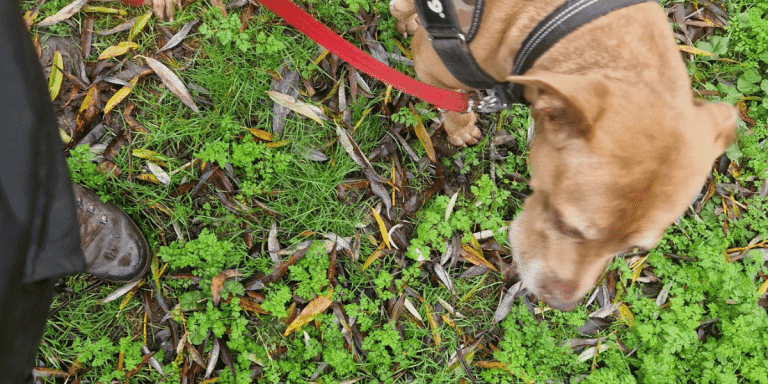
A dog may turn their head away, lick their lips, yawn, scratch or begin sniffing the ground. These actions can be easily missed or dismissed because they also occur as part of normal behaviour.
The context matters.
A dog yawning after waking is probably tired. A dog yawning repeatedly while an unfamiliar person leans over them may be communicating uncertainty or stress.
Learning to notice these quieter signals can help you respond before your dog feels the need to escalate their behaviour.
Summary
- Yawning, lip-licking, scratching, shaking off, and sudden sniffing can sometimes appear when a dog feels uncertain or conflicted.
- These actions are often described as displacement behaviours when they occur outside their usual context.
- One signal alone does not prove that a dog is stressed.
- Look at the whole dog, what happened beforehand and whether the behaviour stops when more space is provided.
- Repeated or sudden behavioural changes may also have a medical cause and should be discussed with your vet.
Affiliate disclosure: This guide contains affiliate links to carefully selected books. If you buy something through one of these links, I may receive a small commission at no additional cost to you. As an Amazon Associate, I earn from qualifying purchases. Books provide general education and do not replace veterinary or individual behavioural advice.
Table of contents
- Summary
- What Is a Displacement Behaviour?
- Displacement Behaviours Are Normal Behaviours
- What Is the Difference Between Stress Signals and Displacement Behaviours?
- How Context Changes the Meaning
- Look for Clusters of Signals
- Notice What Happened Before the Behaviour
- Notice What Happens Afterwards
- How Should You Respond?
- Displacement Behaviours During Training
- Displacement Behaviours During Greetings
- Displacement Behaviours During Walks
- Displacement Behaviours and Trigger Stacking
- When Behaviour May Have a Medical Cause
- My Experience Reading Subtle Behaviour
- How One-to-One Walks Can Help
- When to Contact Your Vet
- When to Seek Accredited Behaviour Support
- Related Guides
- Frequently Asked Questions
- What is a displacement behaviour in dogs?
- Does yawning mean my dog is stressed?
- Why does my dog lick their lips when I stroke them?
- Is sudden sniffing a stress signal?
- Why does my dog shake when they are not wet?
- Should I stop interacting when my dog turns away?
- Should I punish stress signals?
- When should I contact my vet?
- Final Summary
- Veterinary and Behaviour Disclaimer
- Incoming Internal Links to Add
What Is a Displacement Behaviour?
A displacement behaviour is a normal action that occurs in situations where it may seem unrelated to what is happening.
A dog may perform the behaviour when they experience:
- Uncertainty
- Conflict
- Frustration
- Social pressure
- Excitement
- Stress
- Difficulty deciding what to do
For example, your dog may want to investigate a visitor but also feel worried about approaching them.
Rather than moving directly forwards or retreating, the dog might:
- Turn away
- Sniff the floor
- Lick their lips
- Scratch
- Shake off
- Yawn
The behaviour may provide a brief interruption while the dog processes the situation.
It does not automatically mean the dog is frightened, and it should not be interpreted without context.
My Dog Behaviour, Body Language and Emotional Wellbeing Hub explains why individual signals must be considered as part of the dog’s complete body language.
Displacement Behaviours Are Normal Behaviours
Most potential displacement behaviours also have an ordinary physical purpose.
Dogs:
- Yawn when tired
- Lick their lips around food
- Scratch when itchy
- Shake after becoming wet
- Sniff because scent is important to them
- Stretch after resting
- Groom themselves
- Look away to observe something else
The behaviour becomes more significant when it appears:
- Repeatedly
- Suddenly
- During a socially difficult moment
- When the normal physical reason is absent
- Alongside other signs of tension
- Immediately after something changes
- When someone moves closer
- During unwanted handling
- Before barking, growling or retreating
Do not treat a single yawn or scratch as proof of anxiety.
Look for patterns and clusters of behaviour.
What Is the Difference Between Stress Signals and Displacement Behaviours?
The two terms overlap.
A stress signal is any behavioural or physical change that may occur when a dog is experiencing pressure, discomfort or increased arousal.
A displacement behaviour is a normal action that appears in an apparently unrelated situation, often during periods of uncertainty or conflict.
For practical dog care, the most important questions are:
- What happened immediately beforehand?
- What does the rest of the dog’s body look like?
- Does the behaviour repeat?
- Does it stop when the dog receives more space?
- Can the dog move away?
- Are there possible medical causes?
You do not need to label every movement perfectly before helping your dog.
If your dog appears uncomfortable, pause and make the situation easier.
Lip Licking
Dogs naturally lick their lips:
- Around food
- After drinking
- After eating
- When something is on their face
- During grooming
Lip licking may also appear when a dog is:
- Worried
- Anticipating something
- Conflicted
- Nauseous
- Experiencing dental discomfort
- Being approached
- Uncomfortable with handling
Stress-related lip licking may be:
- Quick
- Repeated
- Directed towards the nose
- Accompanied by turning away
- Seen when food is not present
- Triggered by someone moving closer
Dogs Trust lists lip licking as a possible sign that a dog may be worried or uncomfortable. Read its guide to recognising stress, fear and frustration in dogs.
Repeated lip licking can also have a medical cause.
Contact your vet if it is accompanied by:
- Excessive salivation
- Difficulty eating
- Dropping food
- Vomiting
- Pawing at the mouth
- Bad breath
- Facial swelling
- Loss of appetite
Yawning
A dog may yawn because they are:
- Tired
- Waking up
- Settling down
- Relaxing after activity
Yawning may also appear during:
- Training
- Grooming
- Veterinary handling
- Close human interaction
- An unfamiliar situation
- Frustration
- Social uncertainty
- Overstimulation
Consider a dog who yawns repeatedly while a child hugs them.
The yawning should not be dismissed as tiredness without considering:
- Whether the dog can move away
- Their ear position
- Facial tension
- Whether they turn their head
- Whether their body becomes still
- What happens when the hug stops
Children should never be encouraged to hug or climb on dogs.
Read Dogs and Children: Keeping Children Safe Around Dogs.
Sudden Sniffing
Sniffing is one of the most natural and important canine behaviours.
A dog stopping to investigate a scent during a walk is not necessarily avoiding you or feeling stressed.
However, sudden or apparently frantic sniffing may sometimes appear when a dog is uncertain.
For example, your dog may begin sniffing when:
- Another dog approaches
- A person reaches towards them
- They are called into a difficult situation
- They are unsure whether to approach
- Social pressure increases
- They want to disengage
Sniffing can allow a dog to turn their head away and avoid direct eye contact.
Do not assume every sniff is a displacement behaviour. Look at:
- What happened first
- The intensity of the sniffing
- Whether the dog can disengage
- Whether their body is loose or tense
- Whether the behaviour changes with distance
Appropriate sniffing should remain an important part of normal walks.
Read Sniff and Decompression Walks.
Scratching
Dogs scratch for ordinary physical reasons, including:
- An itch
- Allergies
- Parasites
- Skin irritation
- Something caught in the coat
- Ear discomfort
Scratching may also briefly occur when a dog is:
- Uncertain
- Frustrated
- Interrupted
- Conflicted
- Experiencing social pressure
A dog might sit down and scratch when asked to approach something they find difficult.
Do not assume that repeated scratching is behavioural.
Contact your vet if you notice:
- Frequent scratching
- Red skin
- Hair loss
- Sore areas
- Head shaking
- Ear discharge
- Broken skin
- Persistent licking
- Sudden changes
My Dog Health and First Aid Hub explains why behavioural observations should be considered alongside physical health.
Shaking Off
Dogs naturally shake their bodies when wet.
They may also shake after:
- Sleeping
- Wearing clothing
- Removing a harness
- Rolling on the ground
- Physical activity
A full-body shake may also appear after a moment of social pressure or excitement.
You might notice a dog shake after:
- An unfamiliar person stops touching them
- Another dog moves away
- Grooming finishes
- They leave a veterinary examination
- A close encounter ends
- They return home from a stimulating walk
The shake alone does not tell you exactly how the dog felt.
Consider what happened beforehand and whether other signs of tension were present.
Looking or Turning Away
Turning the head away can help a dog reduce the intensity of an interaction.
It may occur when:
- Someone faces the dog directly
- A hand reaches towards them
- A camera is held close
- A child moves towards them
- Another dog stares
- The dog is being hugged
- A person leans over them
Turning away should not be interpreted as an invitation to follow the dog’s face with your hand.
Pause and allow the dog to decide whether they want to re-engage.
Read Does My Dog Want to Be Petted?.
Blinking and Narrowing the Eyes
A relaxed dog may blink normally or rest with its eyes partly closed.
Rapid blinking or narrowing the eyes may sometimes appear during:
- Close interaction
- Direct staring
- Uncertainty
- Anticipation
- Handling
- Discomfort
Eye changes must be considered carefully because squinting can also indicate:
- Injury
- Pain
- Irritation
- A foreign object
- An eye condition
Contact your vet promptly if your dog:
- Keeps one eye closed
- Has redness or discharge
- Rubs their face
- Develops swelling
- Appears sensitive to light
- Shows sudden eye discomfort
Eye problems can deteriorate quickly and should not be treated solely as a matter of body language.
Paw Lifting
A dog may lift a paw because they are:
- Preparing to move
- Pointing
- Offering a trained behaviour
- Expecting a reward
- Uncertain
- Physically uncomfortable
Repeated paw lifting may also indicate:
- A cut
- A grass seed
- A broken nail
- Pad damage
- Joint pain
- Another injury
Check the situation without repeatedly manipulating a painful limb.
Contact your vet if the paw lifting continues or the dog appears lame.
Stretching and Play Bows
Dogs stretch after resting and use play bows during social play.
A stretch-like movement can sometimes occur during uncertainty or after social pressure, but it must be distinguished from:
- Normal stretching
- An invitation to play
- Abdominal discomfort
- A repeated prayer position
Seek urgent veterinary advice if your dog repeatedly lowers their front end while keeping their back end raised and also appears:
- Painful
- Restless
- Bloated
- Unwell
- Unable to settle
- Off their food
- Vomiting or retching
Do not assume repeated unusual stretching is behavioural.
Freezing Is Not a Displacement Behaviour to Ignore
Freezing is a significant signal.
A frozen dog may:
- Stop moving
- Become very still
- Close their mouth
- Stare
- Hold their breath
- Shift their weight backwards
- Become tense through the face and body
Freezing may indicate that the dog feels trapped, frightened, conflicted or physically unable to continue.
If your dog freezes:
- Stop moving towards the trigger.
- Do not pull or drag them.
- Give them space.
- Look for a safe route away.
- Prevent other people from approaching.
- End the interaction if necessary.
Read Dog Stress and Threshold Signs.
How Context Changes the Meaning
The same behaviour can mean different things in different situations.
Example one: yawning
Your dog yawns while settling into bed after a long day.
Tiredness is a likely explanation.
Your dog repeatedly yawns while a visitor bends over them and reaches for their head.
Uncertainty or social pressure should be considered.
Example two: lip licking
Your dog licks their lips while waiting for dinner.
Food anticipation is a likely explanation.
Your dog repeatedly licks their lips while their harness is fastened.
Handling discomfort, fear, or pain should be considered.
Example three: sniffing
Your dog spends several minutes investigating a lamppost.
This is normal canine scent exploration.
Your dog suddenly presses their nose to the ground when another dog approaches directly.
They may be gathering scent, attempting to disengage or responding to social pressure.
Look for Clusters of Signals
One subtle action provides limited information.
A combination is more significant.
For example, your dog may:
- Turn away
- Lick their lips
- Lower their body
- Close their mouth
- Move backwards
Together, these signals suggest that the dog may be uncomfortable and need space.
Another dog may:
- Yawn
- Shake off
- Sniff
- Take food gently
- Continue with a loose body
This dog may be processing mild excitement while remaining able to cope.
Avoid using a rigid checklist to diagnose emotion. Observe the complete sequence.
Notice What Happened Before the Behaviour
Ask:
- Who approached?
- Did someone reach towards the dog?
- Did another dog stare?
- Was the dog prevented from moving away?
- Did a loud noise occur?
- Was equipment being put on?
- Was the dog resting?
- Was food present?
- Did someone touch a sensitive area?
- Was the environment crowded?
- Had the dog already experienced several triggers?
Behaviour is easier to understand when viewed as part of an event rather than as an isolated photograph.
Notice What Happens Afterwards
The response following the behaviour can provide additional information.
Does your dog:
- Relax when the person steps back?
- Move away when given space?
- Return voluntarily?
- Continue to withdraw?
- Escalate to barking or growling?
- Resume normal sniffing?
- Remain tense?
- Struggle to settle later?
If providing more space helps your dog relax, the previous interaction may have been too intense.
How Should You Respond?
Pause the Interaction
Stop what you are doing for a moment.
Do not keep reaching, calling or moving closer while trying to decide what the signal means.
Give Your Dog Space
Allow your dog to:
- Move away
- Turn around
- Change position
- Return to their bed
- Stand behind you
- Leave the room
- Choose whether to re-engage
Read Giving Dogs Choice and Control.
Reduce the Difficulty
You might:
- Increase distance
- Shorten the interaction
- Move to a quieter place
- Stop touching
- Remove an unfamiliar object
- Ask a visitor to sit down
- End the training session
- Choose an easier walking route
Avoid Punishment
Do not correct your dog for:
- Looking away
- Refusing contact
- Moving off
- Barking
- Growling
- Attempting to hide
Punishment may add further stress and discourage the use of useful warning signals.
Record Repeated Patterns
A simple diary may help you identify that your dog lip licks, yawns or scratches:
- Around a particular person
- During harness fitting
- Near other dogs
- Before refusing to walk
- During grooming
- When tired
- After several stressful experiences
This information may help your vet or behaviour professional.
Displacement Behaviours During Training
A dog who yawns, scratches or walks away during training may be:
- Tired
- Confused
- Frustrated
- Distracted
- Worried about the environment
- Physically uncomfortable
- Losing interest
Do not automatically describe the dog as stubborn.
Try:
- Making the exercise easier
- Rewarding an earlier step
- Reducing distractions
- Giving the dog a break
- Moving to a quieter area
- Ending the session
Dogs Trust explains that reward-based training helps dogs learn without fear or intimidation.
Displacement Behaviours During Greetings
Greeting an unfamiliar dog can involve considerable social pressure.
A dog may:
- Turn away
- Sniff
- Move in a curve
- Pause
- Lick their lips
- Shake off afterwards
- Choose not to approach
Do not pull dogs together for a nose-to-nose greeting.
Read How to Greet a Dog Properly.
Not every dog needs to greet unfamiliar dogs. A calm pass at a comfortable distance may be the better outcome.
Displacement Behaviours During Walks
During one-to-one walks, I watch for changes such as:
- Sniffing becoming frantic
- Repeated shaking off
- Sudden scratching
- Turning away
- Slowing down
- Refusing food
- Freezing
- Pulling towards home
These may indicate that the environment has become too difficult.
I may respond by:
- Increasing distance
- Changing direction
- Using a visual barrier
- Choosing a quieter route
- Allowing a pause
- Returning home early
A shorter manageable walk is more useful than forcing a dog through an environment where they can no longer cope.
Displacement Behaviours and Trigger Stacking
A dog may show more subtle signs of stress when several events accumulate.
For example:
- The dog slept poorly
- Building work began outside
- A delivery driver knocked
- An unfamiliar dog approached
- A child then attempted to stroke them
The final lip lick, freeze, or growl should be considered in the context of the entire day.
Read How Long Dogs May Need to Recover After Stress.
When Behaviour May Have a Medical Cause
Repeated yawning, licking, scratching or shaking can have physical causes.
Contact your vet if you notice:
- Sudden behaviour changes
- Excessive lip licking
- Drooling
- Difficulty eating
- Repeated scratching
- Sore skin
- Hair loss
- Frequent head shaking
- Ear discharge
- Persistent paw lifting
- Lameness
- Squinting
- Eye discharge
- Unusual stretching
- Vomiting
- Reduced appetite
- Restlessness
- Sensitivity to touch
Pain and illness can also reduce a dog’s tolerance and alter their body language.
Read Can Pain Change a Dog’s Behaviour?.
My Experience Reading Subtle Behaviour
I have worked professionally with dogs since 2011, including nervous and rescue dogs who do not always show their discomfort through dramatic behaviour.
A dog may not bark or growl.
They may simply:
- Stop sniffing naturally
- Turn their head
- Slow down
- Close their mouth
- Shake off
- Move behind me
- Refuse to continue
Noticing those changes allows me to adjust the walk before the dog becomes overwhelmed.
I do not need to wait for a full reaction to decide that a dog needs more space.
How One-to-One Walks Can Help
Group walks and vehicle collections can make subtle signals harder to notice.
My walks are one-to-one and begin at the dog’s home. I do not use cars, vans or groups of unrelated dogs.
Working with one dog allows me to adjust:
- The route
- The pace
- Distance from triggers
- Time spent sniffing
- The length of the walk
- The number of interactions
- When we turn around
- When we return home
I provide one-to-one walks in Finchley, East Finchley, North Finchley, Finchley Central, Muswell Hill and selected nearby areas.
I do not diagnose behaviour or medical conditions. Where a dog shows new or concerning changes, I will recommend that the owner speak to their vet.
[CTA BUTTON: Ask Del About Calm One-to-One Dog Walks]
Read about my one-to-one walks for nervous and reactive dogs.
When to Contact Your Vet
Speak to your vet if:
- The behaviour appears suddenly
- The behaviour becomes frequent
- Your dog appears in pain
- Eating or drinking changes
- Sleep changes
- Toileting changes
- Your dog becomes sensitive to touch
- They develop unusual aggression
- They repeatedly refuse walks
- They cannot settle
- You notice physical symptoms
The RSPCA advises owners to seek veterinary advice when a dog’s behaviour changes or when they regularly show signs of stress or fear. Read its guidance about understanding dog behaviour.
When to Seek Accredited Behaviour Support
Professional help may be appropriate when your dog:
- Shows persistent fear
- Regularly freezes
- Growls or snaps
- Has bitten
- Panics during handling
- Cannot cope with normal daily situations
- Becomes increasingly reactive
- Presents a risk to people or animals
Begin with your vet.
The Animal Behaviour and Training Council practitioner directory can help you find appropriately assessed behaviour professionals.
Related Guides
- Dog Behaviour and Body Language Hub
- Dog Stress and Threshold Signs
- Giving Dogs Choice and Control
- Does My Dog Want to Be Petted?
- How to Greet a Dog Properly
- Dogs and Children
- How Long Dogs Need to Recover After Stress
- Can Pain Change a Dog’s Behaviour?
Frequently Asked Questions
What is a displacement behaviour in dogs?
It is a normal behaviour, such as yawning or scratching, that appears in an apparently unrelated situation, often during uncertainty, frustration or conflict.
Does yawning mean my dog is stressed?
Not always. Dogs also yawn when tired. Consider what happened immediately before the yawn and look at the rest of your dog’s body.
Why does my dog lick their lips when I stroke them?
They may be anticipating food, physically uncomfortable or uncertain about the contact. Pause and see whether they choose to re-engage.
Is sudden sniffing a stress signal?
It can sometimes occur in periods of uncertainty, but sniffing is also a normal and important canine behaviour. Context is essential.
Why does my dog shake when they are not wet?
Dogs may shake after rest, excitement, handling or social pressure. Repeated shaking may also have a medical cause.
Should I stop interacting when my dog turns away?
Pause and give them space. If they return voluntarily with relaxed body language, they may want the interaction to continue.
Should I punish stress signals?
No. Punishment can increase stress and discourage constructive communication.
When should I contact my vet?
Contact your vet when the behaviour is new, frequent, accompanied by physical symptoms, or associated with changes in eating, movement, sleep, or handling.
Final Summary
Yawning, lip licking, scratching, shaking off and sudden sniffing can all be normal.
They can also appear when a dog feels uncertain, conflicted or under pressure.
Do not diagnose your dog from one isolated signal.
Instead:
- Look at the whole dog
- Consider the context
- Notice what happened beforehand
- Pause the interaction
- Provide more space
- Record repeated patterns
- Consider possible medical causes
- Seek qualified help when needed
Learning to recognise subtle changes can help you respond before your dog needs to bark, growl, snap or escape.
Return to the Dog Behaviour, Body Language and Emotional Wellbeing Hub.
[BACK-TO-TOP BUTTON]
Veterinary and Behaviour Disclaimer
This guide provides general educational information. It does not diagnose stress, anxiety, pain or illness.
Yawning, licking, scratching, shaking and changes in movement may have medical causes. Contact your vet when a behaviour appears suddenly, becomes frequent or is accompanied by physical symptoms.
Where there is severe fear, aggression, snapping, biting or a risk to people or animals, seek prompt advice from your vet and an appropriately accredited behaviour professional.
Incoming Internal Links to Add
Add links from:
- Dog Behaviour and Body Language Hub
Anchor: dog displacement behaviours - Dog Stress and Threshold Signs
Anchor: subtle displacement behaviours - Does My Dog Want to Be Petted?
Anchor: lip licking, yawning and turning away - How to Greet a Dog Properly
Anchor: early signs that a dog needs more space - Dogs and Children
Anchor: subtle signs that a dog is uncomfortable - Giving Dogs Choice and Control
Anchor: recognising when a dog wants to disengage - Why Dogs React Differently on a Lead
Anchor: early displacement and stress behaviours - How Long Dogs Need to Recover After Stress
Anchor: subtle signs that stress is continuing - Can Pain Change a Dog’s Behaviour?
Anchor: when apparent stress signals may have a medical cause
Recommended next review: August 2027.