There’s something about mud that some dogs find irresistible.
You can spend ages choosing a nice, relatively clean path through the woods. Your dog will then find the one muddy patch you missed and head straight for it.
Some dogs delicately step around puddles. Others appear to consider them an invitation.
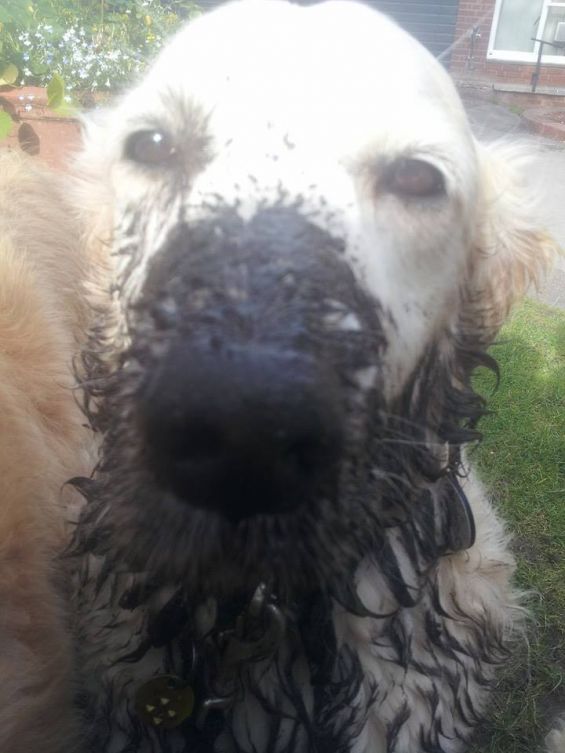
And then there are the dogs who come home looking as though they’ve been excavating a particularly difficult archaeological site.
I’ve been walking dogs professionally around Finchley and Muswell Hill since 2011, and muddy walks are part of the job, particularly during autumn and winter.
Places such as Coldfall Wood, Highgate Wood and Cherry Tree Wood can become extremely muddy after prolonged rain.
The good news is that a bit of mud is not usually a problem for a healthy dog.
The important things are keeping walks safe, checking paws afterwards and cleaning your dog without turning every muddy outing into a full bath.
Summary: Muddy dog walks
- Most healthy dogs can enjoy muddy walks when the conditions are safe.
- Check for slippery ground, deep mud, contaminated water and hidden hazards.
- Use a towel or lukewarm water to remove mud from paws and coats.
- Dogs don’t usually need shampoo after every muddy walk.
- Always check between toes, around paw pads and beneath collars or harnesses.
- Dry your dog thoroughly, particularly around skin folds and areas where the coat stays damp.
- Introduce paw cleaning gradually if your dog dislikes handling.
- Persistent redness, limping, excessive licking or painful paws require veterinary advice.
Table of contents
- Summary: Muddy dog walks
- Is it safe for dogs to walk in mud?
- Can muddy puddles make dogs ill?
- How do you clean muddy dog paws after a walk?
- Does your dog need a bath after every muddy walk?
- How do you dry a dog after a muddy walk?
- What about dogs with long or curly coats?
- My dog hates having muddy paws cleaned. What can I do?
- Do you need a special dog paw-cleaning gadget?
- How can you stop muddy paw prints covering your house?
- Should dogs wear waterproof boots in muddy weather?
- Muddy walks with older dogs
- Muddy walks with puppies and rescue dogs
- Frequently asked questions about muddy dogs
- My approach to muddy dog walks in Finchley
- Related guides
- About the author
- Veterinary disclaimer
Is it safe for dogs to walk in mud?
Generally, yes.
Walking through ordinary mud isn’t automatically harmful to a healthy dog.
In fact, muddy woodland walks can provide plenty of interesting smells, opportunities to explore and a change from walking along pavements.
But the ground conditions matter.
A shallow muddy patch on a familiar path is very different from deep mud, flooding or standing water in an area where contamination may be present.
When I’m walking dogs, I look at:
- Whether the ground is slippery or unstable.
- How deep the mud appears.
- Whether water is flowing or standing.
- The dog’s age, health and mobility.
- Whether the dog is comfortable continuing.
- Whether there are hidden objects or other hazards.
I don’t believe a dog needs to come home spotless to have enjoyed a good walk.
But I also don’t believe every puddle needs investigating.
Sometimes choosing a different path is simply the sensible option.
For more advice about wet-weather walks, read my Walking Your Dog in the Rain guide.
Can muddy puddles make dogs ill?
Some can.
The main concern isn’t ordinary mud itself but what may be mixed into the water or soil.
Standing water can sometimes be contaminated with animal urine, bacteria, chemicals or other harmful substances.
Leptospirosis and contaminated water
Leptospirosis is a bacterial infection that can affect dogs and humans.
Dogs may become infected through contact with contaminated water or soil, particularly where infected animals such as rats have been present.
The PDSA’s guide to leptospirosis in dogs explains the risks and the importance of appropriate vaccination.
I wouldn’t suggest that every muddy puddle contains dangerous bacteria.
It doesn’t.
But I would avoid letting dogs drink from stagnant puddles, drains, floodwater, or other water of uncertain quality.
If your dog becomes unwell after possible exposure to contaminated water, contact your vet and explain where they’ve been.
Ask your vet about the appropriate vaccination schedule for your dog.
Deep mud and hidden hazards
Mud can also conceal problems that are easier to spot on a dry path.
These might include:
- Broken glass or discarded rubbish.
- Sharp stones or branches.
- Deep holes or uneven ground.
- Slippery tree roots.
- Areas where a dog could become stuck.
- Floodwater with an unknown depth.
A dog moving through deep mud may struggle to maintain their footing.
Older dogs, dogs with mobility problems and those recovering from injury may need a different route.
I would rather change a walk than risk an injury simply to complete the usual circuit.
How do you clean muddy dog paws after a walk?
You don’t need anything particularly complicated.
For most dogs, an old towel and some clean lukewarm water are enough.
Here is the routine I recommend.
Step 1: Prepare before you leave
If rain is forecast or your usual walking route is muddy, put a towel near the entrance before going out.
You might also want:
- A washable doormat.
- A shallow bowl or container of clean water.
- A soft, clean cloth.
- A dry towel for finishing.
- A few suitable treats if your dog is learning to accept paw handling.
Having everything ready means you won’t be searching for a towel while your dog happily decorates the hallway.
Step 2: Let your dog settle
Some dogs come home from a walk ready for a drink and a snooze.
Others are still excited.
If your dog is bouncing around, give them a little time to settle before grabbing their paws.
Choose a comfortable, non-slip place for cleaning.
I prefer a calm routine that your dog can predict.
Step 3: Remove loose mud
Use a soft cloth or towel to remove surface mud.
If the mud is dry and sitting loosely on the coat, you may be able to brush it away gently.
Avoid pulling at dried lumps attached to fur.
If the mud has become tangled in longer hair, soften it with water before attempting to remove it.
Step 4: Rinse muddy paws when necessary
If the paws are particularly dirty, use clean lukewarm water to rinse away the mud.
You don’t normally need shampoo for a little ordinary mud.
Gently clean between the toes and around the pads.
Avoid scrubbing irritated skin.
If your dog has cuts, sores, or painful paws, ask your vet how to clean them.
Step 5: Dry the paws properly
Use a clean towel to dry each paw.
Pay particular attention to the spaces between the toes.
You don’t need to rub vigorously.
Gentle drying is usually enough.
If your dog dislikes having their paws held, work in very short stages and reward comfortable cooperation.
Step 6: Check for anything unusual
Once the mud is removed, look for:
- Cuts or grazes.
- Cracked or damaged paw pads.
- Stones or debris between toes.
- Broken or damaged nails.
- Redness or swelling.
- Areas where your dog seems uncomfortable.
A quick check is particularly worthwhile after walks through woodland or rough ground.
My Check Your Dog After a Walk guide explains the wider checks I make after professional walks.
Does your dog need a bath after every muddy walk?
Usually not.
Most dogs don’t need a full bath simply because they’ve walked through mud.
For a little dirt on the paws or legs, rinsing with clean water and drying thoroughly is often sufficient.
The PDSA’s pet grooming guidance explains that dogs generally don’t need frequent bathing unless there is a particular reason.
Excessive shampooing can interfere with the natural oils in their coats and may irritate the skin.
When might a proper bath be necessary?
A bath may be appropriate if your dog:
- Is covered in heavy mud that rinsing can’t remove.
- Has rolled in something particularly unpleasant.
- Has dirt or debris trapped throughout the coat.
- Needs bathing as part of veterinary skin treatment.
Use a suitable dog shampoo, not human shampoo.
Rinse thoroughly to remove all residue.
Dogs with skin conditions may need a specific bathing routine prescribed by their vet.
The Blue Cross guide to washing dogs gives further practical advice.
How do you dry a dog after a muddy walk?
For many dogs, a good towel dry is perfectly adequate.
Start with the paws, then move to the legs, chest and underside.
If your dog has a long or thick coat, take a little more time.
Areas that can remain damp include:
- Behind the ears.
- Beneath collars and harnesses.
- Around the armpits.
- Between the back legs.
- Skin folds.
- Between the toes.
If using a hairdryer, introduce it gradually and use a suitable low-heat or cool setting.
Keep it moving and avoid directing hot air at one area.
Not every dog is comfortable with the noise or sensation of a dryer.
For a nervous dog, a towel and a warm room may be preferable.
If you regularly find dampness, matting or skin irritation beneath your dog’s coat, ask a groomer or vet for advice.
What about dogs with long or curly coats?
Some coats collect mud with remarkable efficiency.
Long-haired dogs may return from a woodland walk carrying half the path around their legs.
Curly coats can also trap mud, leaves and small twigs.
For these dogs, regular brushing and checking are particularly useful.
Let harmless surface mud dry before gently brushing it out, if that is comfortable for your dog.
Avoid pulling at tangles.
If the coat is matted, seek suitable grooming help rather than tugging or trying to cut through tight knots near the skin.
You may also find my Dog Grooming Tips useful.
My dog hates having muddy paws cleaned. What can I do?
This is something I would approach as a training exercise, not a battle.
Some dogs are sensitive about their feet.
Others have had uncomfortable experiences with nail clipping, grooming or previous handling.
A rescue dog may also need more time to feel comfortable.
Trying to restrain a worried dog and wash all four paws at once may make the next attempt even harder.
Introduce paw cleaning gradually
Start when your dog is clean, dry and relaxed.
You could:
- Place a towel on the floor and reward your dog for approaching it.
- Reward them for choosing to stand on the towel.
- Briefly touch a leg, then reward and stop.
- Gradually work towards touching a paw.
- Introduce a soft, dry cloth.
- Practise a single gentle wipe.
- Add a little water only when your dog is comfortable.
Build the activity over several short sessions.
Let your dog move away.
Watch their body language.
If they freeze, tense up, growl or repeatedly withdraw their paw, stop and make the activity easier next time.
If paw handling suddenly becomes difficult when it was previously accepted, consider pain and speak to your vet.
I prefer a dog who cooperates because they feel comfortable rather than one who has learnt they cannot escape.
Do you need a special dog paw-cleaning gadget?
Not necessarily.
There are paw-cleaning cups, wipes, mats and various other products available.
Some owners find them convenient.
However, they aren’t essential.
A clean cloth, towel and lukewarm water will often do the same job.
A paw-cleaning cup may not suit a dog who dislikes having their feet held or placed inside something unfamiliar.
Some devices can also be awkward for dogs with sensitive skin or longer hair between the toes.
If you decide to buy one, make sure it is the right size, easy to clean, and comfortable for your dog.
I wouldn’t recommend forcing a dog’s paw into a cleaning device simply because you’ve bought it.
For equipment recommendations more generally, see my Dog and Pet Products I Recommend page.
How can you stop muddy paw prints covering your house?
I wouldn’t try to eliminate every muddy paw print.
Living with a dog means accepting that the occasional mess is going to happen.
But a little preparation helps considerably.
Create a drying area
Choose somewhere practical near the entrance.
This might be a hallway, utility room or kitchen with an easy-to-clean floor.
Keep a washable mat and a couple of towels nearby.
Try to make the space somewhere your dog feels comfortable.
Teach your dog to wait on a mat
You can teach a simple reward-based routine where your dog comes inside and moves onto a particular mat.
Start practising when the weather is dry.
Reward your dog for standing on the mat, then gradually build the time they remain there.
You don’t need to turn it into a formal obedience exercise.
You just want a predictable routine that makes cleaning easier.
Protect furniture sensibly
Washable throws can be useful for dogs who enjoy the sofa.
You might also use washable bedding near the entrance so your dog has somewhere comfortable to settle.
I’m not particularly interested in having a perfect-looking house at the expense of a dog’s comfort.
But I do appreciate being able to sit on the sofa without discovering a muddy paw print halfway through my tea.
Should dogs wear waterproof boots in muddy weather?
Most healthy dogs don’t need boots simply because the ground is muddy.
Their paws are designed for walking on a variety of natural surfaces.
However, paw protection may be appropriate in some situations, such as specific medical needs or veterinary advice.
If boots are necessary, they need to fit properly and be introduced gradually.
Poorly fitted boots can interfere with movement or cause rubbing.
Don’t assume that boots will automatically prevent slipping on wet or muddy ground.
And don’t put boots on a dog simply because you want to avoid cleaning their paws afterwards.
Muddy walks with older dogs
Older dogs may be less stable on slippery surfaces, particularly if they have arthritis, weakness or other mobility difficulties.
I pay close attention to how a senior dog moves.
If they begin slipping, hesitating, walking stiffly or struggling to keep their balance, I change the route.
Sometimes that means choosing a pavement walk instead of going into the woods.
There’s nothing wrong with that.
A shorter, calmer walk can be much more useful than a longer walk that leaves a dog uncomfortable.
Read my Autumn Dog Walking Tips for more advice on adapting seasonal walks.
Muddy walks with puppies and rescue dogs
Puppies and newly adopted rescue dogs may need a more gradual introduction to muddy environments.
Some will investigate every puddle enthusiastically.
Others may feel uncertain about unfamiliar surfaces.
Don’t force a worried dog to walk through mud.
Let them explore safely at their own pace.
You can reward curiosity and offer alternative routes.
For puppies, consider their age, vaccination status and the advice from your veterinary practice about appropriate public environments.
For nervous rescue dogs, building confidence is more important than covering a particular distance.
Frequently asked questions about muddy dogs
Is mud bad for dogs’ paws?
Ordinary mud is not automatically harmful, but it may conceal sharp objects or irritants.
Check and gently clean paws after muddy walks, and contact your vet if you notice pain, swelling or persistent irritation.
Can I wash my dog’s paws every day?
You can rinse dirty paws with clean lukewarm water when necessary.
Avoid excessive shampooing and harsh scrubbing.
Dry the paws gently afterwards.
Can I use baby wipes on my dog?
I prefer plain water and a soft cloth.
Baby wipes may contain ingredients or fragrances that aren’t ideal for canine skin.
If you need wipes, choose a product suitable for dogs and stop using it if irritation develops.
Is it better to let mud dry before brushing it out?
For harmless surface mud on a comfortable, healthy coat, letting it dry can make gentle brushing easier.
However, remove mud that is causing discomfort, trapping debris or matting the coat.
Why does my dog lick their paws after muddy walks?
Your dog may simply be cleaning themselves, but persistent licking can also indicate irritation, injury or another problem.
Check the paws and contact your vet if licking continues or you notice redness, swelling or pain.
Should I avoid muddy woodland walks in winter?
Not automatically.
Choose routes according to the conditions and your dog’s individual needs.
Avoid unsafe footing, deep mud and contaminated or unknown water.
What is the easiest way to keep a dog clean after walks?
Keep a towel near the door, clean muddy paws with water when needed, dry thoroughly and make the routine calm and predictable.
You don’t need to buy expensive equipment.
My approach to muddy dog walks in Finchley
Autumn and winter are part of the reality of walking dogs in North London.
Some days the ground is firm and dry.
Other days Coldfall Wood seems determined to send everyone home with half a field attached to their shoes.
I don’t mind a bit of mud.
What matters is whether the walk suits the dog.
I’ll change routes when the ground becomes slippery, avoid questionable water and make sure dogs are checked when we get home.
Because I work locally on foot, without vans or group walks, I can adapt each walk around the dog and the conditions.
For nervous dogs, that may mean familiar paths and plenty of space.
For senior dogs, it may mean flatter ground and a shorter outing.
And for dogs who consider every puddle a personal invitation, it may mean being particularly well acquainted with the towel cupboard.
If you’re looking for calm, one-to-one walks in Finchley or Muswell Hill, find out more about my Solo Dog Walking Service.
No vans, no group walks and no pressure to cover unnecessary miles.
Just individual care that suits your dog.
Related guides
- Walking Your Dog in the Rain
- Autumn Dog Walking Tips
- Check Your Dog After a Walk
- Dog Grooming Tips
- Finchley Dog Walker Extreme Weather Policy
- Dog Health and First Aid
About the author
I’m Derek (Del) Chambers, owner of Finchley Dog Walker.
I’ve provided professional one-to-one dog walking and pet care around Finchley and Muswell Hill since 2011.
My approach is based on reward-based handling, practical experience, attention to canine body language and adapting care to individual needs.
I hold an Ofqual Level 3 qualification in Canine First Aid and continue to develop my knowledge through relevant training and professional education.
Veterinary disclaimer
This article provides general dog-care and grooming information. It does not replace veterinary diagnosis or treatment.
If your dog develops painful paws, persistent redness, swelling, limping, skin lesions or signs of illness after a walk, contact your veterinary practice.
First published: 1 October 2014
Substantially updated: 1st November 2026