
Safe Dog Walking: Roads, Leads & Other Dogs
Updated September 2026
Taking your dog for a walk should be enjoyable, but safe dog walking involves more than simply clipping on a lead and heading to the park.
Roads, cyclists, other dogs, wildlife, discarded food, changing weather and unexpected noises can all change an ordinary walk very quickly.
I have walked dogs professionally around Finchley and nearby parts of North London since 2011. The biggest lesson I have learnt is that a safe walk is not necessarily the longest walk or the one that follows the planned route.
Sometimes the sensible choice is to cross the road, turn around, shorten the walk or give another dog more space.
For the wider question of how much walking and physical activity an individual dog needs, read Dog Walking and Everyday Exercise: How Much Does Your Dog Really Need?
Summary
Safe dog walking starts with secure equipment, a suitable route and realistic expectations. Keep your dog close and under control near roads and shared paths, give unfamiliar dogs enough space, use off-lead freedom only where it is appropriate and safe, pay attention to your dog’s body language and be prepared to change the walk when circumstances change. A good walk should fit the dog in front of you rather than forcing them to complete a particular route.
Key Takeaways
- Safe dog walking involves secure equipment, a suitable route, and being adaptable to changing conditions.
- Always check your dog’s lead and collar before leaving home and consider weather conditions when planning walks.
- Keep your dog on a short lead near roads, and give space when you meet other dogs to stay safe.
- Observe your dog’s behaviour during walks and be ready to change your plans if they show signs of stress or discomfort.
- Remember that the dog’s welfare comes first; sometimes it’s best to shorten walks or adjust routes for a better experience.
Table of contents
- Summary
- A safe walk starts before you leave home
- Keep your dog safely managed near roads
- Your dog does not need to greet every dog
- Creating distance is good management
- Watch the dog, not just the route
- Stay calm, but do not rely on calmness alone
- Avoid lead jerks and punishment
- Off-lead does not automatically mean a better walk
- Long lines can provide controlled freedom
- Remember that public spaces are shared
- Choose the route for the dog you are walking
- Be prepared to shorten the walk
- Keep an eye on what your dog may pick up
- Think about your own safety as well
- Have an emergency plan before you need one
- How safe walking fits my one-to-one dog walks
- Frequently asked questions
- Related guides
- Safe walking is about making good decisions
A safe walk starts before you leave home
A small equipment failure can turn an ordinary walk into an emergency.
Before leaving, I check that the lead, clips, harness or collar are secure and in good condition. A harness that fit perfectly several months ago may now be loose. Clips can become worn. Leads can fray or be partly chewed without anybody noticing.
I have a separate guide on the importance of Checking Equipment Before Walking Your Dog, so I will not repeat the full equipment check here.
Your dog should also have the identification required when out in public, and their microchip information should be kept up to date.
Weather matters too.
A normal route may not be sensible during very hot weather, high winds, ice, flooding or thunderstorms. My How Weather Affects Dog Walks guide explains why I sometimes shorten, change or replace a normal walk rather than trying to complete it regardless of the conditions.
Safe dog walking is partly about planning, but it is also about being willing to abandon the plan.
Keep your dog safely managed near roads
Roads are one place where I do not take chances.
The Highway Code advises keeping dogs on a short lead when walking on pavements, roads or paths shared with cyclists or horse riders.
That does not mean your dog has to spend an entire walk marching beside your leg.
You’ll still have plenty of time to sniff and explore once you reach a suitable spot. Close to traffic, though, I want predictable control and enough lead handling to prevent a sudden movement into the road.
I use fixed-length leads rather than retractable leads during my professional walks.
A retractable lead can create a considerable distance between the dog and the person holding it, and that is not something I want beside traffic, around cyclists or when another dog suddenly appears.
Read my guide on retractable leads and retractable vs long line
If you are working on lead skills, see my Loose-Lead Walking Guide. Loose-lead walking should not mean dragging, jerking or correcting your dog whenever the lead becomes tight.
Your dog does not need to greet every dog
One of the biggest changes I would make to the old version of this guide is this:
I would not tell you that crossing the road when another dog appears is a mistake.
Sometimes crossing the road is exactly the right thing to do.
Dogs do not need to greet every dog they encounter.
One dog may be nervous. Another may be recovering from surgery. A rescue dog may still be learning about the world. A dog may be reactive, elderly, in training or simply uninterested in saying hello.
Blue Cross recommends giving dogs space when passing other dogs on lead and keeping an off-lead dog away from dogs that are being walked on lead.
If another owner creates distance, shortens their lead, moves behind a car or crosses the road, I respect that.
They do not owe me or the dog I am walking an explanation.
Read Responsible Dog Walking in Public for more about sharing pavements, parks and open spaces considerately.
Creating distance is good management
There is a difference between panicking when another dog appears and calmly deciding that your dog would benefit from more room.
Creating distance might mean crossing the road, moving into a driveway entrance, turning down another street, waiting behind a parked car or simply changing direction.
That is not failure.
It is management.
For nervous, reactive and easily overwhelmed dogs, acting early is often much easier than waiting until the dog is barking, lunging or unable to disengage.
On my one-to-one walks, I would much rather make an uncomplicated U-turn than prove that a dog can squeeze past another dog on a narrow pavement.
My Dog Behaviour and Body Language Hub explains the quieter signals that can appear before the more obvious reaction.
Watch the dog, not just the route
Safe walking means noticing what your dog is telling you.
A dog may begin walking more slowly, speed up, become unusually still, stare at something, close their mouth, change the way they sniff, move behind you or start pulling towards home.
One signal alone does not tell you exactly how a dog feels.
Context matters.
But changes in your dog’s normal behaviour are information.
If your dog is clearly struggling, I would not continue towards the problem simply because that was the route I intended to walk.
Give them enough room to cope.
If refusing to walk is sudden, persistent or unusual for your dog, also consider whether pain or another physical problem could be involved.
For more detail, read Dog Behaviour, Body Language and Emotional Wellbeing.
Stay calm, but do not rely on calmness alone
Remaining calm yourself can certainly make handling a difficult situation easier.
But being calm does not magically make an unsafe situation safe.
If another dog is charging towards you, a vehicle is approaching, your dog is frightened or the environment has suddenly become difficult, take practical action.
Create space.
Change direction.
Move behind a physical barrier where appropriate.
Shorten the lead safely.
Leave the area.
Good management is more useful than hoping your dog will stay relaxed just because you are.
Avoid lead jerks and punishment
If your dog barks, lunges or pulls towards something, jerking the lead or adding pain does not explain what you would like them to do instead.
It can also add another unpleasant experience to a situation they may already find difficult.
I use force-free, reward-based handling and do not use prong collars, choke or check collars, electronic collars, rattle bottles or deliberate intimidation.
Instead, I look at why the dog is struggling, create distance where necessary, and reinforce useful behaviours such as checking in, moving with me, and turning away.
For training rather than behaviour interpretation, visit my Dog Training Hub.
Off-lead does not automatically mean a better walk
Some dogs enjoy safe off-lead freedom.
Others should remain on a lead or long line.
A dog should not be let off lead simply because you have reached a park.
Consider the individual dog, their recall, wildlife, other dogs, nearby roads, livestock, visibility, local restrictions and how busy the area is.
Public Spaces Protection Orders can also require dogs to be kept on leads or exclude dogs from certain locations, so local signs and restrictions need to be followed.
Good recall also means more than your dog eventually returning when nothing interesting is happening.
If your dog cannot reliably return around the level of distraction you are likely to encounter, manage them rather than repeatedly testing them.
My Dog Recall Training Guide explains how I build recall gradually and why I would rather use a suitable long line than gamble with an unreliable recall.
Long lines can provide controlled freedom
A long line can give a dog more freedom to sniff and explore while maintaining a level of physical management.
I normally use one with an appropriately fitted harness and only in an environment where there is enough space to handle it safely.
A long line is not suitable beside roads or somewhere it can easily become tangled around people, dogs, cyclists, trees or street furniture.
Blue Cross also recommends using longer training lines away from roads and attaching them to a harness rather than allowing a dog to hit the end of a long line on a collar.
Long-line handling is a skill in itself.
More length does not automatically mean more freedom if the environment cannot safely accommodate it.
Remember that public spaces are shared
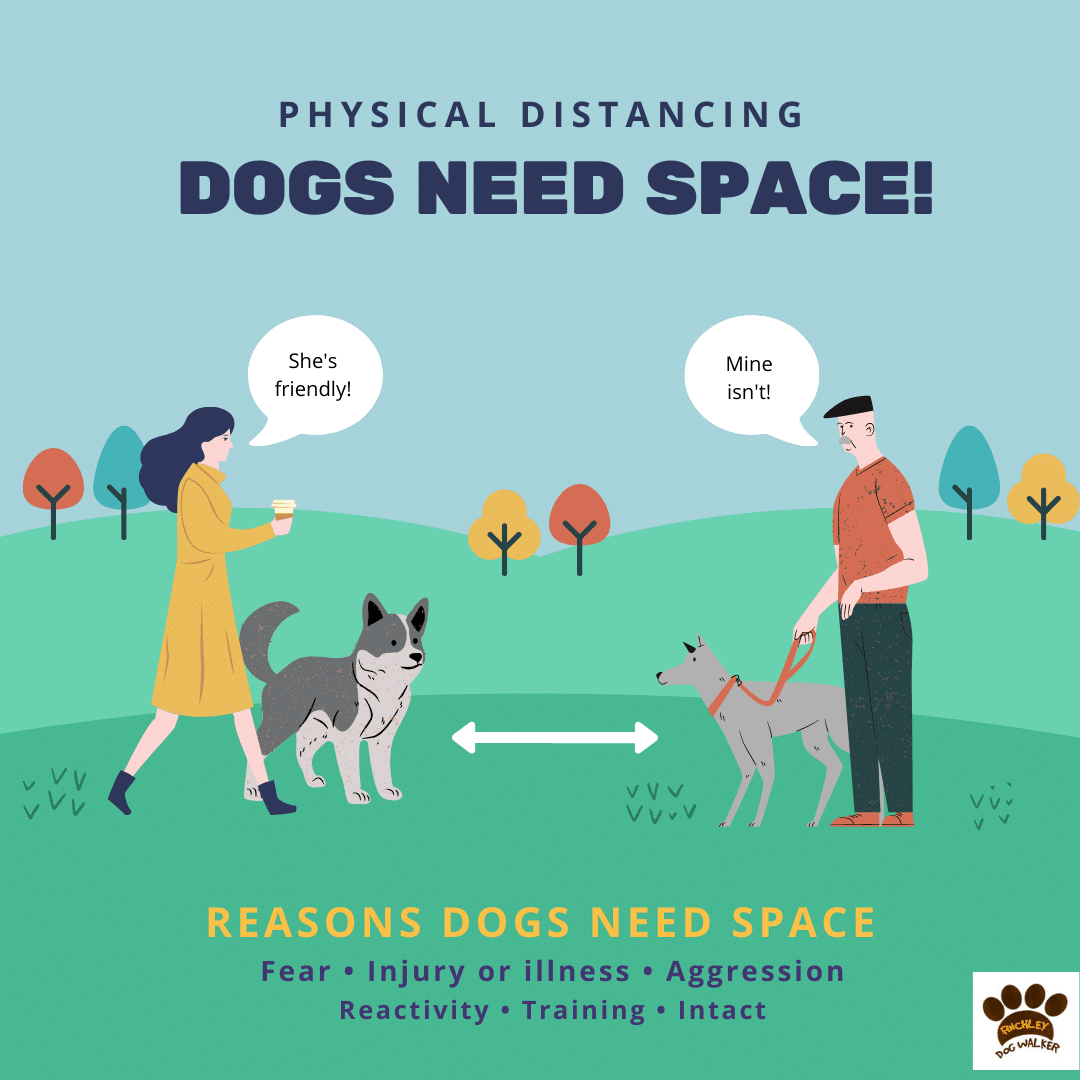
Parks and footpaths are not dog parks simply because dogs are allowed there.
Other people may be running, cycling, pushing buggies, walking children, using mobility aids or simply trying to enjoy the space.
Some people are frightened of dogs.
Other dogs may need considerable space.
Responsible dog walking means thinking about the effect your dog may have on people and animals around you, not only whether your own dog is friendly.
The RSPCA’s guidance on walking your dog safely and responsibly also covers lead use, wildlife, livestock, dog fouling and public-space responsibilities.
“He’s friendly” is not a reason to let a dog run up to somebody asking for space.
Choose the route for the dog you are walking
I do not have one route that every dog must complete.
Around Finchley I may use local streets, Cherry Tree Wood, Coldfall Wood, Highgate Wood, the Parkland Walk or other suitable local areas depending on where the dog lives.
But a woodland walk is not automatically better than a pavement walk.
A narrow woodland path with limited visibility and several off-lead dogs may be difficult for a nervous dog.
A quieter residential route may be far more enjoyable.
Likewise, a normally pleasant route can become unsuitable because of school-run traffic, roadworks, mud, fallen branches, events, weather or an unusually busy park entrance.
You can read more about this in Where I Walk Dogs in Finchley and How I Choose the Right Walk.
The route serves the dog.
The dog does not have to serve the route.
Be prepared to shorten the walk
Longer is not automatically safer, healthier or better.
A dog who is hot, tired, frightened, sore or repeatedly struggling with their environment may benefit from going home.
I do not measure the success of every walk in miles.
A shorter walk with time to sniff, explore and remain comfortable can be much more worthwhile than forcing a dog through another thirty minutes because that was the original plan.
For the bigger picture around physical exercise, sniffing, enrichment and recovery, read Dog Walking and Everyday Exercise.
Keep an eye on what your dog may pick up
North London pavements, verges, parks and woods contain plenty of things I would rather dogs did not eat.
Discarded food, bones, chewing gum, fungi, seasonal plants, rubbish and substances spilt on the pavement can all create problems.
I pay particular attention around bins, benches, takeaway areas and places where food is regularly dropped.
Teaching a useful leave or drop cue can help, but training is not a reason to stop managing the environment.
If your dog eats something potentially toxic, contact your vet rather than waiting to see whether symptoms develop.
Think about your own safety as well
The person holding the lead matters too.
Suitable footwear becomes particularly important on mud, wet leaves, ice and uneven woodland paths.
During darker walks, I prefer routes where I can see what is happening around me rather than choosing isolated or poorly lit areas simply because they are quieter.
Carry your phone where you can reach it, maintain enough awareness to hear or see what is approaching, and let somebody know your route when you are taking a particularly long or unfamiliar walk.
Your hands also need to be available to manage the dog safely.
A walk becomes harder to manage if you are distracted by your phone, carrying several bags or doing something that prevents you from responding quickly.
Have an emergency plan before you need one
You do not need to walk around expecting something terrible to happen.
You do need to know what you would do if something went wrong.
Keep your vet and emergency veterinary details available and make sure your dog’s microchip information remains current.
If your dog becomes injured, collapses, has difficulty breathing or shows signs of another serious emergency, seek veterinary help promptly.
For the fuller preparation, emergency and post-walk checklist, continue with Dog Walking Safety Tips: Before, During and After Every Walk.
You may also find my Dog First Aid and Health Hub useful.
How safe walking fits my one-to-one dog walks
My dog walking service is deliberately one-to-one.
I do not collect several dogs in a van and take them to the same park.
Walks start and finish at your dog’s home, and dogs from unrelated households are not mixed together.
That means I can change the route, slow down, create space, shorten the walk or let a dog spend more time sniffing without having to manage the competing needs of a group.
This can be particularly useful for rescue dogs, nervous dogs, senior dogs and dogs who simply prefer having more personal space.
If that sounds like the kind of walk your dog would benefit from, read Solo Dog Walks in Finchley and Muswell Hill.
Frequently asked questions
Should I cross the road when I see another dog?
Yes, if creating more distance is sensible for either dog.
Crossing the road calmly is ordinary management. You do not need to force your dog into a close encounter merely to prove that they can cope with it.
Does my dog need to say hello to other dogs on walks?
No.
Some dogs enjoy suitable social interactions, but dogs do not need to greet every dog they encounter.
If another dog is being kept on lead or the handler is creating distance, give them space.
Are retractable leads safe for dog walking?
I do not use retractable leads during my professional dog walks.
I prefer a suitable fixed-length lead because it gives me more predictable control, particularly around roads, other dogs and busy pavements.
Where more freedom is appropriate, I may use a properly handled long line attached to a suitable harness.
When can my dog walk off lead?
Only when the location permits it, the environment is suitable and your dog’s recall and behaviour make off-lead freedom safe.
A dog that reliably returns in your garden may not be ready to recall away from wildlife, dogs or exciting smells.
What if my dog suddenly refuses to walk?
Do not automatically assume they are being stubborn.
Look at the environment and your dog’s body language.
They may be frightened, overwhelmed, tired or physically uncomfortable. A sudden or repeated change in willingness to walk should also be discussed with your vet where pain or illness could be involved.
How long should a safe dog walk be?
There is no single correct duration.
Age, health, fitness, weather, confidence, intensity and recent activity all matter.
Read Dog Walking and Everyday Exercise: How Much Does Your Dog Really Need? for my fuller guide.
Related guides
Continue with Dog Walking Safety Tips: Before, During and After Every Walk for equipment, emergency preparation and post-walk checks.
Use Dog Walking and Everyday Exercise for exercise amounts, rest and balancing physical activity with enrichment.
Read Dog Behaviour and Body Language if your dog freezes, reacts, becomes worried or struggles with encounters outside.
Visit the Dog Training Hub for recall, loose-lead walking and other practical everyday skills.
For local professional support, see Solo Dog Walks in Finchley and Muswell Hill.
Safe walking is about making good decisions
A safe dog walk does not require you to spend the whole outing worrying about what might go wrong.
It means paying attention.
Check the equipment. Watch the road. Give other dogs enough space. Notice changes in your own dog. Follow local restrictions. Adapt to the weather. Turn around when continuing would make things harder rather than better.
Most importantly, remember that completing a particular route is never more important than the welfare of the dog you are walking.
Sometimes a successful walk means going further.
Sometimes it means slowing down.
And sometimes it means going home.
General information only. If your dog is injured, unwell, suddenly reluctant to walk or showing a significant change in movement or behaviour, speak to your veterinary practice. Serious fear, aggression or behavioural difficulties may also require appropriately qualified behavioural support.
