Estimated reading time: 9 minutes
Most people mean well when they greet a dog.
They smile, bend down, put out a hand, and try to be friendly. The problem is that from the dog’s point of view, it can feel like a lot all at once.
I see this often on walks around Finchley, Muswell Hill and the local woods. A person wants a quick hello. The dog turns away, stiffens, backs off, or jumps up because it is overaroused. Then the owner is left trying to manage a situation that did not need to happen.
A good greeting is not about getting a dog to like you straight away. It is about giving the dog a choice, reading what they are telling you, and knowing when to leave it alone.
That matters even more for rescue dogs, nervous dogs, older dogs, puppies, and dogs already working hard to stay settled on a walk.
The simple rule most people forget
Not every dog wants to be greeted.
That is the starting point.
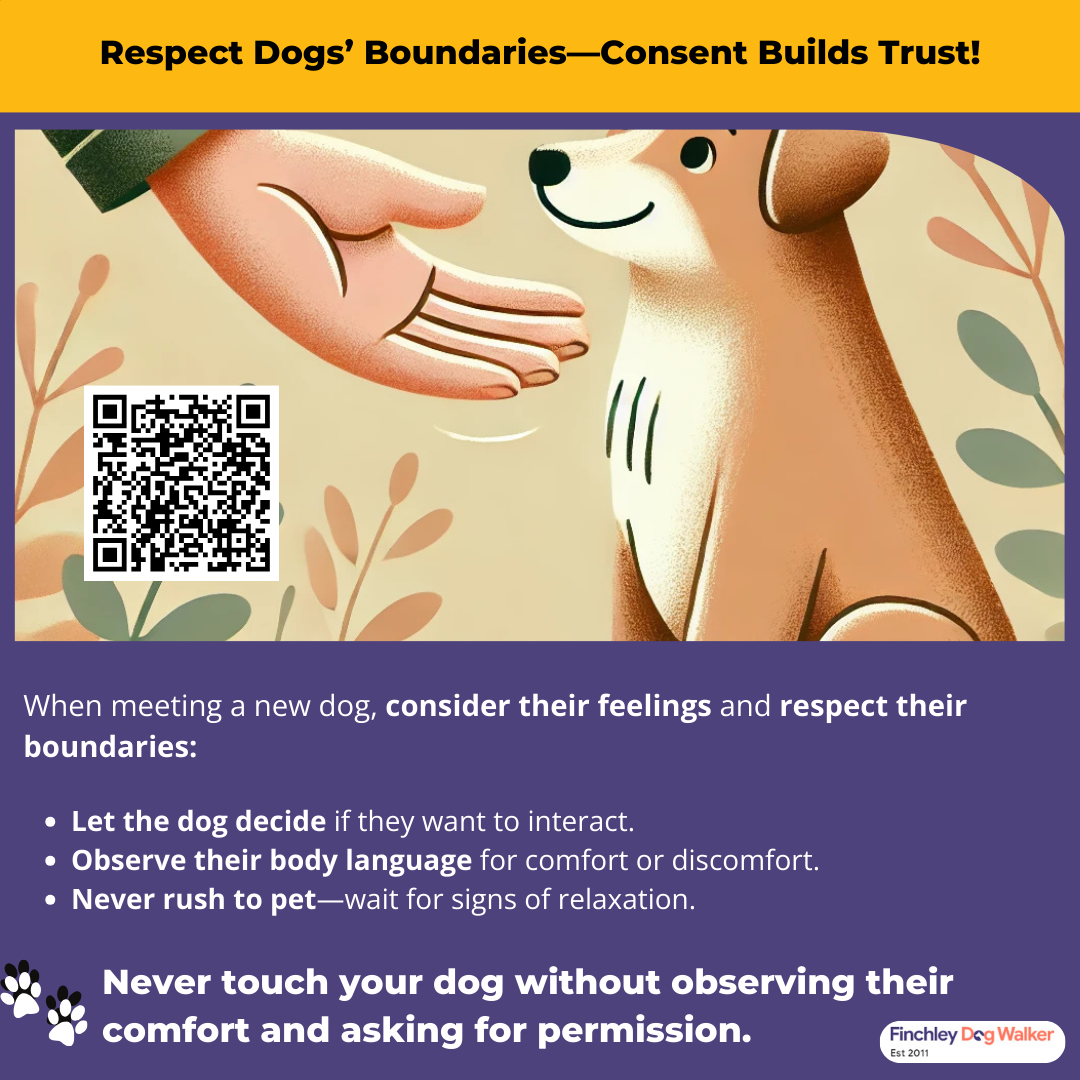
Dogs Trust advises checking with the owner first, then letting the dog choose whether to come over, rather than moving in on them. It also recommends keeping contact brief and low-pressure. (Dogs Trust)
That fits with what I see in real life. Many dogs are perfectly friendly, but do not want hands on them from strangers. Some are worried. Some are tired. Some are in training. Some just want to carry on with their walk.
A polite greeting starts with accepting that “no” is a perfectly normal answer.
How to greet a dog the right way
Here is the approach I would use.
Ask the owner first
Do not assume.
Even if the dog looks soft and waggy, ask first. The owner knows whether their dog is comfortable with strangers, whether they are recovering from something, or whether they are likely to get over-excited.
A simple “Is it all right to say hello?” is enough.
If the owner says no, leave it there. Do not take it personally, and do not keep chatting while edging closer.
Stay calm and give the dog space
Once the owner says yes, do not step straight in.
Stand slightly to the side rather than facing the dog head-on. Avoid looming over them. Keep your movements slow and your voice normal. Dogs often find direct approaches and intense eye contact uncomfortable, while a softer side-on posture is less threatening.
This is one of the biggest problems with greetings. People rush the first few seconds.
For many dogs, those first few seconds decide whether they feel safe.
Let the dog come to you
This is the bit that changes everything.
Do not reach out over the dog’s head. Do not shuffle closer because they have not moved yet. Do not keep calling them if they look unsure.
Let the dog decide.
Dogs Trust’s current guidance is built around that choice. The dog comes forward if they want to. If they do not, the greeting stops there. (Dogs Trust)
That is a far better way to judge comfort than assuming that standing still means consent.
Stroke low and briefly if the dog is happy
If the dog comes over and stays relaxed, keep it simple.
Stroke the shoulder or chest area nearest to you rather than patting the top of the head. Dogs Trust advises a brief greeting, then stopping to give the dog a chance to move away or re-engage.
That is sensible. A short, calm greeting is usually better than a full-body fuss from a stranger.
I would avoid hugging, crowding, kissing, or following the dog if they step away.
A simple checklist
Before you greet a dog, think:
- Ask the owner first
- Stay to the side
- Let the dog choose
- Keep your hand low
- Stroke briefly, then stop
- Back off if the dog turns away
That is enough for most situations.
Signs a dog is not comfortable
Owners often worry that they have to wait for a growl before they take a step back.
You do not.
Dogs usually show smaller signs first. The RSPCA explains that dogs communicate through body language and often try to move away or show they are worried before behaviour gets stronger. PDSA also highlights a “ladder of communication”, where stress signals can build if earlier signs are missed.
What I would watch for:
- Turning the head away
- Moving behind the owner
- Lip licking when there is no food around
- Yawning in a tense moment
- A tucked tail
- A stiff body
- Whale eye, where you can see more of the whites of the eyes
- Stepping back after you move in
- Suddenly freezing
A wagging tail on its own does not always mean a dog is happy to be touched. You need to look at the whole dog, not just the tail. The RSPCA advises reading the full body, including posture, facial tension, and weight distribution.
What I would avoid
There are a few things I would skip completely.
Do not bend over the dog straight away.
Do not stare into their eyes.
Do not put your face close to theirs.
Do not encourage children to rush in.
Do not pat a dog because they “look friendly”.
Do not call a dog over if they are already backing away.
Do not keep trying if the owner looks uncomfortable.
And do not assume small dogs enjoy being fussed over just because people often pick them up or crowd them. Small dogs are often the ones whose space gets ignored.
Greeting a rescue or nervous dog
This is where people need to slow down even more.
A rescue dog may be friendly once they know you, but still find first meetings hard. Some are worried by hands coming over them. Some dislike people leaning in. Some cope well outside but struggle in tighter indoor spaces. Some are still learning that strangers will leave them alone.
That is one reason I offer Rescue Dog Support as a calmer, one-to-one service. Dogs who have had a rough start often do better when people stop expecting instant confidence.
What I would focus on first with a nervous dog:
- No pressure to interact
- Plenty of space
- Sideways body language
- Calm tone
- No reaching over the head
- Ending the greeting early, before the dog gets overwhelmed
Sometimes the best greeting is no greeting at all.
If your own dog finds this hard, it is worth reading my guide, Some Dogs Need Space, and the Reactive Dog Walking Kit. Those pages help owners think more clearly about their approach to managing walks.
Greeting a dog in the home
Home greetings can be harder than outdoor ones.
Dogs often feel more alert at the front door. There is more noise, less space, and more pressure from visitors who expect the dog to say hello. Dogs Trust advises preparing dogs for visitors by teaching them to settle away from the door and allowing introductions only when the dog is calm.
In practice, I would keep it simple:
Let the dog settle first.
Do not make the guest the centre of attention.
Do not encourage excited jumping and then tell the dog off for it.
Give the dog somewhere to go.
Bring them in when they are ready, not the moment the door opens.
This is especially important for puppies, adolescent dogs, and rescues who are still learning about household routines.
What I tell children
Children usually want to do the right thing. They just need a clear method.
I would teach it like this:
Ask first.
Stand still.
Let the dog come to you.
Stroke gently on the side, not on the head.
Stop after a moment.
Leave the dog alone if they walk away.
That is safer and fairer for the dog.
Kids Around Dogs has some great resources you can download
Does putting a hand out help?
Not always.
A lot of people were taught to put a hand out straight in front of the dog’s face. Some dogs are fine with that. Others find it intrusive, especially if the hand is pushed close to them before they have chosen to approach.
I would not thrust a hand forward. I would keep my arm relaxed and low and let the dog come into my space if they want to.
Where do dogs usually prefer to be stroked?
Many dogs are more comfortable being touched on the shoulder, chest, or side of the neck rather than on top of the head.
But every dog is different.
The better question is not “where do dogs like being stroked?” It is “is this dog asking for contact at all?”
That keeps you focused on the dog in front of you rather than a generic rule.
What I would focus on first if your dog dislikes greetings
If your own dog struggles when people approach, I would start here:
- Stop letting strangers practise bad greetings on your dog
- Give your dog more distance earlier
- Tell people clearly that your dog does not want to say hello
- Reward your dog for staying calm as people pass
- Keep greetings short and optional
- Work on calm, repeatable routines rather than forced socialising
A lot of dogs do better when owners stop chasing the idea that every walk needs social interaction.
A quiet, uneventful walk is often more useful than a busy one.
That is one reason my Solo Dog Walks and Walking Big Dogs in Finchley pages both focus on calm handling rather than overloading dogs with too much going on at once.
Related guides
You might also find these useful:
- Dog & Cat Care Guides
- Some dogs need space
- Why do dogs act differently on a lead
- Reactive Dog Walking Kit
FAQ
t can be fine if the dog has already chosen to come over, but I would not push your hand towards their face. Keep your hand low and relaxed and let the dog close the distance.
Often no, especially with a dog you do not know. Many dogs prefer a gentle stroke on the shoulder or chest area instead.
A wag on its own does not tell you enough. Look at the whole body. A stiff posture, turning away, or moving back can still mean the dog is uncomfortable. (RSPCA)
Only with the owner’s permission and close adult supervision. The child should stay calm, let the dog come over, and stop if the dog moves away.
Usually not. Too many greetings can make the problem worse. Shorter, calmer, more controlled interactions are often better.
Not usually. Plenty of dogs are happier when they are not expected to greet everyone. Good social skills are about coping well, not saying hello to every person or dog.
If you are in Finchley, North Finchley, East Finchley, or nearby, and your dog finds greetings difficult, I offer calm, one-to-one walks and rescue-dog support tailored to what your dog can actually cope with. No pressure, no big groups, and no rushing dogs through things they are not ready for.
Other posts
How to stop dogs jumping up
Staying safe around dogs
updated April 2026