
Qualifications, Training & Continuing Professional Development
Professional learning backed by practical experience since 2011
When you trust someone to walk your dog, stay in your home or care for your pets while you are away, qualifications are only part of the picture.
Experience, judgement, patience and knowing when something is outside your own area of expertise matter too.
I established Finchley Dog Walker in 2011 and continue to develop my knowledge through formal qualifications, practical courses, and continuing professional development covering canine first aid, body language, behaviour, enrichment, puppies, senior dogs, and dogs who may be nervous, sensitive, or reactive.
My aim is simple: to understand the animal in front of me and provide calm, individual care rather than expecting every dog or pet to fit the same routine.
View my pet care services | Read about my approach | Contact me
The quick version
I am:
- established as a professional dog walker and pet carer since 2011
- trained in Ofqual-regulated Level 3 Canine First Aid
- Enhanced DBS checked through my work with Scouting
- fully insured for the pet-care services I provide
- committed to ongoing learning and professional development
- experienced with rescue, nervous, sensitive and reactive dogs
- experienced with puppies and older dogs
- committed to calm, reward-based and welfare-led handling
- a one-to-one dog walker rather than a group or van-based walking service
My additional learning includes canine body language, reactive dogs, enrichment, loose-lead walking, puppy development, senior-dog care and other aspects of everyday canine welfare and behaviour.
The certificates shown on this page are evidence of some of that learning. Not every short course is a regulated professional qualification, and completing a course does not make someone a veterinary professional or clinical behaviourist.
What matters to me is using appropriate learning alongside experience, good judgement and knowing when an owner needs help from a vet or suitably qualified behaviour professional.
Ofqual-regulated Level 3 Canine First Aid
Emergencies are thankfully uncommon, but anyone responsible for somebody else’s dog should know how to respond when something goes wrong.
I hold an Ofqual-regulated Level 3 qualification in Canine First Aid.
My first-aid learning covers subjects such as recognising emergencies, assessing an injured or unwell dog, CPR, bleeding, wounds, choking, poisoning, heat-related illness and knowing when urgent veterinary assistance is required.
First aid does not replace veterinary treatment.
My role is to recognise a potential emergency, provide appropriate first aid within the limits of my training and obtain professional veterinary assistance when required.
Read my Dog Health & First Aid Guide
Read why canine first aid training matters
Certificate
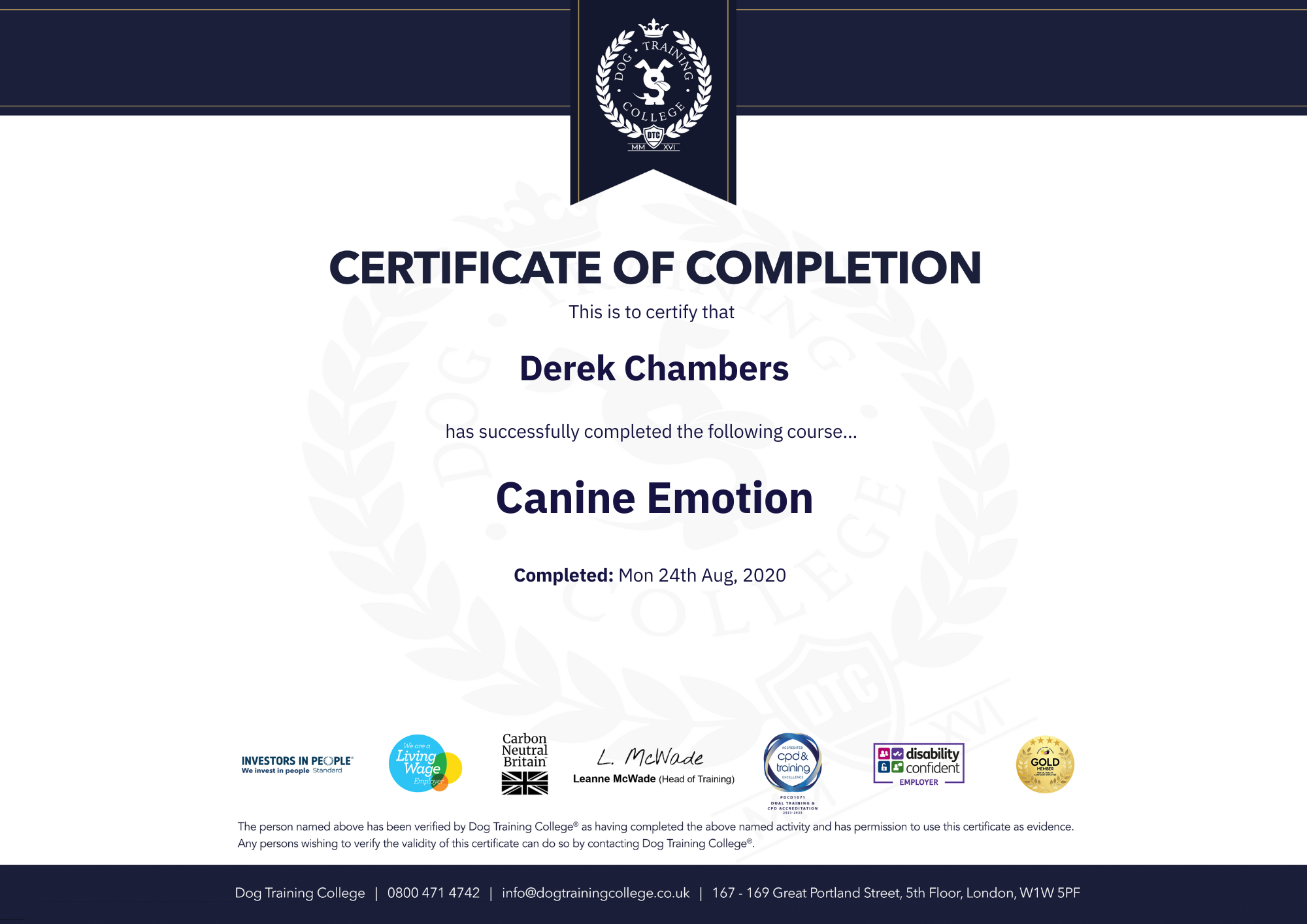
Canine Body Language and Communication
Dogs communicate long before they bark, growl, lunge or try to escape from a situation.
Learning to notice the quieter signals is particularly important when working one-to-one with nervous, rescue or easily overwhelmed dogs.
My continuing professional development has included canine body language and communication, including learning about:
- canine emotions
- facial and body signals
- vocalisation
- stress signals
- uncertainty and avoidance
- dog-to-dog communication
- arousal
- recognising when a dog needs more space
- understanding when a dog may be becoming uncomfortable
I don’t expect every dog to want to greet every person or dog we meet.
Sometimes the kindest and most sensible thing we can do is create a little more distance, slow things down and give the dog time to process what is happening.
This understanding forms an important part of my approach to dog behaviour and body language and my work with rescue dogs.
Certificates and CPD

Supporting Nervous, Sensitive and Reactive Dogs
Some of the dogs I work with are confident social butterflies.
Others are a little more awkward but awesome.
They may find unfamiliar dogs, busy pavements, visitors, noises or particular situations difficult. Some need considerably more space and patience than others.
My learning around reactive dogs and confidence building complements years of practical experience working with rescue, nervous and sensitive dogs.
Rather than trying to force a dog through something they are struggling with, I look at what the dog is communicating and adapt the walk where appropriate.
That might mean:
- increasing distance from a trigger
- choosing a quieter route
- allowing additional sniffing and decompression time
- reducing pressure
- avoiding unnecessary greetings
- using rewards appropriately
- recognising when the dog has had enough
You can read more about my rescue dog support in Finchley and my approach to one-to-one dog walking.
Certificates and CPD
An important distinction
I provide practical walking, enrichment and everyday training support within my experience and competence.
I do not diagnose behavioural disorders or present myself as a clinical animal behaviourist.
Where a dog’s behaviour suggests pain, significant fear, aggression or another problem requiring specialist assessment, I may recommend speaking to your vet and, where appropriate, seeking help from a suitably qualified behaviour professional.
The Animal Behaviour and Training Council provides information about appropriately assessed animal training and behaviour professionals.
Reward-Based Training and Everyday Skills
Training isn’t something that only happens during a formal training session.
Dogs are learning during ordinary walks too.
My training-related CPD includes areas such as loose-lead walking, games-based learning, rewards, focus and other practical skills that can make everyday life easier.
My approach is reward-based.
I don’t use prong collars, electronic shock collars or punishment-based methods to frighten or intimidate a dog into compliance.
Instead, I want the dog to understand what we’re asking and have a reason to choose the behaviour we want.
You can explore this approach in my Dog Training Hub or read my guide to loose-lead walking.
The RSPCA also recommends choosing training approaches that protect a dog’s welfare and points owners towards appropriately assessed professionals for specialist training and behaviour support.
Read the RSPCA’s advice on choosing a dog trainer
Certificates and CPD
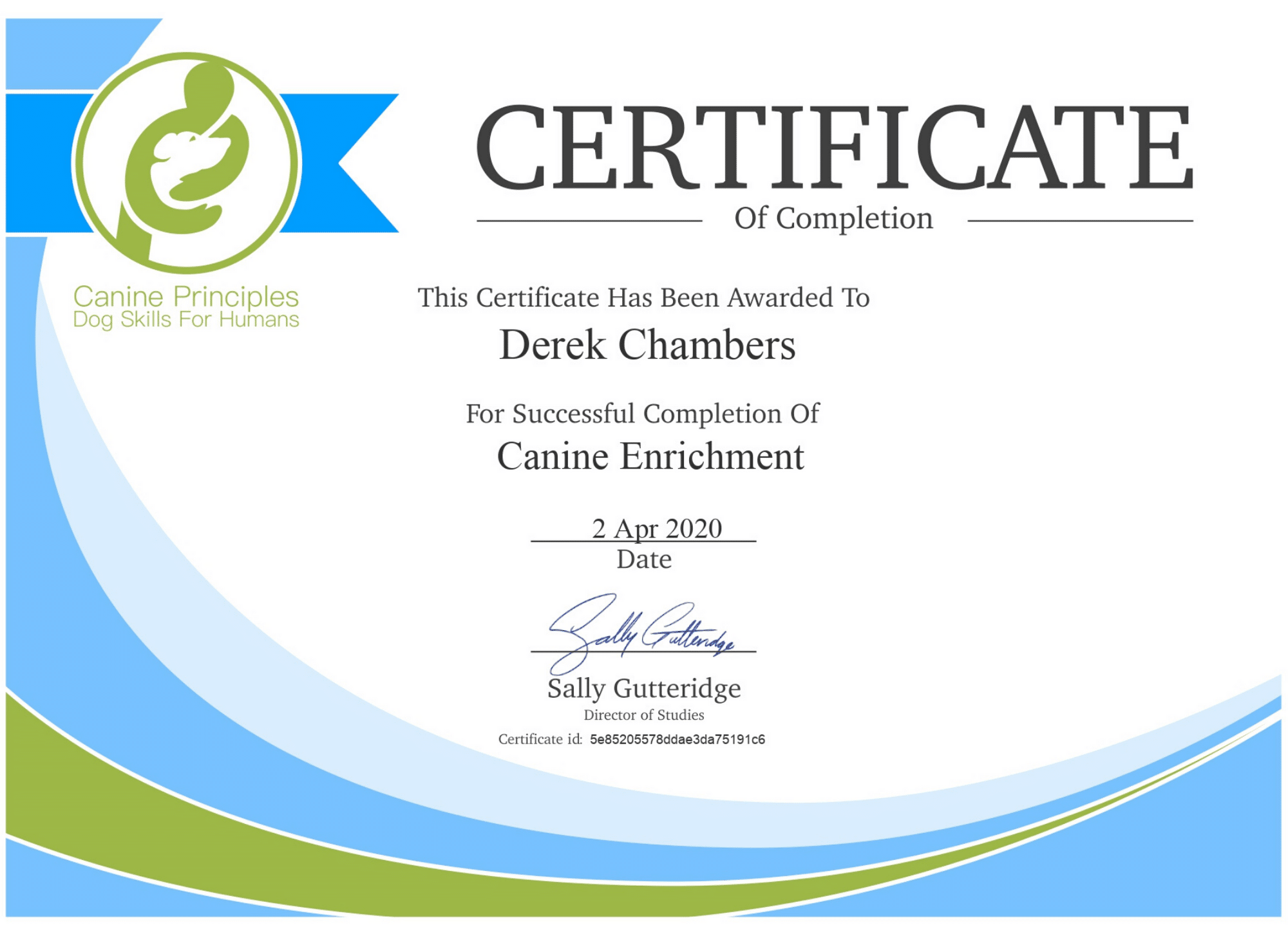
Canine Enrichment
A good walk isn’t simply about covering as many miles as possible.
Sniffing, exploring, making choices and engaging with the environment can all form part of a dog’s walk.
I have completed additional learning in canine enrichment, including thoughtful enrichment and practical enrichment activities.
I use enrichment according to the individual dog rather than assuming that more activity is always better.
For one dog, enrichment might involve searching for a few treats.
Another might benefit from a slow sniff around a familiar green space.
An older dog might enjoy a gentle potter where stopping to investigate smells is far more important than distance.
And sometimes what an overstimulated dog really needs is less activity and more opportunity to settle.
Explore my Dog Training & Enrichment Hub
Certificates and CPD
Senior Dog Care
Older dogs can be some of the most enjoyable dogs to walk.
The walk just needs to be about their needs rather than ours.
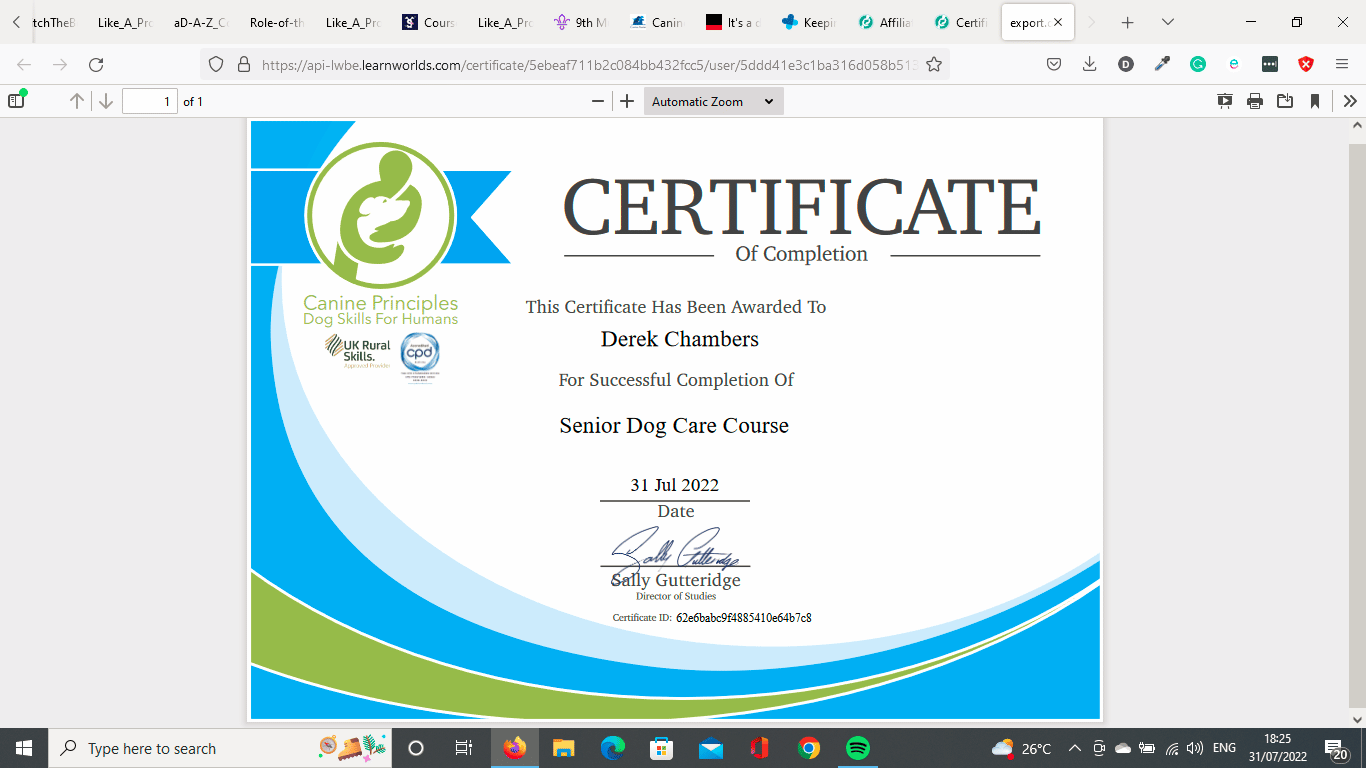
My learning in senior and elderly dog care helps support my practical experience with older dogs whose requirements may change as they age.
That can mean paying closer attention to:
- changes in walking speed
- reluctance to tackle steps
- stiffness
- fatigue
- changes in confidence
- sensitivity to weather
- changes in sight or hearing
- the need for more sniffing and less distance
- behaviour that is unusual for that particular dog
I cannot diagnose arthritis, pain or other medical conditions.
If I notice a meaningful change in a dog I regularly care for, I will tell their owner so they can decide whether veterinary advice is appropriate.
Read about dog walks for older dogs
Certificates and CPD
Puppy Learning and Development
Puppies need considerably more than simply tiring out.
Early experiences, appropriate exercise, sleep, confidence building, socialisation and learning how to cope with everyday life all matter.
I have completed additional learning relating to puppy training, health and welfare.
When caring for a puppy, my role isn’t to cram as much stimulation as possible into every visit. It is to work with the routine agreed with the owner and provide appropriate opportunities for toileting, gentle exploration, play, enrichment, rest and learning.
Read my guide to bringing a puppy home
Certificates and CPD

Experience Matters Too
Certificates are useful evidence of learning, but I don’t believe a wall full of certificates automatically makes somebody good with animals.
I’ve been professionally caring for dogs and other pets since 2011.
Before the COVID pandemic, I also spent more than five years assisting at Tip Top Dog School classes.
That gave me the opportunity to observe and work around many different dogs and owners, from excitable puppies to dogs who needed more confidence and space.
More importantly, the animals I care for continue to teach me that the same approach doesn’t work for everyone.
One dog might race out of the front door desperate to get to the park.
Another might stand there wondering whether today really requires going outside at all.
Good pet care means noticing the difference.
Fully Insured and Enhanced DBS Checked
Training is only one part of choosing somebody who will have responsibility for your pet and, for house sitting and pet visits, access to your home.
I am fully insured for the pet-care services I provide.
I also hold an Enhanced DBS check through my involvement with Scouting.
Relevant evidence can be shown to clients on request.
You can find more information about how I work in my Welcome Pack and read feedback from people whose pets I have cared for on my testimonials page.
Continuing Professional Development
I don’t consider learning finished because I’ve received a certificate.
Dog welfare, behaviour, training and animal care continue to develop, and I continue to learn.
My future professional development is deliberately focused on subjects that are relevant to the animals I actually work with rather than collecting certificates simply for the sake of having more of them.
Areas of particular interest include:
- advanced canine body language
- fear, stress and reactivity
- canine ageing and mobility
- recognising possible signs of pain or discomfort
- puppy development
- feline behaviour and welfare
- small-animal welfare
- enrichment and choice-led care
Where appropriate, I also refer to guidance from veterinary and established animal-welfare organisations rather than presenting personal experience as veterinary or behavioural advice.
Qualifications Are Part of the Picture
If you’re choosing someone to care for your pet, I think you should be able to ask questions.
Ask about their experience.
Ask about insurance.
Ask what happens in an emergency.
Ask how many dogs they walk together.
Ask how they transport them.
Ask what training methods they use.
And ask what they would do if your dog was frightened and simply wasn’t coping that day.
My answer won’t always be that we need to achieve everything originally planned.
Sometimes good care means changing the plan.
That is particularly important with puppies, senior dogs, rescue dogs and the spirited, sensitive or slightly awkward-but-awesome dogs who often benefit most from one-to-one care.
Find Out More About Finchley Dog Walker
I provide calm, individual pet care in Finchley, Muswell Hill and selected surrounding areas.
My services include one-to-one dog walking, rescue dog support, house sitting, cat sitting, puppy visits, enrichment and care for suitable small animals.
I care for one household at a time and dog walks start and finish from your home. I don’t collect dogs in vans for large group walks.
