How to Keep Your Dog Safe During the Festive Season
Estimated reading time: 11 minutes
Table of contents
- How to Keep Your Dog Safe During the Festive Season
- Why Dogs React to Christmas Trees
- Choose the Right Spot for Your Christmas Tree
- Real vs Artificial Trees: Which Is Safer for Dogs
- Choose Dog-Friendly Decorations
- Manage Lights, Wires, and Tree Accessories
- Create a Dog-Proof Christmas Tree Setup
- Teach Boundaries Around the Tree
- Keep Your Dog’s Routine Steady During December
- What To Do If Your Dog Still Goes Near the Tree
- FAQ
- Conclusion
Most families look forward to putting up the Christmas tree. You drag it through the door. You untangle the lights. You stand back and hope it doesn’t fall sideways. It feels like the real start of the season. But if you live with a dog, you also know this moment comes with a small knot of worry.
You might wonder how your dog will react. Will they try to chew the branches? Will they swipe the baubles? Will they treat the whole thing like an indoor activity centre? Or will they nudge it once, make it wobble, and then panic when it drops a shower of needles across the floor?
If you have been through this before, you probably know that dogs and Christmas trees are not always the best mix. Some dogs ignore the tree completely. Others stare at it as if it might open a portal to another world. And some treat it like a brand new toy designed purely for their enjoyment.
You might wonder what approach is safest. Should you get a real tree or an artificial tree? Should you change your decorations? Should you block the tree so your dog can’t get near it? Should you train a new cue or change your routine?
This guide brings all the advice together and gives you practical steps to manage dogs and Christmas trees in a way that feels safe and realistic. I share what I see in local homes during pet visits. I pull in guidance from The Kennel Club, Dogs Trust, and the RSPCA. And I include examples of what other dog owners have tried, so you can pick what suits your home.
Christmas should feel calm and fun. Let’s make sure your dog stays safe, your tree stays upright, and your decorations survive until Boxing Day.
Why Dogs React to Christmas Trees
Dogs notice anything new in their space. A tree is tall, smells unusual, and sometimes carries outdoor scents that excite your dog. If you bring in a real tree, expect more sniffing. If you use a pre-lit artificial tree, expect curiosity about the lights.
Think about your dog’s behaviour. Do they explore new items? Do they steal socks? Do they climb onto the sofa as soon as you stand up? If your dog loves novelty, your Christmas tree will hold the same draw.
Dogs explore with their mouth. They also use paws to test texture and stability. A tree offers both. The scent, the lights, the dangling shapes, and the rustling branches all make this a high-interest object. Some dogs are also sensitive to change, so the tree might trigger anxiety or make them pace around, wondering why their living room has transformed overnight.
Have you noticed your dog getting more excited at certain times of year? Do visitors change their behaviour? Do noise levels rise as the season gets closer? All of this increases stimulation and can lead to bouncy or restless behaviour around the tree.
Understanding why your dog reacts helps you plan the proper setup.
Choose the Right Spot for Your Christmas Tree
Your tree’s location can make your life much easier. Pick a place that suits both your home and your dog’s habits.
Ask yourself a few simple questions.
Where does your dog spend most of their time? Does your dog race down the hallway? Do they jump on furniture near that corner? Do they run to the window every time the doorbell rings? If your tree sits in the middle of your dog’s favourite route, trouble will follow.
Tips for a safer setup
• Place the tree in a quiet corner
• Keep it away from beds, sofas, or window sills that your dog jumps on
• Avoid blocking escape routes, as this makes dogs squeeze past the tree
• Use a wide, heavy stand for stability
• Anchor the top of the tree to a wall hook if your dog is extra lively
Some families even set up a temporary barrier for the first few days. A baby gate or a pen gives your dog time to adjust. You can remove it once they stop trying to investigate.
If you have more than one dog, consider their group dynamics. A calmer dog might ignore the tree until the younger dog approaches it. The moment one goes near it, the other joins in. Think ahead and adjust your layout if needed.
Real vs Artificial Trees: Which Is Safer for Dogs
Both real and artificial trees come with benefits and hazards. The right choice depends on your dog and your home.
Real Trees
Real trees smell wonderful. They also shed needles. These needles can irritate paws, cause stomach upset if ingested, and pierce soft pads. If you choose a real tree, sweep often. Keep water fresh. Some dogs drink from the stand, so check the water level and avoid additives. Plain water only.
The Kennel Club notes that pine needles can cause issues if swallowed in large amounts. Dogs Trust also reminds owners to keep tree water out of reach.
Consider your dog’s habits. Do they chew sticks in the park? A real tree might encourage that behaviour indoors.
Artificial Trees
Artificial trees have fewer scent triggers. They don’t shed, and they tend to feel less interesting once your dog sniffs them a few times. But they come with other hazards. Pre-lit trees carry wires. Chewers love wires.
If your dog mouths cables, cover them. Hide plugs. Use cable guards or place the tree near a socket so the wire runs up the back of the stand out of reach.
Think about your dog’s size. A tall artificial tree can still fall if you have a large dog that brushes past it. Always use a solid base.
Choose Dog-Friendly Decorations
Your decorations matter as much as the tree itself. Some items are safer than others.
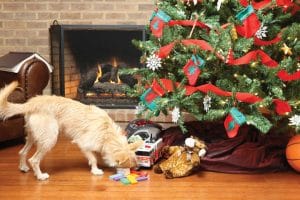
Glass baubles look lovely. They also shatter. If your dog knocks one off the branch, shards scatter across the floor. A single paw step can cause a cut. A single lick can cause injury. If you love the look of glass, place them at the top only.
Consider safer options.
• Shatterproof baubles
• Felt ornaments
• Wood decorations
• Paper garlands
• Fabric stars
All of these reduce risk without losing the festive feel.
Avoid edible decorations. Chocolate ornaments are dangerous. Popcorn strings smell tempting. Dogs Trust warns owners each year about the risk of chocolate poisoning during December. Keep food-based decorations off the tree altogether.
Think about tinsel. Many dogs swallow strands. It can cause stomach blockages. If your dog steals items, skip tinsel.
Take a moment to picture your tree last year. What did your dog show interest in? What got knocked off? Use those clues to guide this year’s setup.
Manage Lights, Wires, and Tree Accessories
Lights add extra sparkle, but they also add additional risk.
Ask yourself whether your dog has a history of chewing phone chargers, laptop cables, or toys with strings. If the answer is yes, assume they will test your Christmas lights.
Keep wires short and hidden.
• Run cables behind furniture
• Use cable wraps
• Tape wires high up the wall if needed
• Choose battery lights with sealed units
Avoid loose wires at floor level. If your dog paws at them, the tree may shift. If they chew them, you risk burns or shocks.
You can also use timers. This helps reduce temptation and stops the lights from being on when you are out of the room. Dogs see flashing lights differently than we do. Some dogs avoid them, but others find them stimulating. Watch your dog’s reaction.
Many pet owners place a tree skirt around the base of the tree. If you pick a firm one, it forms a small barrier. If you choose a soft fabric skirt, make sure your dog cannot drag it.
Create a Dog-Proof Christmas Tree Setup
A dog-proof Christmas tree means more than choosing the right decorations. It means setting the whole environment up to reduce temptation and encourage calm behaviour.
Some families raise the tree slightly. A small table or platform creates a gap between the floor level and the branches. This helps dogs who like to sniff or nibble on low items.
Other ideas include
• Placing the tree in a large playpen
• Using a coffee table as a buffer
• Putting wrapped boxes (without ribbon) around the base
• Setting up a cosy bed area on the opposite side of the room
Think of your dog’s personality. If they are calm, small changes might work. If they are mischievous, you may need a full pen for the first week.
Dogs learn rules through repetition. If you show your dog the new space and calmly guide them away whenever they get too close, they begin to understand. It takes patience, but it helps in the long run.
But do not rely on training alone if your dog is under a year old. Puppies explore everything and often make quick movements. Physical management keeps them safe.
Teach Boundaries Around the Tree
Training supports any physical setup you choose. Start with simple boundaries.
Show your dog where you want them to settle. A mat or bed nearby works well. Use rewards when they choose to lie there. Each time they move towards the tree, guide them back to the mat.
Ask yourself whether your dog knows a leave cue. If not, now is a good time to teach it. A reliable leave makes life easier during the season. Many dogs pick it up quickly when you practise with low-value items first.
Short sessions work best. Keep your voice calm. Keep movements slow. Your dog will mirror your energy.
If your dog becomes overexcited when visitors arrive, plan ahead. Put them behind a gate or in another room while you open the door. Once guests settle, bring your dog back in on a calm note.
Think about Christmas morning. Dogs become very excited with wrapping paper and movement. Plan a few quiet breaks. A stuffed Kong or a safe chew gives your dog an outlet while the room becomes busy.
Keep Your Dog’s Routine Steady During December
Your dog’s behaviour around the Christmas tree often links to their overall routine. December brings late nights, visitors, shopping trips, and changed feeding times. Dogs pick up on that shift.
Keep meal times steady. Keep walksregularly. Keep enrichment simple.
Small changes reduce stress.
If your dog becomes restless in the evening, offer
• A sniffing game
• A slow feeder
• A short training session
• A calm settle with a chew
These tasks help release energy in a controlled way and make it less likely they will investigate the tree out of boredom.
When I dog walk in December, I see the difference the routine makes. Dogs with predictable days stay calmer at home. Dogs with erratic days show more indoor zoomies and often target the tree. A steady rhythm helps everyone.
What To Do If Your Dog Still Goes Near the Tree
Some dogs cannot resist. If your dog goes near the tree, stay calm. Avoid shouting. Dogs respond better to clear guidance.
Check whether your tree is stable. If the base wobbles, secure it.
Check whether the decorations are too low. Move anything tempting to higher branches.
Check whether wires are exposed. Hide them again.
If your dog grabs an ornament, avoid chasing. Swap the item for a treat or a toy. Chasing turns it into a game. Swapping ends the interaction quickly.
If your dog knocks the tree, reset the space. You may need a barrier for a few days. Many dogs lose interest after the first week because the novelty fades.
Watch for signs of stress. Some dogs pace around the tree because the environment feels different. Give them space and quiet time away from the room if needed.
FAQ
Are real Christmas trees dangerous for dogs?
Real trees are safe for most dogs if you manage the space around them. Sweep needles often to protect paws. Keep tree water out of reach. Some dogs try to drink from the stand, so cover the base if needed.
How do I stop my dog from chewing decorations?
Place fragile items high up in the tree. Use shatterproof decorations lower down. Keep edible decorations off the tree. Offer alternative chewing options, such as safe toys or long-lasting chews.
Is tinsel safe for dogs?
Tinsel can cause problems if swallowed. Many dogs chew or steal it. If your dog steals items, avoid tinsel altogether.
Should I leave the Christmas lights on when I go out
Turn the lights off when you leave the house. It reduces the chance of chewing and keeps the space calmer. Use timers if you need the lights on in the evening.
Conclusion
Your Christmas tree can stay upright, and your decorations can survive the season if you plan. A calm home, safe decorations, hidden wires, and steady routines all help your dog feel settled. When your dog understands the space and has clear boundaries, they are far less likely to nibble branches or swipe baubles.
If you take the time to set things up safely now, you protect your dog and enjoy a more relaxed December. You also reduce the chances of emergency vet trips and last-minute panics.
Think about your dog’s habits. Think about what worked last year. Choose the setup that feels manageable for your home. Small changes make a big difference.
You may also be interested in Dogs and Christmas and Christmas decorations article.
Key Takeaways
- A dog-proof Christmas tree requires strategic setup, including placement away from favourite dog areas and using barriers if necessary.
- Choose Christmas decorations wisely: shatterproof ornaments are safer than glass, and avoid tinsel and edible items to prevent health risks.
- Train your dog with clear boundaries around the tree, using cues like ‘leave it’ to manage their behaviour effectively.
- Maintain a consistent routine during the festive season to help your dog feel less anxious and more secure around the tree.
- If your dog persists in approaching the tree, stay calm and redirect their attention rather than chasing after them.
Resources – RSPCA and animal friendly Christmas