
Updated August 2026
Taking your dog out should be enjoyable, but it also comes with responsibilities.
Your dog does not need to walk perfectly at heel or ignore everything around them.
They do need to be managed safely.
That means considering other dogs, people, children, wildlife, cyclists and anyone who may not feel comfortable around dogs.
It also means recognising when your dog needs a lead, more distance or simply a quieter route.
I have been walking dogs professionally around Finchley since 2011. My approach is not based on sharp lead corrections, shouting or trying to dominate a dog.
I prefer calm management, reward-based training and making good behaviour easier for the dog.
For more about that approach, start with my Dog Training Hub.
Key Takeaways
- Controlling your dog in public involves ensuring their behaviour does not pose risks to themselves or others.
- Good management includes using leads, maintaining distance, and being aware of surroundings, rather than requiring perfect obedience.
- Always check local regulations regarding dogs on leads, as requirements can vary by area.
- Reward-based training can enhance skills like recall and loose-lead walking, making outings more enjoyable for both dog and owner.
- Understand that public control is about responsibility and awareness, allowing dogs to explore safely while respecting others.
Table of contents
- What does keeping a dog under control actually mean?
- What does the law say about controlling dogs?
- Does my dog have to be on a lead everywhere?
- Dogs on pavements and near roads
- Your dog’s collar, identification and microchip
- A friendly dog still needs to be under control
- Should dogs greet every dog they meet?
- Give other dogs space
- What if my dog is reactive?
- Why I don’t use sharp lead corrections
- Teach your dog to check in with you
- Recall is about safety, not showing off.
- When should I put my dog back on lead?
- What about children?
- Runners, cyclists and scooters
- Sniffing and public control can coexist
- Dogs around livestock and wildlife
- Picking up after your dog is part of responsible control
- What equipment do I prefer?
- What if something goes wrong?
- When management is more important than training
- When should I seek professional help?
- How I manage dogs on walks in Finchley
- Related dog training and walking guides
- Frequently asked questions
- Does my dog legally have to be on a lead in public?
- Can my dog run up to another dog if they are friendly?
- Is an off-lead dog automatically out of control?
- Should I tell my dog off for reacting to another dog?
- What should I do if another off-lead dog approaches mine?
- Does my dog need a collar if they wear a harness?
- Does my dog still need identification if they are microchipped?
- Should I put my dog on lead when I see another dog on lead?
- Can you help if my dog is difficult to control on walks?
- Need practical help on everyday walks?
- Final thoughts
What does keeping a dog under control actually mean?
People sometimes hear “dog under control” and imagine a dog walking perfectly beside its owner.
That is not what I mean.
A dog can sniff.
They can explore.
They can enjoy themselves.
They can have personality.
Control is about being able to manage your dog so that their behaviour does not put them, another animal or another person at unnecessary risk.
In everyday life, that might mean:
- using a lead beside a road
- calling your dog back before they reach someone
- creating distance from another dog
- keeping your dog away from children playing
- moving to one side for runners or cyclists
- preventing unwanted greetings
- using a long line while recall develops
- choosing a quieter route for a nervous dog
- putting your dog back on lead when the situation changes
Good management is not a failure of training.
It is part of responsible dog ownership.
What does the law say about controlling dogs?
The law is more serious than simply asking owners to be considerate.
GOV.UK guidance on controlling your dog in public explains that it is against the law to allow a dog to be dangerously out of control.
This applies to all dogs.
It can also apply in private places, not only parks and streets.
A dog can be considered dangerously out of control if it injures someone or causes someone to worry that they may be injured.
That means responsible control should start long before an incident happens.
If you know your dog struggles around certain situations, manage those situations rather than hoping everything will be all right.
This page provides practical guidance rather than legal advice. Check current GOV.UK and local authority guidance if you need to know exactly what rules apply in a particular situation.
Does my dog have to be on a lead everywhere?
No.
There is no single rule requiring every dog to be on a lead in every public space.
But there are many situations where keeping your dog on a lead is either required or simply sensible.
Local councils can introduce Public Spaces Protection Orders covering particular areas.
These can include:
- dogs-on-leads requirements
- dog exclusion areas
- requirements to put a dog on a lead
- limits on the number of dogs one person can walk
- dog-fouling rules
Around Finchley, Barnet Council’s current Public Spaces Protection Orders include dog-control conditions.
Always check signs at the entrance to parks and open spaces rather than assuming that yesterday’s rules still apply.
Dogs on pavements and near roads
Roads are one place where I do not take chances.
The Highway Code advises keeping dogs on a short lead when walking on pavements, roads or paths shared with cyclists or horse riders.
You can read the current guidance in the Highway Code rules about animals.
Even a dog with very good recall can be startled.
A cat running across the road, a sudden bang or another dog appearing unexpectedly can change the situation in seconds.
Around Finchley, North Finchley and East Finchley, I often move between quieter residential roads and much busier areas.
My expectations change with the environment.
The closer I am to traffic, people or unpredictable situations, the more important secure lead control becomes.
Your dog’s collar, identification and microchip
Control is not only about training.
Your dog also needs appropriate identification.
Under the Control of Dogs Order 1992, most dogs in a highway or public place must wear a collar displaying the owner’s name and address, either on the collar itself or on an attached tag.
Dogs in England must also be microchipped, and the registered details need to remain current.
A microchip does not replace the collar identification requirement.
It is worth checking occasionally that:
- your dog’s tag is still readable
- the collar fits properly
- your address details are correct
- your microchip registration is current
- your lead, harness and clips are in good condition
I check walking equipment before walks because the best recall training in the world is not much help if a worn clip fails.
You can read more about the equipment and safety standards I use in my Policies and Standards.
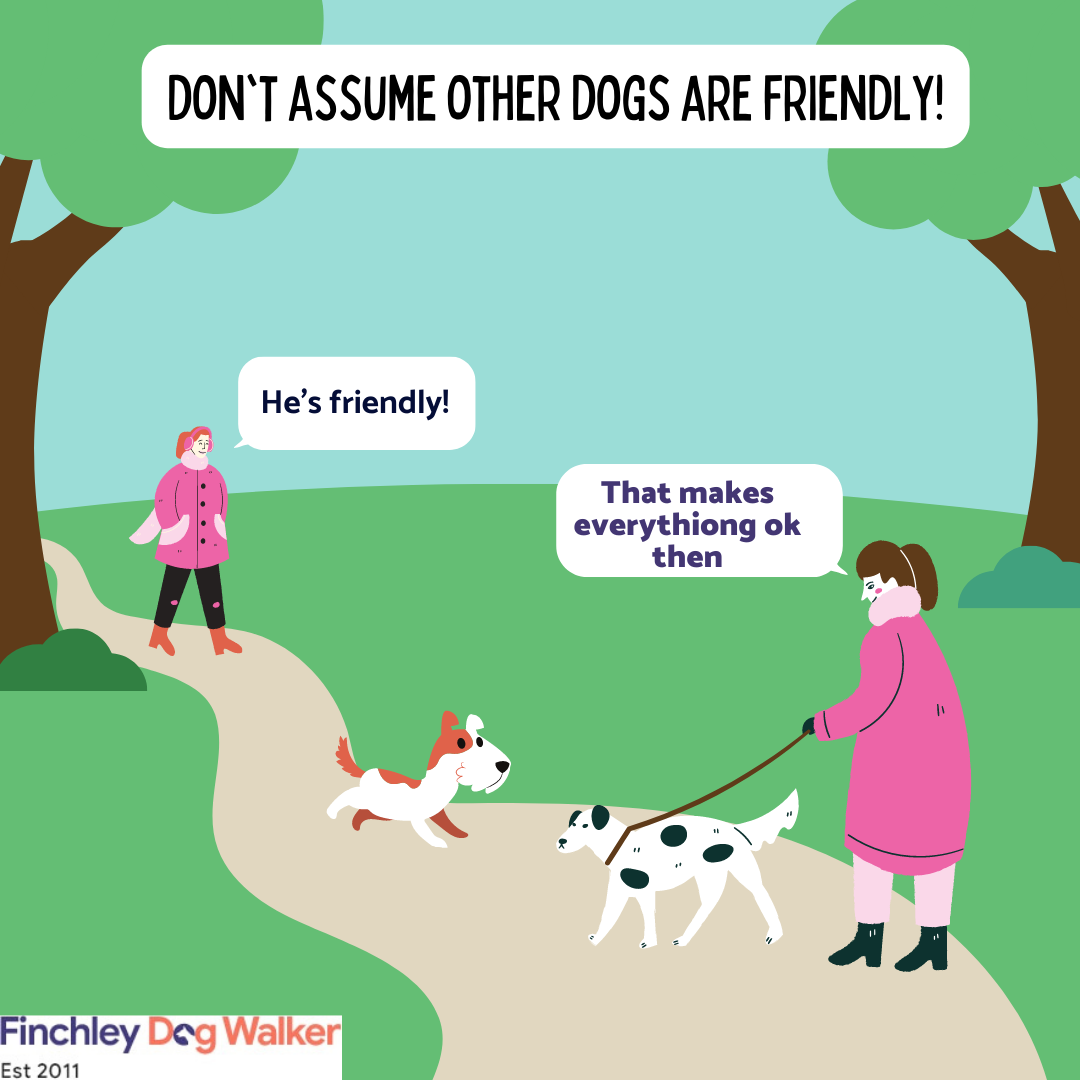
A friendly dog still needs to be under control
“He’s friendly!”
Most dog walkers have heard it.
The problem is that the other dog may not be.
Or they may be recovering from surgery.
They may be elderly.
They may be frightened.
They may be learning to feel safer around other dogs.
Their owner might not want an interaction.
The same applies to people.
Someone may be frightened of dogs.
A child may panic.
A person may have mobility problems.
Someone wearing clean clothes for work may understandably not want muddy paws jumping at them.
Being friendly is not permission to invade somebody else’s space.
If you cannot reliably prevent your dog reaching another dog or person, use a lead or long line where appropriate.
Should dogs greet every dog they meet?
No.
Dogs do not need to greet every dog on a walk.
In fact, constantly expecting greetings can create problems for some dogs.
They may begin pulling towards every dog.
They may become frustrated when they cannot say hello.
A nervous dog may find repeated greetings overwhelming.
And two dogs that are perfectly pleasant individually may not want to interact with each other.
I generally prefer neutral behaviour.
Notice the other dog.
Stay connected with me.
Move past.
Then carry on with the walk.
Dogs can have friends without needing to meet every stranger in the park.
Give other dogs space
One of the simplest things you can do in public is give other dogs room.
If I see someone deliberately crossing the road with their dog, stepping behind a tree or moving to the edge of the path, I assume they are creating space for a reason.
I do not follow them across with the dog I am walking.
If a dog is wearing a muzzle, that is another good reason to respect their space rather than assuming something negative about them.
Muzzles can be used for many reasons, and responsible muzzle use can be an excellent safety measure.
The important principle is straightforward.
You do not need to know why someone wants space.
Just give it to them.
What if my dog is reactive?
Reactive dogs may bark, lunge or pull towards dogs, people, traffic or other things in their environment.
That does not automatically mean the dog is aggressive.
Reactivity can involve fear, frustration, excitement or feeling overwhelmed.
Dogs Trust recommends measures such as creating distance, walking at quieter times, changing direction before reactions escalate and rewarding calmer behaviour.
You can read their guidance on understanding and helping reactive dogs.
This fits closely with how I work.
If I spot something that a dog is likely to struggle with, I would rather cross the road early than march directly towards it and test whether the dog reacts.
I might:
- change direction
- move behind a parked car
- cross the road safely
- increase distance
- use food to reinforce moving with me
- encourage sniffing once we are somewhere safer
- wait in a quieter spot
- abandon that route completely
Avoiding an unnecessary reaction is useful.
The dog does not have to prove anything.
For dogs that need this quieter approach, see my Rescue Dog Support in Finchley.
Why I don’t use sharp lead corrections
Older dog-training advice often recommended jerking the lead or giving a dog a sharp correction when they behaved badly in public.
That is not how I work.
A lead is primarily a safety connection between the dog and me.
If a dog is worried about another dog and I add discomfort every time another dog appears, I risk making that association worse rather than better.
Instead, I concentrate on:
- preventing situations from becoming overwhelming
- rewarding useful responses
- creating distance
- reinforcing attention
- teaching direction changes
- improving lead skills gradually
- helping the dog make better choices
My guide to Training Rewards for Dogs explains how food, play, sniffing and access to the environment can all be used constructively.
Teach your dog to check in with you
One of my favourite everyday walking skills is incredibly simple.
Your dog looks at you voluntarily.
Reward it.
You are building value in the dog noticing where you are.
That can become very useful outdoors.
A dog that regularly checks in is easier to guide around:
- another dog
- a busy crossing
- a cyclist
- wildlife
- children
- food on the pavement
- something unexpected ahead
You do not need your dog staring at you for the entire walk.
I certainly do not want that.
I want dogs to sniff and investigate too.
The useful part is creating a balance between exploring the world and remaining aware of the person holding the lead.
Recall is about safety, not showing off.
A dog being off lead is only enjoyable if you can manage the situation safely.
Recall is therefore one of the most important skills to practise.
Start somewhere easy.
Reward the return generously.
Build distractions gradually.
Do not repeatedly call your dog when they are already too distracted to respond.
And use a long line where appropriate while the behaviour is still developing.
If your dog’s recall is unreliable around dogs, wildlife, people or food, that is useful information.
It tells you they are not ready for unrestricted freedom in that situation yet.
Putting them back on lead is not admitting defeat.
It is responsible management.
When should I put my dog back on lead?
Even dogs that normally have off-lead freedom may need to go back on lead.
I would consider doing so when:
- approaching a road or car park
- entering a busy area
- approaching livestock
- seeing another dog already on lead
- passing children
- passing someone who appears uncomfortable
- wildlife is nearby
- visibility is poor
- the environment is becoming crowded
- recall is deteriorating
- your dog is becoming overexcited
- signs require it
Your dog’s freedom should fit the situation.
It does not have to be all or nothing.
What about children?
Never assume a child wants to interact with your dog.
Some children adore dogs.
Others are terrified of them.
A friendly large dog running towards a small child can be frightening even when the dog has absolutely no intention of hurting them.
I would rather prevent the approach.
Keep enough space that the child and their parent can decide whether an interaction is wanted.
If a greeting does take place, keep it calm and supervised.
A dog that jumps up enthusiastically may need more work before greeting unfamiliar children.
My guide How to Stop Dogs Jumping Up explains how I teach calmer alternatives without using outdated physical corrections.
Runners, cyclists and scooters
Fast movement can be difficult for some dogs.
A runner may trigger excitement.
A cyclist can appear suddenly from behind.
Scooters can be noisy and unpredictable.
For nervous or reactive dogs, these things may be genuinely worrying.
I try to notice them early.
Shorten the lead where appropriate.
Move to one side.
Give the person enough space.
Reward the dog for staying connected with you.
If necessary, turn away altogether.
A shared path belongs to other people too.
Good dog walking includes making their journey easier as well.
Sniffing and public control can coexist
A controlled walk does not have to be a restrictive walk.
Dogs need opportunities to sniff and explore.
I regularly allow the dogs I walk to spend time investigating smells.
The important distinction is between:
“I am letting you explore here”
and
“You can drag me anywhere you like.”
Those are not the same thing.
A dog can have choice within sensible boundaries.
You can read more about this in Why Training Matters and Why Sniffing Wee Is Part of It.
Dogs around livestock and wildlife
If you take your dog into the countryside, different risks arise.
Dogs should be kept under effective control around livestock.
On certain open-access land, GOV.UK requires dogs to be on short leads around livestock and during specified periods protecting ground-nesting birds.
Check current signage and restrictions wherever you walk.
Even a dog that has never shown an interest in sheep or wildlife before can surprise you.
Prevention is much easier than trying to regain control once a chase has started.
Picking up after your dog is part of responsible control
Public responsibility does not stop at training.
Pick up after your dog.
Carry enough bags.
Dispose of them properly.
Do not leave bags hanging from trees or beside paths.
Barnet’s current Public Spaces Protection Order includes requirements concerning dog fouling.
It is a basic consideration for everyone sharing the area.
What equipment do I prefer?
Equipment should help you manage your dog safely without causing unnecessary discomfort.
For most of the dogs I walk, that means an appropriately fitted harness or flat collar with a secure lead.
A long line can be useful for recall practice and controlled freedom where the location makes it appropriate.
I do not use:
- choke chains
- check chains
- prong collars
- shock collars
- slip leads as routine walking equipment
- equipment designed to cause pain or fear
Equipment is not a replacement for training.
But suitable equipment can make training and management considerably safer.
What if something goes wrong?
Even careful owners can encounter unexpected situations.
If your dog slips their equipment or escapes, concentrate on getting them safe rather than panicking or chasing them unthinkingly.
Use familiar recall cues.
Move away rather than towards them if that encourages them to follow.
Use food or a familiar toy where helpful.
Once your dog is secure, check what happened.
Did a clip fail?
Was the harness loose?
Did the dog back out of it?
Was the situation too difficult?
Learning from a near miss can prevent a more serious incident later.
My professional procedure for dogs in my care is explained in my Lost Pet Procedure.
When management is more important than training
Sometimes owners feel that using distance or keeping a dog on lead means they have failed to train them.
I disagree.
Management keeps everybody safe while learning takes place.
Sometimes it remains necessary permanently.
A dog with unreliable recall around wildlife may always need a long line in certain places.
A nervous dog may always be happier avoiding busy events.
A dog that dislikes unfamiliar dogs does not necessarily need to become a social butterfly.
The objective is not to force every dog into the same definition of “well-behaved”.
The aim is to create a safe and manageable life for the dog and the people around them.
When should I seek professional help?
Everyday training and sensible management can solve or reduce many problems.
Some situations need more.
Speak to your vet and an appropriately qualified behaviour professional if your dog:
- has bitten someone
- has caused an injury
- repeatedly attempts to bite
- shows escalating aggression
- experiences significant fear or panic
- is becoming increasingly difficult to manage safely
- suddenly develops a major change in behaviour
- presents a substantial risk to people or other animals
Pain and illness can also affect behaviour, which is why sudden changes deserve veterinary attention.
The Animal Behaviour and Training Council practitioner register is one place to look for appropriately assessed professionals.
Knowing when a situation falls outside everyday walking and training support is part of responsible practice.
How I manage dogs on walks in Finchley
When I am walking around Finchley, I am constantly adjusting what I do to the environment.
A quiet section of Cherry Tree Wood is different from a busy pavement.
An open space where I can see a long way ahead is different from a narrow path with blind corners.
A confident dog is different from a rescue dog still learning that the outside world is safe.
That is why I do not believe in one rigid walking formula.
I look at:
- the individual dog
- their body language
- the environment
- who else is nearby
- traffic
- visibility
- previous experiences
- how settled the dog feels that day
Sometimes the sensible option is to carry on.
Sometimes it is to cross the road.
Sometimes it is to stop and sniff.
And sometimes it is simply to turn around.
Related dog training and walking guides
Continue with:
- Dog Training Hub
- Training Rewards for Dogs
- How to Stop Dogs Jumping Up
- Why Training Matters and Why Sniffing Wee Is Part of It
- Solo Dog Walks in Finchley and Muswell Hill
- Rescue Dog Support in Finchley
Frequently asked questions
Does my dog legally have to be on a lead in public?
Not everywhere.
Different laws and local restrictions apply in different places.
Councils can require dogs to be on leads in designated areas or require an owner to put a dog on a lead.
Always check signs and current local authority guidance.
Even where a lead is not compulsory, you remain responsible for controlling your dog safely.
Can my dog run up to another dog if they are friendly?
I would not allow it.
The other dog might be nervous, injured, elderly, reactive or simply not interested in meeting yours.
If another dog is on lead, give them space unless the owner clearly invites an interaction.
Is an off-lead dog automatically out of control?
No.
Being off lead does not automatically mean a dog is dangerously out of control.
The important issue is whether you can manage the dog safely and comply with any local lead requirements.
If your dog will not reliably return when needed, a lead or long line is the safer option.
Should I tell my dog off for reacting to another dog?
I would not use punishment.
I prefer to create distance, guide the dog away and reward useful behaviour.
If reactions happen regularly, look at the underlying reason and consider appropriate professional support.
What should I do if another off-lead dog approaches mine?
Stay as calm as possible.
Create distance if you can.
Ask the other owner to recall their dog.
Use parked cars, trees or other barriers where appropriate.
If your dog is nervous or reactive, moving away before the interaction happens is usually preferable to waiting to see what happens.
Does my dog need a collar if they wear a harness?
Most dogs in public places are still required under the Control of Dogs Order 1992 to wear a collar carrying the owner’s name and address, even if the lead itself is attached to a harness.
Does my dog still need identification if they are microchipped?
Yes.
Microchipping and collar identification are separate requirements.
Make sure both remain current.
Should I put my dog on lead when I see another dog on lead?
I think that is generally good manners where there is any chance your dog might approach them.
The other dog’s owner may be using a lead for a reason that is not obvious.
Giving them space costs very little.
Can you help if my dog is difficult to control on walks?
I can provide practical everyday support for suitable dogs through calm one-to-one walking and working or training walks.
That may include checking in, lead skills, moving away from distractions, sniffing, confidence and calmer routines.
I do not provide clinical behaviour treatment for serious aggression or complex behavioural conditions.
Need practical help on everyday walks?
If your dog needs calm one-to-one walking rather than a group environment, have a look at my Solo Dog Walks in Finchley and Muswell Hill.
For dogs that benefit from everyday skills being reinforced during their walk, explore my Working and Training Walks.
And if your dog is nervous, reactive or newly rehomed, start with Rescue Dog Support in Finchley.
Final thoughts
Controlling your dog in public is not about demanding perfect obedience.
It is about responsibility.
Notice what is around you.
Give people and dogs space.
Use a lead when it is needed.
Build recall before relying on it.
Reward the behaviours you want.
Manage situations your dog is not ready for.
And remember that other people have as much right to enjoy a park, pavement or woodland path as you and your dog do.
A good dog walk should allow your dog to sniff, explore and enjoy themselves while still being safe and considerate.
Those two things can exist together.
Important
This guide provides general dog-walking, training and public-safety information and is not legal, veterinary or individual behavioural advice. Laws and local restrictions can change. Check current GOV—UK and local council guidance where necessary. Seek veterinary or appropriately qualified behavioural support if your dog’s behaviour changes suddenly or presents a significant safety risk.

