
Updated August 2026
It is a walk planned around the individual dog.
That might mean allowing more time to sniff, choosing a quieter route, exploring safe surroundings, practising one simple skill or creating more distance from something the dog finds difficult.
The aim is not to keep your dog constantly entertained or to exhaust them.
It is to provide a safe and worthwhile walk that takes into account their age, health, confidence, interests, and behaviour on that particular day.
I provide calm, local dog walks in Finchley, North Finchley, Finchley Central, East Finchley and Muswell Hill.
Every walk begins and ends at your dog’s home. I do not use vans, collection rounds or groups containing dogs from different households.
For the full service, prices and booking information, visit Solo Dog Walks in Finchley and Muswell Hill.
Key Takeaways
- One-to-one enriched dog walks focus on individual needs, allowing time for sniffing and exploration.
- These walks provide a calm environment tailored to the dog’s behaviour, age, and health.
- The service avoids group mixing and transport issues, starting and ending at the dog’s home.
- Enrichment does not mean constant entertainment; it values a dog’s comfort and personal pace.
- Suitable for rescue, nervous, senior, and young dogs, enhancing their well-being and confidence.
Table of contents
- One-to-one enriched walks at a glance
- What does one-to-one mean?
- What does enriched mean?
- How is an enriched walk different from a distance-focused walk?
- What might happen during an enriched walk?
- Starting calmly from home
- Choosing a suitable route
- Allowing time to sniff
- Is sniffing always calming?
- Offering safe choices
- Exploring safe surroundings
- Using simple food searches
- Brief reward-based engagement
- Watching the world
- Enrichment does not mean constant entertainment
- Enrichment should not cause frustration
- Which dogs may benefit from enriched walks?
- Rescue dogs
- Nervous and reactive dogs
- Senior dogs
- Puppies and young dogs
- Dogs on restricted exercise
- A real example from my walks
- How do I know whether an activity is helping?
- Enriched walk, sniff walk or decompression walk?
- Are enriched walks a separate service?
- Local one-to-one dog walking
- Is this approach suitable for your dog?
- Frequently asked questions
- What is a one-to-one enriched dog walk?
- Is an enriched walk the same as a long walk?
- Do enriched walks tire dogs out?
- Is sniffing good for dogs?
- Does sniffing replace physical exercise?
- Is sniffing always calming?
- Are enriched walks suitable for reactive dogs?
- Will enrichment stop my dog pulling?
- Do you use food on walks?
- Does every enriched walk include games?
- Can senior dogs have enriched walks?
- Are enriched walks suitable for puppies?
- Can my dog choose the route?
- What happens when my dog does not want to take part?
- Do you offer home enrichment visits?
- How do I enquire?
- Enrichment should fit the dog
- Related Finchley Dog Walker guides
- Veterinary and behaviour disclaimer
One-to-one enriched walks at a glance
| Feature | What it means |
|---|---|
| Walking arrangement | One dog or compatible dogs from the same household |
| Starting point | Your dog’s home |
| Transport | No vans or car journeys |
| Route | Adapted around the individual dog |
| Pace | Based on age, health, confidence and surroundings |
| Enrichment | Sniffing, exploring, safe choices and suitable activities |
| Handling | Calm and reward based |
| Group pressure | No dogs from different households are mixed |
| Main areas | Finchley, N12, N3, N2 and Muswell Hill N10 |
| Booking | Subject to location, availability and a suitable introduction |
What does one-to-one mean?
One-to-one means your dog receives my attention without being added to a group of unfamiliar dogs.
There is:
- No group collection route
- No waiting in a van
- No pressure to match another dog’s pace
- No expectation to greet unfamiliar dogs
- No fixed park used for every client
- No requirement to complete the same route every day
I may walk two compatible dogs from the same household together when I am confident that this is safe and suitable for both dogs.
I do not combine dogs from different homes.
This gives me more freedom to:
- Slow down
- Change direction
- Avoid a busy park entrance
- Create distance from another dog
- Choose a quieter street
- Allow more sniffing
- Return home when the dog has had enough
Some dogs thrive in groups.
Others find the noise, travel, excitement or closeness of unfamiliar dogs overwhelming.
A one-to-one arrangement lets me respond to the dog in front of me rather than manage several competing needs.
What does enriched mean?
Canine enrichment involves giving dogs safe and suitable opportunities to use natural behaviours, engage their senses and interact with their surroundings.
Dogs Trust describes enrichment as providing dogs with opportunities to exercise their bodies and minds, including sniffing, searching, playing and exploring. Read the Dogs Trust guide to enrichment activities.
On a walk, enrichment might include:
- Time to sniff
- Exploring a safe area
- Walking across different suitable surfaces
- Choosing between two safe directions
- Watching the environment from a comfortable distance
- Searching for a small amount of approved food
- Brief reward-based engagement
- Moving away from something worrying
- Walking at a pace the dog can manage
- Having a quiet, familiar outing
It does not require expensive equipment.
The route, surroundings and freedom to investigate can provide much of the enrichment.
For the broader subject, including indoor activities, food enrichment and safe games, read Dog Enrichment Ideas That Actually Help.
How is an enriched walk different from a distance-focused walk?
Human measurements judge many dog walks:
- How far did the dog walk?
- How fast did they move?
- How many steps were completed?
- Did they finish the usual route?
- Did they appear tired afterwards?
Those questions do not tell us whether the walk was suitable.
An enriched walk also considers:
- Did the dog have time to investigate?
- Could they move away from pressure?
- Was the route manageable?
- Did the surface suit their mobility?
- Were they able to respond and make safe choices?
- Did the activity remain enjoyable?
- How did they recover afterwards?
| Distance-focused approach | Enrichment-led approach |
|---|---|
| Success is measured mainly by miles | Success is measured by suitability |
| A fixed route is completed | The route may change |
| Sniffing is treated as a delay | Sniffing is part of the walk |
| The person sets the pace | The pace considers the dog |
| Every day follows the same plan | The plan reflects that day’s needs |
| The walk continues to finish the loop | It may finish early when appropriate |
| More activity is assumed to be better | Activity is balanced with recovery |
Walking further is not automatically better.
Some dogs enjoy brisk, active walks. Others gain more from a shorter outing with time to explore and process their surroundings.
My Dog Walking and Everyday Exercise Guide explains why distance, intensity, health and recovery all matter.
What might happen during an enriched walk?
There is no compulsory list of activities.
A useful walk may contain several forms of enrichment, one simple opportunity or no planned game at all.
The walk depends on:
- Your dog’s age
- Physical health
- Mobility
- Confidence
- Diet
- Normal routine
- Behaviour around food
- Response to people and dogs
- Weather
- Local conditions
- What they have already done that day
- How they appear when I arrive
Starting calmly from home
Every walk begins at the client’s door.
Some dogs are ready to leave immediately.
Others need a few moments to:
- Adjust to my arrival
- Have their equipment fitted
- Look outside
- Check the immediate surroundings
- Move from resting into activity
I do not need every dog to charge through the doorway.
A calm start can be particularly helpful for a nervous dog or a dog who becomes highly excited when the lead appears.
Choosing a suitable route
The most attractive route for a person is not always the most suitable one for a dog.
A woodland path may be enjoyable for one dog but difficult for another because it contains:
- Narrow paths
- Hidden dogs
- Wildlife
- Mud
- Low visibility
- Busy entrances
- Unpredictable off-lead encounters
A dog who struggles in Coldfall Wood may cope better on quieter residential streets.
Another dog may enjoy Cherry Tree Wood during a quiet period but find it too busy after school or at weekends.
When planning the walk, I consider:
- Traffic
- Other dogs
- Park entrances
- Schools
- Roadworks
- Noise
- Narrow pavements
- Weather
- Ground conditions
- Known triggers
- The dog’s physical comfort
Read Where I Walk Dogs in Finchley and How I Choose the Route for more about my local approach.
Allowing time to sniff
Sniffing is one of the simplest ways a dog interacts with their environment.
Dogs use scent to investigate where animals and people have been and what has changed since their previous walk.
Dogs Trust describes sniffing as a natural behaviour and an important way dogs gather information about their surroundings. (Dogs Trust)
A lamppost, hedge, tree or patch of grass may hold far more interest for your dog than it does for you.
I do not automatically drag a dog away because sniffing slows down the route.
There are still times when we need to move on, including when:
- We are close to traffic
- Another dog is approaching
- The surface is unsafe
- The dog is eating rubbish
- We are blocking an entrance
- The dog is becoming tense or frantic
- The area has been treated with chemicals
A sniff walk still needs safe boundaries.
Read Stop Counting Steps: Why Your Dog Needs Time to Sniff for a fuller explanation.
Is sniffing always calming?
No.
Sniffing is a natural and valuable behaviour, but it does not prove that a dog is relaxed.
A dog can sniff while also:
- Scanning the environment
- Holding their body tensely
- Moving increasingly quickly
- Pulling towards home
- Tracking another animal urgently
- Refusing familiar food
- Struggling to disengage
- Reacting to nearby dogs
I look at the whole dog rather than one behaviour.
I pay attention to:
- Body tension
- Pace
- Breathing
- Tail position
- Ability to move away
- Response to sounds
- Interest in normal rewards
- Recovery after noticing something
Sniffing is an activity.
It is not a guaranteed treatment for fear, anxiety or reactive behaviour.
My Sniff and Decompression Walks Guide explains why the environment and the whole dog matter.
Offering safe choices
Choice does not mean allowing a dog to:
- Enter the road
- Chase wildlife
- Approach every dog
- Eat discarded food
- Pull someone across a path
- Enter another person’s garden
- Ignore normal safety boundaries
It can mean offering two manageable options.
For example:
- Left or right at a quiet junction
- Continue or turn towards home
- Sniff this verge or move to the other side
- Watch from a distance or walk away
- Take part in an activity or ignore it
Small choices can tell me something about the dog’s comfort.
A dog who repeatedly chooses to move away may need less pressure.
A dog who suddenly refuses a normal route may be worried, tired, uncomfortable or reacting to something I have not yet noticed.
I remain responsible for safety, but the dog does not need every second of the walk controlled for them.
Exploring safe surroundings
Environmental enrichment may involve exploring different suitable surroundings or surfaces.
Depending on the dog, that might include:
- Grass
- Dry leaves
- Firm woodland paths
- Smooth pavements
- A gentle slope
- A quiet green space
- Familiar street furniture
- Different safe textures beneath the feet
I do not encourage dogs to climb, jump or balance to create an impressive photograph.
Puppies, senior dogs and dogs with mobility concerns need activities adapted to their bodies.
A hesitant dog should not be pulled onto a new surface.
Using simple food searches
Where the owner has agreed, and the location is appropriate, I may use part of the dog’s normal food or approved treats for a brief search.
This could involve:
- Dropping one visible piece of food
- Scattering a few pieces over clean grass
- Placing a reward beside a familiar tree
- Creating a very short scent trail
- Using a simple “find it” activity
I start at an easy level.
The aim is not to make the dog struggle for as long as possible.
Blue Cross explains that scent work uses a dog’s natural ability to search and recommends beginning with simple, achievable games. Read the Blue Cross guide to scent work.
I do not scatter food:
- Near broken glass
- Among unknown plants or fungi
- In dirty roadside grass
- Where chemicals may have been used
- Close to another dog
- Where food competition may occur
- When the dog guards food
- When the owner has not approved it
- When the dog has dietary restrictions
- Where rubbish may be swallowed
Food used during a walk still forms part of the dog’s daily intake.
Dogs Trust advises accounting for food-based enrichment within the dog’s normal allowance to reduce overfeeding.
Brief reward-based engagement
An enriched walk does not need to become an hour-long training lesson.
However, brief moments of reward-based engagement may help a dog navigate ordinary situations.
This might include:
- Responding to their name
- Checking in
- Following a calm direction change
- Pausing before a road
- Reinforcing a loose-lead moment
- Moving away from a distraction
- Returning attention after sniffing
I do not repeatedly drill behaviours.
Your dog should still have time to move, sniff, investigate and rest.
When an owner already has a suitable routine from a trainer or behaviourist, I can reinforce that agreed approach consistently.
Watching the world
Some dogs enjoy pausing somewhere suitable and observing their surroundings.
That may involve:
- Watching people from a distance
- Listening to ordinary local sounds
- Observing traffic from a safe position
- Seeing another dog without approaching
- Resting briefly in a familiar place
This can be useful when the dog remains able to:
- Look away
- Move normally
- Take food as usual
- Respond to the handler
- Leave the area
It is not useful when the dog is:
- Frozen
- Intensely staring
- Barking
- Lunging
- Panicking
- Unable to disengage
Distance and context matter.
Enrichment does not mean constant entertainment
One common mistake is trying to make every minute of a dog’s life stimulating.
A dog does not need:
- Food at every tree
- A game every few minutes
- Constant commands
- A different route every day
- Continuous novelty
- An obstacle course on every walk
- Repeated ball throwing
- Pressure to interact
Too much activity can leave some dogs more restless rather than more settled.
Sometimes the most useful walk involves:
- A familiar route
- Unhurried sniffing
- Predictable handling
- Nothing difficult happening
- Returning home before the dog becomes overwhelmed
That still counts as an enriched and worthwhile experience.
Enrichment should not cause frustration
An activity stops being useful when the dog becomes increasingly confused, frantic or distressed.
Warning signs can include:
- Barking at the activity
- Hard, repeated pawing
- Biting equipment
- Grabbing food roughly
- Repeatedly looking for help
- Abandoning the activity
- Guarding the food or object
- Becoming increasingly agitated
- Freezing or shutting down
- Attempting to leave
Blue Cross advises that food enrichment should not be so difficult that it causes frustration and recommends increasing difficulty gradually. Read the Blue Cross enrichment guidance.
I would rather simplify an activity than praise a dog for struggling.
Read Dog Enrichment Safety: When a Brain Game Becomes Frustrating for fuller guidance.
Which dogs may benefit from enriched walks?
Most dogs can benefit from suitable opportunities to sniff, explore and make safe choices.
The type and amount of enrichment will differ.
Rescue dogs
A newly adopted dog may be coping with:
- A new home
- New people
- New equipment
- Different traffic
- Unfamiliar routes
- New dogs
- A changed routine
They do not necessarily need constant novelty.
Many benefit more from:
- Predictability
- Manageable choices
- Shorter outings
- Quiet routes
- Time to observe
- Familiar activities
Read Low-Pressure Enrichment for Nervous and Rescue Dogs.
Nervous and reactive dogs
A nervous or reactive dog may benefit from:
- Quieter routes
- More distance
- Predictable handling
- Fewer forced interactions
- Permission to move away
- Shorter walks
- Familiar scent activities
- Calm recovery time
Enrichment does not cure reactivity or serious fear.
It can form part of a daily routine that reduces unnecessary pressure and provides appropriate outlets.
My Reactive and Nervous Dog Walking service explains the difference between normal solo walks and more focused support.
Where a dog shows severe fear, aggression, biting or another significant concern, veterinary and appropriately qualified behavioural support may be needed.
The Animal Behaviour and Training Council practitioner directory can help owners look for registered professionals. (ABTC)
Senior dogs
An older dog may no longer want to cover the distance they managed several years ago.
They may still enjoy:
- Sniffing familiar places
- Walking slowly
- Exploring a small area
- Choosing the route
- Watching the environment
- Completing an easy search
The walk must consider their mobility, health and recovery.
A sudden change in movement, willingness to walk or exercise tolerance should be discussed with a veterinary practice rather than treated solely as an enrichment issue.
Puppies and young dogs
Puppies need manageable opportunities to learn about the world without becoming overwhelmed.
An enriched puppy outing might involve:
- A brief walk
- Watching traffic from a suitable distance
- Sniffing a new surface
- Calm lead practice
- Investigating an ordinary object
- Returning home for sleep
A puppy does not need to meet every dog, greet every person or complete a long route.
Read Bringing a Puppy Home: Complete First-Year Guide.
Dogs on restricted exercise
A dog recovering from injury or following veterinary instructions may need adapted activity.
That could involve:
- A short toilet walk
- Calm observation
- A stationary scent activity
- A very simple food search
- Limited movement
- More rest
Veterinary instructions take priority.
I do not add climbing, jumping, chasing or additional distance to a restricted-exercise plan without approval.
A real example from my walks
Rudy is a rescue dog I have worked with for several years.
When we began, simply developing a comfortable relationship and establishing a predictable walking routine took time.
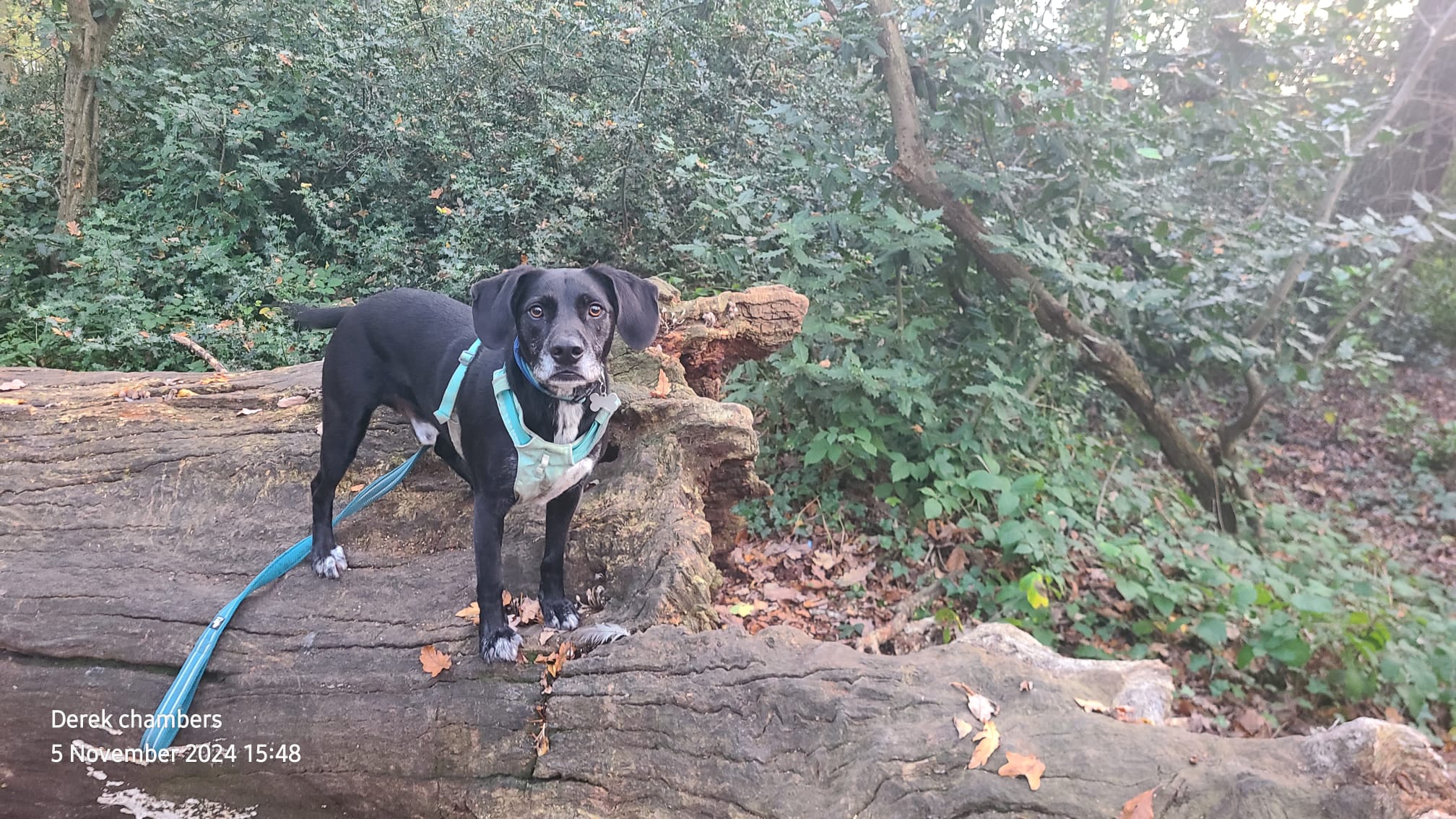
Today, he enjoys exploring Coldfall Wood and searching around what I call his Magic Tree.
The tree is not specialist enrichment equipment.
It is simply a familiar location where I may place a few agreed food rewards for him to find safely.
The activity works because it is:
- Familiar
- Achievable
- Brief
- Safe
- Adapted around Rudy
- Part of the walk rather than the entire walk
We then move on.
Another dog may not enjoy the same activity.
That is why enrichment needs to fit the individual rather than being copied from a social-media video.
You can read more about his progress in Rudy’s Rescue Dog Success Story.
How do I know whether an activity is helping?
I watch how the dog approaches, uses and leaves the activity.
Positive signs may include:
- Approaching voluntarily
- Investigating at a manageable pace
- Taking food normally
- Remaining aware of the surroundings
- Moving away when finished
- Returning to normal walking
- Showing no guarding or frustration
- Remaining physically comfortable
I make the activity easier, stop or change direction when the dog:
- Avoids it
- Becomes frantic
- Appears uncomfortable
- Guards the item
- Attempts to swallow unsafe material
- Cannot disengage
- Becomes overwhelmed by the location
- Needs rest instead
The activity is supposed to help the dog.
The dog is not there to perform the activity for me.
Enriched walk, sniff walk or decompression walk?
The terms overlap, but they do not mean the same thing.
Enriched walk
An enriched walk includes suitable opportunities for natural behaviour, exploration, choice and mental engagement.
It may involve sniffing, searching, brief training and different surroundings.
Sniff walk
A sniff walk deliberately gives the dog more time to use their nose.
The distance may be short because pace and mileage are not the main priorities.
Decompression-style walk
When I use this term, I mean a lower-pressure walk that considers:
- Environment
- Distance from triggers
- Pace
- Predictability
- Body language
- Ability to move away
Sniffing may form part of it, but the setting and emotional pressure matter too.
Focused nervous or reactive support walk
A focused support walk gives more attention to agreed real-life skills, careful route planning and situations the dog finds difficult.
It is not veterinary behavioural treatment or a promise to change behaviour within a set number of sessions.
The name matters less than whether the walk genuinely suits the dog.
Are enriched walks a separate service?
Appropriate enrichment is already included in my solo dog walks.
I do not charge extra because a dog needs time to sniff, a quieter route or a short search activity.
Those decisions are part of providing a suitable walk.
The emphasis varies between dogs.
One dog may enjoy a steady local walk with a few sniffing stops.
Another may spend more time exploring a quiet green space.
A senior dog may need a slower pace.
A nervous dog may need carefully managed distance.
A dog requiring a more involved handling and support plan may be better suited to my focused nervous or reactive walking option.
Visit Solo Dog Walks in Finchley and Muswell Hill for the current options and prices.
For dogs who need calm activity at home rather than a full outdoor walk, visit Canine Enrichment Visits in Finchley.
Local one-to-one dog walking
I mainly provide walks in:
- North Finchley and N12
- Finchley Central and N3
- East Finchley and N2
- Muswell Hill and N10
- Selected nearby locations
I work locally on foot, so availability depends on your postcode and the location of existing clients.
Check the Finchley Dog Walker service area before enquiring.
Is this approach suitable for your dog?
An enrichment-led one-to-one walk may suit your dog when they:
- Need space from unfamiliar dogs
- Find group walks difficult
- Dislike vans or car journeys
- Become overwhelmed in busy places
- Prefer familiar local routes
- Need more time to sniff
- Are newly rescued
- Are older and need a gentler pace
- Are rebuilding confidence
- Have restricted exercise requirements
- Enjoy individual attention
- Need a predictable routine
Your dog does not need to have a behavioural problem.
Some owners prefer their dog to receive personal attention from the same walker.
Frequently asked questions
What is a one-to-one enriched dog walk?
It is an individual walk that includes suitable opportunities to sniff, explore, make safe choices and engage with the environment.
The route, pace and activities are adapted around the dog.
Is an enriched walk the same as a long walk?
No.
An enriched walk may be long or short.
The important question is whether its duration, route, pace and content suit the individual dog.
Do enriched walks tire dogs out?
Mental engagement may help some dogs feel satisfied and ready to rest afterwards.
I do not promise that a specific amount of sniffing or enrichment will make every dog tired.
Is sniffing good for dogs?
Sniffing is a natural way for dogs to investigate their environment.
Dogs Trust recommends allowing dogs time and opportunity to sniff during walks. (Dogs Trust)
Does sniffing replace physical exercise?
No.
Most dogs still need suitable physical movement.
Exercise, sniffing, mental engagement, sleep and recovery should form a balanced routine.
Is sniffing always calming?
No.
Some dogs sniff calmly, while others become increasingly tense, excited or focused.
Look at the whole dog and its surroundings.
Are enriched walks suitable for reactive dogs?
They may be.
Quieter routes, appropriate distance and predictable activities can reduce unnecessary pressure.
Enrichment alone does not treat serious fear, aggression or reactivity.
Will enrichment stop my dog pulling?
Not automatically.
Pulling may be influenced by excitement, fear, training history, equipment, the environment or a desire to reach something.
Sniffing and rewards can form part of a walking plan, but they are not an instant solution.
Do you use food on walks?
I may use owner-approved food when it suits the dog, diet, activity and location.
I do not use food where it would create a dietary, medical, guarding or safety concern.
Does every enriched walk include games?
No.
Many useful walks involve no formal games.
Sniffing, safe exploration, quiet routes and suitable choice can provide enrichment without equipment.
Can senior dogs have enriched walks?
Yes, when the duration, route and activities suit their health and mobility.
A shorter sniffing walk may be more appropriate than maintaining a previous distance.
Are enriched walks suitable for puppies?
They can be, provided outings are brief, manageable and balanced with sleep and recovery.
Puppies do not need constant novelty or excessive exercise.
Can my dog choose the route?
I may offer safe, limited choices.
I still manage roads, wildlife, other dogs and other hazards.
What happens when my dog does not want to take part?
I do not force an activity.
I may simplify it, continue walking, create more space or decide that the dog needs rest.
Do you offer home enrichment visits?
Yes.
A home visit may suit a dog needing companionship, a toilet opportunity or calm activity without a complete walk.
Visit Canine Enrichment Visits in Finchley.
How do I enquire?
Please send:
- Your name
- Postcode
- Dog’s age and breed or type
- Current walking routine
- Behaviour around people and dogs
- Health or mobility information
- Days and frequency required
I will tell you honestly which walking option is most likely to suit your dog.
Contact Del about one-to-one dog walks
Enrichment should fit the dog
The number of games completed does not measure a successful enriched walk.
It is measured by whether the walk was safe, appropriate and worthwhile for the individual dog.
That may mean:
- More sniffing
- A quieter route
- A simple search
- One short reward-based exercise
- More space from another dog
- A slower pace
- Returning home early
- Doing less
Every dog is different.
Their needs can also change from one day to the next.
My job is not to force every dog through the same route or activity.
It is to pay attention to the dog in front of me and provide a walk that suits them.
Read about Solo Dog Walks in Finchley and Muswell Hill or contact Del with your postcode and a brief description of your dog.
Related Finchley Dog Walker guides
- Dog Enrichment Ideas That Actually Help
- Stop Counting Steps: Why Dogs Need Time to Sniff
- Sniff and Decompression Walks
- Dog Walking and Everyday Exercise
- Dog Enrichment Safety
- Low-Pressure Enrichment for Nervous and Rescue Dogs
- Rescue Dog Support in Finchley
- Reactive and Nervous Dog Walking
- Rudy’s Rescue Dog Success Story
- Solo Dog Walks
- Canine Enrichment Visits
Veterinary and behaviour disclaimer
This guide provides general information about dog walking and enrichment.
It does not diagnose pain, fear, anxiety, aggression, reactivity or another behavioural or medical condition.
Speak to your veterinary practice before changing the exercise routine of a puppy, senior dog, unwell dog or dog recovering from injury.
Sudden changes in walking, movement, appetite, behaviour or willingness to exercise should be discussed with your vet.
Dogs showing serious fear, aggression, biting or persistent distress may also need help from an appropriately qualified reward-based behaviour professional.


