Choosing a dog walker isn’t just about finding someone with an hour free who enjoys being around dogs.
You’re trusting another person with your dog’s welfare, safety and daily routine. In many cases, you’re also giving them access to your home.
That’s a significant responsibility.
A good dog walker needs more than a love of animals. They should understand dog behaviour, safe handling, emergency procedures and how to adapt their approach when a dog is worried, tired or unwell.
I’m Del, and I’ve provided professional dog walking and pet care around Finchley and North London since 2011.
My own service focuses on calm, one-to-one walks starting from the dog’s home. I don’t use vans or combine unrelated dogs into group walks.
But I also recognise that different dogs have different needs. A well-managed group walk may suit one dog, while another would be far happier exploring quietly with a familiar walker.
This guide explains what I would look for when choosing a professional dog walker, which questions I’d ask and the warning signs I wouldn’t ignore.
Whether you’re searching in Finchley, Muswell Hill or elsewhere in the UK, the principles are much the same.
This guide provides general dog-care information. It doesn’t replace veterinary advice, an individual behavioural assessment or advice about a specific legal situation.
Affiliate disclosure: This article contains one Amazon affiliate link. As an Amazon Associate, I earn from qualifying purchases. If you buy through the link, I may receive a small commission at no additional cost to you.
Table of contents
- Key takeaways: choosing a good dog walker
- Start with your dog’s needs
- What makes a good professional dog walker?
- 1. Check the dog walker’s insurance
- 2. Ask about experience, training and qualifications
- 3. Ask about handling and training methods
- 4. Will your dog be walked alone or in a group?
- 5. Find out whether the walker uses cars or vans
- 6. Check whether a DBS check is appropriate
- 7. Does a dog walker need a licence in England?
- 8. Ask about canine first aid and emergencies
- 9. Discuss off-lead walking and identification
- 10. Understand the weather policy
- 11. Agree equipment, treats and rewards
- 12. How long is the actual dog walk?
- 13. Ask about reliability and home security
- 14. Check genuine reviews and references
- 15. Arrange a meet-and-greet before regular walks
- 16. Should you arrange a trial walk?
- Warning signs when choosing a dog walker
- A checklist for choosing a dog walker
- Choosing a dog walker in Finchley and Muswell Hill
- Frequently asked questions
- Related guides
- The right dog walker is the one who understands your dog
Key takeaways: choosing a good dog walker
- Choose a walker who understands your dog’s individual needs, rather than expecting every dog to fit the same routine.
- Check appropriate insurance, experience, canine first aid knowledge and emergency arrangements.
- Ask whether your dog will walk alone or with other dogs, and how they manage groups.
- Find out whether they use cars or vans, and how long your dog may spend travelling.
- Discuss handling methods, equipment, treats, recall and off-lead permission before the first walk.
- Meet the person who will actually be caring for your dog.
- Agree prices, bookings, cancellation terms, key security and communication in writing.
- Pay attention to how your dog responds, not just how tired they are afterwards.
Start with your dog’s needs
Before contacting any walkers, think about what your dog actually enjoys and what they find difficult.
Two dogs of the same breed and age can have very different personalities.
One may enjoy meeting unfamiliar dogs and exploring busy parks.
Another might be perfectly happy having a quiet sniff around familiar streets.
An older dog may need a slower pace and more rest.
A newly adopted rescue dog might still be learning that the world outside their new home is safe.
That’s why I don’t believe every dog should automatically be booked onto the same type of walk.
What type of walk would suit your dog?
Think about whether they might benefit from:
- Individual attention.
- A familiar walker.
- Walking directly from home.
- Quieter routes.
- More space around unfamiliar dogs.
- Shorter or slower walks.
- Opportunities to sniff and explore.
- Remaining on a lead or suitable long line.
- A predictable routine.
- Help maintaining everyday reward-based skills.
You should also consider their age, fitness, health, confidence and previous experiences.
If your dog has medical needs, follow your vet’s guidance about suitable exercise.
For a detailed comparison of walking arrangements, read my Solo Dog Walks vs Group Dog Walks Guide.
What makes a good professional dog walker?
A good dog walker should be reliable, observant, responsible and willing to explain how they work.
They don’t need to pretend they can manage every dog or every situation.
In fact, I think knowing when to say no is an important part of professional pet care.
I’d expect a walker to ask about:
- Your dog’s normal routine.
- Health conditions and medication.
- Behaviour around other dogs.
- Behaviour around unfamiliar people.
- Fears and triggers.
- Walking equipment.
- Recall and lead skills.
- Food allergies or restrictions.
- The veterinary practice you use.
- Emergency contacts.
- Anything that might affect safety during a walk.
If somebody wants to start walking your dog without asking anything about them, I would want to know why.
The Dogs Trust guide to finding a good dog walker provides an independent checklist covering training, insurance, transport, emergencies and written arrangements.
1. Check the dog walker’s insurance
Insurance should be one of the first things you ask about.
A professional walker should have suitable cover for the activities they provide.
Don’t be afraid to ask for evidence.
It’s a reasonable request when somebody is taking responsibility for your dog.
What insurance should a dog walker have?
Third-party or public liability insurance is an important consideration.
But the statement “I’m fully insured” doesn’t tell you what a policy actually covers.
I’d ask:
- Is the policy current?
- Does it cover professional dog walking?
- Does it cover walking multiple dogs together?
- Does it cover the activities being offered?
- Are there relevant exclusions or restrictions?
- What arrangements apply if a dog causes injury or damage?
- What happens if a dog requires emergency veterinary treatment?
- Does the policy cover transport if the walker uses a vehicle?
The exact answers will depend on the insurance policy.
Don’t assume that every insurer offers identical cover.
Does insurance guarantee that a walker is safe?
No.
Insurance is an important professional check, but it doesn’t replace competence, appropriate handling or a suitable emergency plan.
Equally, a walker who appears knowledgeable should still be able to demonstrate appropriate cover.
For a fuller explanation, read my Dog Walker and Pet Sitter Insurance Guide.
2. Ask about experience, training and qualifications
There is a difference between having owned dogs and being responsible for other people’s dogs professionally.
A family dog may be well known to its owner.
A professional walker may need to manage animals with unfamiliar health needs, anxieties, handling preferences and behaviours.
That requires an ability to observe and adapt.
Questions worth asking
- How long have you worked professionally with dogs?
- What training have you completed?
- Do you undertake continuing professional development?
- Do you understand canine body language?
- What experience do you have with dogs like mine?
- Are you comfortable managing nervous or reactive dogs?
- What would make you decide a particular walk wasn’t suitable?
- When would you recommend veterinary or specialist behavioural help?
I wouldn’t judge a walker only by the number of certificates displayed on their website.
I would want to know how their knowledge influences what they actually do.
My own experience
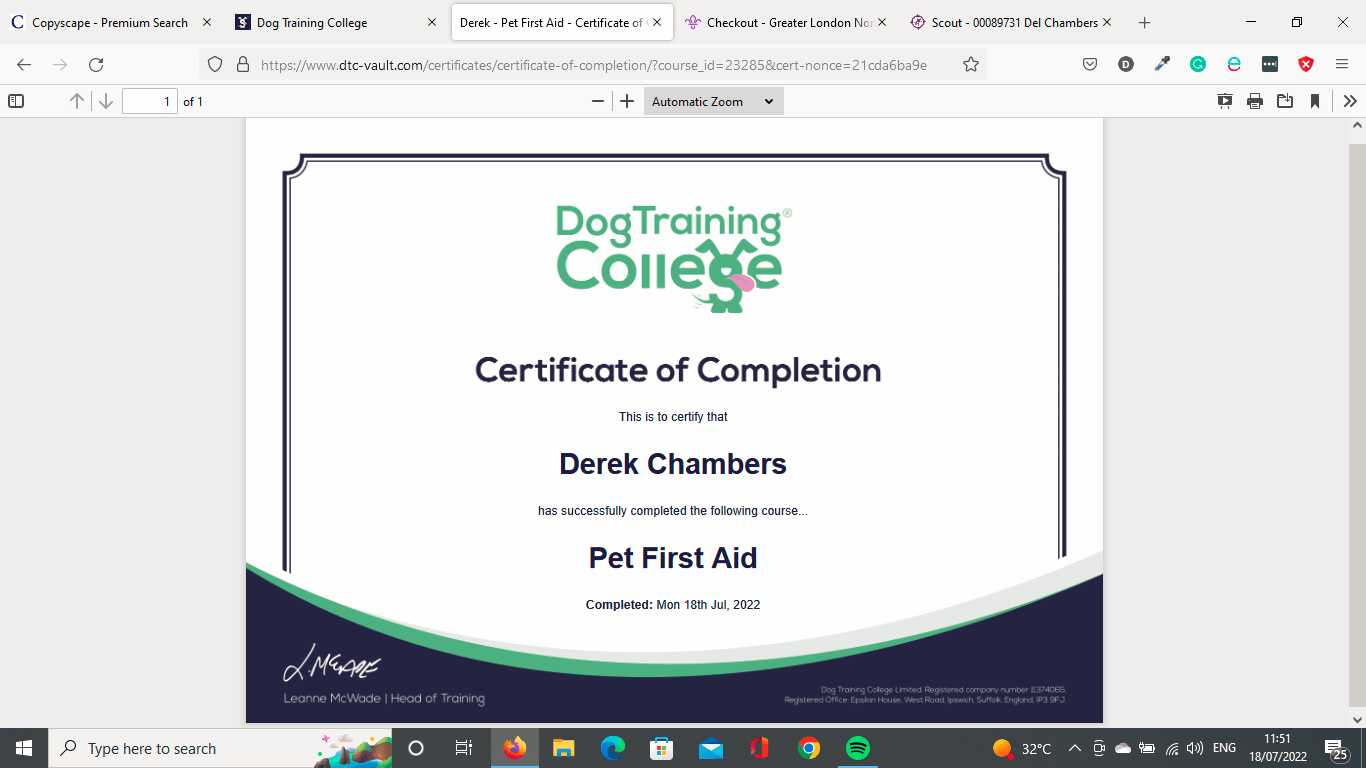
I’ve worked professionally with dogs since 2011 and hold an Ofqual Level 3 qualification in Canine First Aid.
I also continue to study canine body language, enrichment, welfare and reward-based handling.
Much of my practical work involves dogs who benefit from individual attention, including rescues, older dogs and some wonderfully spirited characters.
That doesn’t make me a vet or clinical animal behaviourist.
When a dog has significant fear, aggression, pain-related behaviour or another complex concern, appropriate veterinary and specialist support may be needed.
My Dog Behaviour and Body Language Hub explains some of the signals I look for during everyday care.
3. Ask about handling and training methods
This is an area where I would ask quite specific questions.
Terms such as calm, balanced, structured and trained can mean very different things to different providers.
Rather than relying on a label, ask what happens when things don’t go to plan.
For example:
- What would you do if my dog started barking at another dog?
- How would you handle pulling on the lead?
- What if my dog suddenly stopped walking?
- What if they became frightened by traffic?
- How would you respond if they growled?
- What would you do if they couldn’t cope with the planned route?
The answers can tell you a great deal.
My approach to dog walking
I use reward-based, welfare-conscious handling.
I don’t use prong collars, choke or check chains, electronic collars, rattle bottles or physical corrections intended to frighten or hurt dogs.
If a dog becomes uncomfortable, I look at what’s happening around them.
Perhaps another dog has approached too closely.
Perhaps the route is too busy.
Or perhaps the dog is tired, worried or experiencing discomfort.
Sometimes creating more distance or choosing a different route is more helpful than asking the dog to push through.
I don’t believe every behaviour problem can be solved during an ordinary dog walk.
A professional should understand the limits of their role.
4. Will your dog be walked alone or in a group?
This is one of the most important questions.
Group walking and solo walking can provide very different experiences.
Group dog walks
Group walking usually involves exercising several dogs together.
Some confident, sociable dogs enjoy well-managed groups.
However, group arrangements need appropriate supervision, compatible dogs and clear handling procedures.
I’d ask:
- How many dogs will be walked together?
- Are dogs from different households mixed?
- How do you decide which dogs are compatible?
- What happens if a dog doesn’t enjoy the group?
- Can dogs move away from unwanted interactions?
- What if one dog needs a slower pace?
- How are disagreements managed?
- Does the insurance policy cover the group size?
- Who supervises the dogs when collecting or returning another dog?
A dog who enjoys saying hello to unfamiliar dogs doesn’t automatically enjoy spending an hour in a group. Read why group walks don’t work for everyone
Social interaction needs to suit the individual.
Solo dog walks
A solo walk generally means a dog receives individual attention rather than being part of a group of unrelated dogs.
Ask the provider exactly what solo means.
For example, my walks may include compatible dogs from the same household, where appropriate and agreed.
I don’t combine unrelated client dogs.
Solo walking can be useful for:
- Rescue dogs.
- Nervous or reactive dogs.
- Older dogs.
- Dogs with particular health needs.
- Puppies needing appropriate individual care.
- Dogs uncomfortable in busy environments.
- Dogs who simply prefer their own company.
One-to-one walking also makes it easier to adapt the pace, route and activity.
But a solo walk isn’t automatically the right service for every dog.
It still needs proper planning and management.
Read more on group walks v solo walks
5. Find out whether the walker uses cars or vans
Not every dog walker travels to parks in a vehicle.
Some walk locally.
Others collect several dogs and drive them to a suitable location.
Both arrangements have practical considerations.
Questions to ask about transport
If a walker uses a vehicle, I would want to know:
- How long will my dog be travelling?
- Does the booked walking time include the journey?
- How is each dog secured?
- Do dogs share crates or travel compartments?
- How are incompatible dogs separated?
- How is the vehicle ventilated?
- How are temperatures managed?
- How frequently is the vehicle cleaned?
- Are dogs ever left unattended?
- What happens if the vehicle breaks down?
Dogs Trust recommends appropriate restraint, ventilation, temperature control and suitable arrangements for transporting dogs.
A dog should not spend an unexpectedly large part of its appointment travelling or waiting in a vehicle.
Why I don’t use vans
My own approach is straightforward.
I collect your dog from home and walk locally.
I don’t do van journeys or collection rounds.
That means I can concentrate on the individual dog and their familiar neighbourhood.
Some dogs are comfortable travelling.
Others find the loading, waiting, noise or unfamiliar environment difficult.
I prefer to keep my walks local and simple.
You can read more in Why I Don’t Use Vans for Dog Walking in Finchley.
6. Check whether a DBS check is appropriate
Because a dog walker may hold your keys and enter your home while you’re away, it’s reasonable to ask about their background and any relevant checks.
But there are some important distinctions.
A Disclosure and Barring Service (DBS) check is not a qualification in dog handling.
It also doesn’t guarantee that someone is reliable or trustworthy.
What kind of DBS check should a dog walker have?
There isn’t one automatic enhanced DBS requirement for everyone offering ordinary dog walking.
A self-employed person can request a basic DBS check.
Higher-level checks depend on the role’s legal requirements.
I’d ask what check the person holds rather than assuming that the word enhanced means they provide better dog care.
You can read the official GOV.UK guidance about DBS checks.
References, clear business arrangements, communication and sensible home-security procedures are also important.
7. Does a dog walker need a licence in England?
There isn’t one universal national licensing scheme for ordinary professional dog walking in England.
However, local rules can apply.
Some councils or site managers have permits, restrictions or codes of conduct for commercial dog walking in particular parks or open spaces.
Public Spaces Protection Orders may also restrict where dogs can go, whether they must be on a lead and other activities.
I’d ask whether the walker understands the rules in the areas they use.
Is dog walking the same as daycare or boarding?
No.
Commercial dog daycare and boarding are different activities with their own animal-licensing requirements in England.
Someone being licensed to operate a daycare doesn’t automatically mean they’re more suitable to walk your individual dog.
Likewise, a professional who only provides ordinary dog walking shouldn’t be described as unlicensed in the same sense as a boarding business operating without a required licence.
If you’re unsure, check with the relevant local council.
You can also read the official GOV.UK guidance on controlling dogs in public.
8. Ask about canine first aid and emergencies
I hope every walk is uneventful.
But things can happen.
A dog may be injured.
A loose dog may approach.
A lead may break.
A dog may become suddenly unwell.
Or a person may have an accident and be unable to continue.
The important thing is having a sensible plan.
Questions I would ask
- Do you have current canine first aid training?
- Do you carry suitable first aid equipment?
- How would you respond to an injured dog?
- What if my dog needed an emergency vet?
- Would you contact me or the vet first?
- What happens if you can’t reach me?
- Who is authorised to make decisions about treatment?
- How are veterinary expenses handled?
- What happens if you become unwell during a walk?
- What backup arrangements are available?
It’s important to agree the limits of a walker’s authority and any relevant emergency spending arrangements before care begins.
Leave the right information
Your walker should have access to:
- Your usual vet.
- An appropriate out-of-hours veterinary contact.
- Your telephone number.
- A second emergency contact.
- Relevant medical history.
- Medication information.
- Allergies.
- Agreed emergency instructions.
Canine first aid training helps someone respond appropriately, but it doesn’t replace veterinary care.
For more advice, visit my Dog Health and First Aid Hub.
9. Discuss off-lead walking and identification
Never assume that a professional walker will let your dog off lead.
And never assume that a dog should be allowed off lead just because another dog in the park is running freely.
Off-lead decisions depend on:
- Your express permission.
- Your dog’s recall.
- Their behaviour around people and dogs.
- Wildlife and livestock.
- Local restrictions.
- The immediate environment.
- The walker’s ability to maintain safe control.
I would want off-lead permission recorded clearly.
For a nervous dog, a newly adopted rescue or a dog whose recall is unreliable, an appropriate lead or long line may be safer.
Some dogs may need to remain on lead throughout their walks.
That doesn’t prevent them from enjoying sniffing and exploration.
Check collars, tags and microchips
In England, dogs must normally be microchipped and registered with current details.
Dogs must also wear a collar and identification tag showing the keeper’s name and address when in public, subject to limited exemptions.
A microchip doesn’t replace the legal identification-tag requirement.
The walker may also need suitable emergency contact information, but that isn’t a substitute for the legally required identification.
Read my Dog Microchips and ID Tags Guide and the official GOV.UK microchipping requirements.
10. Understand the weather policy
A dog walking booking shouldn’t become an obligation to march around the park regardless of conditions.
Heat, humidity, ice, thunderstorms, flooding and strong winds can all affect safety.
And different dogs cope differently.
An older dog with mobility problems may struggle on icy paths.
A nervous dog may find strong winds unsettling.
A dog with breathing difficulties may need considerable care during warm weather.
What should you ask?
- What happens during a heatwave?
- Will walks be shortened or rescheduled?
- Can a toilet visit replace a longer walk?
- Are indoor enrichment activities available when appropriate?
- What happens during thunderstorms?
- How are slippery pavements managed?
- Will I be told if the booking changes?
- How do charges work when a walk is adapted or cancelled?
A responsible walker should be willing to change the plan when conditions are unsuitable.
My own weather policy
I assess the weather, route and individual dog rather than relying on one simple temperature rule.
Where necessary, I may shorten a walk, choose a different route, provide a toilet opportunity and calm indoor care, or cancel an unsafe activity.
My Extreme Weather Policy explains how these decisions are made.
Your dog’s welfare matters more than completing a particular distance.
11. Agree equipment, treats and rewards
Before the first walk, discuss the equipment your dog normally uses.
Make sure the walker knows how it fits and whether there are any handling restrictions.
Useful everyday items may include:
- A properly fitted harness or suitable flat collar.
- A reliable fixed-length lead.
- A double-ended lead where appropriate.
- A long line for suitable environments.
- Poo bags.
- Agreed rewards.
- Water when needed.
- Towels or suitable protective clothing for particular weather conditions.
A professional should inspect equipment for obvious problems rather than assume everything is safe because an owner supplied it.
Do you need to buy special walking equipment?
Not necessarily.
If your existing harness and lead are comfortable, secure and appropriate, there’s no reason to replace them simply because you’ve booked a walker.
If you are choosing new equipment, my Leads and Harnesses Buying Guide explains what I look for.
One option I use in suitable circumstances is the Halti Double-Ended Training Lead on Amazon UK.
It provides alternative attachment arrangements, but it isn’t automatically the right lead for every dog.
Check the product details and discuss suitability before purchasing.
Affiliate link. As an Amazon Associate, I earn from qualifying purchases.
Agree which treats can be used
Let the walker know about:
- Food allergies.
- Sensitive digestion.
- Medical diets.
- Treats your dog already enjoys.
- Foods that must be avoided.
- Whether food rewards are suitable around other dogs.
I use reward-based approaches, but the reward should be appropriate for the individual dog.
12. How long is the actual dog walk?
A booking advertised as one hour doesn’t always mean one hour of walking.
Different businesses may include collection, travel, loading and returning dogs within the overall appointment.
Others may separate those activities from the booked walking time.
Neither arrangement should be left unclear.
Ask:
- When does the booked time begin?
- Does it include travelling?
- Does it include collecting other dogs?
- How much time is actually spent outside?
- What happens if a dog needs a slower outing?
- Are photos, updates or cleaning included?
- Can the appointment be adapted to the dog’s health?
Is a longer walk always better?
No.
A sixty-minute outing isn’t automatically better than a calm thirty-minute walk.
The dog may need appropriate exercise, sniffing, companionship or rest.
A senior dog may be more comfortable with a shorter walk.
A nervous dog might cope better with a familiar route and fewer difficult encounters.
I wouldn’t measure the success of a walk simply by how far the dog travelled or how exhausted they were afterwards.
13. Ask about reliability and home security
When somebody has access to your home, you should understand how they work.
I’d ask:
- Will the same person usually attend?
- Will anyone else ever use my keys?
- How are keys stored and identified?
- What happens if a key is lost?
- How is the property secured after each visit?
- What happens if the walker is ill?
- Are visits ever cancelled at short notice?
- What communication should I expect?
- Will the walker contact me if they notice something wrong at home?
Don’t assume that every independent walker has a large backup team.
Some businesses are run by one person, while others employ several walkers.
Either model can work, but you should know the arrangements beforehand.
Written booking terms matter
I’d expect clear information about:
- The service booked.
- Dates and approximate times.
- Prices.
- Payment arrangements.
- Cancellation terms.
- What happens on bank holidays.
- Weather-related changes.
- Access and key arrangements.
- Emergency instructions.
- Your responsibilities as an owner.
If something important has been agreed verbally, ask for it in writing.
For my own services, you can read my Policies and Standards and current prices.
14. Check genuine reviews and references
Reviews can be useful, but I wouldn’t choose a dog walker based on the number of five-star ratings alone.
Look for reviews that describe something meaningful.
For example:
- Reliability over time.
- How the walker communicates.
- Care for a nervous dog.
- Attention to a senior dog’s needs.
- Safe handling.
- What happens when plans change.
- Whether the owner feels informed.
A review with a little detail can be more informative than a vague compliment.
If you’re unsure, ask whether suitable client references are available.
Respect the privacy of other owners and their pets.
A good provider shouldn’t need to share somebody else’s private information without permission.
15. Arrange a meet-and-greet before regular walks
I think this is an important part of choosing professional care.
A meet-and-greet should help both the owner and the walker decide whether the arrangement is suitable.
It isn’t simply an opportunity for the walker to stroke the dog and collect a key.
What I’d expect to discuss
- Your dog’s everyday routine.
- Where they sleep and rest.
- Their walking equipment.
- Their normal behaviour.
- Anything they find frightening.
- Interactions with other dogs.
- Health and medication.
- Feeding and rewards.
- Door and gate security.
- Emergency information.
- The proposed walking schedule.
You should also have the chance to ask questions and explain your priorities.
What about nervous dogs?
Some dogs won’t feel comfortable with a new person immediately.
A newly adopted rescue dog may need extra time and a more gradual introduction.
Don’t judge the entire relationship on whether a worried dog rushes over to greet the walker.
I wouldn’t force an interaction.
Instead, I’d allow the dog space and observe how they respond.
For some dogs, a short introduction followed by a carefully managed trial is more appropriate than immediately starting a normal walk.
My Rescue Dog Support in Finchley service focuses on practical, individual support for dogs who need that approach.
16. Should you arrange a trial walk?
Where appropriate, yes.
A trial walk can help establish whether your dog is comfortable and whether the proposed service suits them.
But it shouldn’t become a test that the dog must pass.
I’d look for:
- Comfortable handling.
- Suitable equipment.
- Awareness of the environment.
- A sensible pace.
- The ability to give the dog space.
- A calm response to unexpected situations.
- An honest discussion afterwards.
For nervous or newly rescued dogs, the first outing may need to be very simple.
It might involve a short local route, time to sniff or even building confidence around leaving the house.
That’s still useful progress.
A good walker should tell you if the dog appeared uncomfortable or if a different arrangement may be better.
Warning signs when choosing a dog walker
I’d be cautious if a provider:
- Refuses to discuss or show appropriate insurance.
- Doesn’t ask about your dog’s health or behaviour.
- Cannot explain group sizes or transport arrangements.
- Uses frightening or painful handling methods.
- Dismisses obvious signs of distress.
- Lets dogs off lead without agreed permission.
- Has no meaningful emergency plan.
- Can’t explain how they manage keys and property access.
- Is unclear about prices or cancellation terms.
- Makes guarantees that no responsible professional could reasonably make.
- Promises to fix serious behaviour problems through ordinary walks without suitable qualifications or assessment.
- Becomes defensive when you ask reasonable questions.
No professional is perfect.
But you should feel that the person responsible for your dog is open, realistic and willing to put welfare first.
A checklist for choosing a dog walker
You can use this when comparing local providers.
Professional arrangements
- I’ve checked suitable insurance.
- I’ve discussed relevant experience and training.
- I’ve asked about canine first aid.
- I’ve checked DBS status where relevant.
- I’ve looked at meaningful reviews or references.
- I’ve checked any relevant local permits or rules.
The walks
- I know who will actually walk my dog.
- I know whether walks are solo or group.
- I understand the maximum group size.
- I know whether transport is involved.
- I understand how much time is spent walking.
- I’ve agreed the normal walking arrangements.
- I’ve explained any lead or off-lead restrictions.
- I’ve discussed equipment and treats.
Safety and welfare
- I’ve shared health and behaviour information.
- The walker understands my dog’s triggers and concerns.
- We’ve discussed emergency veterinary arrangements.
- I’ve provided suitable emergency contacts.
- I understand how bad weather affects bookings.
- My dog’s identification details are up to date.
- We’ve discussed what happens if the walker is unavailable.
Home access and booking
- We’ve agreed key and property-security arrangements.
- I understand the prices.
- I’ve read the cancellation terms.
- I know how updates will be sent.
- We’ve arranged a suitable introduction.
- The booking has been confirmed.
If you aren’t satisfied with an answer, ask for clarification before committing.
Choosing a dog walker in Finchley and Muswell Hill
If you’re looking for a professional dog walker locally, think about what you want your dog’s day to look like.
Would they be happier with a walk around familiar streets?
Do they need more space from unfamiliar dogs?
Would they benefit from a consistent person who understands their routine?
Are they older, nervous or simply happier exploring at their own pace?
These are the dogs and situations my service is designed around.
My solo dog walking service
I provide Solo One-to-One Dog Walks in Finchley and Muswell Hill.
My approach is based on a few straightforward principles:
- One household at a time.
- The same familiar walker.
- Walks beginning and ending at home.
- No van or car collections.
- No groups of unrelated dogs.
- Reward-based handling.
- Appropriate sniffing, movement and enrichment.
- A routine adapted to the individual dog.
My regular walking areas include East Finchley N2, Finchley Central N3, North Finchley N12 and Muswell Hill N10, subject to the exact address and availability.
I also provide suitable focused support for rescue, nervous and reactive dogs.
For young puppies who need home-based care rather than a full walk, my Puppy Visits in Finchley may be a better fit.
You can see my current prices and contact me about availability.
Tell me your postcode, the days you need and a little about your dog.
I’ll explain whether I can help.
Frequently asked questions
What should I ask a dog walker before booking?
Ask about insurance, experience, canine first aid, the number of dogs walked, transport, handling methods, emergency arrangements, off-lead permission, prices and how your dog will be introduced to the walker.
Should a professional dog walker have insurance?
Yes. Professional dog walkers should have suitable third-party or public liability insurance for their activities. Ask to see current evidence and understand any relevant policy restrictions.
Does a dog walker need a DBS check?
You can ask about relevant criminal-record checks, particularly where someone will have access to your home. A basic DBS check can be requested by a self-employed person. Higher-level checks depend on eligibility and aren’t automatically required for ordinary dog walking.
Do dog walkers need a licence in the UK?
There is no single national licensing scheme covering all ordinary dog walkers in England. Local permits, restrictions or codes of conduct may apply, particularly in certain parks. Boarding and daycare have different legal requirements.
Is solo dog walking better than group walking?
It depends on the dog. Some enjoy suitable group walks, while others benefit from individual attention, quieter environments and predictable routines. Choose based on your dog’s behaviour and welfare needs.
Should my dog walker take my dog off lead?
Only where it is safe, legally permitted and expressly agreed. A dog with unreliable recall, significant fears or other safety concerns may need to remain on a lead or suitable long line.
Is it normal to ask for a trial walk?
Yes. A suitable introduction or trial can help establish whether the walker and service are appropriate. A nervous dog may need a slower introduction rather than a normal full-length walk immediately.
How much does a professional dog walker cost?
Prices vary according to location, walking duration, whether care is individual or group-based and any additional needs. Ask what is included in the booking and whether travel or collection time is counted. My current local charges are available on my Prices page.
Is a tired dog a happy dog?
Not necessarily. Tiredness can follow enjoyable activity, but it can also result from stress or excessive stimulation. Look at how comfortably your dog copes during and after walks rather than using exhaustion as the measure of success.
What if my dog is nervous or reactive?
Choose someone who understands canine body language, appropriate distance and reward-based handling. Significant fear, aggression or sudden behaviour changes may require veterinary or suitably qualified behavioural support.
How do I know whether my dog likes their walker?
Look at their behaviour over time. Comfortable approaches, relaxed movement, willingness to participate and the ability to settle afterwards can be encouraging. Repeated avoidance, freezing or distress deserve investigation. No single behaviour tells the whole story.
Related guides
If you’re comparing different types of dog care, these articles may help:
- New & First Pet Owner Hub for preparing for dog ownership and finding suitable support.
- Choosing the Right Dog Care for comparing walkers, pet sitters, boarding and daycare.
- Solo Dog Walks vs Group Dog Walks for deciding which arrangement suits your dog.
- Why I Don’t Use Vans for Dog Walking: Understanding my local approach.
- Dog Walker and Pet Sitter Insurance for checking appropriate cover.
- Dog Walking Etiquette and Responsible Walking for safety and consideration in public places.
- Dog Leads and Harnesses for practical equipment advice.
The right dog walker is the one who understands your dog
Choosing a dog walker shouldn’t be a race to find the cheapest appointment or the person who promises the longest walk.
I’d look for somebody who asks good questions, handles dogs calmly, understands their limits and takes safety seriously.
Someone who notices when a dog is worried.
Someone who knows when to shorten a walk.
And someone who is willing to tell an owner when a different arrangement might be more suitable.
You should feel comfortable asking about insurance, experience, emergencies, equipment, and how your dog will actually be cared for.
Your dog should also have the opportunity to get comfortable with the person walking them.
If you’re looking for calm, individual dog walking around Finchley or Muswell Hill, you’re welcome to get in touch.
No vans. No cars. Just calm, local care built around your dog.
Del Chambers
Finchley Dog Walker
Professional pet care since 2011
First published: 14 November 2016
Substantially updated: 29 October 2026
van journeys
Get in touch and Contact