Substantially updated November 2026
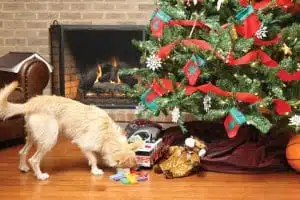
[FEATURED IMAGE: Real Finchley Dog Walker photo of a dog relaxing safely near a decorated Christmas tree]
Putting up the Christmas tree changes a room your dog may know extremely well.
Suddenly there is a tree indoors.
There are dangling decorations.
Lights and cables appear.
Wrapped presents collect underneath it.
And, if you have a real tree, there are unfamiliar smells, fallen needles and a container of water at the base.
Some dogs barely notice.
Others investigate everything.
Puppies, young dogs, scavengers and dogs who enjoy chewing or carrying objects may need particularly careful management.
The answer is not to spend December repeatedly telling your dog off.
A safer approach is to set up the tree so that your dog has fewer opportunities to get into trouble in the first place.
This guide explains how I would dog-proof a Christmas tree, what decorations I would avoid and what to do if your dog eats or damages something they shouldn’t.
For the wider festive picture, including food, visitors, walks and routines, start with my Christmas With Dogs guide.
Affiliate disclosure
This guide contains a small number of Amazon affiliate links to optional enrichment products I already recommend elsewhere on Finchley Dog Walker.
If you buy through a qualifying link, I may earn a small commission at no extra cost to you. As an Amazon Associate, I earn from qualifying purchases.
You do not need to buy anything to dog-proof your Christmas tree.
Safety and sensible management come first.
[INSERT YOAST AI SUMMARY BLOCK HERE]
Quick Christmas tree safety checklist
Before your dog has free access to the room:
- choose a stable tree position
- use a strong, secure base
- consider anchoring the tree if there is a realistic risk of it falling
- keep low branches free from fragile decorations
- avoid chocolate or other edible decorations
- keep tinsel and long ribbons away from dogs likely to swallow them
- hide or protect electrical cables
- keep plugs inaccessible
- prevent access to Christmas tree water
- remove fallen needles regularly
- keep wrapped food gifts away from the tree
- supervise puppies and persistent chewers
- use a physical barrier where appropriate
- provide a familiar quiet resting space away from the tree.
You can find the broader festive checklist in my 12 Christmas Hazards for Dogs guide.
Why are Christmas trees interesting to some dogs?
A Christmas tree can bring several new things into a familiar room at once.
There may be:
- unfamiliar outdoor smells
- branches at nose height
- moving decorations
- lights
- wires
- presents
- paper
- ribbons
- new furniture arrangements
- more people walking through the room.
A dog who likes carrying toys might investigate a bauble.
A scavenger may discover food hidden inside a wrapped present.
A puppy may simply put everything in their mouth.
A nervous dog might be less interested in chewing the tree and more unsettled by the sudden change to their familiar environment.
There is no need to assume every dog will be fascinated by the Christmas tree.
Watch the dog in front of you.
Where should you put a Christmas tree if you have a dog?
Before thinking about decorations, think about location.
I would avoid putting the tree directly:
- beside your dog’s bed
- in a narrow route your dog regularly uses
- beside the front door
- where a dog rushes to the window
- immediately beside furniture your dog jumps on or off
- where a wagging tail can repeatedly hit low branches
- in a place where the electrical cable must cross an open floor.
A quieter corner is usually easier to manage.
Make sure your dog still has a clear route through the room and easy access to their bed, water and normal resting places.
Moving your dog’s familiar bed simply to make room for the tree may be more disruptive than moving something else.
Make sure the tree cannot easily fall
Both real and artificial trees can be knocked over.
Use a solid stand appropriate to the size and weight of the tree.
If your household includes a large dog, lively adolescent or animal likely to pull decorations, consider whether additional securing is sensible.
The RSPCA recommends using a heavy stand or anchoring a Christmas tree to a wall where appropriate to reduce the risk of it falling.
Do not assume:
“My dog has never knocked it over before.”
A dog only needs to become tangled in a decoration or chase something behind the tree once.
Are real Christmas trees safe for dogs?
A real Christmas tree is not automatically dangerous, but it brings a few additional things to manage.
Fallen needles
Natural trees shed needles.
PDSA advises that the needles themselves are not generally considered poisonous, but they can still irritate the mouth, upset the stomach or cause physical injury if swallowed. Fallen needles can also be uncomfortable in paws.
Vacuum or sweep around the tree regularly.
This is particularly important if your dog:
- eats things from the floor
- chews sticks
- investigates objects with their mouth
- has long fur around their paws.
Christmas tree water
Do not allow your dog to drink from the tree stand.
Avoid adding fertiliser, preservative or other chemicals where a pet could access the water.
Even plain standing water can become contaminated, so I would cover the container or block access to it.
Make sure your dog still has easy access to their normal fresh drinking water.
Branch chewing
If your dog repeatedly chews the branches, physical separation is more reliable than repeatedly telling them to stop.
A barrier may be the simplest solution.
Are artificial Christmas trees safer for dogs?
Artificial trees avoid the problem of natural needles and tree water.
That does not make them completely dog-proof.
Potential problems can still include:
- loose plastic pieces
- chewing branches
- exposed internal wires on pre-lit trees
- electrical cables
- decorations
- instability.
Check older artificial trees before use.
If parts are becoming brittle, loose or damaged, I would replace or remove the damaged item rather than give a dog access to pieces they could swallow.
Put fragile decorations higher up
A glass bauble on a low branch can become a problem surprisingly quickly.
A dog does not have to deliberately attack the tree.
One wagging tail may be enough.
If a glass ornament breaks, fragments can injure paws, mouths and noses.
PDSA and the RSPCA both recommend keeping fragile decorations out of pets’ reach and favouring less breakable options where possible.
For lower branches, I would favour decorations that are:
- difficult to break
- securely attached
- too large to swallow
- free from sharp hooks
- free from small detachable pieces.
Even a “shatterproof” decoration should not be treated as a dog toy.
Plastic can still be chewed and swallowed.
I would avoid edible decorations
Chocolate decorations do not belong on a Christmas tree in a home with a dog.
Dogs Trust specifically warns about chocolate tree decorations because they can be easily accessible to dogs.
Remember that your dog may be able to reach much higher than you expect by:
- standing on their back legs
- using nearby furniture
- pulling a lower branch
- knocking food down.
I would also avoid hanging:
- sweets
- biscuits
- popcorn garlands
- dried fruit
- candy canes
- anything containing xylitol.
And don’t forget food inside wrapped presents.
Wrapping paper does not stop a dog smelling chocolate.
Be particularly careful with tinsel and ribbon
Tinsel is not poisonous in the same way as chocolate.
The problem is what can happen if it is swallowed.
Long pieces of tinsel, string and ribbon can cause serious digestive obstruction and internal injury.
PDSA describes swallowed tinsel as a potentially life-threatening foreign-body emergency.
If you have a dog who regularly:
- steals objects
- shreds toys
- swallows fabric
- eats non-food items
- pulls decorations from the tree,
I would simply leave the tinsel off.
The same applies to long gift ribbons around presents left under the tree.
A Christmas decoration is not worth an emergency operation.
Keep electrical cables out of reach
Christmas lights introduce another potential hazard.
Dogs who chew electrical cables can suffer serious injury.
Run cables:
- behind furniture where practical
- away from beds and water bowls
- through appropriate cable protection
- along routes the dog cannot access
- without leaving loops that could become tangled around legs.
Do not leave excess cable piled beneath the tree.
Check cords regularly for damage.
If you know your dog chews cables, I would rely on physical prevention rather than hoping a “leave it” cue will be enough.
Battery-powered does not automatically mean safer
Battery lights remove the need for a trailing mains cable, but the batteries themselves become another hazard.
Make sure battery compartments are secure and cannot be chewed open.
Christmas often brings loose batteries into the home through:
- toys
- remote controls
- musical cards
- light-up decorations
- novelty gifts.
The RSPCA warns that swallowed or chewed batteries can cause chemical burns and other serious injury.
Collect loose batteries immediately when presents are opened.
If your dog chews or swallows a battery, contact your vet urgently.
You can also read my guide on the dangers of batteries
Should you use a barrier around your Christmas tree?
Sometimes, yes.
Management is not a failure of training.
If your dog repeatedly approaches the tree, pulls decorations or chews cables, a barrier may be far safer than correcting them every few minutes.
Depending on your home, that might mean:
- a suitable indoor gate
- a pen
- closing the room when nobody is supervising
- rearranging furniture to provide distance.
Make sure any barrier itself is secure and appropriate for your dog.
Do not create a narrow trap between the barrier and the tree.
Your dog should still have plenty of comfortable space elsewhere.
Puppies and Christmas trees
A puppy may never have seen anything remotely like a decorated Christmas tree.
That means close supervision is important.
Do not give them free access and then expect them to understand immediately that:
- baubles are not toys
- presents are not chew items
- wires should be ignored
- tree branches should not be eaten.
Prevent access to the most tempting parts of the tree.
Give your puppy plenty of appropriate rest.
An overtired puppy who becomes increasingly mouthy does not necessarily need more stimulation.
They may need sleep.
You can find broader puppy advice in my Bringing a Puppy Home guide.
Rescue and nervous dogs
For some dogs, the main issue is not chewing the decorations.
It is change.
Furniture may move.
People visit.
The room smells different.
There may suddenly be flashing lights and unfamiliar objects.
A nervous or newly adopted dog does not need to be repeatedly encouraged toward the tree so they can “get used to it”.
Give them space to investigate if they choose.
Keep their bed and other familiar items available.
Allow them to leave the room.
If practical, introduce larger decorations gradually rather than transforming the entire house in one afternoon.
My How to Prepare for a Rescue Dog guide explains more about reducing unnecessary pressure for a newly adopted dog.
Do you need to train your dog to stay away from the tree?
Training can help.
Management comes first.
Useful everyday skills may include:
- leaving an object
- moving away with you
- settling on a familiar mat
- swapping an item
- checking in with you.
But I would not spend December repeatedly testing whether your dog can resist a tempting decoration.
Set them up to succeed.
If a fragile bauble is within reach of a young dog who likes carrying things, move the bauble.
That is considerably easier than running a training session every time you enter the room.
I use reward-based methods and do not recommend frightening or punishing a dog for investigating something we have suddenly placed in their home.
What should you do if your dog steals a decoration?
Avoid turning it into a chase.
Running after a dog can make an object even more exciting and may encourage them to swallow it quickly.
If it is safe to do so, offer a worthwhile exchange for something suitable.
But if your dog has:
- swallowed the object
- broken glass in their mouth
- swallowed tinsel or ribbon
- chewed an electrical cable
- swallowed a battery
- eaten chocolate or another toxic food,
contact your vet immediately rather than attempting a home remedy.
The RSPCA advises contacting a vet promptly if a dog or cat has swallowed a bauble, tinsel or another Christmas ornament.
Do not wait for symptoms when you already know something dangerous has been swallowed.
Signs of a possible intestinal blockage
Foreign objects can cause serious internal problems.
Possible warning signs include:
- vomiting
- reduced appetite
- diarrhoea
- abdominal discomfort
- lethargy
- difficulty passing faeces.
These signs are not specific to a blockage, so do not try to diagnose the problem yourself.
If you know or suspect your dog has swallowed tinsel, ribbon, part of a decoration or another foreign object, contact your vet.
For wider emergency preparation, visit my Dog First Aid Hub.
Keep Christmas presents away from curious dogs
The area underneath the tree can be as important as the tree itself.
Wrapped presents may contain:
- chocolate
- sweets
- dried fruit
- alcohol
- medication
- toiletries
- batteries
- small toys
- dog treats.
A dog with a good nose may know what is inside long before Christmas morning.
Keep edible and potentially hazardous gifts somewhere your dog cannot access.
That may mean not putting everything under the tree until Christmas morning.
Also clear wrapping, ribbon, batteries and small toy pieces promptly while presents are being opened.
Remember the Christmas plants nearby
The Christmas tree may not be the only seasonal plant in the room.
Holly, ivy, mistletoe, poinsettia and other festive plants each bring different risks.
Rather than treating every Christmas plant as equally poisonous, check the individual plant and keep anything potentially harmful out of reach.
My Christmas Plants and Pets guide goes into the differences in more detail.
Keep some of your dog’s normal routine
Christmas does not need to run like an ordinary Tuesday.
But some familiar anchors can help.
Try to protect:
- normal meals
- medication times
- toilet breaks
- appropriate walks
- rest
- familiar sleeping arrangements.
The RSPCA recommends keeping feeding, exercise, bedtime, and toilet routines reasonably consistent during Christmas and giving pets somewhere quiet to retreat.
My Dog Routine at Christmas guide has more practical ideas.
Give your dog somewhere away from the celebrations
Not every dog wants to spend the evening beside the Christmas tree.
A quiet area might include:
- familiar bedding
- fresh water
- reduced foot traffic
- lower noise
- the option to sleep undisturbed.
Children and visitors should leave a resting dog alone.
Your dog does not need to participate in every part of Christmas to be included in the family.
My Dogs and Christmas Visitors guide covers visitors, children, doors and quiet-space management in more detail.
Optional quiet activities when the house is busy
Your dog does not need to be entertained continuously simply because it is Christmas.
Sometimes rest is the best option.
For a dog who already enjoys food enrichment, a familiar activity can be useful while the household is busy.
I would introduce it before the big family gathering rather than handing a dog a completely unfamiliar puzzle in the middle of Christmas lunch.
KONG Classic
A correctly sized KONG can be filled with suitable food and offered as a supervised licking and food-enrichment activity.
The product linked from my affiliate register is the medium KONG Classic. It is not automatically the correct size or rubber strength for every dog.
View the KONG Classic on Amazon UK – affiliate link
Before choosing one, read my Complete KONG Guide.
LickiMat Tuff Soother Pro
For dogs who enjoy licking activities, a suitable lick mat may provide another quiet option.
The product recorded in my recommendations is the LickiMat Tuff Soother Pro.
Use a thin layer of food your dog can safely eat and supervise the activity. It is not suitable for a dog who is likely to chew or swallow parts of the mat.
View the LickiMat Tuff Soother Pro on Amazon UK – affiliate link
You can also see my wider Dog and Pet Products I Recommend guide.
Neither product is necessary.
A familiar toy, a simple food search or a good sleep may suit your dog better.
My practical approach to Christmas trees and dogs
I have worked professionally with dogs around Finchley and Muswell Hill since 2011.
I don’t think dog-proofing a Christmas tree needs to be complicated.
I would concentrate on:
- preventing access to genuinely dangerous things
- making the tree stable
- removing obvious temptations from dog height
- giving puppies and scavengers more supervision
- protecting cables
- avoiding edible decorations
- giving dogs an undisturbed resting place
- watching how your individual dog responds.
A dog who ignores the tree does not need a complicated management plan.
A dog who keeps trying to dismantle it does.
Adapt to the dog you have.
Frequently asked questions about dogs and Christmas trees
Are real Christmas trees poisonous to dogs?
I would not describe an ordinary real Christmas tree simply as “poisonous”.
The practical concerns include sharp needles, chewing branches, tree water, additives and the possibility of the tree falling.
PDSA advises that swallowed needles can irritate the mouth and digestive system and that tree water should be inaccessible.
Is an artificial Christmas tree safer?
It avoids fallen natural needles and tree water, but it can still be knocked over.
Plastic branches, lights, wires and decorations can also be chewed.
Choose the option you can manage most safely in your own home.
Is tinsel safe around dogs?
I would avoid it around a dog who is likely to chew or swallow it.
Tinsel can cause a dangerous intestinal obstruction if swallowed.
Can I put chocolate decorations high on the tree?
I wouldn’t.
Dogs can be much more determined and resourceful than expected when food is involved.
Dogs Trust specifically includes chocolate tree decorations among festive foods dogs should not eat.
Should I put a fence around my Christmas tree?
For some households, a secure barrier is a very sensible solution.
It may be particularly useful with puppies, persistent chewers or dogs who repeatedly pull things from the tree.
Make sure the barrier itself is suitable and does not restrict your dog’s access to water, bedding or normal routes around the room.
Should I spray something on the tree to stop my dog chewing it?
I would not rely on deterrent sprays.
Some dogs ignore them and some sprays may themselves be unsuitable around pets.
Physical management is clearer and more reliable.
Can my dog drink the water from a real Christmas tree stand?
I would prevent access.
Tree water can become contaminated, and additives or preservatives may be harmful.
Give your dog their normal clean drinking water instead.
What should I do if my dog eats a bauble or decoration?
Contact your vet.
A swallowed decoration may cause choking, internal injury or an intestinal obstruction.
Do not wait for obvious symptoms if you know a potentially dangerous object has been swallowed.
What if my dog eats chocolate from the tree?
Contact your vet immediately and keep the packaging if possible.
Be ready to tell them:
- what chocolate was eaten
- roughly how much
- when it happened
- your dog’s approximate weight.
Do not try to make your dog vomit unless a veterinary professional specifically instructs you to do so.
A safer Christmas tree does not need to spoil Christmas
You can still have a proper Christmas tree.
The goal is not to strip the room bare or spend December worrying about every movement your dog makes.
Think about your dog’s habits.
Secure the things that could genuinely hurt them.
Move fragile and edible decorations out of reach.
Keep electrical cables safe.
Use a barrier if you need one.
Give your dog a familiar place to rest.
And remember that management is often much easier than repeatedly correcting a dog for being curious about a completely new object in their home.
For the wider festive picture, visit my Christmas With Dogs guide.
Related guides
Christmas With Dogs: Safety, Routine and Calm Festive Tips
12 Christmas Hazards for Dogs and How to Avoid Them
Christmas Plants Poisonous to Dogs and Cats
How to Maintain Your Dog’s Routine at Christmas
Dogs and Christmas Visitors: A Calm, Safe Guide
External resources
Dogs Trust: Christmas Advice for Dog Owners
RSPCA: Christmas Dangers for Pets
PDSA: Dangerous Christmas Decorations for Pet Owners
Veterinary disclaimer
This guide provides general Christmas safety information.
It does not diagnose poisoning, illness or injury or replace veterinary advice.
If your dog has swallowed something potentially toxic, a battery, tinsel, ribbon, part of a decoration or another foreign object, contact your vet or emergency veterinary service promptly.
First published: 13 December 2014
Substantially updated: November 2026