Updated July 2026
Estimated reading time: 18 minutes
Cats often appear easy to care for.
They sleep for long periods, wash themselves and usually do not demand the same daily routine as a dog.
That does not mean their needs are simple.
Good cat care involves more than filling a bowl and cleaning a litter tray. Cats need suitable food, fresh water, clean toileting areas, safe places to rest, opportunities to behave naturally and regular health care.
They also need you to notice when something changes.
This guide covers five essential areas of everyday cat care:
- Food and water
- Litter trays and household resources
- Play, enrichment and rest
- Preventative health care and identification
- Recognising changes in your cat
For more advice about living with and caring for cats, visit my Cat Care Advice Hub.
This guide provides general information and does not replace veterinary advice. Contact your vet if your cat is unwell, injured, or showing a sudden change in behaviour.
Quick answer
The most important cat-care habits are:
- feed a suitable complete diet in sensible portions
- provide clean water in more than one suitable location
- keep litter trays clean, quiet and accessible
- give your cat choices about where they sleep, hide and scratch
- provide short, regular opportunities for play
- keep up with veterinary checks and preventative care
- maintain accurate microchip details
- learn what is normal for your individual cat
- take sudden changes seriously
Good cat care is not about keeping your cat constantly busy.
It is about providing a safe, predictable environment in which they can make choices.
Table of contents
- Quick answer
- 1. Provide suitable food and plenty of fresh water
- 2. Provide clean litter trays and separate household resources
- Give your cat safe places to hide and rest
- 3. Provide play, scratching, enrichment and uninterrupted rest
- 4. Keep up with veterinary care, dental health and identification
- 5. Learn what is normal for your cat
- Care for kittens, older cats and indoor cats
- Multi-cat households
- Preparing for somebody else to care for your cat
- Daily cat-care checklist
- Cat sitting in Finchley.
- Frequently asked questions
- What are the five most important areas of cat care?
- How often should I clean a litter tray?
- How many litter trays do two cats need?
- Should my cat’s water be next to their food?
- How much play does a cat need?
- Do indoor cats need veterinary checks?
- How do I know whether my cat is unwell?
- Is hiding always a sign that something is wrong?
- Is a water fountain essential?
- What should I leave for a cat sitter?
- Final thoughts
- Related cat-care guides
- Disclaimer
1. Provide suitable food and plenty of fresh water
A good feeding routine starts with food that suits your cat’s:
- age
- size
- health
- activity level
- body condition
- veterinary needs
Look for food labelled as complete rather than complementary.
Complete food is intended to provide the nutrients your cat requires as their main diet. Complementary foods and treats should make up only a small part of what they eat.
Follow the feeding guide as a starting point, but remember that individual cats differ.
A large, active outdoor cat may need a different amount from a small indoor cat. An older cat with a medical condition may need a diet recommended by their vet.
Measure food rather than guessing.
Portions can easily become larger over time.
A little extra food at breakfast, several treats during the day and another person feeding dinner can add up.
Measuring or weighing your cat’s daily food can help you:
- keep portions consistent
- monitor how much they have eaten
- manage their weight
- give clear instructions to another carer
- include treats within the daily allowance
Weight gain can happen gradually and may be difficult to notice, particularly in long-haired cats.
Your vet can help you assess your cat’s body condition and recommend an appropriate amount to feed.
Avoid sudden food changes.
Changing food too quickly can upset your cat’s digestion or cause them to refuse meals.
Introduce a different food gradually unless your vet has advised otherwise.
Do not make an unnecessary food change immediately before:
- going on holiday
- moving home
- introducing another pet
- arranging a cattery stay
- leaving your cat with a new sitter
These situations already change part of your cat’s routine.
Place food where your cat feels safe
Food should normally be placed somewhere quiet and away from litter trays.
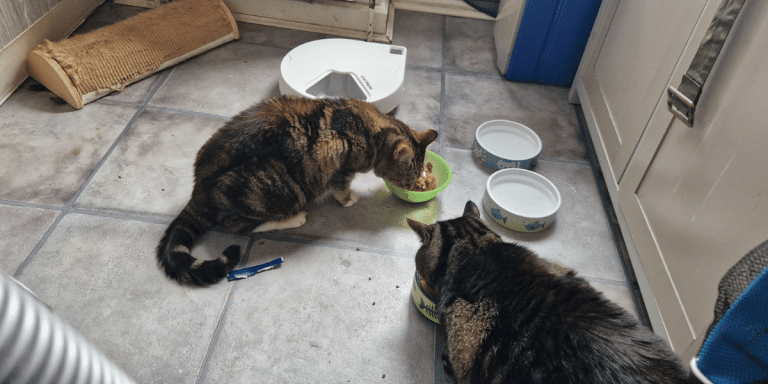
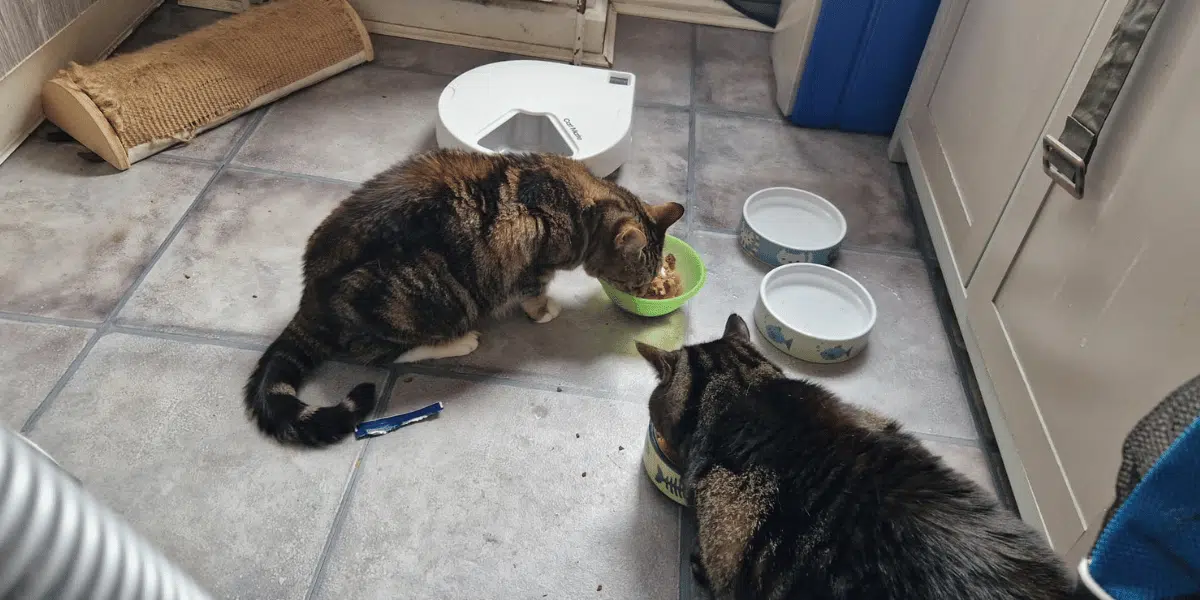
In a multi-cat household, avoid making cats compete around one feeding station.
Some cats appear to eat happily together while one is actually waiting, eating too quickly or avoiding the area until the other cat has left.
Separate feeding locations make it easier to see how much each cat eats.
Cats Protection advises placing food, water and litter trays apart and feeding cats separately where competition may occur.
Read the independent Cats Protection feeding advice for more information and my guide on choosing cat food
Water should not be an afterthought
Your cat should always have access to clean drinking water.
Many cats prefer water:
- away from their food
- in a quiet location
- in a wide bowl that does not press against their whiskers
- in more than one part of the home
- refreshed regularly
Some cats prefer a ceramic bowl. Others drink more readily from a water fountain.
The best option is the one your cat uses reliably.
Introduce a fountain at home and keep an ordinary water bowl available until you know your cat is comfortable using it.
A sudden increase or decrease in drinking can be important, particularly in an older cat. Contact your vet when your cat’s drinking habits change noticeably.
For equipment I use or recommend, visit my Cat Sitting Kit guide.
2. Provide clean litter trays and separate household resources
A litter tray is not simply a plastic box placed wherever there is room.
Its size, location, cleanliness and accessibility all matter.
A cat may avoid a tray because it is:
- dirty
- too small
- difficult to enter
- placed beside noisy equipment
- located in a busy walkway
- close to food or water
- blocked by another cat
- filled with unfamiliar litter
- positioned where the cat feels exposed
How many litter trays should you provide?
A common starting point is one litter tray per cat, plus one extra.
That means:
- one cat may benefit from two trays
- two cats may benefit from three
- three cats may benefit from four
The trays should be placed in different suitable areas rather than lined up side by side.
Cats Protection recommends providing one essential resource per cat plus one extra in multi-cat homes. This includes litter trays, beds, scratching areas and feeding or drinking resources.
Not every home allows a perfect setup, particularly in a smaller North London flat.
Do the best you can with the space available. Even moving resources slightly apart can reduce pressure.
Keep trays clean
Remove waste at least daily, and more often as needed.
Some cats will refuse a tray as soon as it has been used. Others are less particular.
Wash trays regularly using a suitable mild cleaning product. Avoid leaving a powerful chemical or perfumed smell that may discourage your cat from returning.
Do not suddenly change:
- the litter type
- the tray style
- the tray location
- the depth of litter
- a covered tray to an uncovered tray
- an uncovered tray to a covered tray
Introduce changes gradually wherever possible.
Think about age and mobility.
A high-sided tray may contain litter well but be difficult for an older cat with arthritis.
A kitten may also struggle with a very tall entrance.
Consider:
- a low entry point
- a large stable tray
- a non-slip surface nearby
- a tray on each level of the home
- easy access at night
- placing a tray closer to an older cat’s main resting area
Toileting changes need attention.n
Do not assume that a cat urinating outside the tray is being spiteful or difficult.
Possible reasons include:
- pain
- urinary disease
- stress
- a dirty tray
- conflict with another cat
- difficulty reaching the tray
- dislike of the litter
- changes within the home
Straining to urinate, repeatedly entering the tray, crying, passing very little urine or appearing unable to urinate can indicate an emergency.
Contact a vet immediately.
Give your cat safe places to hide and rest
Cats need places where they can withdraw without being disturbed.
A safe resting place might be:
- under a bed
- inside a cardboard box
- on a shelf
- on top of a wardrobe
- in a covered bed
- behind a chair
- in a quiet room
- on a stable cat tree
Some cats prefer low enclosed hiding places.
Others feel safer when they can watch the room from above.
The important point is choice.
Do not pull a nervous cat out of hiding unless there is an immediate safety or medical reason.
International Cat Care recommends placing important resources in suitable quiet locations and giving cats access to resting, hiding and elevated areas.
Read International Cat Care’s guide to making a home cat-friendly.
3. Provide play, scratching, enrichment and uninterrupted rest
Cats need opportunities to express normal behaviour.
This includes:
- stalking
- chasing
- pouncing
- climbing
- scratching
- exploring
- watching
- hiding
- resting
- grooming
You do not need a house full of expensive equipment.
Cardboard boxes, paper bags without handles, a suitable scratching surface and a few carefully chosen toys can provide plenty of interest.
Use short play sessions.
Many cats prefer several short play sessions rather than one long session.
A wand toy can allow your cat to:
- watch
- stalk
- chase
- pounce
- catch
Let them catch the toy regularly.
Constantly moving it out of reach may become frustrating.
Finish play calmly, and put the string, ribbon, and wand toys away afterwards. Toys with string or small detachable parts should not be left out unsupervised.
Adapt play to the individual cat.
A young cat may enjoy active play, such as chasing and climbing.
An older cat may prefer:
- slower floor-level play
- a short treat search
- a puzzle feeder
- gentle brushing
- watching movement from a window
- batting a soft toy while lying down
A nervous cat may not play when another person is watching.
That does not necessarily mean they are bored. They may wait until the room is quiet.
Provide suitable scratching areas
Scratching helps cats:
- maintain their claws
- stretch their body
- leave scent and visual marks
- release tension
- communicate within their environment
Provide a scratching surface that is:
- tall or long enough for a full stretch
- stable
- placed where your cat already likes to scratch
- made from a texture they use
- available near sleeping areas where appropriate
Some cats prefer vertical posts.
Others prefer horizontal cardboard scratchers or mats.
Placing a small unstable scratching post in an unused corner is unlikely to stop a cat scratching the sofa.
Make use of food enrichment
Part of a measured daily food allowance can be used for:
- puzzle feeders
- treat searches
- food balls
- small portions hidden around a room
- scatter feeding on a suitable clean surface
Start with something easy.
A puzzle feeder that is too difficult may cause frustration or be ignored.
Always account for food used during enrichment within your cat’s daily amount.
Allow your cat to sleep
Cats naturally sleep for long periods.
Do not wake them repeatedly because you think they should be more active.
Look instead for changes from their normal pattern.
A cat sleeping in their usual places and waking for meals may simply be following their routine.
A normally sociable cat suddenly sleeping alone, hiding and refusing food needs closer attention.
For more enrichment ideas, read Indoor Cat Enrichment While You Are Away.
4. Keep up with veterinary care, dental health and identification
Every cat needs preventative health care.
This applies to outdoor and indoor cats.
A routine care plan may include:
- veterinary health checks
- vaccinations
- flea and worm treatment based on individual risk
- neutering
- dental checks
- weight monitoring
- grooming
- claw checks
- microchipping
Cats Protection recommends that healthy cats receive a veterinary health check at least once a year. Older cats and cats with existing conditions may need more frequent appointments.
Your vet can advise on the most suitable schedule for your individual cat.
Vaccination
Vaccinations help protect cats against serious infectious diseases.
Indoor cats may still require core vaccinations because some infectious material can be brought into a home on clothing, shoes or other objects.
Your cat’s vaccination requirements depend on their:
- age
- lifestyle
- health
- contact with other cats
- boarding or travel plans
Discuss the correct schedule with your vet rather than following a generic online timetable.
Read the PDSA cat and kitten vaccination guide.
Flea and worm treatment
The correct parasite treatment depends on your cat’s lifestyle and risk.
An outdoor hunter may have different needs from an indoor cat.
Never use a dog flea treatment on a cat unless a vet has specifically confirmed that the product is safe. Some products intended for dogs can be extremely dangerous to cats.
Ask your vet which product to use, how often to use it and whether your cat needs a separate worming treatment.
Dental health
Dental disease can cause considerable pain, but cats often hide mouth problems.
Watch for:
- bad breath
- difficulty eating
- chewing on one side
- dropping food
- reduced appetite
- drooling
- red or bleeding gums
- visible tartar
- pawing at the mouth
- reduced grooming
- weight loss
PDSA advises checking your cat’s teeth regularly and seeking veterinary advice when you notice signs of pain or disease.
Never use human toothpaste.
Speak to your vet before beginning tooth brushing, particularly if your cat already has sore gums or signs of dental disease.
Read the PDSA guide to dental disease in cats.
Grooming and claws
Most cats groom themselves, but some need extra help.
This may include:
- long-haired cats
- elderly cats
- overweight cats
- cats with arthritis
- cats recovering from illness
- cats with skin or coat problems
Gentle brushing can help you notice:
- knots
- skin irritation
- fleas
- wounds
- changes in coat condition
- lumps
- sensitivity
- weight changes
Check claws as well, particularly in older or less active cats.
Overgrown claws can curl towards the paw pad.
Do not force grooming if your cat becomes distressed. Build it up gradually and seek professional advice if the coat is badly matted.
Microchipping is a legal requirement in England.
Owned cats in England must be microchipped before they reach 20 weeks old. The keeper’s contact information must also be registered and kept up to date on an approved database.
The requirement includes cats that live indoors.
Read the government guidance on mandatory cat microchipping.
Remember to update the database when you:
- move home
- change telephone number
- change email address
- transfer ownership
- change the primary emergency contact
A microchip only helps reunite you with your cat when the information attached to it is accurate.
Keep a secure carrier available
Do not store your carrier in an inaccessible place.
In an emergency, you should be able to find and use it quickly.
Leave it somewhere your cat can investigate from time to time rather than bringing it out only before a veterinary appointment.
A familiar carrier is often easier to use than one associated only with stressful journeys.
5. Learn what is normal for your cat
One of the most useful things you can do is understand your cat’s normal routine.
Pay attention to their usual:
- appetite
- water intake
- litter-tray habits
- grooming
- sleeping places
- activity
- movement
- breathing
- vocal behaviour
- sociability
- weight
- outdoor routine
Changes are easier to notice when you know the starting point.
A shy cat hiding when a visitor arrives may be normal.
A confident cat that normally greets everyone but suddenly remains under the bed may be telling you something has changed.
Signs that need veterinary advice
Contact your vet when you notice a significant or unexplained change such as:
- refusing food
- drinking much more or less
- repeated vomiting
- diarrhoea
- straining to urinate
- urinating outside the tray
- sudden hiding
- difficulty walking
- rapid or laboured breathing
- persistent coughing
- reduced grooming
- overgrooming
- sudden aggression
- confusion
- unexplained weight loss
- a painful or swollen area
- a change in coat condition
Not every change means your cat is seriously ill.
However, cats often hide pain and weakness. Waiting for very obvious symptoms can allow a problem to become worse.
Use photographs and simple records
Occasional photographs can help you notice gradual changes in:
- body shape
- coat condition
- posture
- facial appearance
- mobility
You may also find it useful to record:
- monthly weight
- medication
- veterinary visits
- changes in diet
- unusual toileting
- recurring sickness
- changes in drinking
This is particularly useful for older cats and cats with long-term health conditions.
Care for kittens, older cats and indoor cats
The five essential care areas apply to every cat, but some cats need additional support.
Kittens
Kittens need:
- more frequent meals
- close supervision
- age-appropriate play
- safe social experiences
- kitten-proofed rooms
- a suitable vaccination plan
- microchipping before 20 weeks in England
- gradual carrier training
- help learning appropriate scratching and toileting habits
String, small objects, open windows, cables and unstable furniture can all create risks for a curious kitten.
Older cats
Older cats may benefit from:
- more accessible litter trays
- warm resting places
- non-slip surfaces
- food and water on more than one floor
- steps or ramps to favourite areas
- regular weight checks
- more frequent veterinary appointments
- gentle grooming
- closer monitoring of drinking and toileting
Do not assume slowing down is simply old age.
Stiffness, reluctance to jump and reduced grooming may be associated with pain or illness.
Indoor cats
Indoor cats need enough space and opportunity to:
- climb
- hide
- scratch
- watch outside activity
- play
- forage
- rest without interruption
- move away from people or other pets
Indoor living can be safe and comfortable, but the environment needs to meet the cat’s behavioural needs.
A window view, stable climbing area, regular play and separate household resources can make a considerable difference.
Read my guide on How to keep an indoor cat happy
Multi-cat households
Living with several cats does not always mean they consider themselves one social group.
Cats may tolerate each other without wanting to share every resource.
Provide separate:
- food areas
- water stations
- litter trays
- sleeping places
- hiding areas
- scratching surfaces
- high resting places
Watch for subtle signs of tension, including:
- blocking doorways
- staring
- chasing
- guarding food
- waiting to use the litter tray
- one cat remaining upstairs
- one cat eating only when the other leaves
- spraying
- overgrooming
- reduced play
- unexplained toileting problems
Do not place every resource in one room.
A more confident cat could control access to the entire setup.
Preparing for somebody else to care for your cat
Your cat’s everyday routine becomes especially important when you are away.
Leave clear written information covering:
- food amounts
- feeding times
- water locations
- litter arrangements
- medication
- normal behaviour
- hiding places
- outdoor access
- veterinary details
- an emergency contact
- the location of the carrier
- household security
- anything that would concern you
A carer should do more than refill a bowl.
They should notice whether your cat is:
- eating
- drinking
- using the litter tray
- moving normally
- behaving as expected
- showing signs of sickness or injury
Useful holiday-care guides include:
- Why Cats Prefer Staying at Home Instead of a Cattery
- What Your Cat Does While You’re on Holiday
- Can Cats Get Lonely?
- How Often Should a Cat Sitter Visit?
- What to Leave for Your Cat Sitter
- Leaving Cats Alone Overnight
- Indoor enrichment for cats
- Cats and stress
- Cat Care Guide
Daily cat-care checklist
Use this as a simple everyday check.
Food and water
- Normal food has been offered.
- Your cat has eaten approximately their normal amount.
- Fresh water is available.
- Bowls are clean.
- No unexplained increase or decrease in thirst has been noticed.
Litter and toileting
- Litter trays have been checked and cleaned.
- Urination and bowel movements appear normal.
- Your cat is not straining or repeatedly entering the tray.
- Trays remain easy to access.
Behaviour and comfort
- Your cat is using their normal resting places.
- They can access safe hiding areas.
- They have suitable scratching surfaces.
- Their movement appears normal.
- They are behaving normally for them.
Health
- No unexplained vomiting or diarrhoea.
- Breathing appears comfortable.
- Coat and grooming look normal.
- Eyes and nose appear normal.
- No obvious injury, swelling or sensitivity.
- Medication has been given as prescribed.
Enrichment
- Your cat has been offered suitable play or interaction.
- Safe toys are available.
- String and wand toys have been put away after use.
- Your cat has been allowed to rest undisturbed.
Cat sitting in Finchley.
I provide calm cat-sitting visits in Finchley and selected nearby parts of North London.
Visits can include:
- preparing food
- refreshing water
- litter-tray care
- agreed medication support
- calm company
- play and enrichment
- welfare observations
- photographs and updates
- basic agreed home checks
I work at your cat’s pace.
Some cats meet me at the door.
Others prefer to watch from the stairs or remain in a favourite hiding place.
I do not force interaction.
My job is to keep your cat’s routine as familiar as possible and notice anything that appears different.
Read more about Cat Sitting in Finchley or view my pet-care prices.
Frequently asked questions
What are the five most important areas of cat care?
The five core areas are:
- suitable food and fresh water
- clean litter trays and separate household resources
- play, scratching, enrichment and rest
- preventative veterinary care and identification
- recognising changes in health or behaviour
Each area needs to be adapted to the age, health and personality of the individual cat.
How often should I clean a litter tray?
Remove urine and faeces at least daily, and more frequently as needed.
The tray should also be emptied and cleaned regularly using a suitable mild product.
Some cats will avoid a tray sooner than others, so watch how your cat responds.
How many litter trays do two cats need?
A common starting point is one tray per cat plus one extra.
Two cats may therefore benefit from three trays placed in different suitable locations.
The cats’ relationship, the size of the home and each cat’s preferences also matter.
Should my cat’s water be next to their food?
Many cats prefer water placed away from their food.
Try offering clean water in several quiet locations and observe which bowls your cat uses.
Keep all water well away from litter trays.
How much play does a cat need?
There is no single amount that suits every cat.
Several short sessions may suit cats better than one long session.
Age, health, mobility, confidence and access to the outdoors all affect how much play a cat wants.
Do indoor cats need veterinary checks?
Yes.
Indoor cats still require routine veterinary care, dental checks, vaccinations appropriate to their risk, weight monitoring and a suitable parasite plan.
They must also be microchipped by 20 weeks of age in England.
How do I know whether my cat is unwell?
Look for changes from your cat’s normal behaviour.
Changes in appetite, drinking, toileting, grooming, movement, breathing, weight or sociability can all be important.
Contact your vet when a change is sudden, persistent or accompanied by other symptoms.
Is hiding always a sign that something is wrong?
No.
Some cats naturally hide when they are resting or when visitors arrive.
However, sudden or increased hiding may be linked to stress, pain or illness.
Consider what is normal for your individual cat.
Is a water fountain essential?
No.
Some cats enjoy fountains and drink more from them. Others prefer a simple bowl.
Fresh, clean water in a stable and accessible container is the priority.
What should I leave for a cat sitter?
Leave:
- clear feeding instructions
- enough food and litter
- water-bowl locations
- medication instructions
- veterinary details
- an emergency contact
- normal hiding places
- outdoor-access rules
- the cat carrier
- information about normal and concerning behaviour
Use my complete cat-sitter preparation guide.
Final thoughts
Good cat care often comes down to small, consistent habits.
Fresh water.
Suitable food.
Clean litter trays.
Safe hiding places.
Short opportunities to play.
Regular veterinary care.
Knowing what is normal.
These things may sound straightforward, but together they create a home in which a cat can feel secure and behave naturally.
You do not need to entertain your cat every minute or buy every new product.
Provide suitable choices, follow a steady routine and pay attention when something changes.
For more practical advice, browse the Cat Care Advice Hub.
For calm home visits while you are away, read about Cat Sitting in Finchley.
Related cat-care guides
- Cat Care Advice in Finchley
- Cat Sitting in Finchley
- Senior cat holiday care
- Why Cats Prefer Staying at Home Instead of a Cattery
- Can Cats Get Lonely?
- What Your Cat Does While You’re on Holiday
- Leaving Cats Alone Overnight
- Summer Cat Safety Hub
- Cat Sitting Kit
- Best cat care products for when you travel
Disclaimer
This guide provides general cat-care information and does not replace veterinary advice. Contact your veterinary practice if your cat is unwell, injured, or in pain, or is struggling to urinate, or is showing a sudden change in eating, drinking, breathing, toileting, movement, or behaviour.