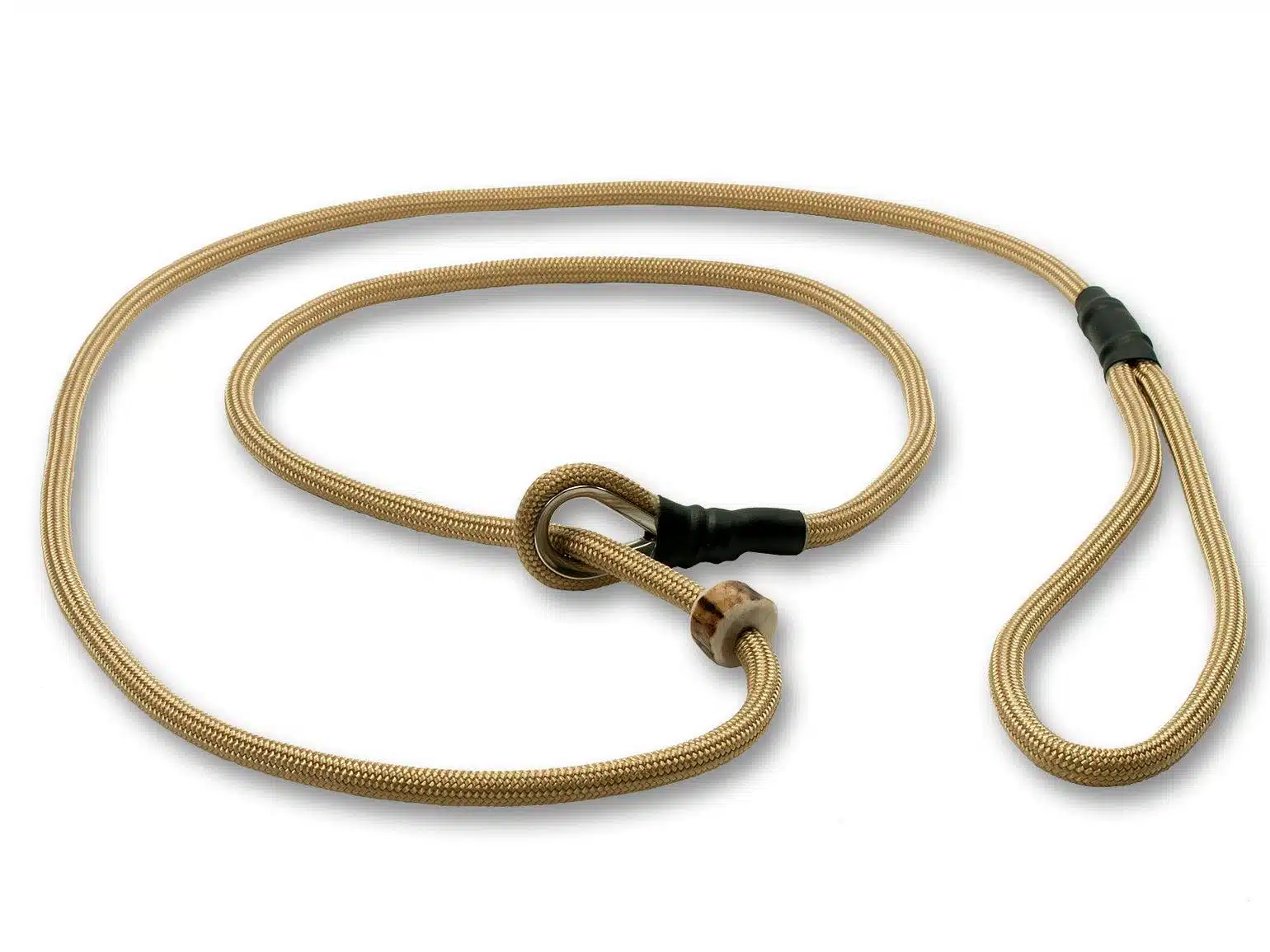
I see slip leads being used quite regularly, including by professional dog walkers. They’re simple, quick to put on and widely available. Some people wouldn’t dream of using anything else.
But are they the best choice for an everyday dog walk?
I’ve worked with dogs around Finchley and North London since 2011, including rescue dogs, nervous dogs, strong pullers and dogs who find the world a little overwhelming.
Over those years, I’ve become increasingly particular about the equipment I use.
I generally avoid slip leads for everyday walking and training. That’s not because I think everyone who uses one is doing something wrong. It’s because I prefer equipment that doesn’t tighten around a dog’s neck when something unexpected happens.
Slip leads do have legitimate uses. The key is understanding the difference between using one for a specific purpose and relying on it for every walk.
Key Takeaways
- Slip leads combine a collar and lead but can tighten around a dog’s neck, posing risks during everyday walks.
- While slip leads offer advantages such as quick application and lightweight design, they are often unsuitable for regular use.
- The author prefers alternatives like harnesses and double-ended leads for safer, more comfortable dog walks.
- It’s crucial to balance convenience with a dog’s safety and emotional well-being when choosing walking equipment.
- Professional dog walkers should assess whether to use slip leads based on the individual dog’s needs and circumstances.
What is a slip lead?
A slip lead combines a collar and lead into one piece of equipment.
Instead of clipping the lead onto a separate collar or harness, you place a loop over the dog’s head. The loop can tighten when tension is applied and loosen when that tension is released.
Many designs have a sliding stopper that helps control the size or movement of the loop. However, different products work differently, and not every stopper prevents the loop from tightening.
Slip leads are commonly used in:
- Gundog work and field trials
- Some veterinary practices
- Animal rescue and kennel environments
- Dog shows and specialist handling
- Short-term or emergency handling
They are also increasingly seen on ordinary dog walks.
The fact that something is widely used doesn’t automatically make it the right choice for every dog.
What are the advantages of slip leads?
I think it’s important to acknowledge the advantages before looking at the disadvantages.
1. They’re quick to put on and remove
You don’t need to find a collar ring or attach a clip.
In certain situations, particularly when an experienced handler needs to secure or move a dog for a short period, that can be useful.
For example, a rescue worker may need to move a dog safely between areas without spending time fitting unfamiliar equipment.
2. They can be useful in emergencies
Imagine a dog has escaped from its collar and is loose near a road.
A suitably trained person might be able to use a slip lead as a temporary way to secure the dog and move them somewhere safer.
That doesn’t mean approaching or trying to catch a frightened, unknown dog is always safe. A panicking dog may bite, struggle or injure themselves. Sometimes the right response is to keep your distance and contact the appropriate dog warden or rescue service.
Emergency use is very different from taking a dog out for an hour’s walk.
3. They’re lightweight and easy to carry
Slip leads are compact and usually don’t have complicated clips or fastenings.
This helps explain why some kennels, rescue organisations and veterinary teams keep them available.
4. They have an established role in working-dog activities
Slip leads have long been associated with gundogs and field trials.
The Royal Kennel Club’s field-trial guidance includes a slip lead among the basic equipment used in that setting.
These activities often involve dogs trained to work closely with their handlers, including periods when they are off lead.
That’s quite different from walking a young, excitable dog along a busy Finchley pavement.
5. They don’t rely on an existing collar
A slip lead can provide a temporary restraint when a suitable collar isn’t available.
This can be useful for trained professionals handling unfamiliar dogs.
However, convenience should never be confused with guaranteed safety.
What are the disadvantages of slip leads?
This is where my concerns begin, particularly when they’re used for ordinary walks or to stop a dog pulling.
1. They can tighten around the dog’s neck
The biggest concern is the way the loop works.
When the dog pulls, lunges, jumps or tries to escape, tension can tighten the lead around their neck.
Unlike a properly fitted, non-tightening collar, a slip lead may continue to constrict as tension increases, depending on its design and adjustment.
That pressure can affect sensitive areas of the neck, including the throat and surrounding soft tissues.
Not every dog using a slip lead will be injured. However, the risk of discomfort and excessive pressure is one reason I prefer other equipment.
Battersea’s advice on teaching dogs to walk on a lead also recommends avoiding slip leads because they can tighten around the neck and cause discomfort.
2. A sudden lunge can create a problem very quickly
Even a dog who normally walks beautifully can react unexpectedly.
A squirrel runs across the pavement.
A motorbike backfires.
Another dog appears around a corner.
Your dog spots a cat.
These things can happen in seconds.
If the dog lunges while wearing a slip lead, the pressure is concentrated around the neck.
I would rather that sudden force was managed through a suitable, correctly fitted harness than through a tightening loop.
3. They may be particularly unsuitable for some dogs
I’d be especially cautious with dogs who have:
- Existing neck pain or injuries
- Breathing or airway difficulties
- A history of coughing when pressure is applied to the neck
- Certain eye conditions where neck pressure may be a concern
- A tendency to panic, lunge or pull strongly
- Significant handling sensitivities
Short-nosed breeds and dogs with known airway problems may need particular care.
If your dog has a medical condition, speak to your vet about suitable walking equipment rather than assuming any particular collar or harness is safe.
4. They don’t teach a dog how to walk nicely
One reason slip leads are sometimes recommended is that they can appear to give the handler more control.
But what is actually happening?
If a dog stops pulling because tightening the lead is uncomfortable, that doesn’t necessarily mean they’ve learnt how to walk calmly.
They may simply be avoiding the uncomfortable consequence.
There’s an important difference between stopping a behaviour and teaching a dog what to do instead.
For me, loose-lead walking is about helping a dog understand how to move comfortably alongside their person, not making pulling unpleasant.
5. They can make difficult situations harder for nervous dogs
This is particularly important to me because I work with rescue dogs and dogs who struggle in busy environments.
Imagine a nervous dog sees another dog approaching.
They become worried and try to move away.
The handler holds the lead firmly.
The slip lead tightens.
Now the dog is dealing with both the original worry and additional pressure around their neck.
That pressure may add to their discomfort or distress.
It doesn’t mean the slip lead caused the original reaction. But it may make an already difficult situation harder.
When a dog is worried, I want to give them more appropriate space, not additional pressure.
My guide to walking nervous and reactive dogs explains how I choose equipment and plan safer walks.
Can slip leads hurt dogs?
Yes, they can cause discomfort and potentially injury, particularly when substantial or repeated force is applied to the neck.
But I wouldn’t claim that every slip lead automatically injures every dog.
The level of risk depends on the design, fit, handling, the dog’s health and the amount and duration of pressure.
A review published in Veterinary Record, Lead Pulling as a Welfare Concern in Pet Dogs, discusses how dogs pulling on slip leads in veterinary settings can experience concentrated pressure around the neck.
It also highlights the importance of considering alternative equipment, particularly for dogs with compromised airways.
To me, that’s a sensible reason to question whether a slip lead is necessary for everyday walking.
Why expose a dog to avoidable neck pressure when a suitable alternative is available?
Why do some professional dog walkers use slip leads?
There can be several reasons.
Some walkers have experience in kennels, gundog handling or other environments where slip leads are commonly used.
Others may like the convenience.
A slip lead can be quick to put on, relatively inexpensive and easy to carry.
Some people also believe it offers better control over a strong or excitable dog.
But I think professional dog walkers should look beyond convenience.
When someone trusts me with their dog, I have a responsibility to consider their comfort, emotional wellbeing and physical safety.
That includes:
- Choosing suitable equipment for the individual dog
- Checking it before each walk
- Understanding the dog’s body language
- Avoiding unnecessary pressure and lead corrections
- Managing the environment rather than forcing the dog through difficult situations
I wouldn’t judge another dog walker simply because I saw a slip lead in their hand.
I’d be more interested in how it was being used, whether the dog was comfortable and whether the walker understood the risks.
However, seeing a dog repeatedly pulling against a tightening slip lead would concern me.
Why I generally don’t use slip leads
My approach to dog walking is based on calm, one-to-one care and reward-based handling.
I want dogs to feel comfortable, secure and able to enjoy their surroundings.
Many of the dogs I walk are perfectly capable of walking calmly in familiar surroundings, but that doesn’t mean they won’t have an unexpected reaction.
Others may be nervous, easily distracted or still learning to cope with everyday life.
A dog might walk comfortably for twenty minutes and then suddenly react to something.
That’s when I want the equipment to help me manage the situation without unnecessarily concentrating force on the dog’s neck.
I don’t need a dog to walk in a perfect heel position for an entire outing.
I want them to be able to sniff, explore, move comfortably and check in with me.
Sometimes that means slowing down.
Sometimes it means changing direction.
Sometimes it means moving further away from another dog.
And sometimes it means recognising that today’s walk needs to be shorter or quieter.
I would rather teach and reinforce the behaviour I want than rely on equipment that tightens when a dog gets something wrong.
This is also why I think the person holding the lead matters just as much as the equipment.
What I use instead of slip leads
For most everyday walks, I prefer a straightforward combination of comfortable equipment and sensible handling.
A well-fitting harness
A suitable harness can help distribute lead forces across the body rather than concentrating them around the neck.
I particularly like properly fitted Y-shaped harnesses that allow comfortable movement.
However, not every harness fits every dog, and a poorly fitted harness can cause rubbing, restrict movement or allow a dog to escape.
I often recommend looking at the PerfectFit modular harness because its separate sections allow a more individual fit.
This is a direct manufacturer link, not an affiliate link.
A fixed or adjustable double-ended lead
For everyday walking, I prefer a reliable fixed-length or adjustable lead.
A double-ended lead can be particularly useful when a harness has suitable attachment points.
It offers flexibility without needing to tighten anything around the dog’s neck.
The Halti Training Lead is one option I regularly recommend.
You can see it in my recommended dog walking equipment, alongside other products I use or consider useful.
Extra security for nervous dogs
Some dogs are genuine escape risks.
They may reverse out of a harness, spin when frightened or suddenly attempt to bolt.
In those circumstances, I may use a carefully fitted harness with an appropriate backup attachment to a secure collar.
The aim is additional security, without creating a tightening restraint around the neck.
For dogs at particularly high risk of escape, the equipment needs to be assessed individually.
Reward-based loose-lead walking
Equipment alone doesn’t teach a dog to walk calmly.
I use rewards, sensible distances, gradual practice and opportunities to sniff.
If a dog struggles, I try to understand why.
Are they excited?
Worried?
In pain?
Frustrated because they want to investigate something?
Or simply being asked to manage more than they can cope with?
The answer matters more than which lead is attached.
You can read my complete guide to loose-lead walking for practical exercises.
What if your dog walker uses a slip lead?
If you’re choosing a dog walker, I think it’s reasonable to ask about their equipment.
You could ask:
- Why do you use a slip lead?
- Is it used for every walk or only in specific situations?
- What happens if my dog pulls, lunges or panics?
- Can you use my dog’s fitted harness and normal lead?
- Do you use lead corrections or jerks?
- How do you help dogs learn to walk calmly?
A good professional should be happy to explain their approach.
The important thing isn’t whether they own a particular piece of equipment.
It’s whether their handling methods suit your dog.
If you aren’t comfortable with the equipment or methods being used, discuss it before handing your dog over.
My guide to choosing a dog walker or pet sitter covers other useful questions to ask.
Are slip leads ever appropriate?
Yes, there are circumstances where a slip lead can be a useful temporary handling tool.
Veterinary teams, trained rescue workers and other experienced handlers may need to secure or move a dog quickly.
The RSPCA’s professional kennelling guidance recognises specific uses for slip leads while emphasising airway safety, competent handling and additional security for dogs at risk of escaping.
That is quite different from using a slip lead to correct pulling during an ordinary walk.
My preference is simple.
Use the least restrictive, most comfortable equipment that allows the dog to be managed safely.
For routine walks, I can usually achieve that without a slip lead.
Frequently asked questions about slip leads
Are slip leads cruel?
A slip lead is not automatically cruel simply because somebody has one.
The concern is how it works and how it is used.
Repeated tightening, forceful corrections or dragging a dog by the neck can cause discomfort and potentially harm.
For ordinary walks, I prefer equipment that doesn’t rely on tightening the neck.
Will a slip lead stop my dog pulling?
It may reduce pulling in some dogs, especially if they find the tightening uncomfortable.
However, that isn’t the same as teaching reliable loose-lead walking.
I prefer reward-based training that helps the dog understand what behaviour works, alongside suitable walking equipment.
Are slip leads safe for puppies?
I wouldn’t recommend a slip lead as my normal walking or lead-training choice for a puppy.
Puppies are still learning about the world, and they can jump, pull, stop suddenly or become startled.
I prefer to gently introduce a comfortable harness and teach lead skills in short, positive sessions.
Are slip leads suitable for reactive dogs?
I generally avoid them.
A reactive dog may lunge, panic, freeze or try to escape when they encounter something difficult.
A tightening lead can add unwanted pressure at exactly the moment the dog is struggling.
Appropriate management, distance, a secure harness and reward-based support are usually better starting points.
Is a slip lead the same as a martingale collar?
No.
A standard slip lead combines the lead and a tightening neck loop.
A properly fitted limited-slip or martingale collar is designed to restrict how far the collar can tighten, although fit and use still matter.
Neither should be used to deliver painful corrections.
My final thoughts on slip leads
I understand why slip leads are popular.
They’re simple, convenient and have legitimate uses in certain professional and working-dog settings.
But something being convenient for the person holding the lead doesn’t automatically make it the best choice for the dog.
For my everyday walks around Finchley, Muswell Hill and Highgate, I prefer comfortable, secure equipment that supports calm handling without relying on pressure around the neck.
A good walk should be about more than getting from one place to another.
It should give your dog opportunities to explore, feel safe and enjoy being outside.
And when things don’t go to plan, I want my handling and equipment to help, not add to the problem.
Related guides
- Best Dog Leads and Harnesses: A Practical UK Guide
- Loose-Lead Walking: A Calm, Reward-Based Guide
- Walking Kit for Nervous and Reactive Dogs
- Retractable Leads vs Long Lines
- Do harnesses encourage pulling
- Choosing the Right Dog Walker or Pet Sitter
Need help with calmer dog walks?
I offer one-to-one dog walking and practical, reward-based training support around Finchley and nearby areas.
If your dog struggles with pulling, confidence or everyday distractions, you can find out more about my one-to-one dog training support in Finchley.
No vans. No pack walks. Just calm, local care.
First published: 24 November 2026