
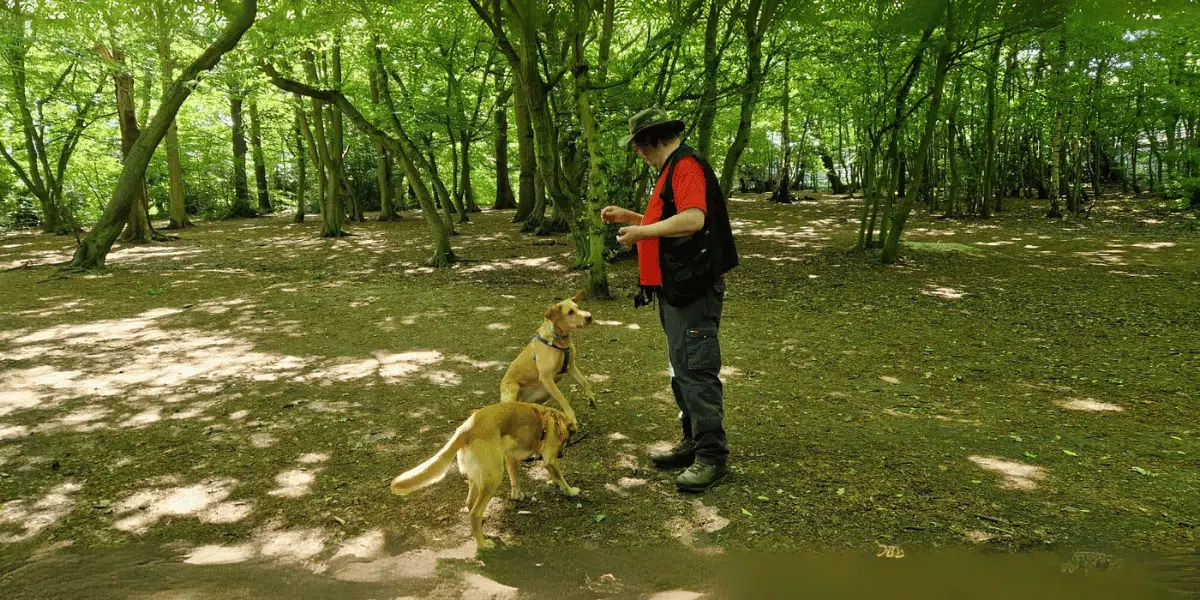
Dog Training Hub: Practical, Reward-Based Training for Everyday Life
Dog training does not have to mean perfect obedience, endless commands or trying to control everything your dog does.
For me, useful training is about helping your dog develop the skills they need to cope with everyday life.
That might mean walking on a looser lead, coming back when called, greeting people without jumping up, being able to disengage from something exciting, settling after a walk or simply feeling confident enough to make good choices.
I use calm, reward-based methods and build training into everyday walks, games and routines.
I have worked professionally with dogs since 2011, including rescue dogs and dogs who are nervous, easily overwhelmed or reactive on walks.
This hub brings together my practical dog-training guides so you can start with the problem or skill that matters most to you.
Quick summary
Good dog training should help your dog understand what you want rather than simply punish them for getting things wrong.
Start by:
- teaching skills somewhere quiet before expecting them in difficult situations
- rewarding behaviours you want to see again
- keeping training sessions short
- allowing your dog time to sniff and explore
- gradually adding distractions
- giving nervous dogs enough distance to feel safe
- considering what your dog’s behaviour is communicating
- building confidence as well as obedience
- giving your dog appropriate choices wherever possible
If your dog is frightened, distressed or unable to cope, more training pressure is rarely the answer.
Start with safety, distance and understanding why the behaviour is happening.
Need some help putting training into practice?
I now offer one-to-one dog training support in Finchley, including recall, loose-lead walking, puppy foundations, confidence-building and help practising exercises you’ve already been given by your trainer or behaviourist
Start with the skill you need
You do not need to work through every guide on this page.
Choose the issue you are dealing with now.
My dog pulls on the lead
Start with my Loose Lead Walking Guide.
Loose-lead walking is not about forcing your dog into a perfect heel.
I want a dog to learn that keeping some slack in the lead and staying connected with the person walking them works.
Sniffing can still be part of that walk.
In fact, access to sniffing can itself become a useful reward.
My dog won’t come back when called
Good recall needs to be worth your dog’s while.
Start with my Recall Training Guide.
Practise somewhere easy before expecting your dog to ignore squirrels, dogs, people and fascinating smells.
If recall is not reliable, use an appropriately handled long line attached to a suitable harness rather than gambling with your dog’s safety.
My dog keeps jumping up
Read How to Stop Dogs Jumping Up.
Instead of concentrating entirely on stopping the jumping, teach your dog something they can do instead.
Four paws on the floor, a sit, a hand target or a simple Find It game can all give an excited dog a more useful option.
My dog barks at everything
Start with How Can I Stop My Dog Barking So Much?
Barking is communication.
Before trying to stop it, consider why your dog is barking.
Excitement, frustration, fear, uncertainty, attention-seeking and alarm barking may look similar but need different approaches.
If barking is connected with fear or reactivity, also visit my Dog Behaviour and Body Language Hub.
My dog gets too excited to listen
Short games can help develop useful real-world skills without making training feel like a chore.
Games can work on:
- recall
- focus
- body awareness
- settling
- disengagement
- confidence
- loose-lead skills
- working around distractions
The aim isn’t simply to tire your dog out.
We’re giving their brain something useful to do.
Training is more than obedience
One of the biggest changes in how I think about dog training is recognising that it is not simply about getting a dog to obey commands.
We need to ask:
Does my dog understand what I’m asking?
Can they actually do it in this environment?
Are they frightened?
Are they too excited to think?
Do they need more distance?
Have I taught the behaviour somewhere easier first?
And sometimes:
Does my dog really need to do what I’m asking?
Those questions matter particularly with rescue, nervous and reactive dogs.
Why sniffing isn’t wasting your walk
If your dog stops at every lamppost, tree and patch of grass, it can sometimes feel as though you’re never going to get anywhere.
But whose walk is it?
Your dog’s nose is one of their main ways of investigating their environment.
My guide to Why Training Matters – and Why Sniffing Wee Is Part of It explains why I don’t see sniffing as the enemy of training.
You can teach your dog when it is time to move on while still giving them opportunities to stop, sniff and be a dog.
Rewards: find out what matters to your dog
Rewards are central to the way I train.
But a reward doesn’t always have to be a dog treat.
Depending on the dog and situation, a reward might be:
- food
- praise
- play
- a favourite toy
- moving forwards
- being allowed to sniff
- creating more distance
- access to somewhere the dog wants to explore
Read my Dog Training Rewards Guide and Guide to Training Dogs With Treats for more practical ideas.
The important question isn’t what you think should be rewarding.
It is:
What does your dog find rewarding at this particular moment?
Building a confident dog
Confidence isn’t created by forcing a dog to confront everything they’re frightened of.
I would much rather give a dog opportunities to succeed.
Confidence can be built through several overlapping areas.
Movement and body awareness
Dogs don’t always have a brilliant awareness of where their bodies are.
Slow, deliberate movement over safe surfaces, stepping over low objects, weaving, turning and exploring different surfaces can help develop body awareness and coordination.
This is one reason I like simple confidence courses.
You don’t need expensive equipment.
Safe household and garden objects can create opportunities for your dog to move, think and investigate at their own pace.
Positive experiences and resilience
Think of your dog’s experiences as deposits and withdrawals from a resilience account.
Lots of safe, enjoyable and successful experiences build up the balance.
Difficult experiences make withdrawals.
We cannot protect our dogs from every unpleasant experience, but we can try to make sure their lives contain plenty of positive ones.
This can be particularly important for puppies, rescue dogs and dogs who have had difficult experiences in the past.
Choice, control and competence
There is another important part of confidence: feeling that you have some control over what happens to you.
That applies to dogs too.
Giving your dog appropriate choices and teaching predictable skills can help them communicate and navigate situations more confidently.
A dog who knows several familiar behaviours has something they can do when the world becomes more difficult.
That could be:
- checking in with you
- moving with you
- touching your hand
- going to a station or mat
- following a familiar pattern
- looking at something and then disengaging
- moving away with you
The important bit is teaching these behaviours somewhere calm first.
Don’t wait until your dog is already overwhelmed.
Training nervous and reactive dogs
If you live with a reactive dog, it is tempting to focus entirely on stopping the barking or lunging.
But the visible reaction is only part of what’s happening.
Your dog may be frightened, frustrated, overexcited, uncertain or simply unable to cope at that distance.
That means training needs to include:
- recognising your dog’s body language
- understanding thresholds
- creating enough distance
- teaching useful behaviours in easy environments
- allowing appropriate choice
- building confidence
- helping your dog disengage
- avoiding repeatedly putting them into situations they cannot handle
Visit my Dog Behaviour and Body Language Hub for a much deeper look at what your dog may be communicating.
You may also find my Rescue Dog Support guides useful if your dog is newly adopted, nervous or struggling with everyday walks.
Reactive dogs aren’t necessarily bad dogs.
Some are frightened. Some are frustrated. Some become overwhelmed incredibly quickly.
And some are, as I rather like to call them, awkward but awesome.
Whatever label we use, though, safety comes first.
Pattern Games and predictable training
Predictability can be extremely helpful for dogs who find the world difficult.
A familiar pattern gives your dog something they already understand.
Leslie McDevitt’s Control Unleashed programme includes Pattern Games designed around this idea.
You practise predictable patterns in easier environments so they become familiar to your dog.
The value isn’t in creating a clever trick.
It is in your dog recognising:
“I know this. I’ve done this before.”
That feeling of competence can be valuable when the environment becomes more challenging.
Look at That: noticing without exploding
Another idea associated with Leslie McDevitt’s Control Unleashed work is Look at That, usually shortened to LAT.
The basic idea is important.
We don’t necessarily need to prevent a dog from seeing something that worries or excites them.
Instead, we can help them learn to notice something and then disengage from it.
That is very different from dragging a dog close to something they’re frightened of and demanding that they behave.
Distance matters.
Your dog’s response matters.
If they can notice something and calmly disengage, that tells us something.
If they’re staring, freezing, leaning forwards, barking, lunging or completely unable to disengage, we may be asking too much.
Move away.
Training should help a dog feel safer, not trap them in a situation they cannot handle.T
Teaching dogs to cope with the real world
A dog who performs beautifully in your kitchen may appear to forget everything the moment you leave home.
They haven’t necessarily forgotten.
The environment became harder.
Dogs need opportunities to practise skills in different places and at gradually increasing levels of difficulty.
Think:
Home.
Then garden.
Then quiet pavement.
Then slightly more interesting environment.
Then greater distractions.
Don’t jump straight from your living room to the busiest part of the park and conclude that training doesn’t work.
This applies particularly to recall, loose-lead walking and calm behaviour around other dogs.
Training puppies
Puppies need training, but they don’t need an exhausting timetable of formal lessons.
They’re learning almost constantly.
Your puppy is discovering:
- what feels safe
- where to sleep
- how to communicate with you
- what different surfaces feel like
- which noises matter
- how to walk on a lead
- how to settle
- how greetings work
- how to cope with being frustrated
- what happens when they come back to you
My Puppy Guides cover those early everyday skills in more detail.
You can also read my Tips for Walking Your New Puppy.
Don’t be in too much of a hurry to create the perfect puppy.
Concentrate on helping them feel safe, curious and able to learn.
Training and enrichment belong together
Training is mental enrichment.
Enrichment can also support training.
Sniffing, searching, problem-solving, chewing, licking and appropriate play give dogs opportunities to use natural behaviours.
That can make life more interesting without simply adding more physical exercise.
Visit my Dog Enrichment Guide for ideas you can use at home and on walks.
This is especially worth considering if your dog comes home from a long walk and still cannot settle.
More exercise isn’t always the answer.
Read How to Help an Excited Dog Settle After a Walk and Is Your Dog Overstimulated, Bored or Overtired?.
Responsible training in public
Training doesn’t happen in isolation.
Other people and dogs have the right to enjoy public spaces too.
Good recall doesn’t mean allowing your dog to run up to every dog they see.
“He’s friendly” isn’t reassuring to someone walking a frightened, injured or reactive dog.
Teach your dog to:
- return when called
- stay reasonably connected with you
- move away when necessary
- pass other dogs with appropriate space
- avoid jumping at strangers
- wait when required
- remain under suitable control
Read my Responsible Dog Walking in Public and Controlling Your Dog in Public guides for more.
If another dog is on lead, give them space unless the owner clearly indicates that an interaction is welcome.
When training isn’t enough
Not every behaviour problem should be treated as a training problem.
Sudden behaviour changes can have medical causes.
Pain can affect walking, tolerance, sleep, handling, aggression and willingness to move.
Speak to your vet if your dog’s behaviour changes suddenly or you suspect discomfort.
For significant fear, aggression, anxiety or other complex behaviour problems, look for an appropriately qualified reward-based behaviour professional.
The Animal Behaviour and Training Council maintains a register of practitioners.
You can also find useful reward-based training guidance from Dogs Trust and RSPCA dog training advice.
One-to-one training support during walks in Finchley
Sometimes the difficult bit isn’t teaching a behaviour in your kitchen.
It’s getting that behaviour to work in real life.
I provide calm one-to-one training and working walks in Finchley and nearby areas, as well as training support at a private secure venue in N6
These are not formal behaviour consultations and I don’t present myself as a clinical behaviourist.
Instead, I can build practical everyday skills into your dog’s walk.
Depending on the individual dog, that might include:
- loose-lead practice
- check-ins
- recall foundations
- sniffing and disengagement
- simple training games
- calmer starts
- confidence-building
- moving away from distractions
- helping your dog settle into a more predictable walking routine
Every dog is different.
For nervous or reactive dogs, sometimes the most useful thing I can do isn’t ask for another behaviour.
It’s give them space.
My walks are one-to-one.
No group walks.
No vans.
No collection rounds.
Your dog’s walk starts and finishes at their own front door.
Dog Training Guides
Use this section as your training library.
Everyday skills
Loose Lead Walking
Help your dog learn to walk without constant tension on the lead.
Recall Training
Build a recall worth responding to and learn when a long line is the safer choice.
How to Stop Dogs Jumping Up
Understand why jumping happens and teach a useful alternative.
How Can I Stop My Dog Barking So Much?
Look beyond the noise and work out what your dog may be communicating.
Training methods
Games-Based Dog Training
Use short games to build focus, recall, confidence and everyday skills.
Training Rewards for Dogs
Learn how food, play, sniffing and other rewards can reinforce behaviour.
Training With Treats
Timing, reward value and using food effectively without turning training into bribery.
Why Training Matters – and Why Sniffing Wee Is Part of It
Why good training should still allow your dog to behave like a dog.
Confidence and behaviour
Building Confidence With a Confidence Course
Use safe, slow movement and different surfaces to develop confidence and body awareness.
Dog Proprioception and Body Awareness
Help your dog become more aware of how their body moves.
Building Resilience in Dogs
Why a history of positive experiences can help dogs recover from difficult ones.
Building Confidence Through Choice and Training
Help your dog develop competence, communication and appropriate control over what happens to them.
Dog Behaviour and Body Language Hub
Understand stress, fear, thresholds, over-arousal and what your dog’s behaviour may be telling you.
Training for real life
Responsible Dog Walking in Public
Controlling Your Dog in Public
Help an Excited Dog Settle After a Walk
Is Your Dog Overstimulated, Bored or Overtired?
A final thought
Dog training isn’t about winning an argument with your dog.
I want the dogs I work with to learn useful skills, but I also want them to feel safe enough to use those skills.
Teach them what you would like them to do.
Reward them when they get it right.
Practise before you need the behaviour.
Listen when they’re telling you something is too difficult.
Give them appropriate choices.
Let them sniff.
Let them learn.
And remember that progress isn’t always a perfect heel or an instant sit.
Sometimes progress is a nervous dog looking at something that used to frighten them, deciding they’re okay, and carrying on with their walk.
That’s training too.
Need practical one-to-one support?
If your dog would benefit from calmer, more structured walks with everyday training and enrichment built in, have a look at my One-to-One Training and Working Walks.
I provide local one-to-one dog walking in Finchley and nearby parts of North London, with particular experience supporting rescue, nervous and reactive dogs.
Contact Finchley Dog Walker or WhatsApp me on 07707 763344 to discuss your dog. My work is reward-based and welfare-led. Read why I don’t use pet correctors, punishment or aversive dog-training equipment.
