
How to Keep Your Dog’s Paws Safe in Summer
Updated April 2026
Hot pavements are one of the easiest summer dog risks to miss.
You step outside in shoes. Your dog does not.
That is the simple bit we often forget.
On warm days, tarmac, paving stones and concrete can heat up far more than the air around us. The walk may feel manageable to you, but the ground can still be painful for your dog’s paws.
I see this every summer around Finchley, North Finchley and Muswell Hill.
A dog is walking nicely beside their owner. The owner looks comfortable. But the dog is stepping quickly, pulling towards grass, lifting a paw, or trying to stop.
That is not stubborn behaviour.
It can be discomfort.
This guide explains how to check the pavement, when to change your plans, what burnt paw pads can look like, and what to do instead of a hot walk.
It is not about making owners feel guilty.
It is about making small, sensible decisions before your dog gets hurt.
Why hot pavements are dangerous for dogs
Dog paw pads are tough, but they are not burn-proof.
Tarmac and concrete absorb heat from the sun. They can stay hot even when the air starts to feel cooler. Direct sunlight, dark surfaces and still air can all make the ground more uncomfortable for dogs.
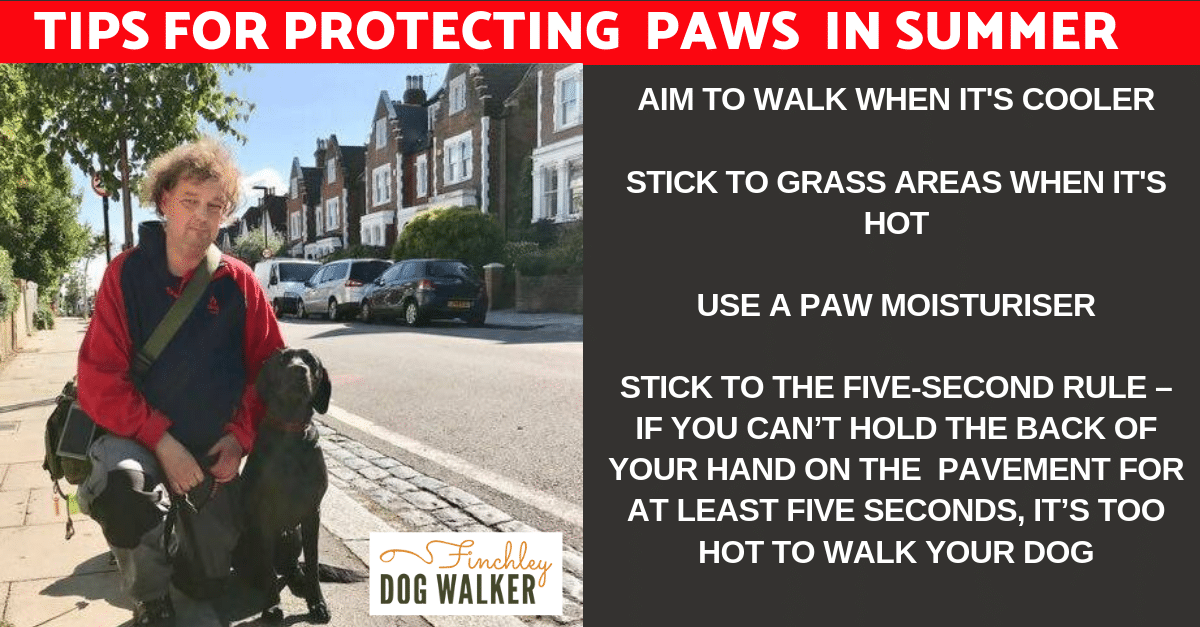
Dogs Trust advises doing a five-second tarmac test before letting your dog walk on it. If you cannot hold your hand on the surface for five seconds, they recommend walking later when it has cooled down.
The Kennel Club also advises testing the surface, walking at cooler times of day and choosing grass where possible to reduce the risk of burnt paws and heatstroke.
The problem is that dogs do not always stop straight away.
Some will keep walking because they want to stay with you.
Some will rush because the ground hurts.
Some will seem fine during the walk, but later lick their paws at home.
That is why prevention matters.
How to test the pavement before a walk
Use the five-second test.
Place the back of your hand on the pavement.
Can you hold it there comfortably for five seconds?
If not, it is too hot for your dog’s paws.
You can also test with bare feet if it is safe for you to do so. If you would not stand there comfortably, do not expect your dog to walk on it.
Check more than one surface.
For example:
- tarmac roads
- concrete pavements
- paving slabs
- artificial grass
- patios
- car parks
- outdoor café areas
A shaded path may feel fine.
A sunny road crossing may not.
That short distance from your front door to the grass can still matter.
When is it too hot to walk your dog?
There is no single number that works for every dog.
Temperature, humidity, sun strength, surface type, age, breed, coat, health and fitness all matter.
But as a working rule, I am cautious on warm days and very cautious during heatwaves.
I avoid the hottest part of the day where possible.
Early morning is usually better than evening because pavements may not have had hours of sun on them yet. Evening can be cooler, but some hard surfaces may still retain heat.
Be extra careful with:
- puppies
- older dogs
- overweight dogs
- flat-faced breeds
- thick-coated dogs
- dogs with heart or breathing issues
- dogs recovering from illness or injury
- nervous dogs who may find heat and busy streets harder to cope with
The RSPCA warns that dogs are at risk in hot weather because they lose heat mainly through panting and can only sweat through their paws. They advise shade, water and care during summer. (RSPCA)
If in doubt, skip the walk.
A missed walk is better than burnt paws or heat stress.
Signs of burnt paw pads
Burnt paws are painful.
You may notice signs straight away, or later when your dog settles at home.
Look for:
- limping
- lifting one paw
- walking quickly or oddly
- pulling towards grass or shade
- licking or chewing paws
- redness
- swelling
- blisters
- peeling skin
- darkened or damaged pads
- reluctance to walk
- sudden sensitivity when paws are touched
Some dogs are stoic.
They may not cry or yelp.
That does not mean they are comfortable.
After any warm-weather walk, check the pads and the spaces between the toes. It only takes a minute.
What to do if your dog burns their paws
If you think your dog has burnt their paws, stop walking.
Move them onto a cool, safe surface.
Gently cool the paws with cool running water. Do not use ice. If possible, do this for 10 to 20 minutes
Try to stop your dog from licking or chewing the sore area.
Keep them calm.
Phone your vet for advice.
Four Paws UK advises cooling affected paws under slow-running water, not ice-cold water, and contacting a vet as soon as possible. (Four Paws UK)
Burns can become infected.
Even if the injury looks small, it is worth getting proper advice.
This guide is general advice only. It is not a substitute for veterinary care. If your dog is in pain, lame, blistered, bleeding, distressed or unwell, contact your vet.
Heatstroke risk matters too
Hot pavements are not the only problem.
A hot walk can also raise the risk of heatstroke.
Watch for:
- heavy panting
- excessive drooling
- wobbliness
- confusion
- vomiting
- collapse
- weakness
- very red gums
- difficulty breathing
The RSPCA advises stopping, finding shade and giving water if a dog is suffering in the heat, and following emergency first aid advice if the dog gets worse
If you suspect heatstroke, contact a vet urgently.
Do not wait to see if your dog improves.
Safer summer walking options
On warm days, I change the walk before the dog has to struggle.
That might mean:
- going earlier
- going later if the ground has cooled
- choosing shaded streets
- using grass routes
- walking in woodland shade
- keeping the walk short
- turning it into a sniff walk
- avoiding road-heavy routes
- planning toilet breaks instead of full walks
- using home enrichment instead
In Finchley, I would think carefully about the route before heading out.
Coldfall Woods, Highgate Woods and Cherry Tree Wood can be better than open streets in hot sun, but even then, I still check the surface, watch the dog and keep the walk calm.
Shade helps.
It does not remove all risk.
What I would focus on first
If you only remember a few things, make them these:
- Check the pavement before every warm-weather walk
- avoid the hottest part of the day
- Choose grass and shade
- carry water
- Keep walks short and slow
- Watch your dog, not just the weather app
- Skip the walk if you are unsure
Your dog does not need a full walk every day in hot weather.
They need to stay safe.
What I would avoid
I would avoid:
- long road walks in the middle of the day
- “just a quick walk” across hot streets
- ball chasing in the heat
- running beside bikes
- heavy exercise when your dog is panting hard
- forcing boots onto a dog who has not been trained to wear them
- relying on paw balm as full protection
- assuming shade means the ground is safe
- walking because you feel guilty
Guilt is not a good reason to take a dog out in unsafe conditions.
A calm rest day is often the kinder choice.
What to do instead of a hot walk
If the pavement is too hot, your dog can still have a good day.
Try:
- scatter feeding in the garden
- a stuffed Kong
- a lick mat
- a short scent game indoors
- hiding treats around one room
- calm trick training
- cardboard box searches
- a shaded toilet break only
- a cool mat in a quiet room
- a frozen dog-safe treat
Keep it gentle.
The aim is not to tire your dog out at any cost.
The aim is to give them something calm and satisfying without adding heat stress.
This is where enrichment helps. Some dogs are more settled after ten minutes of sniffing and problem-solving than after a rushed hot walk.
Affiliate note: Some product links may be affiliate links. If you buy through them, I may earn a small commission at no extra cost to you. I only recommend items that fit the advice on this page.
Paw protection and summer walking kit
Light monetisation fits here, but only if it helps the reader make safer choices.
Useful summer walking items can include:
- a portable dog water bottle
- a dog-safe paw balm
- lightweight dog boots for dogs who tolerate them
- a cooling mat for rest days at home
- a simple treat pouch for scent games and slower walks]
A quick note on dog boots.
They can help some dogs.
But they are not a magic fix.
Dogs need time to get used to them. Start indoors. Reward calmly. Keep sessions short. Do not put boots on for the first time and then head straight out into the heat.
Paw balm can help keep pads supple, but it does not make hot pavement safe.
Use products as support, not as permission to walk in unsafe conditions.
A simple checklist
Before walking your dog in warm weather, ask:
- Can I hold my hand on the pavement for five seconds?
- Is the route mostly shaded?
- Can we stay on grass?
- Is my dog already panting before we start?
- Is my dog young, old, flat-faced, unwell or overweight?
- Do I have water with me?
- Can I shorten the walk?
- Would home enrichment be kinder today?
If the answer makes you pause, change the plan.
How does this fits my dog walking service
For my own dog walking clients, hot weather changes the walk.
That can mean:
- shorter walks
- earlier walks where possible
- shaded routes
- slower sniff walks
- toilet breaks
- enrichment at home
- welfare-first decisions
A dog walk is not successful because it lasts a fixed number of minutes.
It is successful if the dog comes home safe, settled and well cared for.
That is why an Extreme Weather Policy matters. It gives clear expectations before the hot day arrives.
Related guides
You may also find these useful:
- Summer dog safety in Finchley
- Walking your dog in summer
- Extreme Weather Policy
- How to help your dog cope with summer heat
- Dog and Cat Care Guides
- Hot Weather Dog Kit
- The Sniff and Decompress
- Solo Dog Walks in Finchley and Muswell Hill area
FAQs
Can dogs burn their paws on pavements?
Yes. Hot tarmac, paving stones and concrete can burn paw pads. Always test the surface before walking. If it feels too hot for your hand, it is too hot for your dog.
Is the five-second test reliable?
It is a useful quick check, but still use common sense. Check the surface in sun and shade. Watch your dog throughout the walk. If they seem uncomfortable, stop and move to a cooler surface.
What time of day is safest for summer dog walks?
Early morning is often safest because the ground has not had a full day of sun. Late evening may be cooler, but pavements can still hold heat, so always test first.
Should I use dog boots in summer?
Dog boots can help some dogs, but they must be introduced slowly. They are not suitable for every dog, and they should not be used as an excuse to walk on dangerously hot surfaces.
What should I do if my dog is limping after a hot walk?
Move them to a cool place, check their paws, cool the area gently with cool running water, and contact your vet. Do not ignore limping after a hot pavement walk.
Is it bad to skip a dog walk in hot weather?
No. It is often the safest choice. Use a short toilet break, indoor scent games, scatter feeding or a stuffed Kong instead. Missing one walk is much safer than risking burns or heatstroke.
Final thoughts
Hot pavement is a simple risk to avoid once you start checking for it.
Pause before you walk.
Test the ground.
Look at your dog.
Change the route if needed.
And if it feels too hot, leave the walk for another time.
If your dog struggles with summer walks, nervous behaviour, rescue-dog routines, or heat-safe exercise, calm one-to-one walks may be a better fit than busy group walks or fixed routines. In hot weather, I would always rather adapt the visit than push a dog through unsafe conditions
