Updated June 2026
This article offers general guidance only. If your dog is showing serious fear, aggression, anxiety or sudden behaviour changes, speak to your vet and a qualified reward-based behaviour professional.
A dog who is relaxed in the garden, friendly at daycare or comfortable with familiar dogs may bark, freeze or lunge when attached to a lead.
This can be confusing. It may look as though the lead has made your dog aggressive.
Usually, the situation is more complicated.
A lead limits where your dog can go. They cannot easily move closer, move away, curve around another dog or pause to gather information. That loss of choice can make fear, frustration or excitement much harder to manage.
I regularly see this with dogs on walks around Finchley and North London. Narrow pavements, blind corners, busy paths and sudden close encounters can all add pressure.
Understanding why your dog reacts is the first step towards helping them.
As an Amazon Associate, I earn from qualifying purchases.
What does lead reactivity mean?
- Why do dogs behave differently on a lead
- Fear, frustration and excitement
- Early signs your dog is struggling
- What to do when another dog appears
- Common mistakes to avoid
- Equipment that may help
- When to seek professional support
- One-to-one walks for reactive dogs
- Frequently asked questions
What does lead reactivity mean?
Lead reactivity refers to an intense response to a trigger when a dog is attached to a lead.
The trigger might be:
- another dog
- a particular type of dog
- runners
- bicycles
- children
- strangers
- traffic
- wildlife
- loud noises
- people approaching directly
The reaction may include:
- staring
- freezing
- leaning forwards
- whining
- barking
- growling
- spinning
- jumping
- pulling
- lunging
- trying to retreat
Reactivity is a description of what happens. It is not a diagnosis.
A dog may react because it is frightened, frustrated, overexcited, in pain, or unable to cope with its environment.
Barking or lunging does not automatically mean your dog wants to fight.
Sometimes the behaviour is an attempt to make the other dog or person move away.
Why do dogs act differently when they are on a lead?
The lead removes some of their choices.
Dogs usually communicate through movement, posture, facial expressions, and scent.
When free to move, a dog may:
- slow down
- stop
- turn away
- approach in a curve
- sniff the ground
- increase their distance
- choose not to meet
A short or tight lead can remove those options.
Your dog may feel trapped between you, the pavement, a wall, a road or the approaching dog.
That does not mean dogs should be allowed off lead whenever they react. Safety comes first.
It means we should recognise how restriction changes the situation.
Another dog may be too close.
Every dog has a distance at which they can notice a trigger and still think, eat, sniff or respond to you.
Inside that distance, they may become overwhelmed.
This is sometimes called going over the threshold.
Once a dog is over threshold, asking for a sit or repeatedly calling their name may achieve very little. Their nervous system is already dealing with what feels like an urgent situation.
Creating distance is often more useful than demanding obedience.
The approach may feel too direct
Not all dogs enjoy walking straight towards one another.
A head-on approach on a narrow pavement can feel intense, particularly when both dogs are pulling or staring.
Whenever it is safe, I prefer to create a curve, cross the road or step into a driveway rather than force a close pass.
Tight leads can add pressure
Owners naturally shorten a lead when worried.
This may be necessary for immediate safety, but constant tension can further restrict the dog, making movement stiff or uncomfortable.
The aim is not to drop the lead or give the dog complete freedom near a trigger.
It is to create enough space to handle the lead safely without dragging the dog into or away from the situation.
Past experiences affect present behaviour.
A dog who has previously been rushed, frightened or attacked may learn that approaching dogs are unsafe.
Rescue dogs may also arrive with experiences that you know very little about.
Others may have had too few calm experiences with different dogs and in different environments.
This does not make them bad dogs.
It means they need thoughtful management and suitable professional support.
Frustration can look similar to fear
Some dogs are desperate to reach another dog.
They may bark, jump or pull because the lead prevents them from greeting or playing.
This is often called a frustrated greeting.
It can look dramatic, but allowing the dog to pull towards every dog usually strengthens the pattern. It can also frighten the other dog.
A frustrated dog still needs space, calm practice and help learning that seeing another dog does not always lead to a greeting.
Pain or discomfort may lower tolerance.
A vet should check a dog who suddenly becomes reactive.
Pain, reduced vision, hearing changes and other health problems can affect how secure a dog feels.
This is particularly important when the behaviour appears suddenly or is out of character.
Is my dog aggressive or reactive?
The terms are often used as though they mean the same thing, but they do not.
Reactive describes a strong response.
Aggressive behaviour may include threats or actions intended to increase distance or prevent interaction. Even then, it is important to understand the emotion and situation rather than simply attaching a label to the dog.
Look at:
- What happened immediately before the reaction
- how close the trigger was
- Whether your dog tried to move away first
- whether the lead was tight
- whether the route was narrow
- whether your dog was already tired or stressed
- how quickly they recovered afterwards
Keep a simple diary. Patterns are often easier to see on paper.
Early signs your dog is becoming uncomfortable
Barking and lunging are often the most obvious signs, but they may not be the first.
Earlier signs can include:
- slowing down
- stopping
- turning the head away
- lip licking
- yawning when not tired
- closing the mouth suddenly
- lifting one paw
- lowering the body
- ears moving back
- a tucked or very stiff tail
- staring
- refusing food
- frantic sniffing
- trying to hide behind you
- pulling towards home
A wagging tail should not be used as proof that a dog is friendly or relaxed.
Look at the whole dog and the situation.
Read the Dog Trust Guide on signs your dog is feeling anxious
What should I do when another dog appears?
1. Notice the trigger early
The earlier you spot another dog, the more choices you have.
Look ahead at:
- path entrances
- corners
- parked cars
- narrow gates
- woodland paths
- busy crossing points
On walks through places such as Cherry Tree Wood, Coldfall Woods or the Parkland Walk, I avoid getting boxed into narrow sections when walking a dog who needs space.
2. Create distance
Cross the road, turn into a side street or move behind a parked car when safe.
Distance is not failure.
It prevents repeated rehearsals of barking and lunging and gives your dog a better chance of staying calm enough to learn.
3. Use a calm exit cue
Teach a simple phrase such as:
- “This way”
- “Let’s go”
- “Turn”
Practise it at home and on quiet walks before using it near a difficult trigger.
Say the cue once, turn smoothly and reward your dog for coming with you.
4. Reward your dog before they react
At a safe distance, your dog may be able to look at another dog and then turn back towards you.
Reward that calmer choice.
You are not rewarding aggression.
You are building a positive response and reinforcing the behaviour you want to see.
Do not wait until your dog is barking at full intensity before offering food.
5. Use visual barriers
A hedge, a parked vehicle, a wall, a gate, or simply going in someone’s drive, as most people are fine with this when they understand why, can reduce visual pressure.
Even a few seconds out of sight may help your dog recover.
6. Allow time to decompress
A difficult encounter can affect the rest of the walk.
Your dog may need:
- more distance
- a quieter route
- time to sniff
- a shorter walk
- a calm return home
Do not assume they have immediately forgotten the incident. My sniff-and-decompress walks could help.
Common mistakes to avoid
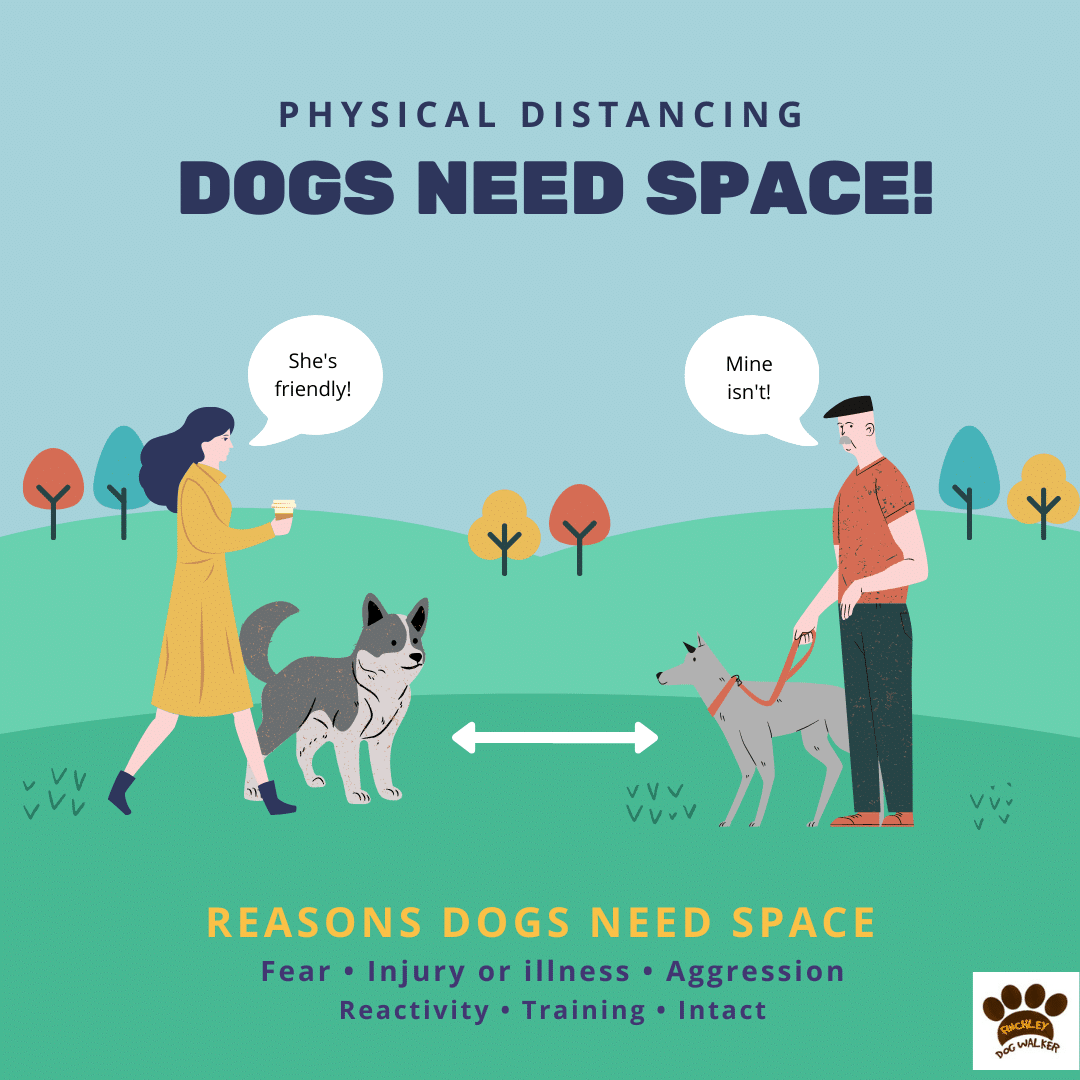
Forcing a greeting
Dogs do not need to greet every dog they pass.
A lead-to-lead greeting can be particularly difficult when either dog is worried, frustrated or unable to move away.
It is fine to say:
“Sorry, my dog needs space.”
Tightening the lead long before the trigger arrives
Constant tension may tell your dog that something worrying is about to happen.
Keep the lead secure, but aim for enough slack to allow natural movement whenever possible.
Telling your dog off
Shouting, leading corrections or punishment may suppress warning signals without changing the underlying emotion.
They can also make the sight of another dog predict the handler’s discomfort.
Reward-based training and careful management are safer choices.
EXTERNAL LINK: PDSA guidance on aggressive or reactive behaviour – place here
Walking directly towards the trigger
Do not force your dog to “face their fear”.
Moving too close may make the reaction stronger and recovery harder.
Work at a distance where your dog can remain aware of the trigger without becoming overwhelmed.
Allowing every greeting
A frustrated greeter may learn that pulling, barking and lunging eventually get them access to another dog.
Choose greetings carefully rather than treating them as an automatic part of every walk.
When you do greet a dog for the first time, do so for only 3 seconds
Expecting treats to fix everything
Food can be useful, but timing and distance matter.
A dog who cannot take food may be too stressed or too close to the trigger.
Move away first.
Skipping meals to make the dog cooperate
I do not recommend withholding a normal meal to make a dog more responsive on a walk.
Use suitable rewards as part of a balanced daily diet. Speak to your vet if your dog has dietary needs, digestive problems or a medical condition.
Equipment that may help
Equipment does not cure lead reactivity, but suitable walking gear can improve safety and comfort.
I generally prefer:
- a well-fitted harness
- a fixed-length lead
- a double-ended lead where appropriate
- a secure collar and identification tag
- a treat pouch that can be reached quickly
- high-value rewards suitable for the dog
- a yellow lead cover when extra space is needed
Avoid:
- retractable leads in busy areas
- choke chains
- check chains
- prong collars
- shock collars
- equipment designed to frighten or hurt
I always recommend a 2-point harness, such as the Perfect Fit, Tellington T-Touch, or xtra dog, with a double-ended lead.
When should I contact a professional?
Speak to your vet when:
- The behaviour began suddenly
- Your dog appears painful or stiff
- The reaction is getting worse
- Your dog has bitten or attempted to bite
- Your dog is anxious in several situations
- Your dog struggles to recover after a trigger
- The behaviour is affecting normal walks
- You feel unable to keep everyone safe
A vet can check for medical causes and refer you when needed.
Choose a qualified behaviour professional who uses reward-based methods and does not rely on intimidation, pain or forced exposure.
Management is still valuable while you wait for support.
Quieter routes, greater distance, and well-planned walks can prevent the problem from becoming more established.
Calm one-to-one walks for reactive dogs
Group walking is not suitable for every dog.
Some dogs cope far better with:
- one consistent walker
- No van journey
- no group of unfamiliar dogs
- walks starting from their own front door
- quieter routes
- flexible pacing
- time to sniff
- space from triggers
My solo dog walks in Finchley, North Finchley, East Finchley, Finchley Central and Muswell Hill are planned around the individual dog.
I do not promise to cure reactivity during a normal dog-walking service. Behaviour work and dog walking are not the same thing.
What I can offer is calm handling, routine, careful route choices and one-to-one attention.
Quick checklist for your next walk
Before leaving:
- Check that the harness and lead are secure.
- Take suitable rewards.
- Choose a quieter route.
- Think about where you can create distance.
- Avoid known bottlenecks where possible.
During the walk:
- Scan ahead.
- Watch your dog’s body language.
- Move away early.
- Reward calm choices.
- Avoid forced greetings.
- Give your dog time to sniff and recover.
After the walk:
- Note difficult moments.
- Record the trigger and distance.
- Consider whether the route was too busy.
- Contact your vet or a qualified professional if the behaviour is sudden, severe or worsening
Related guides
- practical dog care guides
- supporting a nervous rescue dog
- Sniff and Decompress Walks
- safer walking equipment
- calm one-to-one dog walking
Frequently asked questions
Why is my dog friendly off-lead but reactive on-lead?
The lead removes some of your dog’s ability to create distance, change direction or approach in a curve. Fear, frustration or excitement can then become more intense. This does not mean that letting the dog off lead is the solution. Work on distance, calm handling and suitable professional support.
Should I let my reactive dog greet other dogs?
Not automatically. Forced or uncontrolled lead greetings can increase pressure. Your dog does not need to meet every dog. Choose interactions carefully and allow both dogs space to move away.
Am I rewarding barking by giving my dog treats?
Good timing matters. Ideally, reward your dog while they are still calm enough to notice the trigger and respond to you. If they are already barking and lunging, create distance first rather than trying to feed through an overwhelming situation.
Can a tight lead worsen reactivity?
A tight lead can restrict natural movement and may add tension. Safety still comes first, so do not give extra lead near roads or other hazards. Creating more physical distance usually makes safe, looser handling easier.
Will my dog grow out of lead reactivity?
Some young dogs become calmer as they mature, but repeated barking and lunging can become an established response. Early management and reward-based professional guidance are preferable to waiting and hoping it disappears.
Should I punish my dog for barking at other dogs?
No. Punishment may increase fear or frustration and can remove warning signals without improving how your dog feels. Move away, reduce pressure and use reward-based methods.
Why has my dog suddenly started reacting on walks?
Sudden changes can be linked to pain, illness, sensory changes, a frightening experience or a change in the environment. Arrange a veterinary check, particularly when the behaviour is new or out of character.
Can a dog walker help with lead reactivity?
A calm, experienced one-to-one walker can reduce avoidable pressure through careful routes, consistent handling and suitable distance. A dog walker should not claim to replace a vet or qualified clinical behaviourist.
Please also visit the Respect the Lead campaign