If you’ve ever looked for a professional dog walker, you’ve probably come across many descriptions.
Solo walks. Group walks. Enrichment walks. Sniff walks. Decompression walks. Adventure walks. Training walks.
Then there are phrases such as reactive, threshold, meet-and-greet and structured walking.
It’s almost enough to make you wonder whether your dog needs to learn the terminology before going outside.
Fortunately, they don’t.
I’m Del, and I’ve been providing professional one-to-one dog walking and pet care in Finchley and North London since 2011.
I’ve worked with confident dogs, enthusiastic adolescents, older dogs, rescue dogs and some wonderfully spirited characters who need a little more space and patience.
One thing I’ve learnt is that a service name doesn’t necessarily explain what your dog will experience.
An enrichment walk isn’t automatically better than an ordinary walk. An adventure walk isn’t necessarily suitable for a nervous dog. And a group walk isn’t the right choice simply because a dog enjoys meeting other dogs.
This guide explains the most common dog-walking terms, what they generally mean and the questions I’d ask before booking.
Why dog-walking terminology matters
Most professional dog walkers use descriptions to explain how they work.
However, many of these terms don’t have one universally agreed definition.
An adventure walk offered by one business may be very different from an adventure walk offered by another.
Likewise, a training walk could mean anything from practising a few agreed cues to a structured training appointment.
I wouldn’t choose a service based on its name alone.
I’d ask what actually happens during the booking, how the dog is handled, whether other dogs are involved and how the activity is adapted to individual needs.
Solo dog walks
What is a solo dog walk?
A solo walk is generally a walk where your dog receives individual attention from the professional walker.
However, check whether the provider means one dog, one household or something else.
For example, I provide one-to-one walks and may also walk compatible dogs from the same household where suitable and agreed.
I don’t combine dogs from unrelated households.
Who might benefit from solo walks?
Individual walking can be particularly useful for:
- Nervous or shy dogs.
- Reactive dogs.
- Rescue dogs adjusting to new surroundings.
- Older dogs who need a slower pace.
- Puppies who are ready for appropriate outdoor walks.
- Dogs recovering from illness, where walking has veterinary approval.
- Dogs who struggle with unfamiliar dogs.
- Dogs whose normal routine requires particular handling or timing.
- Confident dogs whose owners simply prefer individual care.
Being sociable doesn’t mean that a dog must walk in a group.
And being nervous doesn’t mean that a solo walk will automatically be completely stress-free.
The route, handling, environment and individual dog all matter.
How my solo walks work
My Solo One-to-One Dog Walks in Finchley start and finish at the client’s home.
I don’t use cars or vans to collect dogs, and I don’t arrange group collection rounds.
The walk is adapted to the dog’s age, fitness, confidence, health and preferences.
That might mean a steady local outing, a quiet route with plenty of sniffing or a shorter walk when the dog needs a gentler day.
For a more detailed comparison, read my Solo vs Group Dog Walks Guide.
Group dog walks
What is a group walk?
A group walk involves several dogs being walked together.
Some businesses operate small, carefully selected groups. Others may walk larger groups.
The arrangements vary.
Some walkers collect dogs in vehicles and take them to a particular park or open space.
Others walk directly from a local collection point.
Are group walks good for dogs?
They can be suitable for dogs who genuinely enjoy the arrangement and whose needs can be managed safely.
However, a dog who likes another dog during a brief meeting may not necessarily enjoy spending an entire walk alongside several unfamiliar dogs.
I’d ask:
- How many dogs are walked together?
- How are the dogs assessed for compatibility?
- What happens when one dog becomes worried?
- Can a dog move away from interactions?
- How are different walking speeds managed?
- What happens when a dog is unwell or injured?
- How are dogs transported, if applicable?
- What happens if two dogs cannot safely walk together?
- Are dogs allowed off lead?
A good provider should be willing to explain their approach.
Does a group walk count as socialisation?
Not automatically.
Socialisation and social experiences should be appropriate, positive and manageable.
Being surrounded by unfamiliar dogs doesn’t guarantee that a dog is enjoying themselves or learning useful social skills.
Some dogs benefit from carefully managed interaction.
Others prefer to walk without other dogs approaching them.
Choose based on your dog’s actual behaviour rather than the assumption that every dog needs more canine friends.
Enrichment walks
What is an enrichment walk?
An enrichment walk provides opportunities for a dog to engage in suitable, natural and enjoyable activities alongside physical movement.
This may include:
- Sniffing.
- Exploring suitable environments.
- Searching for food.
- Investigating different safe surfaces.
- Following an interesting scent.
- Gentle reward-based games.
- Having appropriate choices about direction.
- Time to pause and observe.
But enrichment isn’t necessarily an extra activity that happens only when you book a specialist walk.
Every suitable dog walk can include enrichment.
It’s part of how I approach my regular work.
Is an enrichment walk the same as tiring a dog out?
Not necessarily.
Enrichment should provide worthwhile experiences rather than simply leaving the dog exhausted.
A difficult puzzle, repeated excitement or overwhelming surroundings aren’t automatically beneficial just because they’re described as enriching.
The Dogs Trust enrichment guide explains how sniffing, searching and appropriate activities can contribute to a dog’s welfare.
My Dog Enrichment Hub offers further practical ideas.
Sniff walks
A sniff walk is exactly what it sounds like.
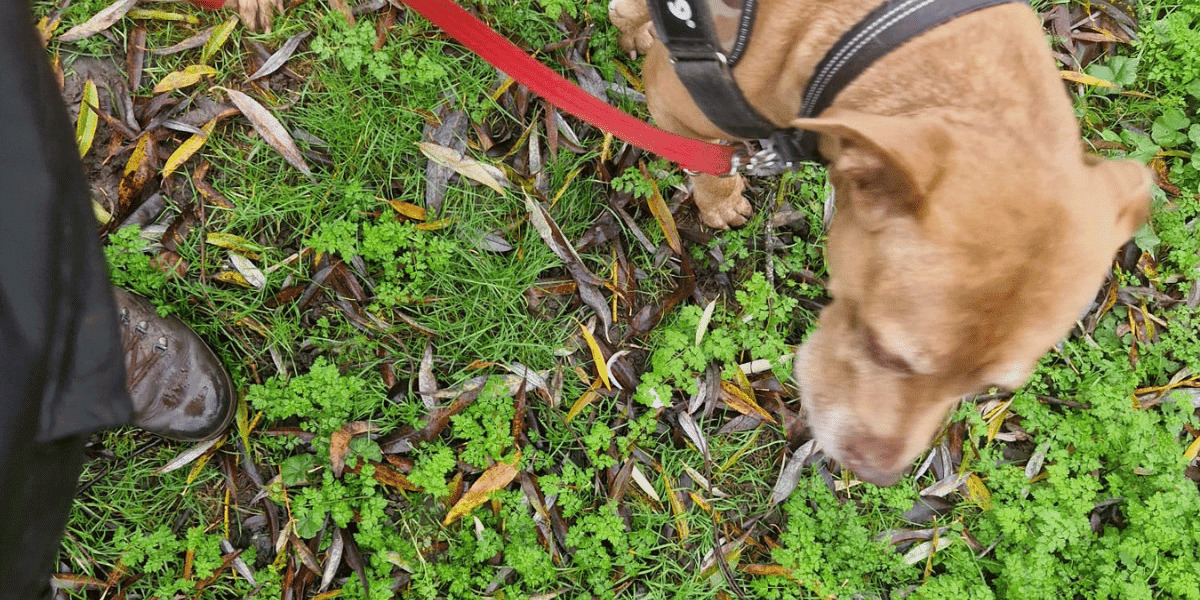
Rather than maintaining a brisk pace and constantly encouraging the dog to move on, you allow more time for suitable sniffing and exploration.
For example, your dog might spend several minutes investigating a particular patch of grass.
That doesn’t mean they’re wasting time.
They’re gathering information about their surroundings.
A sniff walk might cover less distance than a brisk walk of the same duration.
That’s perfectly reasonable when the activity suits the dog.
However, sniffing doesn’t automatically mean a dog is relaxed.
A frightened dog may sniff while showing other signs of discomfort.
I still look at their whole body language, the environment and whether they appear able to cope.
Decompression walks
This is another term you’ll hear frequently.
There isn’t a single regulated definition of a decompression walk.
When I use the term, I’m usually describing a lower-pressure outing where I pay particular attention to the dog’s emotional comfort.
That might involve:
- Choosing a quieter route.
- Avoiding crowded areas.
- Providing greater distance from other dogs.
- Allowing more sniffing.
- Reducing unnecessary training demands.
- Letting the dog pause or change direction where appropriate.
- Returning home before the dog becomes overwhelmed.
It doesn’t mean that every dog must be taken into a forest or allowed to run loose.
It certainly doesn’t mean that a particular duration guarantees a reduction in stress.
One of my favourite reminders is that an interesting walk doesn’t have to be a long walk.
My Sniff and Decompression Walks Guide explains the approach, its benefits and the limits of the evidence in greater detail.
Structured walks
What is a structured dog walk?
This phrase can mean different things to different providers.
Some use it to describe a walk with predictable routines and opportunities to practise everyday skills.
Others use it to describe a more controlled walk where a dog is expected to remain in a particular position.
Those are not necessarily the same thing.
What I would want to know
I’d ask what the walker actually expects from the dog.
Do they allow sniffing?
Can the dog stop?
How do they respond when the dog becomes worried?
What happens if the dog pulls towards something?
What equipment and training methods do they use?
I don’t believe a dog needs to walk at a perfect heel for an entire outing to be behaving appropriately.
There are times when walking close is important, particularly near roads or in crowded areas.
But on a suitable quiet path, there’s often no reason to prevent a dog from exploring comfortably.
Training walks
What is a training walk?
A training walk generally involves practising particular skills during an outdoor session.
These might include:
- Loose-lead walking.
- Recall foundations.
- Checking in with the handler.
- Moving away from distractions.
- Responding to familiar cues.
- Calmly passing everyday activity.
- Building confidence around suitable environments.
However, the title doesn’t tell you how much formal training is provided.
Some dog walkers reinforce skills that have already been taught.
Others are qualified trainers offering specific training appointments.
Does a training walk fix reactivity?
Not necessarily.
Reactivity can involve fear, frustration, excitement, pain or several interacting factors.
A dog who barks and lunges may need veterinary assessment, changes to everyday management and a suitable behaviour plan.
Simply booking a training walk doesn’t guarantee that these issues will be resolved.
My One-to-One Dog Training Support in Finchley focuses on appropriate everyday skills, reward-based practice, enrichment and confidence.
I’m not a clinical animal behaviourist.
If your dog has significant fear, aggression or another serious behavioural difficulty, start with your vet and seek appropriately qualified support.
The Animal Behaviour and Training Council practitioner directory can help you identify assessed trainers and behaviour professionals.
Confidence-building walks
These outings are intended to help a dog develop greater comfort with manageable everyday experiences.
They may be suitable for some nervous, rescue or adolescent dogs.
Activities might include:
- Observing traffic from a suitable distance.
- Practising comfortable movement along a quiet street.
- Investigating unfamiliar but safe surfaces.
- Building familiarity with a particular route.
- Learning that it’s possible to move away from something worrying.
- Rewarding voluntary engagement.
The aim isn’t to force a frightened dog to tolerate increasingly difficult situations.
If the dog is overwhelmed, the experience needs to be made easier.
For suitable local owners, my Street and Public Transport Confidence Support provides practical one-to-one assistance.
Complex behavioural concerns may still require a specialist.
Adventure walks
An adventure walk usually describes a longer or more varied outing, perhaps involving woodland, open spaces or a different destination.
It can sound appealing.
And some dogs genuinely enjoy new places and longer walks.
But before booking, I’d ask:
- How long is the actual walk?
- Is travelling time included in the appointment?
- How is the dog transported?
- Are unfamiliar dogs involved?
- Is the route appropriate for the dog’s fitness?
- Will the dog be on or off lead?
- How are recalls and wildlife encounters managed?
- What happens during bad weather?
- How are rests and water breaks provided?
A long outing to an exciting destination may be enjoyable for one dog and overwhelming for another.
Adventure doesn’t have to mean intensity.
I don’t advertise van-based adventure walks. My own walks remain local and start at the client’s home.
Drop-in visits and puppy visits
A drop-in or pop-in visit generally means a professional comes to the pet’s home for a shorter appointment rather than providing an ordinary walk.
Depending on the service, this might involve:
- Feeding.
- Fresh water.
- A toilet opportunity.
- Gentle company.
- A short play session.
- Appropriate enrichment.
- Medication support where agreed.
- A basic welfare check.
These arrangements may be particularly useful for puppies, older animals or dogs whose normal walking routine needs to change temporarily.
Puppy visits
Young puppies may require frequent toilet opportunities, food, rest and supervision.
A visit should be appropriate to their age and normal routine.
My Puppy Visits in Finchley provide individual daytime care.
However, one short visit won’t necessarily provide enough support for a very young puppy who would otherwise be alone throughout a working day.
The complete care arrangement matters.
Reactive dogs and the word ‘reactivity’
You’ll often see descriptions such as reactive-dog walks or reactive-dog support.
But what does reactive mean?
In everyday language, it usually describes a dog who responds strongly to particular things in their environment.
That may involve barking, lunging, pulling, freezing or attempting to move away.
The response may be connected to fear, frustration, excitement or other factors.
Reactive does not automatically mean aggressive.
Equally, a reactive dog can create a safety risk, and the behaviour should not be dismissed.
I prefer to understand what the dog finds difficult rather than label them as badly behaved.
For suitable dogs, my Rescue and Nervous Dog Support provides calm, individual walking support.
This isn’t clinical behaviour treatment.
What does ‘threshold’ mean?
You might hear somebody say a dog has gone over threshold.
It generally means they’ve reached a point where the situation has become too difficult for them to cope with comfortably.
For example, a dog may be able to observe another dog at a distance.
As the other dog approaches, they might become increasingly tense, stop taking food, freeze, bark or lunge.
Those changes can indicate that the situation is becoming harder to manage.
Rather than waiting for a major reaction, I look for earlier signs and create distance where appropriate.
The aim is to help the dog remain comfortable enough to learn and make suitable choices.
My Dog Behaviour and Body Language Hub explores this in more detail.
What is reward-based walking?
Reward-based walking involves encouraging useful behaviour through appropriate rewards and thoughtful management.
The reward might be food, a toy, access to a suitable sniffing opportunity or something else the dog values.
For example, I may reward a voluntary check-in or a few comfortable steps on a loose lead.
I don’t use prong collars, choke or check chains, electronic collars, rattle bottles or punishment-based corrections.
If you’re hiring a walker, ask what they would do if your dog stopped, barked, pulled or became frightened.
The answer is often more informative than the marketing description.
What is a meet-and-greet?
A meet-and-greet is an introductory appointment before care begins.
It’s an opportunity for the owner and professional to discuss:
- The dog’s normal routine.
- Health and medication.
- Behaviour around people and other dogs.
- Walking equipment.
- Escape risks.
- Feeding and toileting requirements.
- Keys and access.
- Emergency arrangements.
- Preferred handling methods.
- What happens during unsuitable weather.
- The service being requested.
For nervous dogs, more than one introduction may sometimes be appropriate.
A meet-and-greet isn’t simply a quick opportunity for me to stroke your dog and collect a key.
It helps me understand whether I can provide safe and suitable care.
My Finchley Dog Walker Welcome Pack explains the booking and introduction process.
What does ‘insured dog walker’ mean?
Insurance arrangements differ between businesses.
Don’t assume that the statement ‘fully insured’ tells you everything a policy covers.
Ask whether the insurance is appropriate for the services being offered.
Depending on the activity, relevant considerations may include public liability, care of animals, key holding, transport and other policy conditions.
A professional should be able to explain their cover and any important restrictions.
Insurance doesn’t replace suitable experience, handling skills or safe procedures.
What does canine first aid training mean?
Canine first aid training provides knowledge about recognising emergencies and giving appropriate immediate assistance while arranging veterinary care.
It doesn’t qualify a dog walker to diagnose illness or provide veterinary treatment.
I hold an Ofqual Level 3 qualification in Canine First Aid and continue to study canine health and welfare.
I also recommend that owners understand the basics of canine emergencies.
My Dog First Aid Hub provides practical preparation and further reading.
Does a longer walk mean better value?
Not necessarily.
Imagine two different outings.
During the first, a confident dog enjoys an hour of comfortable movement, sniffing and exploration.
During the second, a nervous dog spends an hour struggling with traffic, unfamiliar dogs and situations they find frightening.
The duration is the same.
The experiences are not.
I’d look at:
- Whether the activity suits the dog.
- The time actually spent walking or providing care.
- Opportunities to sniff and explore.
- Whether the dog can cope with the environment.
- How safely the walker manages distractions.
- Whether the dog gets suitable rest.
- How the dog behaves afterwards.
The PDSA’s dog exercise guidance explains why exercise needs vary with age, health and the individual dog.
Do you need special equipment for different walks?
Sometimes additional equipment can be useful, but it should serve a specific purpose.
For most everyday walks, suitable equipment may include:
- A correctly fitted harness or appropriate flat collar.
- A reliable fixed-length lead.
- A legible identification tag.
- Poo bags.
- Suitable rewards.
- Water where needed.
- Appropriate backup equipment for particular dogs.
Long lines may be useful in suitable areas, but they require careful handling and aren’t appropriate in every environment.
I don’t recommend retractable leads for my ordinary urban walks.
Before buying anything, read my Leads and Harnesses Buying Guide.
I would rather see a dog with comfortable, correctly fitted equipment than an expensive collection of gadgets that don’t actually help.
Choosing the right dog walker: questions I would ask
Once you’ve understood the terminology, the next step is choosing a suitable professional.
I’d ask:
- Will my dog walk alone or with other dogs?
- Will they be transported, and how?
- Where will the walk start and finish?
- Does the booked time include travel or collection?
- How will the route be adapted to my dog’s needs?
- What training and handling methods do you use?
- What experience do you have with nervous or reactive dogs?
- How do you handle emergencies?
- What insurance do you have?
- What happens if the weather makes outdoor exercise unsafe?
- What updates will I receive?
- Can we arrange a suitable introduction before care begins?
These questions matter more than whether a walk is described as premium, adventure, enrichment or structured.
For the full checklist, read my How to Choose a Dog Walker guide.
What I offer at Finchley Dog Walker
My service isn’t built around collecting a van full of dogs or completing the same route every day.
I’ve worked professionally with dogs in North London since 2011, and I focus on calm, individual care.
Depending on the dog and booking, I may provide:
- Solo One-to-One Dog Walks.
- Rescue and Nervous Dog Support.
- Puppy Visits.
- One-to-One Dog Training Support.
- Pet and House Sitting.
My regular walking areas include East Finchley N2, Finchley Central N3, North Finchley N12 and Muswell Hill N10, subject to the exact location and availability.
I care for one household at a time.
The aim is to provide an enjoyable, manageable experience suited to the individual animal.
You can see the arrangements on my current pet-care prices page.
Frequently asked questions
What is the difference between a solo and a group dog walk?
A solo walk generally provides individual attention, while a group walk involves several dogs together. The exact arrangements depend on the provider. Always ask how many dogs will attend and whether transport is involved.
Is an enrichment walk better than a normal walk?
Not automatically. A suitable ordinary walk can already provide enrichment through sniffing, exploration and enjoyable activity. What matters is the experience, not the name.
Is a decompression walk a training method?
Not necessarily. The term is often used for a quieter, lower-pressure walk. There is no single standard definition or guaranteed outcome.
Does an adventure walk mean my dog gets more exercise?
Not always. Check the actual walking time, activity, travel arrangements and individual suitability. More distance doesn’t automatically mean a better experience.
Can a dog walker help with training?
Some walkers reinforce everyday reward-based skills, while others provide specific training services. Ask about their experience, qualifications and the scope of the appointment. Complex behavioural issues may need qualified specialist support.
Do reactive dogs need solo walks?
Many benefit from individual arrangements that provide more space and predictable handling. However, suitability depends on the dog, the walker, the environment and any relevant safety concerns.
Should every dog be allowed off lead?
No. Off-lead activity must be safe, appropriate, permitted in the location and compatible with reliable control. Some dogs should remain on a suitable lead or long line.
Does a dog need to be exhausted after a walk?
No. A good walk provides suitable physical activity and enjoyable experiences. Exhaustion isn’t a reliable measure of welfare or success.
Are dog-walking terms legally standardised?
Many everyday service descriptions, such as enrichment walk, adventure walk and decompression walk, aren’t legally defined categories. Ask each provider exactly what is included.
What if I don’t know which walk suits my dog?
Start by describing your dog’s age, health, confidence, normal routine and any difficulties. A responsible provider should discuss whether the service is appropriate rather than promising that every dog will fit.
The dog matters more than the terminology
The dog-walking industry uses a lot of terminology.
Some of it is genuinely useful.
Some of it sounds rather grand for something as simple as allowing a dog to stop and sniff a tree.
For me, the important questions are always the same.
Is the dog comfortable?
Are they safe?
Do they have suitable opportunities to move, explore and enjoy themselves?
Can the experience be adjusted when they’re worried, tired or unwell?
And does the service actually meet their needs?
If the answers are right, the walk doesn’t need a particularly impressive name.
It needs to be the right walk for that dog.
If you’re looking for calm, individual dog walking in Finchley or Muswell Hill, you can contact me here.
Tell me a little about your dog, your postcode and the days you need.
I’ll explain whether I can help.
More dog-training terminology
This article was originally written as part of a pet-professional blog circle.
For a companion explanation of common training and behaviour terms, visit Dave’s Dogs: An A–Z Guide to Dog Training and Behaviour Jargon.
You can also explore my New & First Pet Owner Hub and Dog Training Hub for further guidance.
First published: 1 February 2025
Substantially updated: 26 October 2026