Updated July 2026
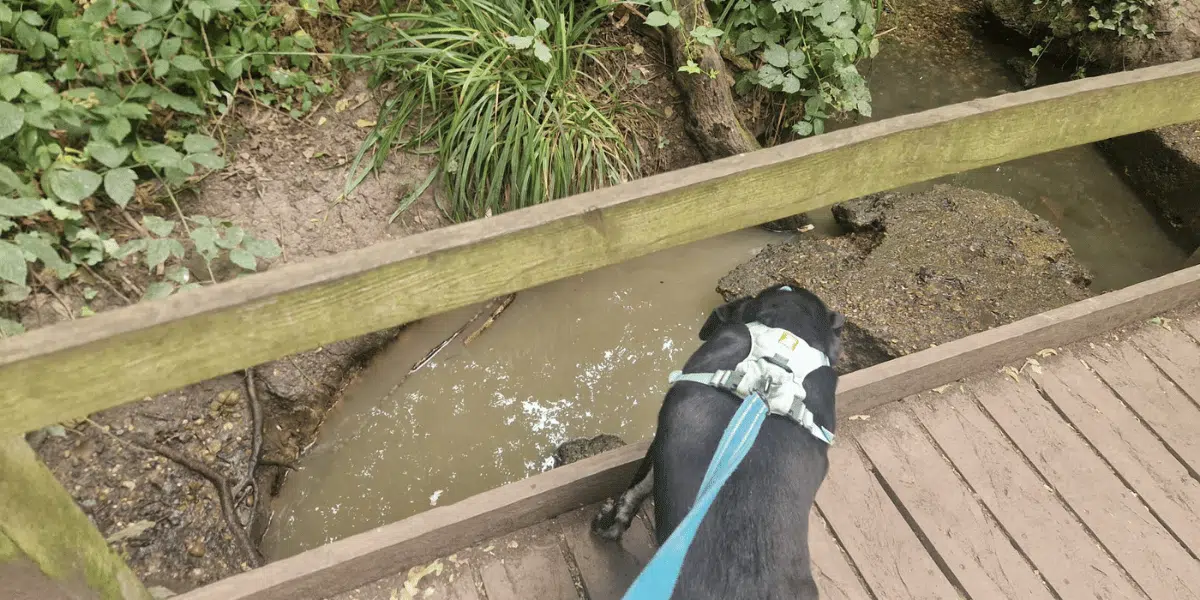
A shallow stream can look very tempting on a hot dog walk.
The water is there.
The dog is pulling towards it.
And letting them paddle seems like an obvious way to help them cool down.
But after weeks of hot, dry weather, I become particularly cautious around ponds, streams, ditches, canals and other slow-moving water.
Some dogs see a muddy pool and apparently think they have discovered a luxury spa.
I see water whose quality I cannot check.
That does not mean every pond or stream is contaminated.
It means I cannot tell that it is safe simply because the water looks clear or because dogs have played there before.
When I am responsible for someone else’s dog, that uncertainty is enough for me to say no.
For the wider picture on heatstroke, hot pavements and changing your dog’s routine, start with my Summer Dog Safety Guide.
Some links on this page may be affiliate links. If you buy through one, I may receive a small commission at no additional cost to you. As an Amazon Associate, I earn from qualifying purchases. I only recommend products that fit the practical advice on this page.
The quick answer
During a long dry spell, I avoid letting dogs drink from or enter unfamiliar ponds, streams, ditches and slow-moving water.
My reasons include:
- blue-green algae
- leptospirosis
- pollution becoming more concentrated
- animal urine and waste
- other bacteria and contaminants
- fishing hooks and discarded line
- broken glass or sharp objects
- deep mud and steep banks
- water that is much deeper than it appears
- dogs overheating through excited water play
Instead, I carry fresh drinking water and adjust the walk.
That may mean:
- walking earlier
- choosing a shaded route
- shortening the walk
- allowing more sniffing and less physical exercise
- returning home
- using a clean paddling pool under supervision
- replacing the walk with calm indoor enrichment
Your dog may be disappointed about missing the pond.
That is still better than becoming seriously ill.
Why dry weather can change a pond or stream
A stream that normally moves steadily may become shallow and slow.
A ditch may turn into a series of isolated pools.
The edge of a pond may become warmer and muddier.
There is less fresh water moving through the area and less dilution of anything entering it.
Leaves, rubbish, animal waste and other organic material may remain in the same place for longer.
Warm, still or slow-moving water can also create better conditions for some types of algae and bacteria.
This does not mean every body of water becomes poisonous as soon as it stops raining.
It does mean the conditions have changed.
The walk needs to change with them.
The Environment Agency reported particularly low rainfall and falling river flows across England during July 2026. That was one of the reasons I originally wrote this guide.
But this is not only advice for one particular summer.
The same principle applies whenever water levels fall and a normally moving stream becomes slow, shallow or stagnant.
Clear water is not necessarily clean water
This is one of the biggest problems.
People naturally look for obvious warning signs.
Green scum.
A bad smell.
Foam.
Dead fish.
Rubbish.
An oily appearance.
Those are all good reasons to keep your dog away.
But water does not have to look filthy to contain something harmful.
You cannot see many bacteria or contaminants.
You may not know what has entered the water farther upstream.
You may not know whether rats or other animals regularly visit it.
You may not know whether there has been a pollution incident.
And you cannot confirm that a blue-green algal bloom is harmless by looking at it.
I therefore work on a simple rule.
If I cannot be reasonably confident that the water is suitable for dogs, I do not let the dog enter or drink from it.
Leptospirosis and dogs
Leptospirosis is a serious bacterial infection.
Dogs can be exposed through water or soil contaminated by the urine of infected animals, particularly rats.
Slow-moving or stagnant water can be a risk. This includes:
- ponds
- streams
- rivers
- canals
- drains
- flooded areas
- muddy standing water
The bacteria may enter through the mouth, nose or damaged skin.
Leptospirosis can affect important organs, including the liver and kidneys, and it can be fatal.
Possible symptoms can include:
- tiredness or weakness
- vomiting
- diarrhoea
- reduced appetite
- fever
- changes in drinking or urination
- yellowing of the eyes, gums or skin
- signs that your dog is generally very unwell
This is not a complete diagnostic list.
Many of these symptoms can have other causes.
Contact your vet if your dog becomes unwell, particularly if they have recently been swimming in or drinking from outdoor water.
You can read the PDSA guide to leptospirosis in dogs.
Is leptospirosis the same as Weil’s disease?
The names are often mixed together.
Dogs develop leptospirosis.
Leptospirosis can also infect people. The severe form of the illness in humans is commonly called Weil’s disease.
That is one reason suspected leptospirosis needs veterinary attention and sensible hygiene precautions.
Do not panic simply because your dog stepped in a puddle.
But do take prevention, vaccination and possible symptoms seriously.
Does vaccination remove the risk?
Vaccination is an important part of reducing the risk of leptospirosis.
Speak to your vet about your dog’s vaccinations and boosters, especially if your dog regularly swims, explores areas with standing water or has contact with rodents.
A vaccination does not turn visibly dirty or stagnant water into a sensible place to swim.
I would still avoid questionable water.
Blue-green algae can be extremely dangerous
Blue-green algae is the common name for groups of bacteria called cyanobacteria.
It is most commonly associated with still or slow-moving freshwater, including lakes, ponds and some rivers and streams.
Some types produce toxins.
These toxins can cause severe illness, organ damage and death.
Dogs may be exposed by:
- drinking contaminated water
- swimming or paddling in it
- fetching a toy from it
- licking contaminated water from their coat
- drinking from the edge where a bloom has collected
Blue-green algae may sometimes appear as:
- blue-green or greenish-brown scum
- something resembling pea soup
- green flakes or dots
- streaks that look like paint
- foam around the edge of the water
However, not every toxic bloom looks the same.
Not every green-looking pond contains toxic blue-green algae either.
The problem is that you cannot safely identify toxicity by sight.
If you see warning signs, unusual colouring, surface scum, dead fish or suspicious foam, keep your dog well away.
I would put them on a lead rather than relying on recall beside the water.
Read the Blue Cross guide to blue-green algae and dogs.
What should I do if my dog may have come into contact with blue-green algae?
Treat suspected exposure as urgent.
Move your dog away from the water.
Do not allow them to lick their coat.
Contact your vet immediately and explain:
- where your dog was
- whether they drank the water
- whether they swam or paddled
- whether you saw scum, foam or unusual colouring
- when the possible exposure happened
- whether your dog is showing any symptoms
Possible signs of blue-green algae poisoning include:
- vomiting
- diarrhoea
- drooling
- weakness
- wobbling
- confusion
- breathing difficulties
- seizures
- collapse
Symptoms may develop quickly.
Do not wait for every symptom on a list to appear.
Your vet can tell you what to do next.
Where it is safe, and your vet advises it, rinsing contaminated fur with clean water may help prevent your dog from swallowing more while grooming.
Do not enter dangerous or contaminated water yourself to retrieve a toy or wash the dog.
Pollution and urban water
Streams and ponds in towns and cities can collect more than rainwater.
Possible sources of contamination include:
- road runoff
- oils and vehicle fluids
- litter
- discarded food
- fertilisers
- garden chemicals
- sewage or drainage problems
- animal waste
- illegal dumping
You may notice:
- an unusual chemical or sewage smell
- discoloured water
- oil on the surface
- large amounts of foam
- dead or distressed fish
- a sudden change in water level or flow
Keep your dog away if anything looks wrong.
Water pollution in England can be reported through the Environment Agency water-pollution service.
The Environment Agency incident hotline is available 24 hours a day on 0800 80 70 60.
Physical dangers around ponds and streams
Illness is not the only concern.
Low water may reveal or partly conceal objects that would normally be submerged.
These can include:
- broken glass
- sharp metal
- fishing hooks
- discarded fishing line
- cans
- stones with sharp edges
- branches
- rubbish
- damaged fencing
Soft mud can also trap or frighten a dog.
A bank that looks gently sloping from a distance may be steep, slippery or difficult to climb out of.
Some dogs jump in confidently and then discover they cannot find an easy exit.
Others become so focused on a duck, a ball, or a floating stick that they stop responding to their owner.
Never assume that a dog can manage every body of water because they are normally a strong swimmer.
Age, tiredness, current, weeds, cold water, illness and panic can all affect them.
PDSA advises supervising dogs around water and not assuming that every dog can swim well.
Read the PDSA water-safety advice for dogs.
Swimming does not make a hot walk automatically safe
A dog can still overheat during water play.
This is particularly easy to miss when a dog becomes excited.
They repeatedly jump in.
Run out.
Shake.
Chase a toy.
Run back into the water.
Then do it all again.
The water may feel cooling, but the dog is still exercising.
Excited dogs do not always decide for themselves that they have done enough.
Watch for:
- excessive panting
- frantic behaviour
- slowing down
- reluctance to move
- drooling
- wobbling
- confusion
- weakness
Provide shade, rest and fresh drinking water.
Do not use swimming to continue a long, energetic outing that would otherwise be too hot.
My How Hot Is Too Hot to Walk Your Dog? guide explains why temperature is only one part of the decision.
What I do instead on a dry-weather dog walk
My priority is not completing a particular route.
It is returning the dog home safely and comfortably.
During hot or prolonged dry weather, I may:
- leave earlier
- choose a shorter route
- stay in shaded streets or wooded areas
- walk at a slower pace
- avoid exposed pavements
- allow more time for calm sniffing
- turn around sooner than planned
- carry fresh water
- avoid streams, ponds and stagnant ditches
- replace part of the walk with calm home enrichment
I use a clean portable dog water bottle rather than relying on ponds, puddles or communal outdoor bowls.
Carrying water does not make an unsafe walk safe.
It simply means I can offer clean water during a sensible walk.
Read my Hot Weather Dog Kit for the equipment I find genuinely useful.
Safer ways for a dog to enjoy water
Avoiding a questionable pond does not mean your dog can never play in water.
Safer options may include:
- a clean, shallow paddling pool at home
- a sprinkler used calmly and under supervision
- floating toys in a clean paddling pool
- a damp towel placed for your dog to lie beside, rather than wrapped over them
- fresh water in several clean bowls
- chilled or frozen food enrichment
- visiting a properly managed dog-swimming facility
Always supervise water play.
Change paddling-pool water regularly.
Do not leave a filled pool where a dog, child or wildlife could enter unsupervised.
Not every dog enjoys water.
A dog who prefers to remain dry is not missing an essential life experience.
My Does Your Dog Love to Play in Water? guide covers safer water games, swimming ability and what to do after your dog has been in the water.
Calm alternatives may be more useful than swimming
Sometimes the dog does not really need cooling water.
They need less exercise.
During a heatwave, I often prefer:
- a short toilet break
- scatter feeding
- a simple scent search
- a stuffed Kong
- a lick mat
- a cardboard-box search
- a calm training game
- rest in the coolest available room
The aim is not to recreate a full walk indoors.
The aim is to help your dog remain settled without adding unnecessary heat or physical exertion.
Read What to Do Instead of Walking Your Dog in a Heatwave.
What if my dog has already been swimming?
Do not assume there will be a problem.
Most outdoor swimming trips do not end in an emergency.
Once your dog is safely out of the water:
- stop them drinking more
- check their paws and coat
- look for cuts, hooks, fishing line or other debris
- rinse them with clean water
- dry them properly
- prevent them becoming chilled
- watch for unusual behaviour
- contact your vet if you are concerned
Tell your vet about the water exposure if your dog later develops vomiting, diarrhoea, weakness, lethargy, jaundice, breathing problems, wobbling, seizures or collapse.
The location and timing may be important information.
Frequently asked questions
Are ponds safe for dogs during dry weather?
Not necessarily.
Low, warm or slow-moving water may contain algae, animal urine, pollution or hidden debris.
You cannot confirm that a pond is safe simply by looking at it.
Can dogs drink from streams?
I prefer dogs to drink fresh water that I have carried.
A moving stream may look clean but can still be contaminated upstream.
Is flowing water safer than stagnant water?
Flowing water may pose a lower risk of certain problems than warm, stagnant water, but it is not automatically safe.
Pollution, animal waste, sharp objects, currents and other hazards may still be present.
Can a dog catch Weil’s disease from water?
Dogs can develop leptospirosis after exposure to contaminated water or soil.
The term Weil’s disease is generally used for severe leptospirosis in people.
Can vaccinated dogs catch leptospirosis?
Vaccination is an important way to reduce risk, but owners should still avoid questionable stagnant or contaminated water.
Ask your vet which vaccinations and boosters are appropriate for your dog.
Can blue-green algae grow in streams?
It is more commonly associated with still or slow-moving freshwater, but it may occur in lakes, ponds, rivers and slow-flowing streams.
Keep dogs away from suspicious water.
Does blue-green algae always look blue or green?
No.
It may appear green, blue-green, greenish-brown, foamy, flaky or paint-like.
You also cannot tell whether a bloom is toxic just by looking at it.
Should I make my dog sick after drinking suspicious water?
Do not try to make your dog vomit unless a vet specifically instructs you to do so.
Contact your vet immediately and follow their advice.
Is a paddling pool safer than a pond?
A clean, shallow paddling pool at home is usually much easier to supervise and maintain than an unknown outdoor pond.
Change the water regularly and supervise your dog.
Should dogs swim to cool down during a heatwave?
Swimming can be enjoyable, but it still involves exercise.
It does not make an excessively hot or energetic outing safe.
My simple rule around water
Dogs do not understand water quality.
They do not know what blue-green algae is.
They do not know whether a rat has contaminated a ditch or whether somebody has dropped a fishing hook into a pond.
They see water.
Sometimes very muddy water.
And they want to jump in.
My job is to make the less exciting decision.
During prolonged dry weather, I avoid unfamiliar ponds, stagnant ditches and slow-moving streams.
I carry fresh water.
I choose another route.
And where the conditions are not right for a normal walk, I change the plan completely.
That is not spoiling the dog’s fun.
It is part of keeping them safe.
Read my Summer Dog Safety Guide for more advice on heatstroke, hot pavements, walks and summer hazards.
You can also read my Extreme Weather Policy to see how I adapt booked dog walks when conditions become unsafe.
Looking for careful one-to-one dog walking?
I provide calm, local solo dog walks in Finchley and Muswell Hill.
I do not use vans or group walks.
Routes, pace and activity are adjusted around the dog and the conditions on the day.
That includes saying no to a stream when the dog would very much prefer a different answer.
Contact Del to ask about dog walking or pet care.
Disclaimer
This guide provides general dog-safety information and does not replace veterinary advice. Contact your vet immediately if your dog becomes unwell or may have been exposed to blue-green algae, polluted water or another harmful substance. Speak to your vet about vaccinations and individual health risks.